
Table of Contents >> Show >> Hide
- What Cassini Actually Found on Titan
- Why Titan’s Methane Lakes Are Such a Big Deal
- How Cassini Figured It Out
- Mesas, Buttes, and a Landscape That Should Not Be This Dramatic
- Titan’s North Is Not One Simple Lake District
- Seasonal Change: Titan Likes to Keep Scientists Nervous
- Rivers, Canyons, Coasts, and the Rest of Titan’s Liquid Drama
- Why This Discovery Matters for Future Missions
- The Bigger Meaning of Titan’s Methane Mesas
- Related Experiences: What Following Titan’s Discovery Feels Like
- Conclusion
If Earth had a weird cousin who dressed in orange haze, swapped water for methane, and built lakes on top of giant plateaus just to be dramatic, that cousin would be Titan. Saturn’s largest moon has been a favorite of planetary scientists for years, but Cassini’s late-stage discoveries took Titan from “cool and strange” to “excuse me, what?” One of the biggest surprises was the discovery that some of Titan’s small northern lakes are not only filled mostly with methane, but also sit high above sea level on towering landforms that resemble giant mesas or buttes.
That is not a typo, and it is not science fiction showing off. Cassini really did find deep methane lakes perched atop elevated terrain on a moon more than 700 million miles from the sun. In other words, Titan is out here building rooftop liquid geology in a place cold enough to make Antarctica feel like a beach vacation.
This finding matters for more than its headline value. It helps scientists understand Titan’s methane cycle, the moon’s unusual geology, and the ways alien worlds can mimic Earth while refusing to follow Earth’s rules. If Mars is the solar system’s dusty museum of old climates, Titan is the active, moody, weather-soaked oddball that keeps rewriting the guest book.
What Cassini Actually Found on Titan
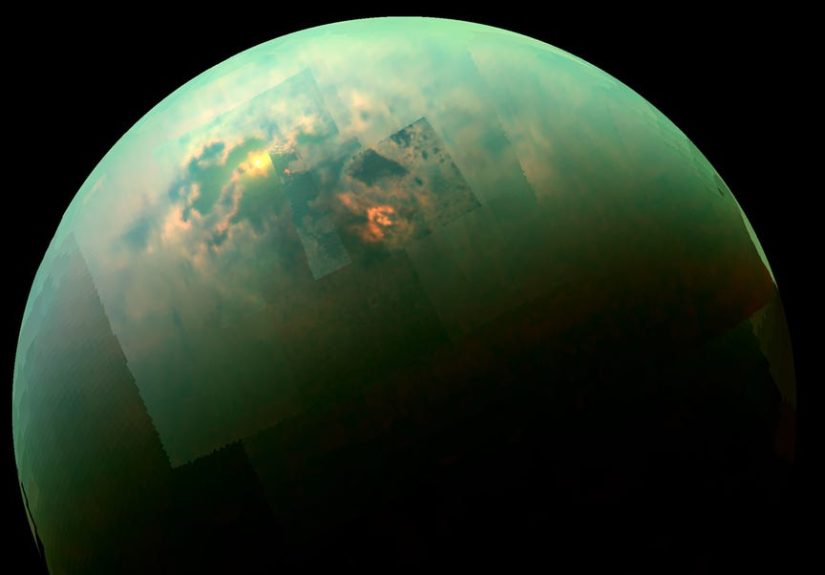
During Cassini’s final close look at Titan in 2017, the spacecraft used radar data to examine small lakes in the moon’s northern hemisphere. Scientists learned three important things. First, some of these lakes are surprisingly deep, reaching more than 300 feet, or about 100 meters. Second, they are filled predominantly with methane. Third, and perhaps most visually striking, they appear to be perched on high-standing landforms rather than clustered in low-lying basins next to the big northern seas.
That last point is where the “giant mesas” description comes from. Researchers compared the terrain to mesas or buttes because the lakes seem to sit on raised blocks of landscape standing hundreds of feet above surrounding areas. Imagine finding a deep lake on top of a broad stone table in the desert. Now replace the water with liquid methane, the rock with water ice and organics, and the desert with a frozen moon wrapped in orange smog. Congratulations, you have arrived at Titan.
Scientists had already known that Titan’s north polar region contained large seas such as Kraken Mare and Ligeia Mare. But the small perched lakes told a different story. They suggested that Titan’s liquid bodies are not all formed by the same process, nor do they all sit in the same geologic setting. On Titan, one part of the north can behave like a shoreline world of broad seas, islands, and drowned canyons, while another behaves like a highland lake district built on plateaus.
Why Titan’s Methane Lakes Are Such a Big Deal
Titan is the only place beyond Earth known to have stable liquids on its surface. That sentence alone is enough to earn it a permanent seat at the cool-kids table of planetary science. But Titan’s liquids are not water. Because the moon’s surface temperature hovers around minus 290 degrees Fahrenheit, water is rock-hard there. Methane and ethane, meanwhile, can exist as liquids.
So while Earth has a water cycle, Titan has a methane cycle. Methane evaporates, forms clouds, falls as rain, runs across the landscape, pools in lakes and seas, and can seep underground. It is eerily familiar and deeply alien at the same time. Titan is basically Earth after a chemistry prank.
The perched lakes are especially important because they show this methane cycle is not simple. These are not just puddles sitting where gravity told them to sit. Their depth, location, and composition suggest complicated interactions among rainfall, evaporation, infiltration, topography, and subsurface reservoirs. Titan does not merely have lakes. Titan has a full hydrocarbon plumbing system, and it may be weirder than anyone expected.
How Cassini Figured It Out
Cassini was built for patience, precision, and the occasional cosmic mic drop. Orbiting Saturn from 2004 to 2017, the spacecraft used radar to peer through Titan’s thick atmosphere, which blocks most normal visible-light observations of the surface. Without radar and infrared imaging, Titan would remain a beautifully frustrating orange blur.
The radar instrument sent signals toward the surface and measured the returning echoes. Smooth liquids reflect radar differently than rough terrain, which allowed scientists to identify lakes and seas. In some cases, the radar could also help determine depth and composition based on how signals interacted with the liquid and the bottom below it.
That is how researchers concluded that some of Titan’s small lakes are both deep and methane-rich. These lakes were not just dark spots on a map. They became measurable, chemical, physical places with topographic meaning. Cassini turned Titan from a rumor into a world.
Mesas, Buttes, and a Landscape That Should Not Be This Dramatic
On Earth, mesas and buttes are usually linked to erosion. Over time, softer material wears away while tougher layers remain, leaving isolated flat-topped hills and steep-sided landforms. Titan’s version is not a copy-and-paste job, but the comparison is useful. The elevated lake terrain suggests Titan’s surface has been shaped by long-term geological change, including erosion, dissolution, and perhaps collapse.
That matters because Titan’s surface materials are not standard Earth ingredients. Its “bedrock” can include water ice as hard as stone, coated or mixed with organic solids produced in the atmosphere. Over long timescales, liquid hydrocarbons may dissolve some of these materials, altering the landscape and carving out depressions. Scientists have compared some Titan lake basins to karst terrain on Earth, where water dissolves rock and creates sinkholes, caves, and enclosed lakes.
In Titan’s case, the process would involve methane, ethane, propane, and organic-rich solids instead of rainwater and limestone. Same planetary logic, different grocery list.
A Karst World, but Make It Cryogenic
One of the leading ideas is that at least some of Titan’s smaller lakes formed when the surrounding icy-organic crust dissolved and collapsed. This would explain why certain lakes are small but very deep, and why they appear isolated on high terrain. On Earth, karst lakes often form where soluble rock gives way over time. On Titan, the chemistry is stranger, but the principle may rhyme.
This is one of the reasons the mesa story is so compelling. Elevated, deep, methane-filled lakes hint at a surface that has been chemically sculpted. Titan may look bizarre, but the forces shaping it are surprisingly understandable: liquids flow downhill, rain changes landscapes, and repeated wetting and drying can remodel a world.
Titan’s North Is Not One Simple Lake District
Another lesson from Cassini is that Titan’s northern hemisphere is geologically uneven in a big way. The eastern side includes large low-elevation seas, islands, and flooded canyons. The western side features smaller perched lakes sitting higher up. That split tells scientists Titan’s hydrology and geology vary by region.
It is a little like flying over Earth’s North Pole and discovering that one continent has giant inland seas while another is covered in elevated sinkhole lakes and plateau basins. You would immediately suspect differences in rock type, climate history, drainage, or tectonics. Titan invites the same questions.
This regional contrast also supports the idea that some of Titan’s liquids are connected to subsurface storage. Methane rain may feed the lakes, but not every drop necessarily stays at the surface. Some liquid probably infiltrates underground, forming hidden reservoirs that may later recharge surface lakes or influence their chemistry.
Seasonal Change: Titan Likes to Keep Scientists Nervous
As if giant methane lakes on mesas were not enough, Cassini also found evidence that some smaller lakes seem to appear and disappear with the seasons. These “transient” or seasonal lakes suggest that shallow liquids can evaporate, infiltrate, or shift in response to Titan’s long seasonal cycle.
Because Saturn takes about 29.5 Earth years to orbit the sun, Titan’s seasons move slowly. A change that takes only a few months on Earth may take years there. Cassini’s long mission gave researchers just enough time to watch some of those changes unfold. In several places, features that looked like shallow lakes in one set of observations were gone in another.
That is a huge clue. It tells us Titan’s surface is active right now, not merely a fossilized relic of ancient methane weather. Rain falls, liquids move, lakes change, and the landscape continues to evolve. Titan is not sleeping. It is just slow and chilly and wearing a giant orange coat.
Rivers, Canyons, Coasts, and the Rest of Titan’s Liquid Drama
The mesa lakes are one chapter in a much bigger Titan story. Cassini found rivers, branching channels, and steep flooded canyons cut into Titan’s surface. Some coasts around its northern seas may even show signs of wave-driven erosion. That means Titan’s liquids are not only sitting still but also reshaping shorelines, incising valleys, and moving sediment.
The result is a world with a genuine hydrologic system, even though the chemistry is upside down from Earth’s perspective. Water is the bedrock. Methane is the weather. Ethane joins the party. Organic compounds collect in the seas and on the seabed. Wetlands may exist along some margins. It is geology, meteorology, and chemistry all rolled into one extraordinarily photogenic puzzle.
That broader context makes the perched lakes even more meaningful. They are not isolated curiosities. They are part of a planet-scale system involving atmosphere, surface, and subsurface exchange. When scientists say Titan is Earth-like, they do not mean it has beaches, sunscreen, and reasonable temperatures. They mean it has interconnected natural processes operating across an entire world.
Why This Discovery Matters for Future Missions
Cassini did not just solve mysteries. It also created a long to-do list. Titan’s methane lakes, flooded channels, shorelines, and organic-rich surface make it one of the most compelling places in the solar system for future exploration. Researchers want to know how the lakes formed, how deep the major seas really are, how methane is stored and cycled, and whether Titan’s chemistry could teach us something profound about prebiotic environments.
That is one reason NASA’s Dragonfly mission matters so much. Scheduled to launch no earlier than 2028, Dragonfly will explore Titan’s surface and atmosphere in much greater detail. It is not headed directly for the north polar lakes, but the mission builds on the world Cassini revealed: a moon where chemistry, climate, and geology meet in ways no other place does.
Even without splashing into a methane sea, Dragonfly will benefit from Cassini’s map of Titan as a dynamic, layered system. The perched lakes on giant mesas are part of the reason Titan remains irresistible. Every time scientists think they understand this moon, it responds with another polite but firm “actually, no.”
The Bigger Meaning of Titan’s Methane Mesas
There is something wonderfully humbling about Titan. It keeps showing that Earth is not the only place where landscapes can be shaped by rain, lakes, rivers, evaporation, and erosion. Those processes are not exclusive to blue skies and liquid water. Give nature enough time, enough chemistry, and enough stubbornness, and it will build familiar patterns out of unfamiliar ingredients.
Cassini’s finding that Titan has lakes of methane resting on giant mesas reminds us that alien worlds are not random collections of weird facts. They are coherent places with rules, history, and style. Titan’s style just happens to include hydrocarbon rain and rooftop lakes on cryogenic highlands, which is objectively excellent branding.
For scientists, the discovery sharpens questions about topography, climate, and subsurface exchange. For the rest of us, it offers one of the best gifts astronomy can provide: the realization that the universe is stranger than expected, but not so strange that we cannot begin to understand it.
Related Experiences: What Following Titan’s Discovery Feels Like
There is a special kind of experience that comes with learning about Titan, especially when a discovery like the mesa lakes lands in your brain and refuses to leave. It starts with a simple reaction: wait, lakes? On a moon? Then the details arrive and the experience turns from curiosity into full-scale mental furniture rearrangement. Not water lakes, methane lakes. Not lowland ponds, but deep pools perched on elevated terrain. Not on some fantasy planet in a paperback novel, but on a real moon that a real spacecraft studied in exquisite detail.
For many readers, the emotional arc of Titan goes something like this. First comes recognition. Titan sounds familiar because it has weather, clouds, rainfall, rivers, coastlines, and lakes. Then comes disorientation, because every one of those familiar things is made from unfamiliar chemistry. Water is not flowing there. Water is the equivalent of stone. Methane does the jobs that water does on Earth. Suddenly the mind has to hold two truths at once: Titan is deeply alien, and Titan is strangely relatable.
That tension is what makes reading about Cassini’s discoveries such a memorable experience. You are constantly translating. A lake is not a lake in the earthly sense, but it is still a lake. A mesa is not made of dry desert rock, but it still behaves enough like a mesa to make the comparison meaningful. A hydrologic cycle is happening, but the liquid in that cycle would be fuel on Earth. Titan keeps nudging you into a bigger imagination without letting go of real science.
There is also the experience of scale. Cassini was not hovering over Titan like a drone taking vacation photos. It was a spacecraft operating across the outer solar system, using radar to peer through a moon’s opaque atmosphere. When you picture that, the discovery feels even more impressive. Human beings built a machine, sent it across interplanetary distance, and taught it to recognize the depth and composition of liquid bodies on a hidden world. That is not just data collection. That is civilization showing off in the best possible way.
And then there is the almost poetic experience of realizing how patient science has to be. Titan does not reveal itself quickly. Its seasons are long. Its atmosphere hides the surface. Its lakes change slowly. Cassini had to keep watching, year after year, pass after pass, letting patterns emerge. Following that story teaches a kind of scientific humility. Some worlds do not yield to one dramatic snapshot. They require attention, memory, and the willingness to be surprised late in the mission.
In that sense, the experience related to Titan is not just wonder. It is disciplined wonder. It is the feeling of seeing imagination and evidence work together. You get the cinematic thrill of methane lakes on giant mesas, but you also get the quieter satisfaction of knowing exactly how scientists reached that conclusion. That combination is rare, and it is one reason Titan has become such a beloved destination in planetary science. It does not just invite awe. It rewards careful thinking. And honestly, any moon that can make chemistry, geology, and weather feel like plot twists deserves the attention.
Conclusion
Cassini’s discovery that Titan has lakes of methane resting on giant mesas is one of those rare scientific findings that manages to be visually wild, chemically weird, and geologically important all at once. It confirmed that Titan’s small northern lakes can be deep, methane-rich, and perched high above surrounding terrain, hinting at a complex history of rainfall, dissolution, collapse, and subsurface exchange.
More broadly, the discovery strengthens Titan’s reputation as the most Earth-like alien world in the solar system, not because it copies Earth, but because it runs familiar landscape processes with entirely unfamiliar materials. Cassini showed us a moon with rivers, seas, flooded canyons, seasonal changes, and shoreline evolution. The mesa lakes are not a side note. They are a perfect symbol of Titan itself: recognizable enough to understand, strange enough to stay unforgettable.




 Close
Close