Table of Contents >> Show >> Hide
- What “easy to spot” really means (and why it matters)
- The 11 best ways to make luggage easier to spot
- 1) Start with a suitcase that doesn’t look like everyone else’s
- 2) Add a bright luggage strap (the simplest high-visibility upgrade)
- 3) Use a handle wrap instead of tying a ribbon
- 4) Upgrade your luggage tag: go bold, legible, and privacy-smart
- 5) Put identification inside the suitcase, too (because tags fall off)
- 6) Try a bold luggage cover for instant “main character energy”
- 7) Use colorful tape strategically (but don’t block airline tags)
- 8) Swap zipper pulls for something you can see from five feet away
- 9) Add one unmistakable “signature marker” (patch, decal, or monogram)
- 10) Drop a tracker inside your luggage (and learn how airline sharing works)
- 11) Do the “three-photo habit” and remove old barcodes before your next flight
- Quick checklist: your “spot-it-fast” luggage setup
- of real-world luggage-spotting experiences (the kind you only learn once)
- Conclusion: make your bag obvious (but not complicated)
Baggage claim is basically a game show where the prizes are identical black suitcases and the soundtrack is a conveyor belt that sounds like it needs a vacation.
If you’ve ever stood there squinting like you’re trying to identify a distant whale, you already know the problem: most luggage looks like it was designed by a committee of “meh.”
The good news? Making your bag easier to spot doesn’t require rhinestones, a laser light show, or naming your suitcase “Greg” (though… tempting).
With a few smart, airline-friendly tweaks, you can spot your luggage faster, reduce mix-ups, and make it easier to describe your bag if it’s delayed.
What “easy to spot” really means (and why it matters)
“Easy to spot” isn’t just about vanity. It’s about speed, accuracy, and fewer awkward moments where you wheel away someone else’s bag for three steps,
realize it’s not yours, and pretend you were just “testing the handle.”
A distinctive bag also helps if your luggage is delayed or misrouted. Airlines and baggage offices often ask for a description, and “medium black suitcase”
is about as helpful as saying “one human” in a crowded stadium. Better visual identifiers make your bag easier to describe, easier to verify, and less likely
to walk off with another traveler.
The 11 best ways to make luggage easier to spot
1) Start with a suitcase that doesn’t look like everyone else’s
If you’re buying new luggage anyway, this is the easiest “future you” gift. Patterned luggage, a bold color, or a distinctive texture stands out
instantlyno accessories required. If your suitcase is already neutral, don’t worry. The next ten options are basically the glow-up squad for boring bags.
Practical tip: pick something recognizable from a distance. A subtle gray pinstripe looks classy… until it blends into 47 other “subtle gray” bags.
2) Add a bright luggage strap (the simplest high-visibility upgrade)
A colorful luggage strap does two things well: it adds an unmistakable visual cue, and it can help keep the suitcase closed if a zipper gets stressed.
Look for a strap color that contrasts with your bagneon on black, bright red on navy, or anything that screams, “I am not your suitcase.”
Pro move: choose a strap with a distinctive pattern (checkerboard, stripes, color-blocking) so you’re not just “the person with the yellow strap”
at an airport full of “people with yellow straps.”
3) Use a handle wrap instead of tying a ribbon
The ribbon trick is famous, but there’s a catch: loose ribbons can cause baggage-handling headaches if they interfere with scanning or snag in the system.
A handle wrap gives you the same “I can spot this instantly” benefit in a more secure, low-risk way.
Pick a wrap that’s bright, thick enough to see quickly, and snug enough that it won’t slip. Bonus: it makes carrying your luggage more comfortable,
especially during that long walk when your gate is somehow located in a different time zone.
4) Upgrade your luggage tag: go bold, legible, and privacy-smart
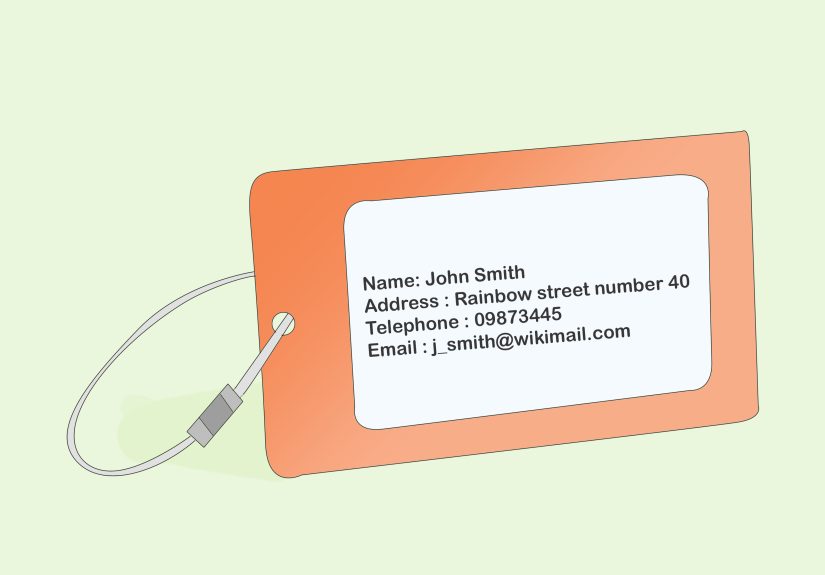
A luggage tag shouldn’t be a tiny beige rectangle that whispers, “Maybe I exist.” Choose a tag that’s high-contrast, easy to read, and durable.
Bright colors help, but clarity matters more: large lettering, a strong border, and a design you can recognize instantly.
Privacy-smart approach: use a “privacy tag” style that conceals personal details unless someone opens it. If you prefer not to display your home address,
use your name, email, and phone number (with country code for international trips), and keep additional details inside the bag.
5) Put identification inside the suitcase, too (because tags fall off)
External tags can get torn off. That’s why travel authorities and travel organizations often recommend placing your contact information inside each bag as well.
Use a simple card with your name and best contact methods, plus where you’ll be staying or how you can be reached during the trip.
Keep it easy for a baggage agent to help you: name, phone, email, and destination contact (hotel name and phone, or an itinerary page).
No novel-length life story neededsave that for your group chat.
6) Try a bold luggage cover for instant “main character energy”
A fitted luggage cover can make your bag stand out dramatically and can also protect it from scuffs, grime, and that mysterious “airport dust”
that appears from nowhere. Covers are especially useful if your suitcase is dark, common, or has the visual personality of a stapler.
Choose a cover with a high-contrast pattern (big shapes, bright colors) so it’s visible as the bag turns on the carousel. Avoid anything overly delicatecovers
need to survive conveyor belts, stacking, and baggage carts with the grace of a stunt performer.
7) Use colorful tape strategically (but don’t block airline tags)
A strip of vivid tape can be a quick DIY way to create a “signature look.” Think: a bold X on one corner, a diagonal stripe, or a color pattern that’s unique
to you. Some travelers use bright duct tape for visibility and for added reinforcement on scuffed spots.
Important: keep tape away from where airline baggage tags and barcodes are placed. You want the scanners to do their job without confusion.
Your goal is “easy to spot,” not “send my bag on its own solo trip.”
8) Swap zipper pulls for something you can see from five feet away
Zipper pulls are underrated. Bright paracord pulls, chunky silicone pulls, or distinctive metal pulls make your bag easier to identify up closeespecially
on crowded carousels where only the top edge is visible at first.
Keep it functional: avoid anything overly long or loose that could snag. Think “visible and tidy,” not “wind chime.”
9) Add one unmistakable “signature marker” (patch, decal, or monogram)
Pick a single, obvious marker that is uniquely yours. A big letter monogram, a sturdy patch, or a distinct decal can work wellespecially if you place it
in the same spot every time (like the top corner or a side panel).
This helps in two scenarios: spotting your bag quickly, and describing it accurately if you need to file a report. “Black suitcase with a large white ‘M’
on the front” is a thousand times better than “black suitcase, kind of… suitcase-y.”
10) Drop a tracker inside your luggage (and learn how airline sharing works)
Trackers like Apple AirTag and other Find My network accessories have become popular because they can help you locate a bag if it’s delayed.
Modern airline processes increasingly allow travelers to share a secure location link with baggage teams for faster recovery.
Best practice: place the tracker inside the bag (not dangling outside). If your airline supports location sharing through its app or a baggage office workflow,
you can provide that information during a delayed-bag report. Remember: trackers don’t replace airline baggage systems, but they can speed up the “Where is it?”
conversation when things go sideways.
Battery note: if you travel with spare lithium batteries or power banks, follow aviation safety guidance on where those items can go. The rules are not vibes-based.
11) Do the “three-photo habit” and remove old barcodes before your next flight
This is the boring tip that saves real time. Before you check your bag, take quick photos of:
- The outside of your suitcase (including straps, tags, and your signature marker)
- The bag tag / claim check (the number matters if your bag is delayed)
- A simple overview of the contents (helpful for claims and reimbursement)
Thenbefore your next tripremove old airline barcode stickers and tags. Old stickers can create confusion in baggage systems, and there’s no upside to leaving them on.
Your suitcase doesn’t need a scrapbook. It needs to arrive with you.
Bonus: when you check your bag, glance at the destination on the bag tag before it disappears down the belt. A 2-second check can prevent a multi-day headache.
Quick checklist: your “spot-it-fast” luggage setup
- One big visual cue: strap, cover, or bold handle wrap
- One identity cue: bright luggage tag + matching inside ID card
- One smart backup: tracker inside the suitcase (optional but helpful)
- One documentation habit: quick photos + keep your claim check info
You don’t need all eleven strategies. Two or three done well will beat ten done halfway.
The goal is to build a bag that is unmistakably yourswithout becoming a hazard to baggage handling.
of real-world luggage-spotting experiences (the kind you only learn once)
If you travel enough, you start collecting “baggage claim lore”those little stories that make you change your habits forever. Like the couple in Orlando
who both checked identical black hard-shell suitcases. They added the same tiny black tag because it was “sleek.” At baggage claim, they stood shoulder-to-shoulder,
staring at a parade of twins. Finally one bag appeared with a small scuff near the wheel, and they cheered like they’d won a championship… until they saw the owner
across the carousel doing the same victory dance with the other twin. The fix was hilariously simple: a bright handle wrap that could be spotted from ten feet away.
Then there’s the ski trip scenarioDenver, Salt Lake City, or anywhere winter travelers gather like migrating birds. Half the carousel is black roller bags,
and the other half is black roller bags wearing snow stickers. A traveler with a neon luggage strap grabbed their bag in seconds, while everyone else played the
“Is that mine?” shuffle. The strap didn’t just help with spotting; it also made the suitcase easier to describe when a friend asked, “Which one is yours?”
That’s the hidden benefit: a good visual marker doesn’t only help your eyesit helps your words.
International connections add a different kind of drama. Picture a tight layover, a terminal sprint, and the nagging fear that your suitcase is enjoying a leisurely
espresso somewhere else. Travelers who tuck a tracker inside their luggage often describe the same feeling: relief when they see the bag move with them, and clarity
when it doesn’t. The important lesson is that trackers are best used as collaboration tools, not solo detective gadgets. When airlines accept secure location sharing,
the tracker becomes a useful data point in a real processone that helps staff focus the search instead of guessing.
One of the most underrated experiences is the “lost luggage form” moment. When a bag is delayed, the questions are surprisingly specific: brand, size, color, hard vs.
soft shell, distinguishing features, and sometimes what was inside. People who took quick photosespecially of the outside and the bag tagtend to move through this
faster. They can show exactly what the suitcase looks like, including that bright strap and the quirky patch, rather than trying to reconstruct the details from memory
while jet-lagged and annoyed.
Finally, there’s the lesson you only learn after you’ve collected a suitcase worth of old barcode stickers: nostalgia is adorable, but old baggage stickers can cause
confusion in baggage systems. Travelers who peel them off before the next trip often say it’s like resetting a messy desktopclean, clear, and less likely to create
chaos. The best luggage habits aren’t flashy. They’re repeatable. A bright strap. A privacy-smart tag. An ID card inside. A quick photo. And a suitcase that doesn’t
blend into the crowd like it’s auditioning for camouflage.
Conclusion: make your bag obvious (but not complicated)
Making luggage easier to spot is really about one thing: reducing friction. You want to walk up, recognize your bag instantly, and leave the carousel like a calm,
organized adult (or at least like someone convincingly pretending to be one).
Start small: one bold visual cue (strap, wrap, or cover) and one solid ID strategy (outside tag + inside ID card). Add a tracker if you want extra peace of mind.
And if you do nothing else, take a quick photo of your bag and bag tag before check-inbecause memory gets fuzzy, but photos don’t.