
Table of Contents >> Show >> Hide
- Why Red, Yellow, and Green Appear So Often on Flags
- 24 Red, Yellow, and Green Flags Used Around the World
- 1. Bolivia
- 2. Ghana
- 3. Cameroon
- 4. Guinea
- 5. Mali
- 6. Senegal
- 7. Ethiopia
- 8. Burkina Faso
- 9. Benin
- 10. Republic of the Congo
- 11. Guinea-Bissau
- 12. Togo
- 13. São Tomé and Príncipe
- 14. Grenada
- 15. Guyana
- 16. Suriname
- 17. Lithuania
- 18. Myanmar
- 19. Seychelles
- 20. Zimbabwe
- 21. Mozambique
- 22. Vanuatu
- 23. Mauritius
- 24. Comoros
- Common Themes in Red, Yellow, and Green Flags
- How to Tell Similar Red, Yellow, and Green Flags Apart
- Experience Section: What These Flags Teach Travelers, Students, and Curious Readers
- Conclusion
Note: This article is based on cross-checked public flag references, official national-symbol descriptions, and reputable encyclopedia-style sources. Source links are not inserted so the content remains clean and publication-ready.
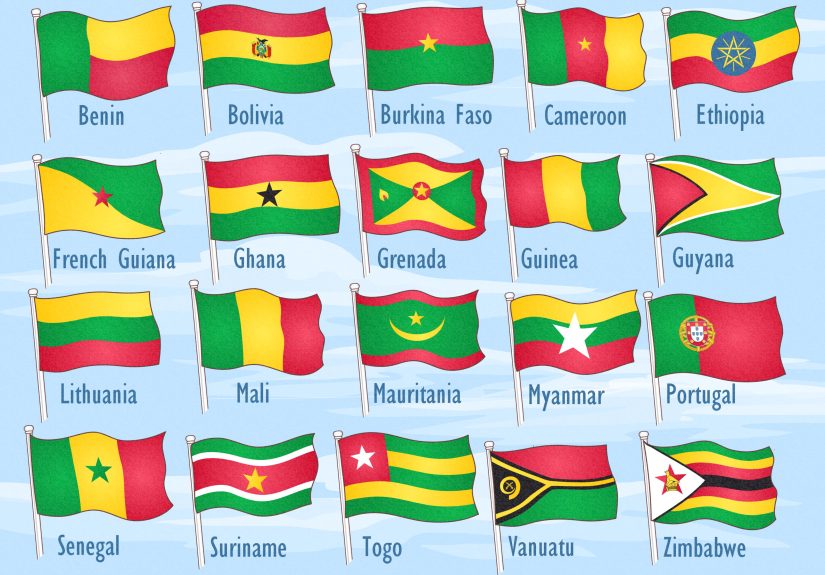
Red, yellow, and green flags are the extroverts of the flag world. They do not whisper from the flagpole; they show up like a marching band with snacks. These colors appear across Africa, the Caribbean, South America, Europe, Asia, and the Pacific, often carrying stories of independence, natural wealth, unity, sacrifice, sunshine, agriculture, and national pride.
At first glance, many red, yellow, and green national flags may look related. In some cases, they are. Several African countries use what are commonly called Pan-African colors, inspired in part by Ethiopia’s historic green, yellow, and red tricolor and later associated with liberation and continental identity. But not every red-yellow-green flag tells the same story. Bolivia’s colors speak of minerals and land. Guyana’s design is nicknamed the Golden Arrowhead. Grenada proudly adds nutmeg, because apparently one spice was enough to make a whole flag more delicious.
Below are 24 red, yellow, and green flags used around the world, with their designs, meanings, and a few interesting details that make each one more than a rectangle having a colorful day.
Why Red, Yellow, and Green Appear So Often on Flags
In flag symbolism, red often represents courage, sacrifice, struggle, vitality, or the energy of a people. Yellow or gold commonly points to sunlight, mineral wealth, freedom, wisdom, or prosperity. Green frequently stands for land, forests, agriculture, fertility, hope, or the natural environment. These meanings are not universal laws, of course. Flags are not traffic lights with passports. A color can shift meaning depending on the country’s history, culture, geography, and political journey.
The red, yellow, and green combination is especially common in Africa because of Pan-African influence, but the palette also appears in Caribbean island flags, Asian tricolors, and South American designs. Sometimes the three colors dominate the whole flag. Other times, one color appears as a star, triangle, border, emblem, or stripe. Either way, the combination is visually bold and instantly memorable.
24 Red, Yellow, and Green Flags Used Around the World
1. Bolivia
Bolivia’s national flag features three horizontal bands: red at the top, yellow in the middle, and green at the bottom. The colors are commonly linked to the bravery of the army, the country’s mineral wealth, and the fertility of the land. The yellow stripe makes perfect sense for a nation historically known for rich natural resources. The green stripe is a visual nod to the productive landscapes that support life beyond the mountains and high plains.
2. Ghana
Ghana’s flag is a horizontal tricolor of red, yellow, and green with a black star in the center. Red recalls the struggle for independence, gold represents mineral wealth, and green symbolizes forests and natural resources. The black star is one of the most famous symbols in African vexillology, representing African freedom and unity. It is simple, strong, and instantly recognizablebasically the flag version of a great logo.
3. Cameroon
Cameroon uses vertical green, red, and yellow bands with a yellow star centered on the red stripe. The colors are Pan-African, but they also carry local meaning: green is often associated with forests and hope, red with unity, and yellow with sunshine or the northern savannas. The central star is known as a symbol of unity, making the design both colorful and politically meaningful.
4. Guinea
Guinea’s flag has three vertical stripes: red, yellow, and green. Its arrangement resembles a vertical version of several Pan-African tricolors, but the order gives it a distinct identity. Red is associated with sacrifice and labor, yellow with the sun and mineral wealth, and green with vegetation and agricultural life. It is a clean, balanced flag with no extra emblem, proving that sometimes three stripes can do the whole speech.
5. Mali
Mali’s flag is a vertical tricolor of green, yellow, and red. The design is close to Guinea’s flag but with the colors reversed, which is either elegant symbolism or the kind of detail that keeps geography quiz players awake at night. Green is commonly associated with fertility and land, yellow with purity or mineral wealth, and red with sacrifice and independence.
6. Senegal
Senegal’s flag uses vertical green, yellow, and red stripes with a green star in the yellow band. The colors reflect Pan-African identity while also carrying national meanings. Green is associated with hope and spiritual importance, yellow with wealth, work, and cultural progress, and red with sacrifice and determination. The star adds a sense of national direction and unity.
7. Ethiopia
Ethiopia’s green, yellow, and red tricolor is one of the most influential flags in the world. Many African nations later adopted the same color family partly because Ethiopia remained a powerful symbol of independence. The modern Ethiopian flag includes a blue disk with a yellow star emblem at the center. Green is linked to fertility and development, yellow to hope and justice, and red to sacrifice.
8. Burkina Faso
Burkina Faso’s flag has two horizontal bandsred above greenwith a yellow star in the center. Red represents revolutionary struggle, while green symbolizes hope, abundance, and the country’s natural or agricultural wealth. The yellow star is often interpreted as a guiding light. The design is direct, bold, and easy to spot, even when surrounded by other Pan-African flags.
9. Benin
Benin’s flag combines a vertical green band at the hoist with horizontal yellow and red bands on the fly side. The colors are linked to hope, national treasures, and courage. Benin first adopted this flag in the late 1950s, later replaced it under a different political system, and restored it in 1990. In other words, this flag made a comebackand did it without needing a reunion tour.
10. Republic of the Congo
The Republic of the Congo has one of the most dynamic red, yellow, and green flags. Instead of standard horizontal or vertical stripes, it uses a diagonal yellow band dividing green and red fields. Green is commonly associated with forests and agriculture, yellow with friendship or nobility, and red with national history. The diagonal layout gives the flag a sense of movement and makes it stand out from stripe-heavy neighbors.
11. Guinea-Bissau
Guinea-Bissau’s flag features a red vertical stripe at the hoist with a black star, plus horizontal yellow and green bands. The design reflects Pan-African colors and the influence of liberation movements. The black star is often associated with African identity and anti-colonial resistance. Yellow and green point toward prosperity, sunlight, agriculture, and the land.
12. Togo
Togo’s flag is made of five alternating green and yellow horizontal stripes, with a red canton containing a white star. The five stripes are often connected with the country’s regions. Green represents agriculture and hope, yellow suggests natural resources and faith in progress, red recalls sacrifice, and the white star symbolizes peace, wisdom, and light. The proportions of the flag are also unusual, which gives vexillology fans something extra to discuss at partiesassuming they are invited back after the first discussion.
13. São Tomé and Príncipe
This island nation’s flag has green bands at the top and bottom, a wider yellow band in the center, a red triangle at the hoist, and two black stars. Green represents the islands’ vegetation, yellow the tropical sun and sometimes cocoa, red the independence struggle, and the two stars represent the two main islands: São Tomé and Príncipe. It is a compact geography lesson in flag form.
14. Grenada
Grenada’s flag is one of the most distinctive red, yellow, and green flags in the world. It has a red border, yellow and green diagonal sections, seven stars, and a nutmeg symbol near the hoist. Green represents fertility and agriculture, yellow stands for wisdom and sunshine, and red reflects courage, vitality, unity, and harmony. The nutmeg reminds viewers of Grenada’s reputation as the “Spice Island.” Not many flags can make you think of both sovereignty and baking.
15. Guyana
Guyana’s flag, nicknamed the Golden Arrowhead, uses a green field with a large yellow triangle edged in white and a red triangle edged in black. Green represents agriculture and forests, gold represents mineral wealth, red suggests zeal and energy, white symbolizes rivers and water, and black stands for endurance. The arrowhead shape gives the flag forward motion, as if the whole country is pointing toward tomorrow.
16. Suriname
Suriname’s flag features green bands at the top and bottom, white separators, a broad red center band, and a yellow star in the middle. Green represents the fertility of the land, white stands for justice and freedom, red symbolizes progress, and the yellow star represents unity and a bright future. The centered star makes the design feel balanced and optimistic.
17. Lithuania
Lithuania’s flag is a horizontal tricolor of yellow, green, and red. Yellow is commonly linked to the sun, prosperity, and light; green represents forests, countryside, liberty, and hope; red stands for courage and the sacrifices made for the nation. Unlike many red-yellow-green flags in Africa, Lithuania’s symbolism comes from European national history and landscape rather than Pan-African influence.
18. Myanmar
Myanmar’s current flag has horizontal yellow, green, and red stripes with a large white star in the center. Yellow is associated with unity and wisdom, green with fertility and peace, and red with courage and decisiveness. The white star adds a unifying national symbol that stretches visually across all three bands. It is bright, clean, and hard to miss.
19. Seychelles
Seychelles uses five oblique bands radiating from the lower hoist: blue, yellow, red, white, and green. Yellow represents the sun, red symbolizes the people and their determination to work for the future, and green stands for the land and natural environment. The design feels energetic, like a sunrise that has had a very strong coffee.
20. Zimbabwe
Zimbabwe’s flag includes green, yellow, red, black, and white stripes, plus a white triangle containing the Zimbabwe Bird and a red star. Green represents agriculture and rural areas, yellow represents mineral wealth, red recalls the struggle for independence, black represents the majority population, and white symbolizes peace. The Zimbabwe Bird connects the flag to the ancient stone ruins of Great Zimbabwe.
21. Mozambique
Mozambique’s flag includes green, black, yellow, white, and red, with a distinctive emblem in a red triangle at the hoist. Green represents the riches of the land, black the African continent, yellow mineral wealth, white peace, and red the struggle for independence and sovereignty. The emblem combines ideas of education, labor, defense, and national vigilance, making the flag one of the most symbol-packed designs in the world.
22. Vanuatu
Vanuatu’s flag uses red and green horizontal fields separated by a yellow Y-shape outlined in black, with a black triangle at the hoist containing traditional symbols. Green represents the richness of the islands, red the unity of humanity, black the Melanesian people, and yellow the shape of the island chain and spiritual light. The design is deeply tied to geography, custom, and identity.
23. Mauritius
Mauritius uses four horizontal bands: red, blue, yellow, and green. Red represents the struggle for freedom and independence, blue the Indian Ocean, yellow the light of freedom, and green the island’s vegetation and agriculture. It is a cheerful-looking flag with serious historical meaning underneath. The four bands are so well known that the flag is often called “Les Quatre Bandes,” or “The Four Bands.”
24. Comoros
The flag of Comoros has four horizontal stripesyellow, white, red, and bluewith a green triangle at the hoist containing a white crescent and four stars. The stripes represent the four main islands associated with the nation, while the green triangle and crescent reflect the country’s Islamic identity. The red, yellow, and green elements are part of a larger symbolic system, giving the flag both geographic and religious meaning.
Common Themes in Red, Yellow, and Green Flags
Independence and Sacrifice
Red appears again and again as a reminder that independence is rarely handed over like a polite invitation. In Ghana, Guinea, Mali, Burkina Faso, Mozambique, Mauritius, and many others, red carries the memory of sacrifice, struggle, or courage. It is the color that says, “This country has a backstory.”
Sunlight, Wealth, and Hope
Yellow and gold often represent sunlight, mineral wealth, freedom, or wisdom. Ghana, Bolivia, Guyana, Mauritius, and Guinea all connect yellow or gold with resources or prosperity. Island nations such as Grenada, Seychelles, and São Tomé and Príncipe also use yellow to suggest sunshine and warmth. The color does a lot of work, and it does not even ask for overtime.
Land, Agriculture, and Nature
Green is one of the easiest flag colors to interpret because it so often points to land, forests, agriculture, vegetation, and hope. From the forests of Cameroon and Guyana to the island landscapes of Mauritius and Seychelles, green anchors many flags in geography. It reminds viewers that nations are not only political communities but also physical places with soil, rivers, trees, farms, and coastlines.
How to Tell Similar Red, Yellow, and Green Flags Apart
Some red, yellow, and green flags look similar at first, especially the vertical tricolors. Here is the cheat code: Guinea runs red-yellow-green from the hoist side, while Mali runs green-yellow-red. Senegal also runs green-yellow-red, but it adds a green star in the center. Cameroon uses green-red-yellow with a yellow star in the middle. Ghana is horizontal and includes a black star. Ethiopia is horizontal too, but its modern flag has a central blue disk and star emblem.
Outside Africa, the designs become easier to separate. Guyana has the arrowhead. Grenada has the nutmeg and star border. Lithuania is a simple horizontal yellow-green-red tricolor. Myanmar adds a white star over yellow-green-red bands. Seychelles looks like colorful rays bursting from a corner. Vanuatu has the yellow Y-shape. If you remember the signature feature, the flag becomes much easier to identify.
Experience Section: What These Flags Teach Travelers, Students, and Curious Readers
Spending time with red, yellow, and green flags is a surprisingly fun way to learn world history. At first, you may only notice the colors. Then you start seeing patterns. Then suddenly you are the person at the airport saying, “Actually, that is not Mali; that is Senegal because of the star.” Congratulations: you have become mildly dangerous in a trivia contest.
One useful experience is comparing flags by region. In West Africa, the shared use of red, yellow, and green quickly shows how countries can express regional solidarity while keeping their own national identity. Ghana’s black star, Senegal’s central green star, Togo’s striped layout, and Guinea-Bissau’s hoist stripe all use a similar color family but tell different stories. This makes flag study a great doorway into decolonization, independence movements, and political symbolism.
Another helpful experience is noticing how geography shapes design. Island countries often connect yellow with the sun and green with lush land. Grenada’s nutmeg symbol is not decoration tossed in for cuteness; it points to the island’s agricultural identity. São Tomé and Príncipe uses two stars for its two main islands. Comoros uses stripes and stars to represent islands. Vanuatu’s yellow Y-shape echoes the layout of the island chain. These flags show that geography is not just something printed in an atlasit can be woven into national symbols.
For students, red, yellow, and green flags are also excellent memory tools. Instead of trying to memorize 24 designs at once, group them by layout. Horizontal tricolors include Bolivia, Ethiopia, Lithuania, Myanmar, and Mauritius. Vertical tricolors include Guinea, Mali, Senegal, and Cameroon. More complex designs include Grenada, Guyana, Vanuatu, Mozambique, and Seychelles. Once you sort them by structure, the details become less overwhelming.
For travelers, flags can make places feel more familiar before arrival. Seeing Guyana’s Golden Arrowhead on a sign, Grenada’s nutmeg-bearing banner near a harbor, or Ethiopia’s green-yellow-red tricolor at a cultural event can spark curiosity. A flag is often the first national symbol visitors notice and the last one they see at departure. Understanding it adds context to the journey.
For writers and content creators, these flags offer rich storytelling opportunities. The topic is visual, global, educational, and full of human meaning. It connects color psychology, political history, geography, agriculture, religion, and national identity. That is a lot of mileage from three colors. Red, yellow, and green may seem simple, but in the hands of nations, they become memory, pride, struggle, landscape, and hope stitched into one flying symbol.
Conclusion
Red, yellow, and green flags are among the most meaningful and visually powerful national symbols used around the world. Some represent Pan-African identity and liberation. Others celebrate sunlight, land, forests, islands, minerals, unity, courage, and independence. From Bolivia’s resource-rich tricolor to Grenada’s spice-filled design, from Ghana’s black star to Guyana’s Golden Arrowhead, each flag proves that color is never just color when a nation is involved.
The next time you see a red, yellow, and green flag, look twice. Is the stripe order different? Is there a star, triangle, bird, nutmeg, crescent, or arrowhead? Those details are not random. They are tiny doors into a country’s historyand thankfully, they are much easier to carry around than a 900-page history book.







 Close
Close