Table of Contents >> Show >> Hide
- What Happens When You Divide an Odd Number by 2?
- Method 1: Use Quotient and Remainder
- Method 2: Turn the Remainder into a Fraction or Decimal
- Method 3: Use Place Value and Mental Math
- Common Mistakes When Dividing Odd Numbers by 2
- Quick Practice Examples
- Which Method Is Best?
- Why This Skill Matters
- Experience and Practice Notes: What Learners Notice Over Time
- Final Thoughts
- SEO Tags
Dividing odd numbers by 2 sounds simple until a whole number suddenly refuses to stay whole. You start with confidence, punch in 7 ÷ 2, and boom: the answer is 3.5. Not 3, not 4, and definitely not “math is broken.” The truth is much friendlier than that. Odd numbers can absolutely be divided by 2; they just do not split into two equal whole-number parts. Instead, they produce a remainder, a fraction, or a decimal. Same math. Different outfit.
If you have ever wondered how to divide odd numbers by 2 without getting tangled up in remainders, fractions, or place value, this guide is for you. We will walk through three practical methods you can use at home, in class, or while helping a younger student who is staring at the number 13 like it just insulted them personally.
Along the way, you will see clear examples, mental math shortcuts, and common mistakes to avoid. By the end, you will not just know the answer to odd-number division problems. You will know why the answers work.
What Happens When You Divide an Odd Number by 2?
An odd number is any whole number that leaves 1 left over when divided by 2. That is the key idea. So when you divide an odd number by 2, one of two things happens:
- You get a whole number with remainder 1.
- You express the same answer as a fraction or decimal.
For example:
- 5 ÷ 2 = 2 remainder 1
- 5 ÷ 2 = 2 1/2
- 5 ÷ 2 = 2.5
Those are not three different answers. They are three ways to describe the same result. Think of them as math speaking in different accents.
Method 1: Use Quotient and Remainder
Why this method works
This is the most straightforward method, especially for elementary math or long division practice. You divide the odd number by 2 as far as possible using whole numbers. Since odd numbers are not evenly divisible by 2, there will always be 1 left over.
How to do it
- Ask how many times 2 fits into the number.
- Write that whole-number answer.
- Whatever is left is the remainder.
Examples
9 ÷ 2
2 fits into 9 four times because 2 × 4 = 8. That leaves 1.
Answer: 4 remainder 1
17 ÷ 2
2 fits into 17 eight times because 2 × 8 = 16. That leaves 1.
Answer: 8 remainder 1
31 ÷ 2
2 fits into 31 fifteen times because 2 × 15 = 30. That leaves 1.
Answer: 15 remainder 1
When to use this method
Use quotient-and-remainder form when:
- You are doing basic division exercises.
- Your teacher wants answers with remainders.
- You are working with equal groups and leftover items.
Imagine sharing 11 cookies between 2 people. Each person gets 5 cookies, and 1 cookie is left sitting there like the last kid waiting to be picked for dodgeball. That is 11 ÷ 2 = 5 remainder 1.
Method 2: Turn the Remainder into a Fraction or Decimal
Why this method matters
Sometimes “remainder 1” is not the most useful answer. In real life, people often want an exact value. That is where fractions and decimals come in. When an odd number is divided by 2, the leftover 1 becomes 1/2, which is the same as 0.5.
The pattern to remember
If a whole number is odd, then dividing it by 2 will always end in .5.
Examples:
- 3 ÷ 2 = 1.5
- 7 ÷ 2 = 3.5
- 15 ÷ 2 = 7.5
- 101 ÷ 2 = 50.5
How to convert a remainder into a fraction
Take the remainder and place it over the divisor.
So if you get:
13 ÷ 2 = 6 remainder 1
That becomes:
13 ÷ 2 = 6 1/2
How to convert to a decimal
Since 1/2 = 0.5, you can write:
13 ÷ 2 = 6.5
Examples with context
7 dollars split between 2 people
Each person gets $3.50.
19 feet cut into 2 equal pieces
Each piece is 9.5 feet.
25 pizzas for 2 teams
Each team gets 12.5 pizzas. That sounds like a suspiciously great day.
When to use this method
Use fractions or decimals when:
- You need an exact answer.
- You are measuring money, length, or weight.
- You want to compare values more easily.
Method 3: Use Place Value and Mental Math
Why this method is powerful
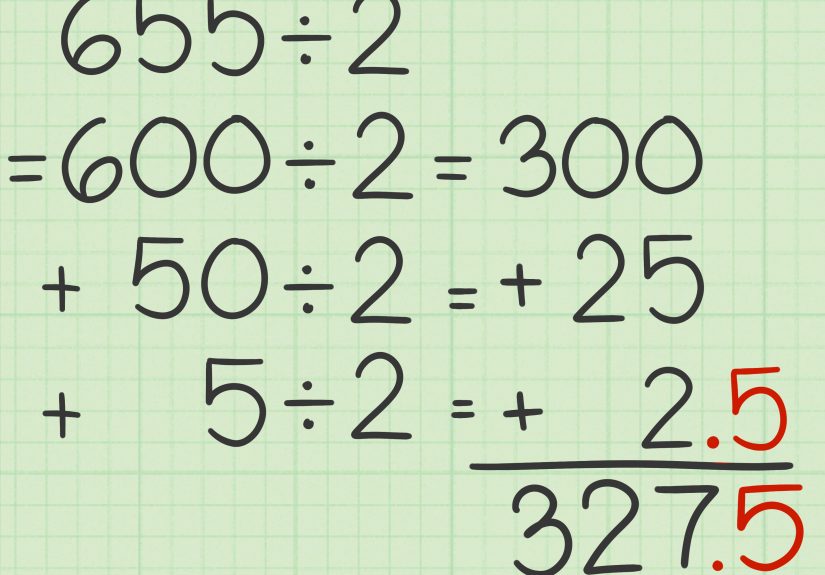
This method is perfect for larger odd numbers. Instead of doing long division step by step, you break the number into parts that are easy to divide by 2. It is fast, clean, and surprisingly satisfying.
Basic strategy
Split the odd number into an even part and 1 extra unit, or into place-value chunks.
For example:
27 ÷ 2
Break 27 into 20 + 7.
- 20 ÷ 2 = 10
- 7 ÷ 2 = 3.5
Add them together: 10 + 3.5 = 13.5
Answer: 13.5
More examples
45 ÷ 2
- 40 ÷ 2 = 20
- 5 ÷ 2 = 2.5
20 + 2.5 = 22.5
93 ÷ 2
- 90 ÷ 2 = 45
- 3 ÷ 2 = 1.5
45 + 1.5 = 46.5
247 ÷ 2
- 200 ÷ 2 = 100
- 40 ÷ 2 = 20
- 7 ÷ 2 = 3.5
100 + 20 + 3.5 = 123.5
Shortcut pattern
If a number is odd, divide the even part by 2, then add 0.5.
Example:
81 ÷ 2
Half of 80 is 40, then add 0.5.
Answer: 40.5
This trick works because every odd number is just one more than an even number.
Common Mistakes When Dividing Odd Numbers by 2
1. Thinking odd numbers cannot be divided by 2
They can. They just do not divide into equal whole-number parts. That is a big difference.
2. Forgetting the remainder becomes one-half
If the remainder is 1 and the divisor is 2, the fractional part is always 1/2.
3. Mixing up answer formats
9 ÷ 2 = 4 remainder 1 = 4 1/2 = 4.5. These all describe the same result, but your class or assignment may prefer one format over another.
4. Making decimal errors
Students sometimes write 7 ÷ 2 = 3.2, which is not correct. Since half of 1 is 0.5, odd numbers divided by 2 should end in .5, not random decimal confetti.
Quick Practice Examples
- 11 ÷ 2 = 5 remainder 1 = 5.5
- 23 ÷ 2 = 11 remainder 1 = 11.5
- 37 ÷ 2 = 18 remainder 1 = 18.5
- 55 ÷ 2 = 27 remainder 1 = 27.5
- 99 ÷ 2 = 49 remainder 1 = 49.5
See the pattern? Every odd number divided by 2 lands on a number ending in .5. That is one of the friendliest patterns in arithmetic.
Which Method Is Best?
The best method depends on what you need:
- Use remainder form for basic division and equal-group problems.
- Use fractions or decimals for exact values and real-world problems.
- Use place value for speed, mental math, and larger numbers.
In truth, strong math students usually know all three. They are not separate worlds. They are three doors into the same room.
Why This Skill Matters
Learning how to divide odd numbers by 2 helps with far more than worksheet survival. It builds number sense, supports fraction and decimal understanding, and makes mental math less scary. It also helps students understand why some numbers split neatly and others leave leftovers.
That matters in cooking, budgeting, measuring, sports stats, sharing items, and just about any place where “cut it in half” shows up. Which, honestly, is a lot of places. Pizza alone makes this a life skill.
Experience and Practice Notes: What Learners Notice Over Time
One of the most interesting experiences people have with the topic “3 Ways to Divide Odd Numbers by 2” is that the lesson starts out feeling tiny and ends up teaching much bigger ideas. At first, students think the problem is just about whether a number is odd or even. Then they realize it is also about how math represents answers. A child may first say, “You can’t divide 7 by 2,” because they are only thinking about whole numbers. After a little practice, that same child begins to say, “You can, but it makes 3 and a half.” That moment is more important than it looks. It means the student has moved from rigid arithmetic into flexible thinking.
Another common experience is that learners become much faster once they spot the .5 pattern. Before that, every problem feels new. After that, odd-number division by 2 becomes almost automatic. A student who struggles with 41 ÷ 2 may suddenly breeze through 43 ÷ 2, 45 ÷ 2, and 47 ÷ 2 because they now understand the structure: take half of the even part, then add 0.5. It stops being a pile of separate facts and becomes one connected idea.
Parents and tutors often notice something similar during homework time. A student may be perfectly comfortable with 20 ÷ 2 = 10 and 30 ÷ 2 = 15, but then freeze at 21 ÷ 2. The hesitation is not really about division. It is about confidence. Once they learn to say, “Half of 20 is 10, and half of 1 is 0.5,” the fear starts to disappear. That is why place-value strategies are so useful: they turn a scary-looking problem into smaller pieces the brain already knows how to handle.
Real-life experience helps too. When people split money, food, distance, or time, they quickly see why decimals matter. Sharing $9 between two people gives $4.50 each. Splitting 15 minutes in half gives 7.5 minutes. Cutting 13 feet of ribbon into two equal parts gives 6.5 feet each. Suddenly, odd-number division is not a school trick. It is just normal reasoning.
Teachers also report that students remember the concept better when they compare all three answer forms side by side: remainder, fraction, and decimal. When learners see that 17 ÷ 2 = 8 remainder 1 = 8 1/2 = 8.5, they stop treating those forms as unrelated rules. Instead, they understand them as translations. That kind of understanding lasts longer than memorization.
Over time, the topic builds a quiet kind of mathematical maturity. Students learn that numbers are not misbehaving when the answer is not whole. The math is still exact. The format just changes. And once that idea clicks, other topics get easier too, including fractions, decimals, measurement, algebra, and mental math. Not bad for a lesson that starts with a humble little problem like 5 ÷ 2.
Final Thoughts
If you want to master how to divide odd numbers by 2, remember this: odd numbers do not divide evenly into two whole-number parts, but they do divide exactly. You can express the answer as a remainder, a fraction, or a decimal. Once you understand that, the mystery disappears.
So the next time an odd number shows up and tries to look dramatic, just smile, divide the even part, add 0.5, and move on with your mathematically enlightened life.