
Table of Contents >> Show >> Hide
Writing an application letter can feel a little like showing up to a first date with a résumé in one hand and mild panic in the other. You want to sound confident, capable, and genuinely interested, but not robotic, desperate, or like you swallowed a corporate buzzword generator. The good news is that a strong application letter is not magic. It is a practical, persuasive document that explains why you fit the job, why you want it, and why the employer should keep reading.
In the United States, the phrase application letter is often used interchangeably with cover letter. In plain English, it is the letter that goes with your résumé and helps connect the dots between your experience and the role. A great one is tailored, concise, and written with the employer in mind. A bad one sounds copied, vague, and suspiciously like it was assembled by a sleep-deprived office printer.
This guide breaks down four effective ways to write an application letter, depending on your situation. Whether you are applying in a traditional way, leading with achievements, switching careers, or using a referral, there is more than one smart way to make your case. The trick is choosing the approach that fits your background and the job in front of you.
What Is an Application Letter, Exactly?
An application letter is a professional letter that introduces you to an employer, explains the role you want, and highlights the most relevant parts of your background. It is not meant to repeat your résumé line by line. Instead, it adds context, personality, and strategy. Think of your résumé as the facts and your application letter as the argument.
A strong job application letter usually does four things:
- States the position you are applying for
- Shows that you understand the company or organization
- Connects your skills and results to the employer’s needs
- Ends with a clear, professional close
In other words, the letter should answer one central question: Why you, for this job, at this company, right now?
Before You Start Writing
Before typing “Dear Hiring Manager,” stop and do the part most applicants try to skip: homework. Read the job posting closely. Circle the keywords that appear more than once. Notice the required skills, the tone of the posting, and the mission of the company. Then compare that information with your own experience.
This step matters because employers are not looking for a generic “hardworking team player” who is “passionate about opportunities.” They are looking for someone who can solve problems. Your application letter should show that you understand the problems and have relevant proof that you can help.
Also, keep the format professional. Use a business-letter structure, a readable font, consistent spacing, and a clean layout. One page is the sweet spot for most roles. If your application letter starts wandering into novella territory, the hiring manager may stage a quiet escape.
4 Ways to Write an Application Letter
1. Write a Traditional Targeted Application Letter
This is the classic approach and still the best choice for many job seekers. A traditional targeted application letter works especially well when your experience lines up clearly with the job posting. You are not reinventing your story. You are presenting the best parts of it in a focused, employer-friendly way.
Start with a direct opening. Name the role, mention where you found it if relevant, and quickly establish interest. Then use one or two body paragraphs to show how your background matches the position. End by expressing enthusiasm and inviting further conversation.
Best for: applicants whose experience already fits the job closely
What to emphasize: relevance, professionalism, company fit, and clear structure
Example opening:
“I am writing to apply for the Marketing Coordinator position at BrightPath Media. With two years of experience supporting digital campaigns, content calendars, and email performance reporting, I am excited about the opportunity to contribute to a team known for sharp strategy and strong brand storytelling.”
Why this works: it is specific, polished, and immediately tells the employer what role you want and what you bring. No dramatic throat-clearing. No mysterious life philosophy. Just useful information.
In the body, mention two or three qualifications that directly match the posting. If the job asks for project coordination, analytics, and communication skills, speak to those points with examples. A targeted letter proves you read the posting and did not send the same paragraph to 47 employers before lunch.
2. Write an Achievement-First Application Letter
Sometimes the smartest move is to lead with results. An achievement-first application letter starts with a measurable win or clear accomplishment instead of a standard introduction. This grabs attention quickly and helps you stand out in competitive fields.
This method works well because hiring managers care about impact. They want evidence that you can improve sales, streamline operations, increase engagement, support clients, or solve real business problems. Numbers are not everything, but they do speak fluent employer.
Best for: applicants with strong accomplishments, metrics, or notable wins
What to emphasize: outcomes, value, momentum, and confidence
Example opening:
“In my current customer success role, I helped reduce client churn by 18% over 12 months by redesigning follow-up workflows and improving onboarding communication. That experience is one reason I am excited to apply for the Customer Success Specialist position at NorthGate Software.”
This kind of opening says, politely but clearly, “I get results.” Then the rest of the letter can explain how those results connect to the new role.
Use this format carefully. You want confidence, not chest-thumping. The tone should still feel professional and grounded. Focus on two or three achievements that matter most for the target role. If you improved efficiency, increased revenue, trained a team, or launched a project successfully, say so. Better yet, say how much.
For SEO-minded readers and modern job seekers alike, this approach also pairs well with ATS-friendly cover letter strategy. Use relevant keywords from the job description naturally, especially when describing your achievements. The goal is not to stuff the letter with jargon. The goal is to mirror the employer’s language where it truthfully fits your experience.
3. Write a Career-Change Application Letter
If you are changing careers, your application letter has an extra job to do: build the bridge. A hiring manager may not instantly understand why a teacher is applying for a corporate training role, why a retail supervisor wants to move into recruiting, or why a journalist is pivoting into content strategy. Your letter helps make that transition make sense.
The biggest mistake career changers make is apologizing for their background. Do not do that. Your previous experience is not a flaw to explain away. It is raw material to frame strategically. Focus on transferable skills, relevant accomplishments, and the logic behind your move.
Best for: career pivots, industry changes, and re-entry into the workforce
What to emphasize: transferable skills, motivation, adaptability, and relevance
Example opening:
“After five years in classroom teaching, I am excited to apply for the Learning and Development Coordinator role at Horizon Health. My experience designing lesson plans, presenting complex information clearly, and tracking student progress has prepared me to create training experiences that are organized, engaging, and measurable.”
That opening works because it does not pretend the career shift does not exist. It addresses the change directly and then translates past work into current value.
In the body, explain why the new field makes sense for you. Mention coursework, certifications, volunteer work, freelance projects, or related responsibilities from past roles. The employer does not need your whole life story. They need a practical explanation of why your skills transfer and why your interest is serious.
This is also a great place to show personality in a measured way. Career changes are often driven by real motivation. If you can communicate that honestly and professionally, your letter becomes more memorable.
4. Write a Networking or Referral-Based Application Letter
Sometimes your best opening is a connection. If someone inside the company referred you, or if you met a recruiter or manager through an event, internship, or professional contact, a referral-based application letter can create instant context. It is not a golden ticket, but it does give the reader a reason to pay closer attention.
The key is to mention the connection naturally and early, then move quickly into your qualifications. A referral should open the door, not carry the entire conversation.
Best for: employee referrals, alumni connections, networking events, and warm introductions
What to emphasize: connection, credibility, shared context, and strong fit
Example opening:
“At the suggestion of Maria Chen, whom I met through the Chicago Product Marketing Association, I am applying for the Associate Product Marketing Manager role at LumaTech. Our conversation about your upcoming product launch and cross-functional culture made me even more interested in contributing my experience in campaign planning and market research.”
This works because it mentions the referral, shows genuine interest, and smoothly pivots to qualifications. It does not say, “Maria knows me, therefore hire me immediately.” Tempting, perhaps. Effective, not so much.
In this kind of letter, it helps to reference something specific you learned from the connection or from your research. That detail makes the letter feel real. It shows you are not name-dropping for sport.
The Best Structure for Any Application Letter
No matter which of the four approaches you use, most successful application letters follow the same basic structure:
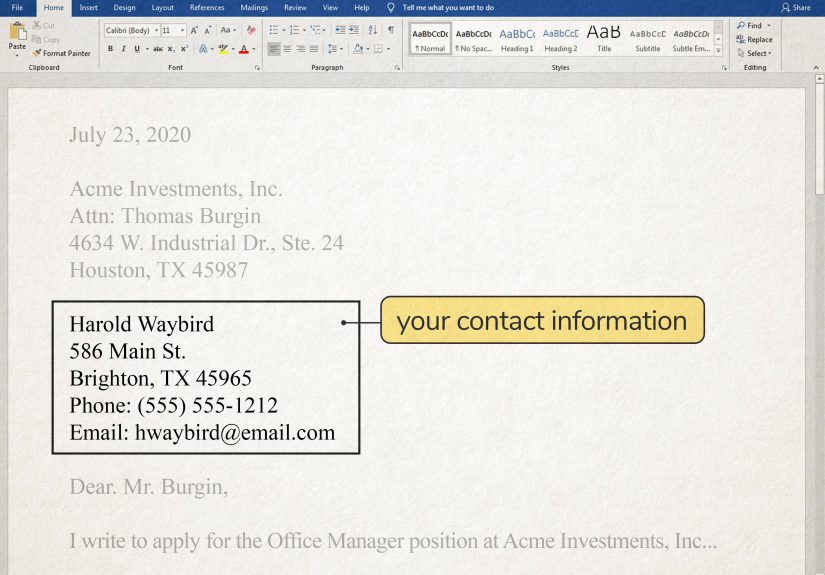
Header
Include your name, city and state, phone number, email, date, and the employer’s contact information if you have it.
Greeting
Address a specific person whenever possible. “Dear Hiring Manager” is acceptable when a name is not available. Skip outdated greetings that sound like they were typed on a typewriter during a thunderstorm.
Opening Paragraph
Say what role you want and why you are writing. Make the opening relevant and specific.
Body Paragraphs
Show how your experience, skills, and accomplishments match the employer’s needs. Use examples. Use keywords naturally. Use numbers when helpful.
Closing Paragraph
Reinforce your interest, thank the reader, and note that you would welcome the opportunity to discuss your qualifications further.
Professional Sign-Off
Use “Sincerely,” “Best regards,” or a similar professional close, followed by your name.
Common Mistakes to Avoid
Even strong candidates can sabotage themselves with a weak letter. Here are some classic mistakes:
- Sending the same generic letter to every employer
- Repeating the résumé instead of adding value
- Using vague claims with no evidence
- Making the letter too long or too formal
- Misspelling names, titles, or company details
- Talking only about what you want instead of what you can offer
A good application letter is employer-centered. Yes, you are applying because you want the job. But the letter should be written through the lens of what the company needs and how you can help meet that need.
Experience-Based Lessons From Real Application Letter Scenarios
One of the most common experiences job seekers have is sending out a perfectly decent but painfully generic application letter and hearing absolutely nothing back. The letter is not offensive. It is not chaotic. It is just forgettable. That happens when the writer uses broad phrases like “I am a motivated professional” without proving anything specific. The lesson is simple: employers respond better when a letter sounds tailored to them, not mass-produced for humanity at large.
Another familiar experience is realizing that the strongest letter usually starts long before the first sentence. People who get better results often spend extra time studying the job description, reviewing the company’s website, and identifying which skills matter most. That preparation changes the writing. Suddenly the letter becomes sharper. Instead of listing everything the applicant has ever done, it highlights the handful of experiences that actually matter for the role.
Many applicants also learn that numbers change everything. A sentence like “I helped improve team performance” is fine, but “I helped cut response time by 22% over six months” is stronger, clearer, and more believable. This is a common turning point for job seekers who wonder why one version of their letter feels flat and another feels convincing. Specific evidence creates trust. Hiring managers do not just want confidence; they want proof.
Career changers often have another important experience: they assume their nontraditional background will be a disadvantage, but it becomes an advantage once they explain it well. Someone moving from teaching to training, hospitality to operations, or journalism to content marketing may initially worry that their résumé does not look “right.” Yet a smart application letter can reframe the story. It can show communication skills, leadership, organization, and adaptability in a new light. That is often the difference between being overlooked and being taken seriously.
There is also the proofreading lesson, and it is not glamorous. Plenty of applicants spend an hour polishing their achievements, then send a letter with the wrong company name or a typo in the first paragraph. That kind of mistake can undo the whole effort. People often discover the hard way that proofreading is not the boring final step; it is part of the strategy. A clean letter signals care, professionalism, and attention to detail.
Then there is the experience of tone. Some applicants write like courtroom lawyers. Others write like they are texting a cousin. The best letters tend to land in the middle: professional, clear, warm, and human. Employers are not looking for a machine, and they are not usually impressed by theatrical language. They want someone who communicates well, understands the role, and sounds like a person they would actually want to work with.
Finally, many job seekers discover that the application letter is not dead weight after all. They may begin the process thinking the résumé is all that matters, only to realize that the letter gives them space to explain interest, clarify a pivot, highlight a major win, or add context a résumé cannot hold. In real hiring situations, that extra layer can matter. It may not rescue a weak application, but it can absolutely strengthen a strong one.
The big takeaway from these experiences is that application letters work best when they are intentional. Not longer. Not fancier. Just more intentional. When the letter is tailored, evidence-based, and written with the employer’s needs in mind, it stops being a formality and starts becoming a persuasive tool.
Conclusion
There is no single perfect way to write an application letter, but there are smart ways to write one. A traditional targeted letter is ideal when your background matches the role clearly. An achievement-first letter helps you lead with impact. A career-change letter builds a bridge between past experience and new goals. A referral-based letter adds useful context and credibility when a connection exists.
Whichever format you choose, the essentials remain the same: research the employer, tailor the message, use a professional structure, include relevant examples, and proofread like your interview depends on it. Because, honestly, it might.
A great application letter does not try to sound impressive in the abstract. It makes a focused case. It tells the employer, in clear American English, that you understand the opportunity and can bring value. That is the kind of letter that gets remembered, and remembered is a very good place to start.






 Close
Close