
Table of Contents >> Show >> Hide
- Why some yoga poses need to change during pregnancy
- Quick-scan guide: poses to avoid during pregnancy and what to do instead
- 1) Avoid deep closed twists try an open twist instead
- 2) Avoid full backbends like Wheel try Cat-Cow instead
- 3) Avoid deep forward folds that compress the belly try Wide-Knee Child’s Pose
- 4) Avoid belly-down poses like Bow, Locust, or full Cobra try Bird Dog
- 5) Avoid risky inversions like Headstand, Shoulder Stand, or Handstand try Warrior II or Goddess Pose
- 6) Avoid long flat-on-your-back Savasana try Side-Lying Savasana
- One more thing: skip hot yoga during pregnancy
- How to make prenatal yoga safer and more comfortable
- What yoga can still do for you during pregnancy
- Common real-life experiences with pregnancy yoga
- Conclusion
Pregnancy yoga can be a beautiful thing. It can ease stress, loosen tight hips, calm a racing mind, and help you feel a little more at home in a body that is changing by the hour. One day you are floating through gentle stretches like a serene woodland goddess. The next day you are trying to roll off the couch like a determined burrito. Both experiences are valid.
The good news is that yoga is often a safe, smart form of movement during pregnancy when your healthcare provider says exercise is okay. The catch is that pregnancy is not the season for treating your body like a pretzel audition. As your belly grows, your center of gravity shifts, your joints get looser, and certain positions can become uncomfortable, awkward, or simply not worth the drama.
This guide walks through six yoga poses commonly avoided or heavily modified during pregnancy, along with safer alternatives that can still help you stretch, strengthen, and breathe without picking a fight with your pelvis. Think of it as a prenatal yoga reality check: less “look what I can still do,” more “let’s do what actually feels good and makes sense.”
Why some yoga poses need to change during pregnancy
Pregnancy changes the rules of movement. Hormones that help prepare the body for birth can also make joints feel looser and less stable. Your growing uterus changes posture and balance. Lying flat on your back for too long may feel lousy later in pregnancy. Deep abdominal compression can become uncomfortable. And anything that overheats you, strains your breathing, or makes you feel wobbly deserves a side-eye.
That does not mean yoga is off the table. It means the goal shifts. During pregnancy, yoga works best when it helps you:
- maintain gentle mobility,
- build functional strength,
- practice breathing and relaxation,
- ease common aches such as back or hip tension, and
- leave class feeling better than when you walked in.
If a pose makes you hold your breath, clamp your jaw, wobble like a shopping cart with one bad wheel, or feel pressure in your belly or pelvis, that is your cue to back off. Pregnancy yoga should feel supportive, not like a personal vendetta.
Quick-scan guide: poses to avoid during pregnancy and what to do instead
| Pose to Avoid or Modify | Why It Can Be Problematic | Pose to Try Instead |
|---|---|---|
| Deep closed twists | Can compress the belly and feel restrictive | Open seated twist |
| Full backbends like Wheel | Can overstretch the front body and strain the low back | Cat-Cow or supported chest opener |
| Deep forward folds that crush the belly | Can create too much abdominal pressure and reduce breathing comfort | Wide-knee Child’s Pose |
| Belly-down poses like Bow or Locust | Direct pressure on the abdomen is not practical or comfortable | Bird Dog in tabletop |
| Inversions like Headstand or Handstand | Balance shifts make falls riskier | Warrior II or Goddess Pose |
| Flat-on-your-back Savasana for long periods | May become uncomfortable later in pregnancy | Side-lying Savasana |
1) Avoid deep closed twists try an open twist instead
Twists are where pregnancy yoga gets very particular. A gentle, open twist can feel great through the upper back and ribs. A deep, closed twist that rotates the torso toward the bent knee or compresses the abdomen? Not so charming.
Closed twists can create pressure through the belly and may simply feel cramped as pregnancy progresses. Even if you can still get into the shape, pregnancy is not the time to wring yourself out like a dish towel.
Try this instead: Open seated twist
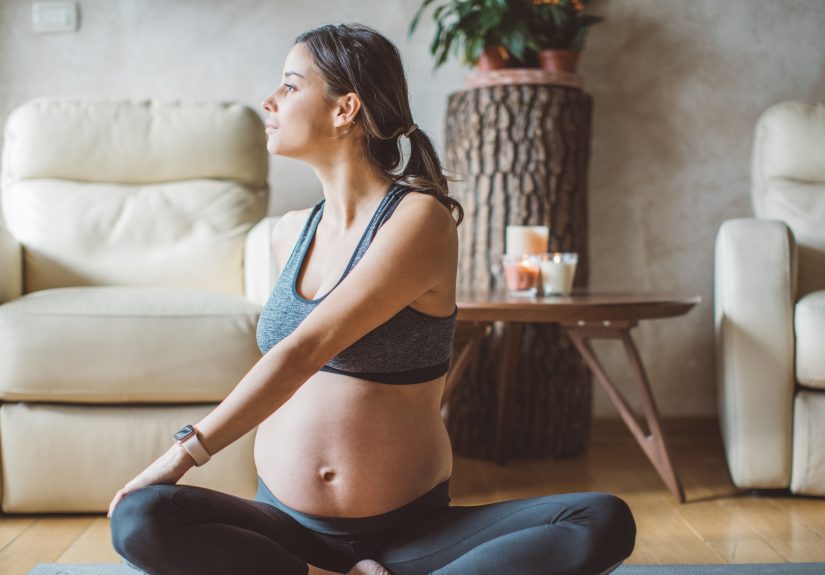
Sit comfortably with legs crossed or on a folded blanket. Lengthen your spine, then rotate gently toward one side, keeping space across the belly. Think broad chest, soft ribs, easy breath. The twist should come more from the upper back than from aggressively hauling your torso around.
Best for: easing upper-back tightness and improving posture without compressing the abdomen.
2) Avoid full backbends like Wheel try Cat-Cow instead
Deep backbends look dramatic and can feel energizing, but pregnancy already places extra demand on the low back. Add a growing belly, softer ligaments, and a shifting center of gravity, and suddenly a big backbend can go from “expansive” to “absolutely not.”
Poses such as Wheel, Camel, or a very deep Cobra may overstretch the front of the body and dump too much pressure into the lower back. During pregnancy, “more stretch” is not always “better stretch.” In fact, it is often “future complaint to your physical therapist.”
Try this instead: Cat-Cow
Come onto hands and knees with wrists under shoulders and knees under hips. On an inhale, lift the chest and tailbone gently for Cow. On an exhale, round through the spine for Cat. Move slowly and stay within a comfortable range.
Cat-Cow is a favorite for a reason. It can relieve back tension, create space through the spine, and help you reconnect to your breath without forcing your body into a giant arc.
Best for: back discomfort, spinal mobility, and that “why does my lower back feel 97 years old today?” feeling.
3) Avoid deep forward folds that compress the belly try Wide-Knee Child’s Pose
Forward folds are lovely in theory. In pregnancy, they can become a negotiation between your thighs, your belly, your hamstrings, and your patience. A deep fold that presses the torso hard into the legs can crowd the abdomen and make breathing less comfortable.
This includes shapes like an intense seated forward bend or a narrow-legged standing fold where you are trying to drape yourself forward like a melting candle. The issue is not folding forward at all. It is folding in a way that ignores the very obvious fact that a baby bump now lives there.
Try this instead: Wide-Knee Child’s Pose
Bring your knees wider apart to make room for the belly. Sink hips back comfortably and reach arms forward, or stack your hands and rest your head on them. A bolster or pillows under the chest can make the pose even more supportive.
This modification gives you the calming, grounded feel of a forward fold without the squeeze. It also tends to be a crowd favorite when hips and low back are feeling cranky.
Best for: relaxation, gentle hip opening, and taking a breather without folding yourself in half.
4) Avoid belly-down poses like Bow, Locust, or full Cobra try Bird Dog
This one is not subtle. Once your belly grows, lying face-down becomes less “yoga practice” and more “logistical impossibility.” Even early in pregnancy, belly-down poses may become uncomfortable quickly.
Bow Pose, Locust, and prone backbends place pressure on the front body and are usually not worth forcing. Pregnancy is a great time to retire the idea that every pose needs to be muscled through just because it used to feel fine six months ago.
Try this instead: Bird Dog from tabletop
Start on hands and knees. Extend one leg behind you, keeping hips level. If it feels stable, extend the opposite arm forward. Pause, breathe, then switch sides. Keep the movement controlled and the core gently engaged.
Bird Dog strengthens the back body, glutes, shoulders, and deep core muscles without putting pressure on the abdomen. It is practical, efficient, and refreshingly free of acrobatics.
Best for: core support, balance practice, and building functional strength for everyday movement.
5) Avoid risky inversions like Headstand, Shoulder Stand, or Handstand try Warrior II or Goddess Pose
Some experienced yogis can continue select inversions during pregnancy with professional guidance. But for most people, pregnancy is not the ideal time to start auditioning for Cirque du Soleil. As your center of gravity changes, balance can get trickier. A pose that once felt rock solid may suddenly feel surprisingly sketchy.
Inversions also vary widely. A brief, well-supported inversion may be fine for some seasoned practitioners, but unsupervised upside-down balancing poses are often a “why risk it?” category during pregnancy.
Try this instead: Warrior II or Goddess Pose
Warrior II builds leg and hip strength while encouraging upright posture and steady breathing. Goddess Pose can also be a great prenatal option if your hips enjoy it. The key is to take a stance wide enough to feel stable, soften the shoulders, and avoid sinking so deeply that the pose turns into a complaint letter from your inner thighs.
These poses deliver strength, stamina, and body awareness without the drama of potentially toppling over upside down.
Best for: lower-body strength, endurance, and feeling powerful in a very grounded way.
6) Avoid long flat-on-your-back Savasana try Side-Lying Savasana
Savasana is supposed to be the dessert of yoga. During pregnancy, especially later on, lying flat on your back for a long time may stop feeling restful and start feeling awkward, breathy, dizzy, or just plain uncomfortable.
That does not mean rest is off limits. It means your final relaxation pose may need a prenatal remix.
Try this instead: Side-Lying Savasana
Lie on one side with a pillow between the knees and another under the head. You can also hug a bolster or place support behind your back. Settle in, relax your jaw, and let your breath slow down. This version often feels much more natural during pregnancy and still gives you the calming payoff at the end of practice.
Best for: relaxation, recovery, and finishing class without feeling like a stranded turtle.
One more thing: skip hot yoga during pregnancy
Hot yoga is not one of the six poses above because it is a whole class style, not a single pose, but it deserves a very clear mention. Pregnancy is not the time to exercise in extreme heat. Overheating and dehydration are not the sort of plot twists anyone needs.
If the room feels tropical, the instructor describes the class as “Bikram-inspired,” or your mat turns into a slip-and-slide before you even begin, choose a cooler prenatal-friendly class instead.
How to make prenatal yoga safer and more comfortable
- Get cleared first. If you have a high-risk pregnancy, multiples, a history of preterm labor, vaginal bleeding, severe pain, or other medical concerns, ask your clinician what is safe for you.
- Choose prenatal yoga when possible. Classes designed for pregnancy usually offer better pacing, props, and modifications.
- Use props like they are your best friends. Blocks, bolsters, folded blankets, pillows, and the wall are not cheating. They are excellent judgment.
- Do not chase your old range of motion. Pregnancy is not a flexibility competition.
- Stay hydrated and breathe normally. If you cannot speak comfortably, back off.
- Stop if something feels wrong. Pain, dizziness, contractions, bleeding, leaking fluid, chest symptoms, or decreased fetal movement are reasons to stop and check in with your provider.
What yoga can still do for you during pregnancy
Even with modifications, prenatal yoga can still do quite a lot. It may help reduce stress, support mood, encourage gentle movement, and ease common discomforts such as back tension and stiffness. It also gives you a chance to practice breath control and body awareness, which can be useful long before labor begins and long after it is over.
Just as important, yoga can offer something many pregnant people desperately need: a structured moment to slow down. Not to answer messages. Not to compare nursery paint colors. Not to read one more wildly contradictory internet thread. Just to breathe, move, and remember that your body is doing an extraordinary job.
Common real-life experiences with pregnancy yoga
Many pregnant people begin yoga expecting a graceful wellness montage and discover that the real experience is more practical, more human, and honestly more helpful. Early on, someone might come to class hoping to keep up with the exact routine they loved before pregnancy. Within a couple of weeks, they realize the goal has changed. Instead of chasing a deep stretch, they start appreciating smaller movements that ease rib tightness, reduce back tension, or help them sleep a little better. It is less about performance and more about relief.
A common experience is surprise at how much balance changes. A pose that used to feel automatic can suddenly feel weirdly uncertain. Standing on one leg to transition into something elegant may become an instant negotiation. This is where many people fall in love with the wall. The wall becomes a quiet hero of prenatal yoga: reliable, sturdy, and not at all judgmental.
Another frequent experience is that breathing practices become more valuable than expected. In the beginning, some people assume the breathing part is just the slow, serious intermission before the “real workout.” Then pregnancy advances, stairs become personal enemies, and a few minutes of intentional breathing starts to feel surprisingly powerful. Learning how to soften the shoulders, unclench the jaw, and breathe steadily through discomfort can make daily life feel more manageable.
Back pain is another big theme. Many pregnant people report that gentle spinal movement, especially in tabletop positions, feels much better than dramatic stretching. Cat-Cow, side stretches, and supported hip openers often become the stars of the show. Not because they are flashy, but because they work. It turns out humble poses can be absolute legends when your lower back is filing complaints.
There is also the emotional side. Pregnancy can be joyful, strange, exhausting, exciting, and occasionally overwhelming before lunch. People often describe prenatal yoga as one of the few places where they feel invited to notice what is happening without having to “fix” it. If they feel strong, great. If they feel tired, the class can meet them there too. That flexibility of expectation can be just as helpful as physical flexibility.
Some people discover they love props during pregnancy and never fully recover from the revelation. A bolster under the chest, blankets under the knees, blocks under the hands, and suddenly a pose that felt impossible becomes supportive. This often changes how they think about yoga overall. Instead of seeing props as beginner tools, they start seeing them as smart tools. Which, to be fair, they are.
One more very real experience: prenatal yoga often teaches people to stop proving things. They stop proving they are still flexible. They stop proving they can still do advanced poses. They stop proving they are handling pregnancy “perfectly.” In place of all that proving, they start listening. That is a skill worth carrying into labor, postpartum recovery, and regular life.
So if your pregnancy yoga journey looks less like a magazine cover and more like you building a pillow fortress for side-lying relaxation, welcome. You are not doing it wrong. You are probably doing it exactly right.
Conclusion
Pregnancy yoga can be a wonderful tool, but this is the season for strategy, not stubbornness. The smartest prenatal practice is not the one with the fanciest poses. It is the one that supports your changing body, respects your energy, and helps you move with less pain and more confidence. Skip the poses that compress the belly, challenge balance unnecessarily, or keep you flat on your back too long. Choose supportive alternatives that let you breathe, strengthen, and relax. In pregnancy, the best yoga pose is often the one that leaves you feeling steadier, calmer, and slightly less likely to groan when standing up.






 Close
Close