
Table of Contents >> Show >> Hide
- Before the Pretty Stuff: Quick Layout Rules That Save You Regret
- 75 Kitchen Ideas for Every Layout and Style
- One-Wall Kitchens (Ideas 1–10)
- Galley Kitchens (Ideas 11–20)
- L-Shaped Kitchens (Ideas 21–30)
- U-Shaped Kitchens (Ideas 31–40)
- Peninsula & G-Shaped Kitchens (Ideas 41–50)
- Island & Open-Concept Kitchens (Ideas 51–60)
- Storage & Organization That Actually Works (Ideas 61–70)
- Cabinets, Color, and Style Moves (Ideas 71–75)
- Putting It Together: Three Easy “Kitchen Recipes” You Can Copy
- Common Kitchen Mistakes (So You Don’t Pay Twice)
- Real-World Kitchen Experiences: What People Learn After Living With Their Choices
- Conclusion
The kitchen is where coffee becomes courage, leftovers become lunch, and someone always asks,
“Do we have any clean spoons?” (Spoiler: no. Never.) The good news: you don’t need a full
demolition derby to make your kitchen work better and look sharper. You need smart layout moves,
storage that doesn’t play hide-and-seek, and a few design decisions that feel like you
not a showroom that forbids fun.
This guide rounds up practical, real-world kitchen ideas across the most common layoutsone-wall,
galley, L-shaped, U-shaped, peninsula, and island/open-conceptplus style upgrades that work in
everything from modern minimal to cozy cottage. Pick a handful, mix them, and suddenly your
kitchen starts behaving like the hardworking room it claims to be.
Before the Pretty Stuff: Quick Layout Rules That Save You Regret
Layout is the kitchen’s “bones.” You can dress it up with tile and hardware, but if the flow is
awkward, you’ll feel it every single day. Keep these principles in mind as you shop, sketch,
or plan your remodel.
1) Protect your work zones
Think in stations: refrigeration (grab ingredients), prep/cleanup (sink + counter), and cooking
(range/oven). When these zones are reasonably closeand not blocked by trafficcooking feels
smoother and less like an obstacle course.
2) Leave breathing room
Crowded aisles are the fastest way to make a nice kitchen feel stressful. Plan clear walkways,
especially around islands, dishwashers, and ovens. (If two people can’t pass without doing the
sideways crab-walk, it’s too tight.)
3) Give yourself “landing spots”
You’ll want countertop space near the fridge (groceries), near the sink (dirty dishes and prep),
and near the cooktop (hot pans). A little landing zone prevents clutter from migrating to the
nearest flat surfacelike your stove. Please don’t store mail on the stove.
4) Light the work, then light the mood
Great kitchens use layers: task lighting (under-cabinet, pendants), ambient lighting (ceiling),
and accent lighting (toe-kick or inside glass cabinets). This is how you get both “I can chop
onions safely” and “this looks like a magazine.”
75 Kitchen Ideas for Every Layout and Style
Use this list like a menu: choose what fits your layout, steal a couple style moves, and skip
anything that doesn’t match how you actually live. (If you never bake, you don’t need to design
around a stand mixer shrine.)
One-Wall Kitchens (Ideas 1–10)
- Go tall, not wide: use full-height uppers to maximize storage on one wall.
- Add an island only if it clears: a slim prep table can beat a bulky island.
- Choose panel-ready appliances: they visually “quiet” a compact run of cabinets.
- Run the backsplash to the ceiling: it adds height and makes one-wall kitchens feel intentional.
- Use a single counter material: fewer transitions make small spaces feel larger.
- Hide the microwave: a drawer microwave or appliance garage reduces countertop chaos.
- Pick a statement hood (even small): it creates a focal point without adding clutter.
- Try open shelving sparingly: one short run looks airy; too much turns into a dust museum.
- Use reflective finishes: glossy tile or a light quartz can bounce light in tight spaces.
- Create a “drop zone” at the end: a small tray area keeps keys and mail out of prep space.
Galley Kitchens (Ideas 11–20)
- Keep the center aisle clear: prioritize smooth traffic so cooking doesn’t feel like rush hour.
- Go light up top: pale uppers (or glass fronts) reduce the tunnel effect.
- Use under-cabinet lighting everywhere: it makes galley counters feel twice as usable.
- Swap bulky pulls for slim hardware: less snagging when you squeeze past open doors.
- Choose a runner rug with grip: comfort underfoot, less slip, more “I live here.”
- Try a single-bowl sink: it frees counter space for prep in narrow layouts.
- Put the dishwasher next to the sink: loading becomes a one-step process, not a scavenger hunt.
- Use a rolling cart as a “movable island”: extra prep space without permanent blockage.
- Make the ends count: add a tall pantry cabinet or coffee bar at one end for function.
- Choose vertical tile: stacked patterns visually lift the room and feel modern.
L-Shaped Kitchens (Ideas 21–30)
- Don’t waste the corner: use a lazy Susan, pull-out shelves, or a corner drawer system.
- Float a small island if space allows: it adds prep room and social seating without boxing you in.
- Keep the sink off the dead corner: a corner sink often steals valuable landing space.
- Create a baking zone: dedicate one stretch of counter to mixing, measuring, and storing tools.
- Mix cabinet depths: a shallower cabinet run can widen walkways in tight L-shapes.
- Use a contrasting island color: it anchors the room and adds personality fast.
- Make one wall “tall storage”: pantry + fridge + oven tower keeps the other wall cleaner.
- Add a window shelf: a slim ledge for herbs and mugs (not 47 random gadgets).
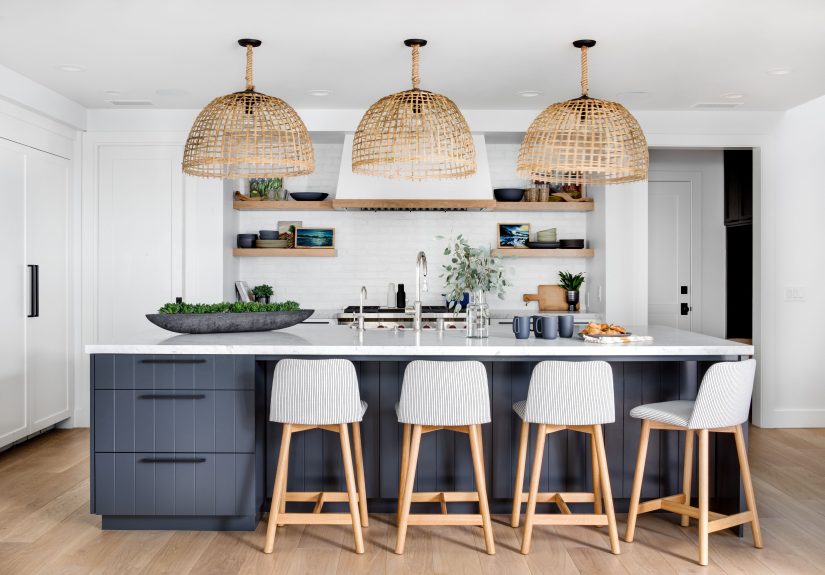
- Try a statement pendant pair: balanced lighting looks polished over an island or peninsula.
- Run a backsplash behind open shelves: it looks finished and protects the wall.
U-Shaped Kitchens (Ideas 31–40)
- Use the “U” for workflow: place fridge, sink, and cooktop on different legs for easy stationing.
- Keep one side lighter: open shelves or glass fronts prevent a boxed-in feeling.
- Turn a short leg into a breakfast nook: a shallow counter + stools = casual seating.
- Consider two prep zones: a main prep counter plus a secondary “snack station” for helpers.
- Choose a single continuous floor: uninterrupted flooring makes U-shapes feel more open.
- Use corner uppers wisely: angled cabinets or open corner shelves can reduce visual bulk.
- Add toe-kick lighting: it makes lower cabinets feel lighter and helps nighttime navigation.
- Try a pot-filler only if you’ll use it: fancy plumbing is fununtil it isn’t.
- Go for drawers on lowers: drawers beat deep shelves for everyday access.
- Upgrade the sink view: even a small window treatment or art moment makes cleanup less tragic.
Peninsula & G-Shaped Kitchens (Ideas 41–50)
- Use the peninsula as a “bridge”: it connects kitchen to living/dining without losing workspace.
- Put seating on the outer side: keep stools out of the cooking lane.
- Build storage into the peninsula: shallow cabinets for trays and cutting boards are a win.
- Choose waterfall edges selectively: stunning, yesbest when the rest of the kitchen is simple.
- Make it a homework hub: add outlets and a drawer for chargers and pens.
- Try a raised bar only with intention: one-level counters generally feel more modern and usable.
- Use pendant lighting to define the zone: it signals “this is seating” without adding walls.
- Install a narrow wine fridge: it’s a small luxury that doesn’t steal major prep space.
- Keep traffic out of the triangle: aim for walkways that skirtnot cut throughwork zones.
- Finish the back side beautifully: panels, shiplap, or trim make the peninsula look built-in.
Island & Open-Concept Kitchens (Ideas 51–60)
- Plan generous clearance: enough space so people can pass while appliances are open.
- Add outlets to the island: nobody wants a blender cord stretching across the room.
- Use the island for prep, not clutter: build in trash pull-outs and utensil drawers.
- Try seating on one side only: it keeps the working side clean and the stools out of the way.
- Consider a second sink: a small prep sink helps when multiple cooks share the space.
- Pick durable countertops: islands take the most abuseheat, knives, homework, you name it.
- Use oversized pendants carefully: they’re dramatic, but don’t let them block sightlines.
- Create an “appliance wall”: hide toaster/coffee gear in a dedicated zone to reduce visual noise.
- Anchor with a bold rug (washable): open concept needs grounding, but spills will happen.
- Let the island color lead the palette: repeat it in hardware, stools, or a backsplash accent.
Storage & Organization That Actually Works (Ideas 61–70)
- Use deep drawers for pots: one pull beats digging through a cave cabinet.
- Add tray dividers: keep baking sheets and cutting boards upright and easy to grab.
- Install a pull-out trash + recycle: it’s the unglamorous hero of daily life.
- Try a narrow pull-out pantry: perfect for spices and oils near the cooktop.
- Use a lazy Susan for corner base storage: it turns lost corners into accessible zones.
- Organize by frequency: daily dishes at arm height, holiday platters up high.
- Make one drawer the “snack drawer”: fewer raids on your prep space during cooking.
- Add under-sink pull-outs: cleaning supplies stop toppling like dominoes.
- Use vertical space inside doors: mount holders for wraps, lids, and cleaning tools.
- Create a landing shelf for small appliances: keep them plugged in, but visually contained.
Cabinets, Color, and Style Moves (Ideas 71–75)
- Mix finishes with restraint: choose one “main” metal and one accent for a layered look.
- Use two-tone cabinetry: darker lowers + lighter uppers keeps things grounded but airy.
- Pick a backsplash with personality: zellige, stone slab, or patterned tile can carry the whole room.
- Add art where you’d least expect it: a framed piece on a shelf or hood softens hard surfaces.
- Upgrade hardware like jewelry: it’s a small change that can make cabinets feel brand new.
Putting It Together: Three Easy “Kitchen Recipes” You Can Copy
Recipe 1: Small Kitchen Glow-Up (Weekend-Friendly)
- Swap hardware + add under-cabinet lighting.
- Paint walls a warm white or soft neutral; use a washable, low-sheen finish.
- Add a rolling cart for extra prep space and storage.
- Choose a simple, durable runner rug (with grip).
Recipe 2: Classic-But-Not-Boring Transitional Kitchen
- Shaker cabinets, quartz counters, and a backsplash with subtle texture.
- One primary metal finish (like brushed nickel) + one accent (like aged brass).
- Layer lighting: recessed + pendants + under-cabinet strips.
- Use glass-front uppers for a lighter feel and an easy display moment.
Recipe 3: Modern Kitchen With Warmth (No “Cold Showroom” Vibes)
- Flat-panel cabinetry in a warm neutral or natural wood tone.
- Matte or honed surfaces (less glare, more cozy).
- Minimal open shelvingjust enough for breathing room.
- Soft pendants and an island that’s built for real life (trash pull-out, deep drawers, outlets).
Common Kitchen Mistakes (So You Don’t Pay Twice)
- Over-islanding: an island is great until it blocks the fridge or traps traffic.
- Too little task lighting: pretty pendants won’t help if the counters are dim.
- Storage without a system: more cabinets aren’t helpful if they’re awkward to use.
- Choosing finishes before flow: layout decisions should come first, always.
Real-World Kitchen Experiences: What People Learn After Living With Their Choices
Here’s the part design shows don’t always highlight: the “best” kitchen isn’t the one with the
fanciest marble or the most dramatic pendant lights. It’s the one that keeps up with everyday
lifeweeknight dinners, rushed breakfasts, meal prep Sundays, and the occasional snack stampede.
Across different homes and budgets, people tend to report the same practical wins (and the same
facepalm moments) after a kitchen refresh.
First, clearance is comfort. Homeowners who squeeze in an oversized island often say
they regret it once the fridge door swings open and traffic jams start forming. Even when an island
looks perfect in a photo, daily movement matters more. People consistently appreciate islands and
peninsulas that are slightly smaller but leave generous walkwaysbecause the kitchen becomes
a place you can actually share. If you cook with a partner or have kids circling for snacks, that
breathing room feels like a lifestyle upgrade, not a technical detail.
Second, drawers beat shelves in real life. Deep base cabinets can turn into black holes
where lids disappear and your favorite pot becomes a myth. Kitchens that swap lower shelves for
deep drawers often feel instantly more functionalno kneeling, no digging, no “why is the colander
behind the slow cooker behind the blender?” This is especially noticeable in U-shaped and galley
layouts where efficiency is everything. People also love small, specific organizerstray dividers,
pull-out trash, under-sink slidesbecause they reduce daily friction. It’s not glamorous, but it’s
the kind of change you feel every day.
Third, lighting affects mood and accuracy. Many homeowners say they didn’t realize how
much bad lighting impacted their kitchen until they fixed it. Under-cabinet lighting, for example,
can make prepping safer and easier, while also making countertops and backsplashes look more expensive.
And layered lighting helps kitchens flex from “work mode” to “hangout mode.” People who add dimmers
often describe it as the simplest way to make the kitchen feel calmer at nightlike the room finally
learned how to whisper.
Fourth, maintenance is part of design. The finishes that look best in a styled photo
aren’t always the easiest to live with. High-gloss surfaces can show fingerprints. White grout can
become a full-time job. Open shelving can feel airy, but it also asks you to curateand dustlike
you’re running a tiny museum. A common “best of both worlds” approach is using a small amount of
open shelving (for everyday, attractive items) and relying on closed storage for everything else.
People also tend to be happiest when they choose materials that are durable and forgivingespecially
for islands and heavy-use countertops.
Finally, personality matters more than perfection. The kitchens people love long-term
usually include a few choices that feel personal: a color that makes them happy, a backsplash that
sparks conversation, or a small display shelf for art and cookbooks. Even practical upgradeslike a
coffee station or a snack drawercan reflect how a household actually functions. In other words:
the best kitchen isn’t just beautiful. It’s honest. It supports your routines, forgives your messes,
and still looks good when friends pop over and you pretend you “always keep it like this.”
Conclusion
The secret to a great kitchen isn’t chasing every trend. It’s choosing layout moves that improve
flow, storage that reduces daily clutter, and style choices that feel intentionalwhether your vibe
is modern, farmhouse, transitional, or totally your own. Start with the changes that fix the
everyday annoyances (clearances, lighting, landing zones), then layer in personality through
color, tile, hardware, and a few well-placed details. Your future selfholding a hot pan while
someone opens the fridgewill thank you.





 Close
Close