
Table of Contents >> Show >> Hide
- Why Bodyweight Leg Exercises Work
- How to Warm Up Before a Bodyweight Leg Workout
- 9 Bodyweight Leg Exercises for Strength, Balance, and Mobility
- Sample Bodyweight Leg Workout
- How to Progress Without Weights
- Common Mistakes to Avoid
- Who Can Benefit From Bodyweight Leg Exercises?
- Experience-Based Tips for Better Bodyweight Leg Training
- Conclusion
Note: This article is written for general fitness education and is based on widely accepted guidance from reputable U.S. health and fitness organizations. Anyone with pain, injury, medical concerns, or limited mobility should check with a qualified healthcare or fitness professional before starting a new workout routine.
You do not need a squat rack, a mystery machine with 47 levers, or a gym membership that silently judges your bank account to build stronger legs. Some of the best lower-body exercises use the oldest piece of workout equipment in history: your own body.
Bodyweight leg exercises are practical, beginner-friendly, and sneaky in the best way. They train your quadriceps, hamstrings, glutes, calves, hips, and core while improving balance, coordination, mobility, and everyday strength. Translation: stairs become less dramatic, getting out of a chair feels easier, and your knees stop sending “we need to talk” emails every time you move.
This guide breaks down 9 bodyweight leg exercises you can do at home, at the park, in a hotel room, or in that tiny apartment space between the couch and the coffee table. You will learn how each move works, which muscles it targets, common mistakes to avoid, and how to turn these exercises into a smart lower-body workout.
Why Bodyweight Leg Exercises Work
Bodyweight training uses gravity and your own mass as resistance. That may sound simple, but simple does not mean easy. A slow, controlled squat can light up your legs. A single-leg glute bridge can humble even confident gym-goers. A wall sit can make 30 seconds feel like a small documentary about survival.
The biggest advantage of bodyweight leg workouts is that they train movement patterns you use in real life. Squats help with sitting and standing. Lunges help with walking, climbing, and balance. Glute bridges strengthen hip extension, which supports posture and athletic movement. Calf raises build lower-leg strength for walking, running, and jumping.
Another benefit is accessibility. You can adjust nearly every exercise by changing range of motion, speed, reps, rest time, or body position. Beginners can use a chair for support. More advanced exercisers can slow the lowering phase, add pauses, try single-leg versions, or combine moves into circuits.
How to Warm Up Before a Bodyweight Leg Workout
A good warm-up is like knocking before entering a room. Your joints, muscles, and nervous system appreciate the heads-up.
Before starting these bodyweight leg exercises, spend 5 to 8 minutes raising your body temperature and practicing easy movement. Try marching in place, hip circles, ankle rolls, gentle bodyweight squats, alternating reverse lunges, and glute bridges. Keep it light. The goal is not to win the warm-up Olympics. The goal is to move better during the main workout.
9 Bodyweight Leg Exercises for Strength, Balance, and Mobility
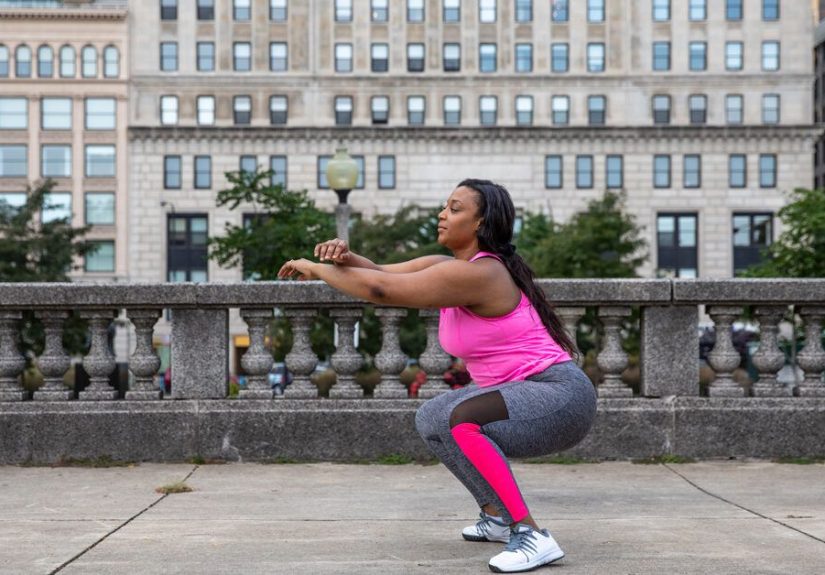
1. Bodyweight Squat
The bodyweight squat is the classic lower-body exercise because it trains one of the most important human movements: lowering and standing back up. It targets the quadriceps, glutes, hamstrings, hips, calves, and core.
To do it, stand with your feet about shoulder-width apart. Keep your chest lifted, brace your core, and push your hips back as if sitting into a chair. Bend your knees and lower until your thighs are about parallel to the floor, or as low as you can comfortably control. Press through your whole foot to stand back up.
Form tip: Keep your knees tracking in the same direction as your toes. Do not let them cave inward. Imagine your knees are polite but firm: they know where they are going.
Make it easier: Squat to a chair or bench. Pause lightly, then stand.
Make it harder: Slow down the lowering phase for 3 to 5 seconds or add a pause at the bottom.
2. Reverse Lunge
The reverse lunge is a knee-friendly lunge variation that trains the quads, glutes, hamstrings, calves, and balance. Because you step backward instead of forward, many people find it easier to control than a forward lunge.
Stand tall with your feet hip-width apart. Step one foot back and lower your body until your front knee bends to about 90 degrees. Your back knee should move toward the floor without crashing into it. Push through the front foot to return to standing. Alternate sides or complete all reps on one leg before switching.
Form tip: Keep your torso tall and your front knee aligned over your foot. If you wobble, slow down. Wobbling is not failure; it is your balance system asking for a meeting.
Make it easier: Hold a wall, chair, or countertop for support.
Make it harder: Add a knee drive at the top or use a slower tempo.
3. Glute Bridge
The glute bridge may look relaxed because you are lying on the floor, but do not be fooled. This exercise strengthens the glutes, hamstrings, hips, and core. It is especially helpful for people who sit a lot, because prolonged sitting can leave the glutes underused and the hips feeling stiff.
Lie on your back with your knees bent and feet flat on the floor, about hip-width apart. Place your arms by your sides. Brace your core, press through your heels, and lift your hips until your body forms a straight line from shoulders to knees. Squeeze your glutes at the top, then lower slowly.
Form tip: Do not arch your lower back at the top. The movement should come from your hips, not from turning your spine into a small bridge-shaped drama.
Make it easier: Use a smaller range of motion and focus on control.
Make it harder: Try single-leg glute bridges or pause for 3 seconds at the top.
4. Step-Up
The step-up is one of the most useful bodyweight leg exercises because it directly mimics climbing stairs. It strengthens the quads, glutes, hamstrings, calves, and stabilizing muscles around the hips and knees.
Use a sturdy step, bench, or low platform. Place one foot fully on the surface. Press through that foot to stand up, bringing the other foot onto the platform. Step back down with control. Repeat on one side or alternate legs.
Form tip: Avoid pushing off too much from the back foot. The leg on the step should do most of the work. If the step is too high, your form may turn into a climbing expedition. Choose a lower surface.
Make it easier: Use a low stair and hold a railing.
Make it harder: Slow the lowering phase or drive the opposite knee upward at the top.
5. Wall Sit
The wall sit is simple, spicy, and surprisingly effective. It builds muscular endurance in the quads, glutes, calves, and core. It is an isometric exercise, meaning your muscles work while holding a position instead of moving through reps.
Stand with your back against a wall and your feet a couple of steps forward. Slide down until your knees are bent, ideally around 90 degrees, but only as low as you can hold safely. Keep your back against the wall and your core engaged. Hold the position.
Form tip: Keep your knees over your ankles rather than letting them drift far past your toes. If your legs start shaking, congratulations: your quads have joined the conversation.
Make it easier: Stay higher on the wall with less knee bend.
Make it harder: Hold longer, add small heel raises, or try single-leg wall sit holds for short intervals.
6. Calf Raise
Calf raises train the gastrocnemius and soleus muscles in the lower leg. Strong calves help with walking, running, jumping, balance, and ankle stability. They also make stairs feel less like a personal attack.
Stand tall with your feet hip-width apart. Hold a wall or chair if needed. Press through the balls of your feet and lift your heels as high as you can. Pause briefly, then lower with control.
Form tip: Do not bounce. A slow calf raise beats a rushed one. Think elevator, not trampoline.
Make it easier: Use both legs and hold support.
Make it harder: Try single-leg calf raises or lower your heels from the edge of a step for a deeper stretch.
7. Bulgarian Split Squat
The Bulgarian split squat is a challenging single-leg exercise that targets the quads, glutes, hamstrings, hips, and core. It is excellent for building balance and correcting strength differences between legs. It is also excellent for making you question your life choices halfway through the set.
Stand a few feet in front of a bench, couch, or sturdy chair. Place the top of one foot behind you on the elevated surface. Keep your front foot planted. Lower your body by bending the front knee, then press through the front foot to stand.
Form tip: Start with a small range of motion. Keep your front knee aligned with your toes and your torso controlled. If your setup feels awkward, adjust your front foot forward or backward until the movement feels smoother.
Make it easier: Do a regular split squat with both feet on the floor.
Make it harder: Slow down, pause at the bottom, or increase your range of motion.
8. Lateral Lunge
Most daily movement happens forward and backward, but your hips and legs also need side-to-side strength. The lateral lunge trains the glutes, quads, hamstrings, adductors, and hip stabilizers. It is great for improving mobility and building strength outside the usual straight-line pattern.
Stand with your feet together. Step one foot out to the side, bend that knee, and push your hips back while keeping the other leg straight. Your bent knee should track over your foot. Push through the bent leg to return to standing.
Form tip: Keep your chest lifted and your foot flat. Do not collapse into the movement like a folding lawn chair.
Make it easier: Use a smaller step and shallower bend.
Make it harder: Add a pause at the bottom or alternate sides in a smooth rhythm.
9. Single-Leg Romanian Deadlift
The single-leg Romanian deadlift, often called a single-leg RDL, trains the hamstrings, glutes, calves, ankles, and core while challenging balance. It also teaches hip hinging, which is useful for lifting objects safely in daily life.
Stand on one leg with a soft bend in the knee. Hinge at your hips and let your opposite leg extend behind you as your torso tilts forward. Keep your back long and your hips square. Lower only as far as you can control, then squeeze your glutes and return to standing.
Form tip: Think of your body moving like a seesaw from the hip. Avoid rounding your back or twisting open at the hip.
Make it easier: Keep your back toes lightly on the floor as a kickstand.
Make it harder: Slow the movement and pause when your torso is tipped forward.
Sample Bodyweight Leg Workout
Here is a simple lower-body workout using the 9 bodyweight leg exercises above. Do it 2 to 3 times per week on nonconsecutive days, depending on your fitness level and recovery.
Beginner Routine
- Bodyweight squat: 2 sets of 8 to 12 reps
- Reverse lunge: 2 sets of 6 to 10 reps per side
- Glute bridge: 2 sets of 10 to 15 reps
- Step-up: 2 sets of 8 reps per side
- Calf raise: 2 sets of 12 to 20 reps
- Wall sit: 2 rounds of 20 to 40 seconds
Intermediate Routine
- Bodyweight squat with 3-second lowering: 3 sets of 10 to 15 reps
- Bulgarian split squat: 3 sets of 8 to 12 reps per side
- Lateral lunge: 3 sets of 8 to 10 reps per side
- Single-leg Romanian deadlift: 3 sets of 8 to 12 reps per side
- Single-leg calf raise: 3 sets of 10 to 15 reps per side
- Wall sit: 3 rounds of 30 to 60 seconds
Rest 30 to 90 seconds between sets. Move slowly enough to control your form. If your technique breaks down, stop the set. Good reps are like good jokes: timing matters.
How to Progress Without Weights
One common myth is that bodyweight exercises stop working once you get stronger. Not true. You just need to progress intelligently.
Start by increasing repetitions. Then increase sets. After that, slow down the tempo, add pauses, reduce rest time, or move from two-leg exercises to single-leg variations. For example, a regular glute bridge can become a single-leg glute bridge. A squat can become a slow squat, pause squat, or split squat. A calf raise can become a single-leg calf raise.
Progress should feel challenging, not chaotic. If your knees cave in, your back rounds, or you are using momentum instead of control, the exercise is too advanced for the moment. Step back, clean up the form, and build from there.
Common Mistakes to Avoid
Skipping the Warm-Up
Cold muscles and stiff joints do not love sudden deep squats. Warm up first so your body is ready to move.
Rushing Every Rep
Speed can hide weak form. Slower reps improve control and help you feel the target muscles working.
Letting the Knees Collapse Inward
During squats, lunges, and step-ups, keep your knees tracking with your toes. This supports better alignment and reduces unnecessary stress.
Training Through Sharp Pain
Muscle fatigue is normal. Sharp pain, joint pain, numbness, or anything that feels wrong is a signal to stop and reassess.
Doing Too Much Too Soon
Your muscles may be enthusiastic. Your tendons and joints prefer paperwork and gradual approval. Increase volume slowly.
Who Can Benefit From Bodyweight Leg Exercises?
Nearly everyone can benefit from lower-body strength training when exercises are matched to their ability. Beginners can start with chair squats, supported lunges, glute bridges, and calf raises. Active people can use bodyweight leg exercises as warm-ups, finishers, travel workouts, or conditioning sessions. Older adults can use modified versions to support balance, independence, and daily function.
These exercises are also helpful for people who do not enjoy traditional gyms. There is no waiting for equipment, no complicated setup, and no need to pretend you understand what the cable machine attachment is called. You just need space, patience, and a willingness to make your legs work.
Experience-Based Tips for Better Bodyweight Leg Training
The first thing most people learn from bodyweight leg exercises is that “no equipment” does not mean “no challenge.” A set of slow squats can feel easy for the first five reps, educational by rep ten, and deeply personal by rep fifteen. The trick is not to chase exhaustion every time. The trick is to build quality movement you can repeat consistently.
One helpful experience is to treat every exercise like a skill before treating it like a workout. For example, many beginners rush into lunges and feel awkward right away. Instead, start with reverse lunges while holding a chair. Practice stepping back quietly, lowering under control, and pushing through the front foot. After a few sessions, the movement usually feels smoother. Strength improves, but confidence improves too.
Another useful lesson is that your stronger leg may try to steal the spotlight. During step-ups, one side might feel powerful while the other side wobbles like a baby deer wearing roller skates. That is normal. Single-leg exercises reveal differences in balance and strength. Do not panic or punish the weaker side with endless extra reps. Add one or two additional controlled reps on that side if appropriate, but keep the workout balanced and focused on form.
Tempo is also a secret weapon. Many people think they need more exercises when they really need slower reps. Try lowering into a squat for four seconds, pausing for one second, and standing up with control. Suddenly, a basic squat becomes a serious strength exercise. The same idea works with glute bridges, calf raises, split squats, and single-leg Romanian deadlifts.
Wall sits are another exercise that teaches patience. The first 15 seconds may feel harmless. Then your thighs start negotiating. Then the wall becomes your closest friend and worst enemy. Use wall sits to build mental focus as well as muscular endurance. Keep breathing, keep your posture tall, and stop before your form collapses.
For people working out at home, consistency matters more than creating the “perfect” program. A short 20-minute bodyweight leg workout done twice a week is better than a legendary spreadsheet workout that never leaves your notes app. Put the workout on your calendar. Wear comfortable shoes. Choose a small training space. Keep the routine simple enough that you do not need a motivational speech to begin.
It also helps to connect these exercises to real life. Squats make it easier to sit and stand. Step-ups help with stairs. Calf raises support walking and balance. Glute bridges help wake up muscles that spend too much time smashed into a chair. Lateral lunges train side-to-side control, which can help when you step around obstacles, play sports, or dodge a rogue laundry basket.
Finally, recovery is part of the workout. Your legs need time to adapt. Sleep, hydration, balanced meals, and rest days all support progress. You should feel challenged after training, not destroyed. If your legs are so sore that stairs look like a mountain expedition, reduce the volume next time. Fitness is not a punishment; it is practice. And with bodyweight leg exercises, that practice can happen almost anywhere.
Conclusion
Bodyweight leg exercises are simple, effective, and surprisingly powerful. With squats, lunges, glute bridges, step-ups, wall sits, calf raises, Bulgarian split squats, lateral lunges, and single-leg Romanian deadlifts, you can train your entire lower body without equipment.
The key is to focus on control, alignment, consistency, and gradual progress. Start with versions that match your current ability. Add reps, sets, slower tempo, pauses, or single-leg variations as you improve. Keep your knees aligned, your core engaged, and your ego politely outside the workout room.
Whether your goal is stronger legs, better balance, improved mobility, or simply surviving stairs with less dramatic breathing, these 9 bodyweight leg exercises are a smart place to start.




 Close
Close