
Table of Contents >> Show >> Hide
- When “Do Not Try This at Home” Was Not Enough
- 10 Fatal Incidents Associated with Jackass-Style Stunts
- 1. Adam Ports and the Burning Chair
- 2. Tobias and the High-Speed Playground Carousel
- 3. The Teenager Dressed as a Mummy on a Highway
- 4. Matt Evans and the Hood-Riding Prank
- 5. Stephen Paul Rauen and a Moving Pickup
- 6. Aaron Brown and the Railroad-Track Jumps
- 7. Cameron Bieberle and the Shopping Cart
- 8. Adam Page and the Driverless Car
- 9. Bobbi MacKinnon and the Truck-Powered Merry-Go-Round
- 10. Darnell Mitchell and the Ballistic-Vest Video
- Why Young People Attempt Dangerous Copycat Stunts
- Experience-Based Lessons from Jackass Copycat Tragedies
- Conclusion
The outrageous stunts associated with Jackass were produced as entertainment, not as weekend instructions. Yet several young viewers attempted similar homemade spectacles involving moving vehicles, playground equipment, fire, and cameras. These ten tragedies show how peer pressure, the promise of internet fame, and one reckless decision can turn a supposed joke into an irreversible loss.
When “Do Not Try This at Home” Was Not Enough
Jackass arrived on MTV in 2000 with a simple formula: willing performers, ridiculous ideas, physical pain, and cameras positioned to capture every wince. Johnny Knoxville and his castmates rode shopping carts, challenged gravity, irritated animals, and repeatedly demonstrated that the human body is not manufactured with a lifetime replacement warranty.
The television program and its movies displayed prominent warnings telling viewers not to imitate the stunts. Producers also said they would not watch unsolicited imitation videos. Those precautions mattered, but they could not eliminate a basic problem: the polished footage showed the stunt, the laughter, and the social reward while revealing much less about planning, emergency personnel, editing, insurance, abandoned attempts, or recovery from injuries.
For some young viewers, the camera created an additional temptation. A dangerous idea no longer seemed like ordinary recklessness if it could become a video, win attention, or impress friends. Unfortunately, gravity does not become more cooperative when someone presses “record.”
10 Fatal Incidents Associated with Jackass-Style Stunts
1. Adam Ports and the Burning Chair
In November 2002, 18-year-old college student Adam Ports joined three friends for a homemade stunt in rural Ohio. According to contemporary reports, the group placed an old chair in the back of a pickup truck, set it on fire, and attempted to throw it out while the truck was moving. Friends were photographing the stunt.
During the activity, Ports fell or jumped from the truck bed and suffered a severe head injury. He died at a hospital the following day. A local law-enforcement officer compared the group’s behavior to material seen on Jackass, while an MTV and Paramount representative disputed any direct connection to a stunt shown by the franchise.
That disagreement is important. Media influence is difficult to prove from surface similarities alone. What is beyond dispute is that combining an open truck bed, speed, fire, and divided attention produced a situation with virtually no margin for error.
2. Tobias and the High-Speed Playground Carousel
In 2012, a 20-year-old German man identified in news coverage as Tobias participated in a stunt with a group that called itself the “Bavarian Dumbasses.” The group had posted videos of dangerous, Jackass-style antics online.
For the fatal stunt, Tobias was secured to a playground carousel. The group connected the equipment to a BMW so the vehicle could make the carousel spin rapidly. The restraints failed, throwing Tobias from the equipment and causing fatal head injuries.
A playground carousel is designed to be pushed by people, not transformed into a human centrifuge powered by a car. The stunt illustrates a recurring mistake in imitation videos: ordinary objects appear harmless because they are familiar. Add automotive power, however, and the forces involved change dramatically.
3. The Teenager Dressed as a Mummy on a Highway
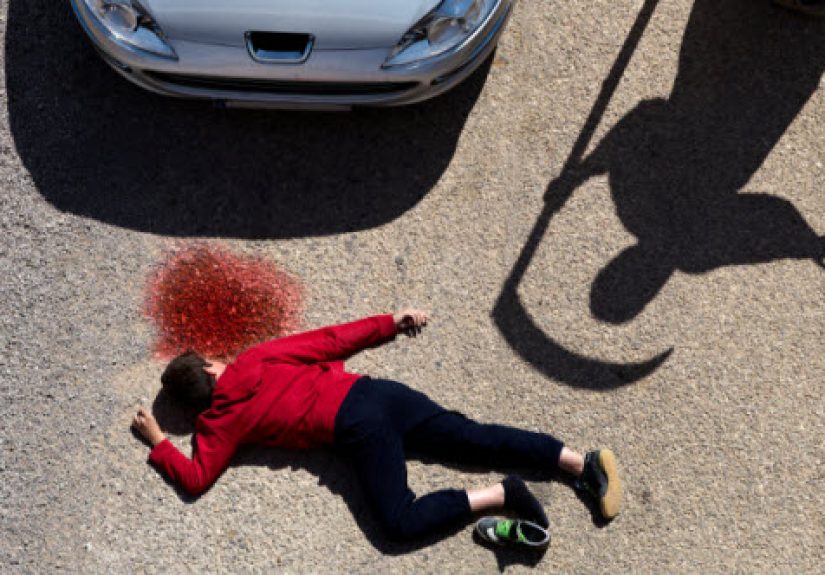
In April 2004, an 18-year-old Swedish teenager and two friends reportedly planned to film a traffic stunt near Askim, Norway. Wearing a mummy-like costume, the teenager ran onto a busy highway and lay in the road while his companions recorded him.
One driver managed to avoid him. A second vehicle arrived moments later and could not stop in time. Norwegian police reportedly believed the group had been influenced by stunt-based television, including Jackass.
The tragedy demonstrates why traffic can never serve as an entertainment prop. Drivers need time and distance to recognize a hazard, react, and brake. A costume, darkness, road curvature, or an unexpected obstacle can shrink that window to almost nothing.
4. Matt Evans and the Hood-Riding Prank
In May 2008, 18-year-old Matt Evans was close to graduating from Granite City High School in Illinois. Friends described him as an honor student and a practical joker. During an evening celebration, a friend drove toward the group while honking and shouting.
Evans jumped onto the approaching car’s hood. When it appeared that he was losing his grip, the driver panicked and applied the brakes. Evans was thrown onto the pavement and suffered a catastrophic head injury. He died the next night.
No malicious plan was required. The participants apparently expected a brief joke, not a fatal emergency. That is precisely what makes vehicle stunts so dangerous: the outcome can depend on one startled reaction from an inexperienced driver.
5. Stephen Paul Rauen and a Moving Pickup
Fifteen-year-old Stephen Paul Rauen died in Albuquerque, New Mexico, in December 2002 after jumping onto the hood of a moving pickup truck driven by a teenage friend. When the driver braked, Rauen was thrown onto the roadway and then struck by the vehicle.
Albuquerque police said the teenagers were mimicking what they believed they had seen in Jackass: The Movie. Representatives connected to the film disputed whether the movie contained a matching stunt. Police also received information suggesting that the group had attempted similar behavior before.
Repeated success can create a dangerous illusion of competence. Surviving a reckless act once does not prove that it is safe; it merely means the worst variable did not appear on that attempt.
6. Aaron Brown and the Railroad-Track Jumps
In December 2002, six Indiana teenagers drove a van repeatedly over railroad tracks at an estimated 70 miles per hour. Thirteen-year-old Aaron Brown was among the passengers.
After several passes, the teenage driver lost control and crashed into a parked van. The vehicle traveled hundreds of feet during the crash. Five occupants were injured, and Aaron was killed.
Investigators reported finding a camcorder, previously recorded stunt footage, and material related to Jackass inside the van. The driver admitted speeding over the tracks and reportedly said the group had nearly struck a bicyclist during an earlier pass.
The warning signs were already flashing brighter than a casino marquee. A near collision should have ended the activity immediately. Instead, repetition allowed excitement and group momentum to overpower the evidence that someone was about to be hurt.
7. Cameron Bieberle and the Shopping Cart
In March 2008, 18-year-old Cameron Bieberle climbed into a shopping cart in a Florida parking lot and held onto an SUV driven by his friend Michael Smith. When the cart struck a speed bump, Bieberle was thrown onto the pavement and died at the scene.
Investigators learned that the friends had previously recorded shopping-cart stunts. Bieberle’s father believed Jackass had inspired his son’s behavior. Smith was later convicted of vehicular homicide and received a prison sentence, probation, and permanent revocation of his driver’s license.
Shopping carts are not vehicles. They lack brakes, restraints, steering systems, suspension, and protection for their occupants. Their small wheels can stop abruptly on obstacles that a car barely notices.
8. Adam Page and the Driverless Car
In September 2005, 18-year-old Adam Page attempted a prearranged stunt in Vermont with several friends. Page drove a Subaru at approximately 30 miles per hour, opened the door, and jumped from the moving car while its cruise control remained engaged.
A friend in the passenger seat grabbed the steering wheel, and at least two cameras were reportedly recording. Page was found unresponsive on the roadway and died while being transported for medical care.
The plan treated cruise control as if it were an autonomous driving system. It is not. Cruise control maintains speed; it does not steer, identify hazards, protect someone jumping from the vehicle, or summon common sense when the occupants have temporarily misplaced theirs.
9. Bobbi MacKinnon and the Truck-Powered Merry-Go-Round
In January 2004, 16-year-old Roberta “Bobbi” MacKinnon met friends at a park in Northern California. The teenagers attached a rope between a playground merry-go-round and a pickup truck, intending to spin the equipment at high speed.
Bobbi was thrown from the merry-go-round and landed in the street. Emergency efforts could not save her. She had been an honor student and a high-school junior.
Her death closely resembled the later carousel tragedy in Germany. Both involved a vehicle applying enormous force to playground equipment never designed for motorized use. Both transformed a familiar place associated with childhood fun into the scene of a preventable death.
10. Darnell Mitchell and the Ballistic-Vest Video
This incident is frequently included in lists about fatal Jackass imitation, although the participants were adults rather than teenagers. In 2014, Darnell Mitchell and longtime friend Mark Ramiro spent a night drinking and using drugs in Baltimore before filming a series of dares.
Mitchell put on a ballistic vest and asked Ramiro to shoot him. The bullet struck above the area protected by the vest, fatally wounding Mitchell. Ramiro later pleaded guilty to second-degree murder and received a prison sentence.
A ballistic vest is not a magic shield. Its protection depends on its rating, condition, fit, coverage, ammunition, angle of impact, and other variables. More fundamentally, no consumer safety device turns being deliberately shot into a reasonable experiment.
Why Young People Attempt Dangerous Copycat Stunts
Peer Approval Changes the Calculation
Many of these incidents involved several friends rather than one person acting alone. A group can provide encouragement, an audience, a camera operator, and a convenient way for everyone to assume that someone else will object if the idea is truly dangerous.
Research on teenage driving supports the concern. U.S. road-safety agencies have found that young drivers are more likely to engage in risky behavior when teenage passengers are present. Each extra passenger can add distraction, social pressure, and another voice saying, “Come on, it will be funny.”
The Camera Creates a False Sense of Purpose
Without a camera, lying in traffic or jumping from a moving car is obviously senseless. Add a camera, and participants may begin describing the same behavior as “content,” a “challenge,” or a route to fame. The activity has not become safer. It has merely acquired a title.
The desire to capture an impressive clip can also encourage repetition. A participant may attempt a stunt again because the first camera angle was poor, nobody reacted dramatically enough, or the result looked less exciting than expected.
Professional Footage Conceals Professional Controls
Even experienced Jackass performers suffered concussions, fractures, burns, infections, and other serious injuries. Their survival should never be interpreted as proof that the stunts were manageable for amateurs.
Commercial productions may use medics, stunt coordinators, protective equipment, controlled locations, rehearsals, emergency plans, specialized camera positions, and editing. Viewers see the finished joke, not every precaution or rejected concept. Homemade imitators often remove the professional controls while keeping the danger.
Experience-Based Lessons from Jackass Copycat Tragedies
The most useful lesson from these cases is not simply “teenagers do foolish things.” Adults do foolish things too, as several incidents demonstrate. The deeper lesson is that dangerous group behavior develops through a recognizable sequenceand that sequence can be interrupted.
It often begins with boredom and a suggestion. Someone proposes an activity that sounds absurd enough to be entertaining but familiar enough to seem survivable. A second person laughs. A third takes out a phone. Once filming begins, backing out can feel embarrassing because the volunteer believes an audience is waiting for a performance.
The safest intervention is blunt and early: stop the vehicle, put away the fuel, unload the weapon, leave the tracks, or step away from the ledge. Do not debate the physics while the stunt is already in motion. Distance should come before discussion.
A useful personal rule is that vehicles, firearms, fire, electricity, heights, traffic, trains, water hazards, intoxicants, and improvised restraints are automatic deal breakers for entertainment stunts. Combining two or more of those elements should produce an immediate refusal, not a more exciting thumbnail.
Friends can also create a face-saving exit. Instead of insulting the person who suggested the stunt, someone can say, “This is not worth a hospital visit,” “We cannot control the traffic,” or “Let’s film something else.” Offering an alternative matters because it allows the group to preserve the social goalhaving fun or making a videowithout preserving the danger.
Parents and educators should discuss specific scenarios rather than relying only on general warnings. “Be careful online” is vague. “Never ride outside a moving vehicle, tow a person or cart, imitate a fire stunt, or participate in a challenge involving unconsciousness” is much clearer.
It is also important to separate courage from compliance. Refusing a dare does not make someone weak. In a group moving toward a reckless act, the person willing to say no may be the only one demonstrating independent judgment.
When an accident occurs, friends should call emergency services immediately and provide accurate information. Several historical copycat cases involved confusion, delayed explanations, or fabricated stories. Fear of punishment is understandable, but misleading responders can waste valuable time and interfere with treatment.
Finally, spectators share responsibility. Holding the camera, driving the vehicle, supplying materials, or cheering from the side can contribute to the stunt’s continuation. “I was only filming” is not a safety plan and may not be a legal defense. A person behind the camera is still part of the event.
Good comedy creates a story everyone can laugh about later. A successful prank does not require an ambulance, a criminal trial, or an empty chair at graduation. The best stunt is sometimes the one abandoned before anyone presses record.
Conclusion
The deaths associated with Jackass-style imitation were not inevitable consequences of television, nor can every tragedy be blamed on one franchise. Millions watched the same programs without attempting dangerous stunts. Personal choice, peer dynamics, alcohol or drugs, driving inexperience, and the pursuit of attention all played roles in different cases.
Nevertheless, the pattern is impossible to ignore. Moving vehicles appeared repeatedly. Cameras and friends were often present. Familiar objects were pushed far beyond their intended use. Participants mistook previous survival, fictional confidence, or edited entertainment for evidence of safety.
There is no shame in enjoying outrageous comedy. The line is crossed when spectators treat a professionally produced spectacle as a set of instructions. Watch the stunt. Laugh at the stunt. Then leave the stunt on the screen, where the pause button works and gravity cannot reach you.




 Close
Close