
Table of Contents >> Show >> Hide
There are vacation rentals, and then there are places that make you reconsider every throw pillow decision you have ever made. A Scottish stone house with a minimalist soul belongs firmly in the second category. This is not the kind of property that tries to win you over with gimmicks, neon signs, or the decorative equivalent of jazz hands. Instead, it does something far more effective: it stays quiet, lets the landscape speak first, and uses design with the restraint of someone who knows they do not need to shout to be interesting.
Set against the wild drama of the Scottish Highlands, this restored stone retreat feels like a masterclass in edited living. Its old masonry, spare palette, carefully fitted oak interiors, and oversized views create a mood that is both grounded and transporting. It is historic without being precious, contemporary without being cold, and luxurious without acting like it deserves a round of applause for having nice faucets. In short, it is the rare house that understands a truth many modern renovations miss: the point is not to outshine the setting. The point is to frame it beautifully.
For travelers, design lovers, and anyone suspicious of clutter with a deep and personal conviction, this house offers more than a place to sleep. It offers a way of being. You arrive for the stone walls and Highland views, and stay for the atmosphere of calm competence. Every detail seems to whisper, “Relax. The house has this handled.”
The House That Keeps Its Cool
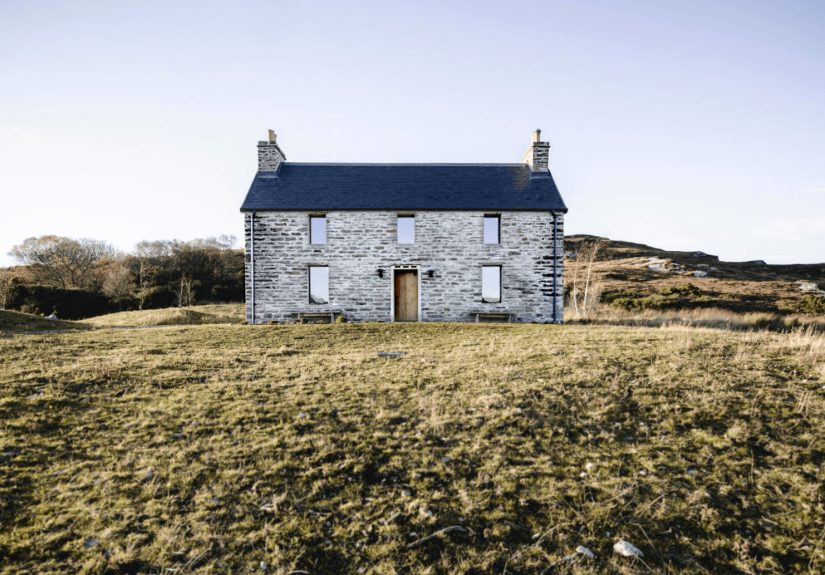
The property most closely associated with this story is Kyle House in Sutherland, a restored stone dwelling at the southern end of the Kyle of Tongue. The house sits in a breathtakingly exposed setting, with expansive views that make ordinary windows seem like a missed opportunity. Originally dating to the early-to-mid nineteenth century and believed to have been built using salvaged stone from a nearby Iron Age broch, the structure carries that special kind of weight only old buildings possess: the sense that weather, labor, and time have all left fingerprints on it.
What makes the renovation so compelling is that the exterior remains humble and rooted in Scottish building tradition, while the interior has been reimagined with near-monastic clarity. The old shell was preserved and reinforced with traditional materials, while the inside was transformed into a sequence of finely detailed oak volumes that organize the rooms without overcomplicating them. That move alone tells you everything about the project’s priorities. This is not a makeover built on cosmetic panic. It is a thoughtful act of editing.
The result is a house that reads as deeply Scottish from the outside and quietly international on the inside. There is a Scandinavian influence in the restraint, the joinery, the pale timber, and the confidence to let emptiness do some of the design work. But it never feels imported or fake. The minimalism here is not a trend costume. It is a response to place.
Why Minimalism Works So Well in a Stone House
Minimalism gets a bad reputation because too many people confuse it with sterility. A blank white room and one heroic chair are not automatically sophisticated. Sometimes they are just evidence that somebody ran out of ideas halfway through the mood board. Warm minimalism, however, is a different animal. It uses fewer elements, but better ones: tactile wood, natural stone, muted colors, soft textiles, hidden storage, and furniture that feels chosen rather than accumulated in a panic over free shipping.
That is exactly why a Scottish stone house is such fertile ground for this approach. The architecture already brings depth, age, texture, and visual gravity. Thick walls, deep-set windows, lime-plastered surfaces, and weathered masonry do not need much help. In fact, they are often at their best when the interior stops performing and starts listening. A restrained design scheme allows the shell to be the main character, while timber, metal, linen, and glass step in as excellent supporting cast members.
At Kyle House, this philosophy shows up in all the smartest ways. Oak counters and floor-to-ceiling cabinetry keep the kitchen composed instead of noisy. Pocket doors allow rooms to open and close with flexibility, preserving privacy without interrupting the flow. Built-in seating at the windows turns the landscape into live theater. Heated black stone floors add physical comfort while staying visually quiet. That is the magic trick: warmth without fuss, luxury without sparkle overload.
Less Stuff, More Sensation
The best minimalist interiors are not empty; they are legible. You understand them immediately. They calm the eye because they are not competing with themselves. In a stone house, this matters even more. The bones are already rich. The view is already dramatic. The weather outside is already doing Oscar-worthy mood lighting. A crowded interior would only muddy the experience.
Here, every choice seems designed to heighten sensation rather than distract from it. You notice the grain of the oak. You notice the way daylight slides across plaster. You notice the thickness of a window reveal and the cozy authority of a wool throw near the stove. This is a house that proves minimalism is not about deprivation. It is about concentration.
A Minimalist Soul, Not a Minimal Personality
One reason this house feels memorable is that it avoids the biggest trap of pared-down interiors: blandness. Minimalist spaces fail when they become so committed to “clean” that they lose any sense of life. But this house understands the difference between calm and boredom. Its palette may be restrained, but its mood is rich. Stone, oak, velvet, metal, glass, and soft gray tones create depth through contrast, not clutter.
There is also something wonderfully confident about a house that does not try to explain itself too much. It does not need a feature wall screaming for attention. It does not need twenty-seven decorative objects lined up like they are waiting for a group photo. Instead, it trusts proportion, materiality, and light. That trust is what gives the place its soul.
Even the luxury feels unusually intelligent. Instead of “look at me” extravagance, you get thoughtful comforts: a soaking tub, a walk-in shower, a log-burning stove, generous storage, and a bedroom that feels deliberately cocooning rather than aggressively staged. It is the difference between a house designed for Instagram and a house designed for actual human nervous systems.
The Landscape Is Half the Design
The house would still be good if it were moved somewhere else. But it would not be this good. Its setting matters too much. North Sutherland delivers the kind of scenery that makes even cynical people go temporarily silent: peatlands, lochs, moors, mountains, white-sand beaches, and weather that changes the whole emotional tone of a room in twenty minutes flat.
The wider region includes the Flow Country, now recognized by UNESCO for its globally significant blanket bog landscape. That adds a deeper layer to the experience of staying here. You are not just checking into a pretty rental. You are entering a landscape with ecological importance, unusual geological character, and a sense of time that dwarfs your unread emails. Suddenly, the house’s restraint makes even more sense. In a place like this, design should feel like a respectful pause, not a speech.
Large windows are especially powerful in such a setting because they turn weather, distance, and terrain into living components of the interior. A gray morning becomes part of the palette. Low cloud becomes atmosphere. Evening light becomes décor with no assembly required. In many homes, windows are holes in the wall. Here, they are framing devices for solitude.
Why It Works So Well as a Let
“Available for let” is a very British phrase, and for American readers it basically means “yes, you can rent this beauty, and no, you do not need to inherit an estate first.” That matters, because houses like this are not just aspirational eye candy. They are livable design case studies.
As a rental, the house is especially clever because it leans into exactly what travelers increasingly want: privacy, authenticity, nature, and design that feels restorative rather than performative. It is configured for two guests, which keeps the whole place intimate and focused. Self-catering adds freedom, but the experience still feels elevated because the architecture does so much of the hospitality work. You do not need a giant footprint when the proportions are right and every room earns its keep.
This also reflects a broader shift in high-end travel. The most appealing places are often the ones that offer immersion over spectacle. People are not only booking square footage anymore. They are booking mood, silence, craftsmanship, and the right to pretend for three days that they are the kind of person who wakes up cheerfully to mist rolling over a Highland loch.
Design Lessons Worth Stealing
1. Let original materials do the talking
If you have stone walls, exposed structure, or deeply recessed windows, do not smother them under decorative noise. Edit around them. Historic character is not a problem to solve; it is free production value.
2. Use warm minimalism, not icy minimalism
The difference is everything. Bring in wood, stone, linen, wool, matte finishes, and earthy neutrals. Minimal does not have to mean emotionally unavailable.
3. Make the view part of the floor plan
Arrange seating, dining areas, and even bathing moments around what is outside. When the landscape is that strong, decorating can become a matter of simply getting out of its way.
4. Hide the practical stuff
Flush cabinetry, integrated storage, and built-ins are not boring. They are the behind-the-scenes crew that lets a room look effortless on opening night.
5. Give every room a clear purpose
One reason this house feels calm is that the plan is rational. Sleeping, bathing, eating, reading, and resting all have their place. Good design is often just good editing with better materials.
Final Thoughts
A Scottish stone house with a minimalist soul succeeds because it understands restraint as a form of respect. Respect for the landscape, respect for old materials, respect for the intelligence of the guest, and respect for the idea that comfort can be quiet. It does not fight its setting. It collaborates with it.
That is why the house feels so modern without losing its history. It is not trying to turn a Highland stone structure into a glossy showroom. It is trying to create a place where architecture, weather, and daily life can exist in unusually satisfying balance. The stone walls bring memory. The oak interiors bring order. The windows bring the wild in. And the overall effect is almost unfairly attractive.
For anyone who loves design that is subtle, intelligent, and deeply rooted in place, this house is a reminder that the most unforgettable spaces are often the ones with the lowest pulse rate. They do not clamor for your attention. They hold it.
The Experience of Staying in a Scottish Stone House Like This
Staying in a house like this is not dramatic in the usual luxury-travel sense. Nobody arrives with a silver tray. There is no lobby fragrance engineered to smell like “wealth and citrus.” And that is exactly the point. The experience begins with distance, quiet, and a slow recalibration of your senses. As the road narrows and the landscape opens out, the modern world begins to feel faintly ridiculous. Your phone loses enthusiasm. Your shoulders drop an inch. You start to understand why a house like this should be made of stone, timber, slate, and not much else.
The first impression is often the weight of the place. A heavy door, thick walls, deep windows, the hush that old masonry creates. Stone houses have a way of making silence feel structural. Even before you unpack, there is a sense that the building is doing something gentle to your nervous system. The rooms do not rush at you. They reveal themselves in layers: oak joinery here, a framed view there, a bench that makes you want to sit before you have even taken off your coat.
Morning feels different in a house like this. You wake up to a softer kind of light, the kind filtered by weather and distance. Coffee becomes an event, not because the coffee has suddenly earned a Michelin star, but because the setting improves your attention. You notice the steam against the window. You notice the color of the moor. You notice that breakfast at a simple timber table can feel borderline poetic when the room is this calm. In ordinary life, you scroll while the kettle boils. Here, you stand still and look outside like a thoughtful character in a novel.
The middle of the day invites a different rhythm. You walk, read, cook, nap, stare, wander, repeat. That might sound suspiciously like doing nothing, but it is actually the highly advanced art of doing only what matters. A well-designed retreat gives small acts a dignity they rarely get at home. Chopping vegetables in a restrained kitchen feels meditative. Sitting by the stove with a book feels earned. Taking a bath while wind presses at the glass feels like the architectural version of a deep exhale.
Evening may be the best part. Minimalist interiors come alive at dusk because shadows, lamp glow, and firelight add depth without adding clutter. The house becomes warmer, smaller, more protective. Outside, the Highlands stretch into darkness. Inside, the materials begin to glow: oak turns honeyed, stone goes inky, metal softens, fabric looks richer. You are suddenly very grateful that nobody filled the room with unnecessary furniture. Space itself becomes part of the comfort.
And then there is the emotional aftereffect, which is the real luxury. A stay in a house like this leaves you with a sharper idea of what home can feel like when it is stripped back to essentials: shelter, warmth, usefulness, beauty, view, rest. Not emptiness. Not deprivation. Just enough, done exceptionally well. You come back from places like this slightly suspicious of your own clutter, slightly more aware of light, and very tempted to remove at least three decorative objects that have been freeloading on your shelf since 2021.
That is the quiet power of a Scottish stone house with a minimalist soul. It does not merely host you. It edits you, gently. It reminds you that beauty can be sturdy, that comfort can be simple, and that sometimes the most memorable travel experience is not about seeing more things. It is about feeling more present inside fewer, better ones.







 Close
Close