Table of Contents >> Show >> Hide
- What Is Acoustic Levitation?
- Where the “Twist” Comes In
- How Acoustic Levitation Actually Balances Gravity
- Why Scientists Care About Floating Droplets
- Acoustic Levitation in Biology and Medicine
- From Levitation to Contactless Manufacturing
- The Challenges: Why We Are Not Floating Sandwiches Yet
- Real-World Examples of Acoustic Levitation With a Twist
- Experience Section: What Acoustic Levitation Feels Like Up Close
- Conclusion
Imagine placing a tiny bead, water droplet, or speck of foam into midair and watching it hover as if gravity forgot to clock in. Now imagine that same object not only floating, but spinning, shifting, clustering, or sliding through space under the command of invisible sound fields. That is the delightful weirdness of acoustic levitation with a twist: a branch of physics where ultrasound does the heavy lifting, and carefully shaped waves add the drama.
Acoustic levitation is not stage magic, although it absolutely looks like the kind of trick a wizard would demonstrate before refusing to explain the wand warranty. It is a real scientific technique that uses sound pressure to trap small objects without touching them. The “twist” comes from more advanced wave patterns, including acoustic vortices, phased arrays, and holographic sound fields that can rotate, steer, or manipulate matter in three dimensions.
For scientists, this matters because touching a sample can contaminate it, deform it, cool it, heat it, or generally ruin the day. Containerless handling opens doors in chemistry, materials science, pharmaceutical research, biology, microfluidics, and even future manufacturing. For the rest of us, it is a jaw-dropping reminder that sound is not just something we hear. Sound is mechanical energy moving through matter, and when it is organized with precision, it can push back against gravity itself.
What Is Acoustic Levitation?
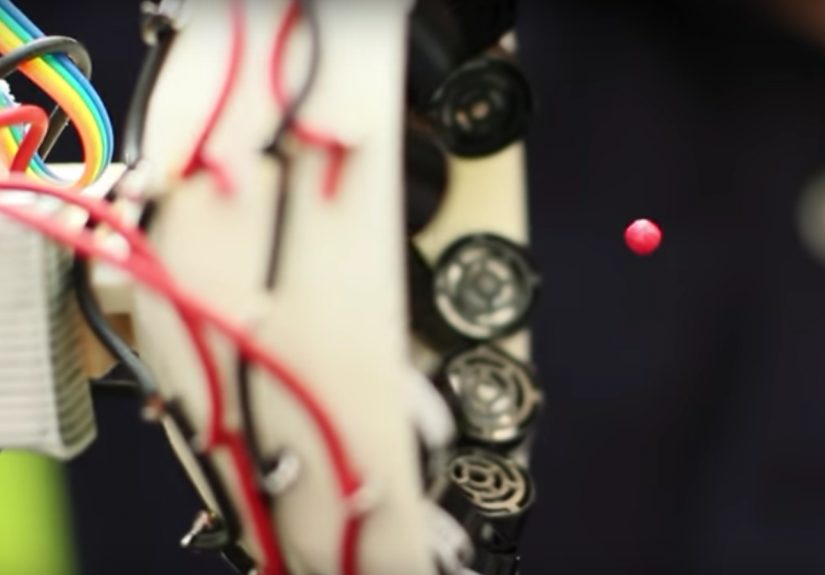
Acoustic levitation is the use of sound waves, usually ultrasound, to suspend small objects in air or liquid. The most familiar setup uses a transducer and a reflector facing each other. The transducer emits high-frequency sound, and the reflector bounces it back. When the outgoing and returning waves overlap, they form a standing wave, a repeating pattern of high-pressure and low-pressure zones.
Objects can become trapped at stable points in that pattern. In many demonstrations, tiny foam balls or droplets gather at pressure nodes, where the acoustic forces balance gravity. The object hangs there, not because gravity has vanished, but because sound pressure is pushing it into a tiny invisible parking spot.
The Simple Version: Sound Makes a Trap
A useful way to picture acoustic levitation is to imagine a stack of invisible shelves made of vibration. The shelves are not solid, of course, but pressure gradients in the sound field can act like tiny force barriers. When a small object tries to move away, the acoustic radiation force nudges it back toward the stable zone.
Most acoustic levitators work with objects smaller than the wavelength of the sound or comparable to it. That is why you often see beads, droplets, grains, seeds, or lightweight foam pieces instead of floating coffee mugs. As much as the internet deserves a levitating burrito, physics remains annoyingly strict.
Why Ultrasound Is Usually Used
Ultrasound refers to sound above the range of typical human hearing. Many acoustic levitation systems operate around tens of kilohertz or higher. At these frequencies, the wavelength is short enough to create small, controlled trapping zones. The sound may be inaudible, but it is still physical energy traveling through air or liquid.
That point is important: acoustic levitation does not rely on magnetism, static electricity, or air jets. It can work with a wide variety of materials because it depends on the interaction between sound waves and the object’s size, density, shape, and acoustic properties. This material flexibility is one reason researchers are so interested in it.
Where the “Twist” Comes In
Traditional acoustic levitation is already impressive, but it is often limited to holding an object in a fixed point or moving it along a simple axis. Acoustic levitation with a twist adds more control. Researchers shape the sound field so that it can grip, turn, guide, or reorient objects.
The twist can be literal. Acoustic vortices are swirling sound fields that carry orbital angular momentum. In plain English, the wavefront spirals like a corkscrew. When a small object is trapped in such a field, the sound can transfer torque to it and make it rotate. It is the acoustic equivalent of giving matter a gentle invisible spin, except the “hand” is a carefully engineered pressure pattern.
Acoustic Vortices: Sound Waves With a Corkscrew Personality
An acoustic vortex has a phase structure that winds around a central axis. Instead of the wavefront moving forward like a flat marching band, it twists as it propagates. This creates a region of low intensity near the center and a ring-like structure around it, making the field useful for trapping and rotating particles.
When the sound field carries orbital angular momentum, it can transfer some of that angular momentum to an object. A trapped bead, droplet, or disk may begin to spin. The rotation speed can often be influenced by the strength of the sound field, the object’s shape, and the properties of the surrounding medium.
Phased Arrays: Many Tiny Speakers, One Smart Sound Field
Another major breakthrough comes from ultrasonic phased arrays. Instead of using one sound source and a reflector, researchers use many small transducers, each controlled individually. By adjusting timing, phase, and amplitude, the system can sculpt a sound field in midair.
This is similar in spirit to how pixels create an image on a screen. One pixel is not very exciting. Thousands of pixels arranged correctly can show a movie, a spreadsheet, or a cat wearing sunglasses. Likewise, one ultrasonic emitter can make sound. Dozens or hundreds of emitters, coordinated precisely, can create acoustic traps, cages, tweezers, and twisting fields.
How Acoustic Levitation Actually Balances Gravity
At the center of acoustic levitation is acoustic radiation pressure. Sound waves carry energy and momentum. When those waves interact with an object, they exert forces. If the upward or stabilizing force from the sound field balances the downward pull of gravity, the object can hover.
The balance is delicate. If the sound pressure is too weak, the object falls. If the field is unstable, the object wiggles, escapes, or gets flung aside like a popcorn kernel with ambitions. If the object is too heavy, too large, or poorly matched to the wave pattern, levitation becomes difficult or impossible with the available setup.
Standing Waves vs. Traveling Waves
Standing-wave levitation creates fixed pressure nodes and antinodes. This method is reliable and widely used in laboratory demonstrations. However, it can be limited when researchers want dynamic motion, rotation, or free-space transport.
Traveling waves and structured beams, including vortex beams, offer more advanced manipulation. They can push, pull, trap, rotate, or move objects along designed paths. This is where acoustic levitation begins to look less like a physics trick and more like a contactless robotic gripper made of sound.
Why Scientists Care About Floating Droplets
Floating a droplet may look cute, but it is scientifically powerful. A droplet held in midair can be studied without touching a container wall. That matters because container walls can trigger crystallization, absorb chemicals, introduce contamination, or interfere with measurements.
In pharmaceutical research, acoustic levitation has been used to study liquid droplets and amorphous materials. Some drug molecules dissolve poorly when they form crystals. By using containerless methods, researchers can investigate forms of materials that may improve solubility and performance. The droplet floats, the equipment analyzes it, and no glass vial gets invited to meddle in the chemistry.
Containerless Chemistry
Acoustic levitation can turn a suspended droplet into a tiny reaction vessel. Scientists can merge droplets, evaporate solvents, observe crystallization, or analyze chemical changes. Since the sample is not sitting on a surface, researchers can study processes that might otherwise be distorted by contact.
This has obvious appeal in analytical chemistry. A levitated droplet can be probed by lasers, X-rays, spectroscopy, or mass spectrometry. It can also be heated, cooled, mixed, or concentrated. In other words, the droplet becomes a miniature laboratory with no countertop.
Materials Science Without the Messy Container
Materials scientists also benefit from levitation. When studying molten materials, glasses, gels, or sensitive compounds, the container can become a problem. Acoustic levitation can help researchers observe samples in a cleaner state and examine how they transform as they dry, cool, or react.
NASA and other research organizations have long been interested in containerless processing, especially for microgravity research. In space or simulated microgravity conditions, levitation can help researchers understand droplets, melts, and materials without the complications introduced by gravity-driven settling or container contact.
Acoustic Levitation in Biology and Medicine
Biology is messy, delicate, and famously unwilling to behave just because a lab notebook asked nicely. Acoustic levitation offers an intriguing way to handle biological samples with minimal contact. Researchers have explored its potential for cell studies, droplets containing biomolecules, microgravity simulation, and biological reaction environments.
In some experiments, acoustic fields have been investigated as platforms for studying embryos, cells, and biological materials. The appeal is clear: if a sample can be positioned without tweezers, surfaces, or channels, researchers may gain a cleaner way to observe development, aggregation, or chemical reactions.
Acoustic Tweezers and Tiny Targets
Acoustic tweezers use sound fields to trap and move tiny objects, including particles and cells. Compared with optical tweezers, acoustic methods can exert stronger forces on larger objects and may work in situations where light-based methods are less practical. They are especially interesting for microfluidics, where controlling tiny volumes of liquid and microscopic particles is a daily challenge.
The twist matters here, too. Vortex-based acoustic tweezers can rotate objects, adjust orientation, or create more flexible trapping fields. In biological contexts, that could help researchers position samples for imaging, sorting, assembly, or analysis.
From Levitation to Contactless Manufacturing
One of the most exciting ideas in acoustic levitation is contactless assembly. If sound can hold and move small parts, it may be able to help build structures without physical tools touching the components. Researchers have demonstrated systems that can manipulate beads, droplets, and even elongated parts such as small sticks.
That does not mean tomorrow’s factories will be run by invisible choirs humming bolts into place. But it does suggest a future where sound fields could assist in handling fragile, sterile, sticky, or contamination-sensitive materials. Think micro-assembly, electronics, biomedical devices, or specialized manufacturing in environments where contact is a problem.
Why Contactless Handling Is So Useful
Physical grippers are excellent for many tasks, but they have limitations. They can scratch surfaces, spread contamination, crush delicate parts, or fail with awkward shapes. Acoustic fields offer a different approach: hold the object by surrounding it with pressure.
For small-scale manufacturing, that could be a major advantage. A sound field can potentially move an item, rotate it, align it, and release it without mechanical contact. Add computer control, sensors, and feedback, and acoustic levitation starts to resemble a soft robotic system made from wave physics.
The Challenges: Why We Are Not Floating Sandwiches Yet
Acoustic levitation has limits. The objects must generally be small and light. Strong sound fields can create heating, airflow, streaming effects, or instability. Liquid droplets can deform, evaporate, oscillate, or split. Biological samples may respond to acoustic stress, so careful design is essential.
There is also the challenge of precision. To trap and move an object reliably, the acoustic field must be shaped with great accuracy. Phased arrays require electronics, algorithms, calibration, and often real-time control. The more complex the movement, the more carefully the system must be tuned.
Scaling Up Is Hard
The dream of levitating large objects with sound runs into practical barriers. Larger objects require more acoustic power and larger wavelengths. High-intensity sound can become unsafe, inefficient, or disruptive. Acoustic levitation is best suited to small-scale manipulation, not replacing forklifts with subwoofers.
Still, small-scale does not mean small importance. Many of the most valuable processes in modern science happen at the scale of droplets, particles, cells, powders, films, and microcomponents. Acoustic levitation fits beautifully into that world.
Real-World Examples of Acoustic Levitation With a Twist
One classic example is the levitated droplet used in chemistry and pharmaceutical research. A tiny drop of solution is suspended between acoustic sources, then analyzed as it evaporates or changes structure. Researchers can observe how compounds form gels, glasses, or amorphous solids without a container interfering.
Another example is the acoustic tractor beam, where shaped ultrasound fields hold and move small objects using only one side of the setup. Some systems create pressure structures described as tweezers, cages, or twisters. These fields can trap particles, move them through space, or rotate them using vortex-like patterns.
A third example is acoustic vortex manipulation in liquids. Instead of floating a particle in air, researchers trap microscopic beads or particles in a fluid and use the vortex beam to spin them. This can support studies of torque, viscosity, microfluidic transport, and particle mechanics.
The “Twist” as a Design Tool
The twist is not a gimmick. Rotation is a form of control. If a particle can be turned, it can be oriented for imaging, aligned for assembly, spun for mixing, or used as a tiny probe. In fluids, rotating particles can reveal information about viscosity and flow. In manufacturing, orientation can be just as important as position.
That is why acoustic vortices are so exciting. They add a new control dimension to levitation. Instead of asking, “Can we make it float?” researchers can ask, “Can we make it float, spin, tilt, move, merge, separate, and stop exactly where we want?” That is when the science graduates from neat trick to serious technology.
Experience Section: What Acoustic Levitation Feels Like Up Close
The first time you see acoustic levitation in person, your brain may file a complaint. A tiny object hangs in midair, and there is no string, no magnet, no fan, no visible support. The equipment may look ordinary: a frame, a transducer, a reflector, perhaps an array of ultrasonic emitters. Then the object snaps into place, and suddenly the room feels like it has discovered a secret loophole in gravity.
What makes the experience memorable is not just the hovering. It is the stability. A small bead can sit calmly in an invisible pocket, as if resting on a shelf made from pressure. Move it slightly, and it may wobble back toward the node. Add another bead, and it may stack into the pattern. Put a droplet into the field, and it can flatten, tremble, or rotate depending on the acoustic conditions. It looks alive, but it is only physics being unusually theatrical.
Watching a twisted acoustic field is even stranger. A particle may begin to spin without anything touching it. The motion feels almost mischievous, like the object is responding to a command no one else can hear. In reality, the sound field contains structured momentum. The wave pattern is doing mechanical work, transferring force and torque into the trapped object.
For students, makers, and science communicators, acoustic levitation is one of the best demonstrations of invisible forces. It turns abstract ideas into something you can see instantly. Standing waves stop being textbook diagrams. Pressure nodes become real places in space. Resonance is no longer a vocabulary word; it is the reason a foam bead is hovering in front of your face like it owns the laboratory.
The experience also teaches humility. Acoustic levitation can be fussy. The object may refuse to trap. A droplet may drift. Air currents may interfere. The setup may need careful alignment. Too much power can destabilize the sample, while too little power does nothing interesting. That trial-and-error process is part of the lesson: levitation is not magic because magic would be less picky.
In a research setting, the experience becomes more serious. A levitated droplet is not merely cool; it is a sample protected from surfaces. A rotating particle is not merely fun; it is a probe of torque and fluid behavior. A phased array is not merely a gadget; it is a programmable acoustic landscape. The wonder remains, but it is paired with purpose.
That is the charm of acoustic levitation with a twist. It feels futuristic, but it is grounded in real wave physics. It looks playful, but it solves practical problems. It begins with a floating bead and ends with questions about medicine, materials, micro-robotics, and manufacturing. The technology reminds us that innovation often starts by noticing that something familiar, like sound, can behave in a completely unfamiliar way when shaped with enough imagination.
Conclusion
Acoustic levitation with a twist shows how far sound technology has moved beyond simple vibration. By shaping ultrasonic waves into standing patterns, vortices, tweezers, cages, and holographic fields, researchers can suspend and manipulate small objects without contact. That ability has serious value in chemistry, pharmaceuticals, materials science, biology, microfluidics, and future manufacturing.
The basic idea is elegant: sound carries energy and momentum, and under the right conditions, those forces can balance gravity. The advanced idea is even better: if sound fields can be programmed, twisted, and steered, they can become tools for precise manipulation. Acoustic levitation is not about making everyday objects float for fun, although the fun part is undeniable. It is about creating cleaner experiments, gentler handling systems, and new ways to control matter at small scales.
In the end, the twist is both literal and symbolic. Acoustic vortices can spin particles, but the broader twist is in how we think about sound itself. It is not merely something that passes through a room and disappears. It can lift, trap, rotate, assemble, and reveal. For a force we usually experience as noise, sound has a surprisingly elegant future.