Table of Contents >> Show >> Hide
- Meet the Irish Designer Behind the Working Girl Stool
- From Factory Floors to Co-working Spaces: A Short History of the Industrial Stool
- Reinterpreting the Workshop Classic: Inside the Working Girl Collection
- Why Industrial Stools Still Work for Modern “Working Girls”
- Styling Tips: How to Use Industrial Stools at Home
- Sustainability and Longevity in an Industrial Frame
- Design Lessons from the Working Girl Stool
- Real-World Experiences with Industrial Stools and the Working Girl Look
- Conclusion: A Humble Stool with Serious Design Credentials
- SEO Summary
Somewhere between a factory floor and a sleek co-working space, an Irish designer looked at the humble industrial stool and thought,
“You deserve better.” The result is the Working Girl collection: a family of steel-and-wood stools, benches, and chairs that feel
equally at home in a workshop, a kitchen, or a design studio full of laptop-toting “working girls” (and guys, and everyone in between).
Originally spotlighted by Remodelista, the Working Girl series by Northern Ireland–born designer David Irwin is a love letter
to the classic workshop stool, updated with clean lines, warm timber, and quietly clever details. It’s industrial design,
but ironed, pressed, and ready for its close-up: stackable for tight spaces, tough enough for high-traffic cafés, and stylish enough
to park next to your marble-topped kitchen island.
In this deep dive, we’ll unpack how Irwin reinterprets the industrial stool, why this “working” seat still makes so much sense for
modern interiors, and how you can steal the look for your own home or studiowithout turning your space into a faux factory set.
Meet the Irish Designer Behind the Working Girl Stool
David Irwin grew up in Northern Ireland and set up his studio in Newcastle upon Tyne, where he built a reputation for no-nonsense,
utility-driven furniture. Early in his career, he collaborated with British furniture brand Deadgood on a collection that would become
a signature: the Working Girl series of stools and tables inspired by the simple, hard-wearing seats found in workshops and schools.
Before the Remodelista feature, Irwin’s work had already been recognized with design awards and residencies that champion young,
innovative furniture designers. His approach is consistent: start with an archetype people already understand (in this case,
the workshop stool), then carefully strip, refine, and rebuild it until only the essential lines and details remain.
The “working girl” in the name isn’t about dated stereotypes; it’s a wink at contemporary creative workersthe designers, coders,
baristas, and makers who spend as much time perched on a stool as they do sitting at a desk. Irwin’s design is meant to keep up with
that kind of life: mobile, flexible, and unbothered by a little hustle.
From Factory Floors to Co-working Spaces: A Short History of the Industrial Stool
To understand why Irwin’s reinterpretation feels so right, it helps to look back at the original industrial stool. In early
factories and workshops, workers spent long hours on their feet, and the first stools were simple metal frames with a circular
or square seatjust enough support to keep people off the ground without getting in the way of machines and tools.
Classic designs like the early 20th-century French Nicolle stoolthree stamped metal legs and a round seatshow how industrial
furniture started to balance sturdiness with a surprising amount of elegance. These pieces were stackable, lightweight,
and easy to mass-produce, which made them ideal for factories, offices, and schools long before they became Pinterest-famous kitchen seating.
Industrial stools also quietly paved the way for ergonomic seating. Manufacturers realized that even a basic perch
could reduce fatigue and increase productivity if it was the right height and shape for the job. Over time that thinking
evolved into more sophisticated ergonomic chairs, but the original industrial stool remains an icon: minimal, honest,
and built with a clear purpose.
It’s that legacy Irwin taps into. His Working Girl pieces don’t imitate a specific vintage model; they borrow the spirit:
tough materials, efficient construction, and a silhouette that looks right at home next to metal machines or MacBooks.
Reinterpreting the Workshop Classic: Inside the Working Girl Collection
Irwin’s Working Girl pieces are refreshingly straightforward at first glancejust a simple steel frame and a wood seat
but the details are where the design quietly flexes.
Honest Materials, Subtle Refinement
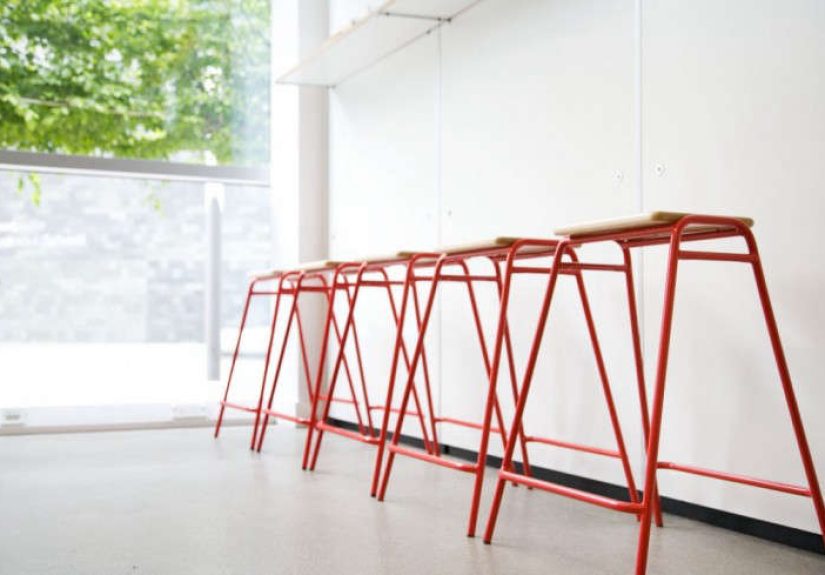
The core palette is industrial and timeless: steel for the frame and beech or oak for the seat and, in some pieces, the backrest.
The frames are available in raw steel for that “fresh from the workshop” vibe, or powder-coated in solid colors like black, white,
and signal red. The powder coat not only adds personality but also protects the metal from scuffs and everyday wear.
The lightly rounded timber seat brings warmth to the design, preventing the stools from feeling cold or overly utilitarian.
Brass fixings and neatly finished edges give each piece a tailored, almost jewelry-like touchjust enough polish to make the stools
feel considered, not purely industrial.
Proportions That Actually Work for Working
The Working Girl range comes in several heights: a bar stool for high counters and café bars, a counter or medium stool for kitchen
islands, and a low stool that doubles as an extra seat or a small side table. Matching chairs and benches share the same language:
a slim tubular frame, a wood seat, and a signature cutout detail.
That cutout is more than a styling flourish. It acts as a built-in handle so you can grab the stool and move it one-handed,
whether you’re cleaning the floor, rearranging a studio, or pulling up extra seating around a project table.
It’s a small, thoughtful gesture toward real-life use.
Stackability and Space-Savvy Design
One of the biggest wins of the Working Girl design is its ability to stack. The frame geometry allows multiple stools to nest
neatly, which is a lifesaver in cafés, schools, and small apartments where floor space is always under negotiation.
Stackability might not sound glamorous, but in hospitality and education projects, it’s everything: you can clear a room for an event,
reconfigure seating for a workshop, or stash extra stools away when they’re not needed. Irwin’s design treats this practical
requirement as an integral part of the aesthetic, not an afterthought.
Why Industrial Stools Still Work for Modern “Working Girls”
The phrase “industrial stool” might make you think of drafty warehouses, but in 2025 it’s just as likely to live in a sunlit kitchen
or a co-working lounge. Irwin’s reinterpretation makes sense precisely because our lives have gotten more flexible and fluid:
we work at kitchen counters, answer emails at café bars, and brainstorm around high tables in open-plan offices.
A good industrial stool fits all of that. It’s easy to slide in and out of, it doesn’t visually clutter a room, and it encourages
short, active perchingperfect for quick catch-ups, laptop sprints, or morning coffee rituals. When the stool is well-designed,
you get comfort without committing to full-on armchair lounging.
Small Apartments, Big Personality
For city apartments with limited square footage, a bar or counter-height Working Girl stool can double as dining chair, extra guest seating,
and impromptu side table. The open base keeps the floor feeling clear, which visually enlarges a small space.
Choose a raw steel frame with a pale wood seat for a more understated, Scandi-industrial vibe, or go for a bright powder-coated red
if your kitchen needs a little caffeine jolt even before the coffee kicks in.
Studios, Cafés, and Co-working Spaces
In commercial settings, the same qualities scale up. Stackable, durable stools can live at a bar, flank a high meeting table,
or serve as flexible overflow seating for events. Designers and operators appreciate pieces that stand up to heavy use without
feeling like anonymous contract furniture, and Irwin’s stools hit that sweet spot: tough enough for the job, but with a recognizable,
characterful silhouette.
Styling Tips: How to Use Industrial Stools at Home
So how do you bring a Working Girl–inspired look into your own home without turning it into a themed “factory chic” restaurant?
The key is balancemixing the crisp lines of industrial stools with softer materials and textures elsewhere.
1. Contrast with Warm Materials
If your stools lean toward cool metal (black or raw steel frames), offset them with warm surfaces: butcher-block counters,
oak floors, linen seat cushions, or even a textured wool runner under the island. The wood seat already helps, but adding one or two
additional natural textures keeps the space inviting, not clinical.
2. Use Color Strategically
Powder-coated frames in red, white, or black can act as exclamation points in a neutral kitchen. In a white, minimalist space,
a run of red stools instantly becomes a focal line. In a darker, moodier kitchen, white or raw steel keeps things light and airy.
If you’re mixing multiple colors, keep the palette tighttwo related tones at mostso it feels intentional rather than random.
3. Mind the Proportions
A design-forward stool can look lost next to a massive, traditional island. Make sure the scale of the stool matches the scale of your
surfaces: slender stools look best with equally streamlined counters, while chunkier islands can handle slightly larger, more substantial
frames. As a rule of thumb, leave about 10–12 inches of legroom between the top of the seat and the underside of your counter,
and 6 inches between stools so people can actually move.
4. Mix, Don’t Match Everything
You don’t have to match your stools to your dining chairs. In fact, pairing industrial stools with upholstered dining chairs or a wooden
bench can make your dining area feel layered and collected over time. The trick is to repeat at least one elementwood tone, metal finish,
or basic silhouetteso the pieces still feel related.
Sustainability and Longevity in an Industrial Frame
Another quiet strength of the Working Girl concept is how sustainable it can be when treated well. Steel and solid wood are
repairable, refinishable, and recyclable. Unlike trend-driven plastic seating, a well-made industrial stool can be sanded, re-coated,
or re-powder-coated instead of replaced.
The design also resists fashion fatigue. There’s nothing overly ornamental or “of the moment”; the lines are simple enough to age well,
the way classic school chairs and lab stools still look right decades later. You can change everything around thempaint colors,
backsplashes, even the kitchen layoutand the stools will keep working.
In other words, you’re not just buying a seat. You’re buying a long-term background player for your home’s story.
Design Lessons from the Working Girl Stool
You don’t need to be a furniture designer to steal a few ideas from Irwin’s playbook. The Working Girl collection quietly teaches
some solid design lessons:
- Edit ruthlessly. Start with the function, then remove every extra flourish that doesn’t earn its keep.
- Use honest materials. Let metal look like metal and wood look like wood; don’t fake what you can celebrate.
- Make details do double duty. The seat cutout is both a visual signature and a practical handle.
- Think in families. Designing a stool, chair, bench, and table as a system gives interiors visual continuity.
Whether you’re sketching your own DIY stool or just choosing seating for a renovation, these principles help you spot pieces that
will still feel right long after the latest micro-trend has scrolled past.
Real-World Experiences with Industrial Stools and the Working Girl Look
It’s one thing to admire a design in photos; it’s another to live with it. To understand how a reinterpretation like the Working Girl
stool behaves off the page, imagine a few real-life scenarios where this kind of piece shines.
In a Creative Studio
Picture a small branding agency tucked into a converted warehouse. The team uses a single long high table for everything:
morning check-ins, laptop work, lunch, mood-board sessions, and occasional birthday cakes with questionable candles.
Stackable industrial stools line one side of the table during the day, then get moved and regrouped as the room flips from “meeting”
to “event” mode.
Here, Working Girl–style stools make total sense. The steel frames shrug off bag scuffs and shoe marks, and the wood seats only look
better as they pick up a few small dings. The cutout handles make it easy to reshuffle the room without wrestling furniture.
In a Compact City Kitchen
Now jump to a narrow city apartment, where the kitchen island is both dining room and home office. Two counter-height industrial stools
tuck neatly under the overhang, maintaining a clean sightline from entryway to balcony. In the morning, they’re coffee perches;
at lunch they’re Zoom-call thrones; in the evening they become dinner seating for two.
Because the frames are slim, the stools don’t visually overwhelm the space. A powder-coated black finish echoes the cabinet hardware,
while the oak seats pick up the tone of the floorboards. The whole setup feels cohesive without being too matchy-matchy.
In a Neighborhood Café
In a busy café, furniture has to deal with spills, constant traffic, and the occasional wobbly laptop. Working Girl–style stools
at the front window bar let customers people-watch while they work. The staff loves them because they’re light, tough,
and easy to stack after closing. Customers love them because the footrest sits at that Goldilocks height where your legs feel supported
but not cramped.
Industrial stools also help the café keep a consistent visual language: metal frames echo the espresso machine and shelving,
while the wood seats soften all the stainless steel. It’s an easy, relatively affordable way to give the space a “designed on purpose”
feeling without commissioning fully custom furniture.
In a Hybrid Home Office
Finally, think about a home office that doubles as a guest room. A high table along one wall serves as a drop zone for mail,
a standing desk, and a crafting station. A low industrial stool slides underneath when not needed and pops out on demand.
When guests arrive, the stool shifts to the side of the bed as a nightstand, holding books and a phone instead of a laptop and mug.
This is where the adaptability of an industrial stool really shines. It’s not locked into one role; you can rotate it through multiple
jobs as your life changesproject by project, year by year.
Taken together, these scenarios show why Irwin’s reinterpretation resonates. It respects the history of the industrial stool
while acknowledging how people actually live and work now: fluidly, in spaces that work harder than ever.
Conclusion: A Humble Stool with Serious Design Credentials
An industrial stool may not seem like a big design statement, but David Irwin’s Working Girl collection proves that the most modest
objects can quietly transform the way we use our spaces. By pairing honest materials with carefully tuned proportions and smart
details, he turns a factory workhorse into a flexible, good-looking seat for modern “working girls” everywhere.
Whether you’re plotting your dream kitchen, kitting out a studio, or just looking for a stool that won’t wobble, chip, or date itself
in two years, this Irish designer’s reinterpretation offers a clear lesson: invest in pieces that are simple, sturdy, and thoughtfully
made. Your future selfand your future spacewill thank you.
SEO Summary
meta_title: Irish Designer Reinterprets Industrial Stool | Working Girls
meta_description:
Discover how Irish designer David Irwin’s Working Girl stools reinvent the classic industrial stool for modern kitchens, studios, and co-working spaces.
sapo:
The industrial stool used to be the quiet kid in the corner of the workshopsolid, useful, and totally overlooked. In the hands of Irish designer
David Irwin, it gets a major glow-up. His Working Girl collection, featured by Remodelista, reimagines the classic workshop perch with slim steel
frames, warm wood seats, and clever details like stackable silhouettes and grab-and-go cutouts. The result is a family of stools, benches, and chairs
that slide effortlessly between kitchen islands, cafés, and co-working spaces. This in-depth guide explores the story behind the design,
breaks down what makes these stools so functional and durable, and shows you how to style industrial seating at homeplus real-world examples
of how Working Girl–style pieces perform in studios, city apartments, and neighborhood cafés.
keywords:
industrial stool, Working Girl stool, David Irwin furniture, Remodelista industrial design, Deadgood Working Girl collection, industrial bar stools kitchen, Irish furniture designer