Table of Contents >> Show >> Hide
Some people go diving and come back with a cool shell. Two recreational divers off Israel came back with the kind of story that makes every history buff sit bolt upright and whisper, “Excuse me, they found what?” Near the ancient harbor of Caesarea, a remarkable Roman shipwreck yielded a stunning cargo: bronze statues, rare figurines, anchors, lamps, and masses of ancient coins fused together after centuries underwater. It was the kind of discovery that turns a casual dip in the Mediterranean into a headline heard around the world.
The shipwreck, dating to the Late Roman period, was found off the coast of modern-day Israel near Caesarea National Park, a site already famous for ruins, sea views, and enough history to make your average museum gift shop blush. Archaeologists quickly realized this was no ordinary wreck. The cargo was not just valuable; it was unusually well preserved, deeply revealing, and packed with clues about Roman trade, religious imagery, recycling practices, and life along the eastern Mediterranean. In other words, this was not simply treasure. It was a time capsule wearing a dramatic bronze costume.
What Was Found in the Roman Shipwreck?
The short version: a lot. The better version: a dazzling assortment of bronze artifacts, coin hoards, and ship equipment that helps reconstruct both the vessel’s final journey and the commercial world it belonged to.
Bronze statues and figurines
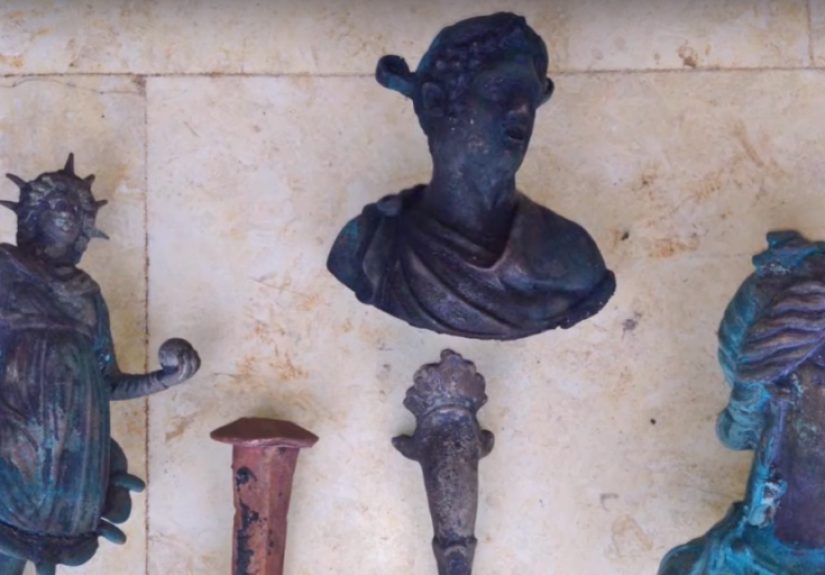
Among the most eye-catching finds were fragments of life-size bronze statues and smaller bronze pieces that appear to depict mythological and decorative subjects. Archaeologists reported a lamp featuring the Roman sun god Sol, a figurine of Luna, the moon goddess, and other finely made objects including animal-shaped pieces and decorative fittings. Bronze statues from antiquity are rare discoveries because many were melted down and reused long ago. That makes underwater finds like this one especially valuable. The sea, oddly enough, sometimes acts like the world’s most dramatic storage locker.
Coin hoards
The wreck also produced large clumps of bronze coins, some still fused in shapes that suggested they had once been stored in ceramic containers. These coins helped date the shipwreck to the fourth century C.E., and several bore the images of emperors including Constantine and Licinius. For historians, coins are more than pocket change from a dead empire. They are timestamps, political billboards, and economic fingerprints all rolled into one small metal disk.
Anchors, lamps, and ship gear
Iron anchors, bronze lamps, drinking vessels, and other maritime objects were found scattered across the seabed. Their placement suggests a desperate final moment for the crew. As the storm intensified and the ship drifted near the harbor entrance, sailors likely tried to stop it by dropping anchors. It did not work. The vessel appears to have smashed into the seawall or nearby rocks and gone down with its cargo before reaching safety.
Why Caesarea Harbor Matters So Much
To understand why this discovery matters, it helps to understand Caesarea itself. Ancient Caesarea was one of the most important port cities on the eastern Mediterranean coast. Developed by Herod the Great and later shaped by Roman power, the harbor connected trade routes, political power, and urban life. Goods, ideas, religions, and people all moved through this port. It was busy, strategic, and, by ancient standards, probably had excellent gossip.
A shipwreck at Caesarea is never just about one boat. It is about the entire world that boat moved through. The harbor linked the Levant to larger Roman networks stretching across the Mediterranean. A wreck here can reveal how materials were transported, what kinds of objects were reused, how ships approached the port, and how storms could turn commerce into catastrophe in a hurry.
This discovery also fits into a broader pattern. Israel’s coastline, especially around Caesarea, has produced multiple major underwater finds over the years, including coin hoards and other shipwreck-related artifacts. That tells archaeologists the area was not only active in antiquity but also rich in preserved seabed deposits waiting to be studied. The Mediterranean off Israel is basically an archaeology teaser trailer that keeps dropping sequels.
Why the Bronze Statues Are a Big Deal
Bronze statuary from the Roman world is rare for a simple reason: bronze was too useful to waste. In antiquity, old statues were often melted down and recast into new ones, or turned into tools, fittings, or military equipment. Marble statues survive in larger numbers because no one could conveniently toss them into a furnace and say, “Let’s make something trendier.”
That is why the Caesarea wreck is so important. The statues and fragments found there were likely on their way to be recycled when the ship sank. In one sense, the cargo was scrap. In another sense, it was elite material culture in transit, pieces of artistic and civic life being broken down and repurposed in a changing empire. Later archaeological analysis suggested the cargo may have included large amounts of scrap metal and raw materials, offering a rare window into the Roman recycling economy.
This gives the wreck unusual interpretive power. It does not just show what Romans made. It shows what Romans did with old things. That distinction matters. Archaeology often celebrates shiny first uses, but second lives can be just as revealing. A bronze statue that ended its career as reusable cargo tells us about markets, shortages, tastes, politics, and practical decision-making. The Romans, it turns out, were very good at both empire and upcycling.
What the Coins Reveal About the Date
The coin finds were crucial in dating the shipwreck. Coins bearing the images of Constantine and Licinius place the cargo in the early to mid-fourth century C.E., a period of major change in the Roman Empire. This was an age of political rivalry, administrative reform, economic adjustment, and growing Christian influence at the imperial level.
That timing matters because it helps explain the mixed feel of the cargo. Mythological bronze imagery such as Sol and Luna sits beside coins from an empire in transition. The Roman world was changing, but it had not stopped carrying the visual language of its older religious and cultural traditions. Empires rarely wake up one Tuesday and become entirely different by lunch. Change is messy, layered, and often transported by ship.
The fused coin masses also tell a more physical story. Long exposure underwater caused the coins to corrode together, preserving the shape of the containers that once held them. That kind of preservation is both scientifically valuable and strangely moving. You are not just looking at money. You are looking at a moment when an ordinary storage decision made by ancient people froze in time on the seafloor.
Treasure or Scrap? Actually, Both
Headlines love the word “treasure,” and to be fair, bronze statues plus ancient coins absolutely qualify as click-worthy treasure. But archaeologically speaking, the more interesting interpretation is that the ship may have been carrying recyclable metal and other materials rather than a pristine luxury cargo fresh from a sculptor’s workshop.
That does not make the discovery less exciting. It makes it more interesting. Scrap cargo is evidence of economic behavior. It suggests systems for collecting old bronzes, transporting them, and returning them to production. Some of the bronze pieces found in the wreck were broken or fragmentary, which supports the idea that these objects were valued as metal as much as art. Later reports also pointed to associated raw materials, including glass, that deepen the impression of a merchant vessel involved in practical commercial exchange.
In other words, this was not a floating museum. It was a working ship operating inside a real economy. And that economy cared about reuse, salvage, and material value every bit as much as it cared about beauty. The story becomes richer when we stop asking, “How valuable was this cargo?” and start asking, “Valuable to whom, and for what purpose?”
How the Ship Probably Sank
Archaeologists believe the vessel encountered stormy conditions as it approached the harbor entrance. The distribution of the artifacts, combined with the presence of anchors and ship equipment, suggests the crew tried to prevent the ship from being driven onto the rocks. The plan failed. The anchors did not save the ship, and the vessel appears to have smashed against the harbor defenses or surrounding stones before sinking.
There is something painfully human in that scenario. You can almost picture the sequence: darkening water, shouted orders, ropes straining, anchors dropped, waves rising, cargo shifting, and then impact. Centuries later, divers find the evidence spread across the seabed like the punctuation marks of a disaster.
The sand that later covered the site turned out to be a gift to archaeology. It protected many of the artifacts from heavy damage, which is why several bronze objects survived in unusually strong condition. Objects that might have been destroyed on land were preserved underwater because the storm buried them almost as soon as it wrecked them. History loves irony, and this shipwreck is full of it.
Why This Discovery Still Matters
The Caesarea Roman shipwreck matters for several reasons. First, it is visually spectacular. Bronze gods, ancient coin hoards, and shipwreck drama are hard to top. Second, it expands our understanding of marine archaeology in the eastern Mediterranean, especially around one of the most important ancient ports in the region. Third, it gives rare evidence for the transport of recyclable bronze and other reusable materials in the Roman world.
It also reminds us that archaeology is not always about kings, temples, and famous battles. Sometimes it is about logistics. Sometimes it is about metal markets. Sometimes it is about a vessel that almost made it to port and did not. That kind of story may sound less glamorous at first, but it is often closer to how ancient life really worked.
And finally, the discovery is a celebration of good reporting and responsible action. The recreational divers who found the site reported it to authorities instead of pocketing artifacts. That decision preserved the context of the wreck, which is everything in archaeology. A bronze statue on its own is an object. A bronze statue in documented relation to coins, anchors, and harbor geography is history.
The Human Experience Behind the Discovery
One of the most compelling parts of this story is not just what was found, but what the discovery must have felt like for the people involved. Imagine being a diver gliding over the seabed near Caesarea, expecting a routine day underwater, and then spotting a shape that is clearly not a rock, not modern debris, and definitely not your average fish hangout. At first, there is confusion. Then curiosity. Then the mind does that wonderful little electric jump when it realizes it is looking at something ancient. Not old in the “vintage chair at a flea market” sense. Old in the “this object saw the Roman Empire firsthand” sense.
For recreational divers, finds like this are a strange mix of thrill and restraint. The thrill is obvious. You have stumbled onto one of the greatest accidental discoveries imaginable. The restraint is the harder part. You have to stop yourself from treating the site like a treasure hunt and understand that the real value lies in documentation, context, and preservation. The divers who reported the wreck did the right thing, and that choice allowed archaeologists to recover not just objects, but a story.
Then there is the archaeologists’ experience. Marine archaeology is not glamorous in the Hollywood sense. It is slow, technical, physically demanding work. Visibility changes. Sand shifts. Currents interfere. Objects are fragile. Context can disappear if the site is handled badly. So when a discovery like this appears, the emotional reaction is probably split between excitement and professional urgency. Every bronze fragment, every coin cluster, every anchor position matters. The team has to record, conserve, interpret, and protect the site while knowing that underwater environments do not wait politely for researchers to finish their notes.
There is also a quieter experience, one that belongs to the rest of us. Reading about the wreck or seeing images of the artifacts creates a strange emotional bridge between the present and the ancient world. A bronze lamp, a god’s face, a fused handful of coins, a broken statue fragment: these are not abstract history terms. They are physical reminders that ancient people built things, traded things, lost things, and panicked in storms just as real as the ones sailors fear today. The shipwreck collapses distance. Suddenly Rome is not a textbook chapter. It is a failed harbor approach, a lost cargo, and a handful of human decisions frozen beneath the sea.
For travelers, museum visitors, and anyone drawn to the Mediterranean’s layered past, discoveries like this also change how a coastline feels. Caesarea is no longer just scenic. It becomes charged. You look at the water and realize that beneath the surface may lie fragments of empire, commerce, worship, repair, and disaster. The sea stops being a backdrop and becomes an archive.
That may be the most lasting experience of all. The story of this Roman shipwreck invites us to see history not as something tucked safely behind glass, but as something still emerging, still surprising us, and still capable of turning an ordinary day into an unforgettable encounter with the ancient world. Not bad for a dive that probably started with someone thinking, “Maybe I’ll just look around for an hour.”
Conclusion
The discovery of an ancient Roman shipwreck full of coins and bronze statues off Israel is more than a dramatic archaeological headline. It is a rare, layered, and unusually informative glimpse into the Late Roman world. The finds from Caesarea harbor reveal trade routes, storm risk, material recycling, artistic survival, and the economic afterlife of bronze objects that might otherwise have vanished forever in a furnace.
That is what makes this story so memorable. It combines visual drama with serious historical value. The ship may have failed to reach port, but its loss delivered something extraordinary to the future: a vivid snapshot of Roman commerce, belief, and craftsmanship resting under Mediterranean sand for roughly sixteen centuries before deciding, at last, to make the news.