
Table of Contents >> Show >> Hide
- A Cafe, a Home, and a Very Good Argument for Doing Less
- The Yokohama Setting: Why This Cafe Belongs Here
- Inside the Design: Humble Materials, Big Personality
- Why Japanese Cafe Culture Makes This Project Feel So Natural
- The Bakery Side: Why Bread and Sweets Matter in Japan
- Living Quarters Behind the Cafe: Privacy Without Separation Anxiety
- What Makes the Cafe Feel “Low-Key” in the Best Way
- Design Lessons to Borrow From Bed and Bakery
- Experience: What It Feels Like to Spend Time in a Bed-and-Bakery Space
- Conclusion: A Small Cafe With a Big Design Lesson
Some places announce themselves with neon, long lines, and a menu so complicated it requires a small committee. Others simply glow from the sidewalk, smell faintly of butter, coffee, and flowers, and make you wonder whether you accidentally stepped into someone’s dream kitchen. Bed and Bakery: A Low-Key Cafe and Living Quarters in Japan belongs firmly to the second category.
Set in Yokohama, this quietly charming cafe-and-home concept is not a flashy hospitality project trying to win the internet before breakfast. It is more intimate than that. It is a renovation story, a small-business story, and a design lesson rolled into one warm scone. The project centers on Peace Flower Market Factory, a weekend-style cafe and bakery space connected to the life and work of floral designer and cafe owner Yuko Safu. Designed by No.555 Architectural Design Office, the renovation transformed part of a modest wooden house into a cafe with living quarters behind it. In plain English: business in the front, domestic calm in the back, and baked goods doing diplomatic work in between.
What makes it special is not extravagance. It is restraint. Polycarbonate panels, plywood, stainless steel, leftover decking wood, exposed structure, flowers, vinyl records, and handmade sweets all come together without shouting. The result is a Japanese cafe design that feels honest, useful, and deeply human. It is the kind of place that reminds you that “low-key” does not mean boring. Sometimes it means someone was clever enough not to ruin a good thing by over-designing it.
A Cafe, a Home, and a Very Good Argument for Doing Less
The main charm of this low-key cafe and living quarters in Japan is its hybrid identity. It is not only a cafe. It is not only a home. It is a place where work, hospitality, and private life overlap carefully. In many cities, that combination can feel chaotic. Here, it feels almost inevitable.
The front portion of the house was once used as a flower shop and later became storage. Rather than demolishing everything and starting from zero, the architects gave the existing structure a new role. They enclosed the front with a greenhouse-like layer of polycarbonate, creating a soft, glowing cafe space. The material choice matters. Polycarbonate is affordable, lightweight, and translucent. It filters light instead of exposing everything. It gives the cafe a gentle lantern effect, as if the building is politely raising its hand and saying, “Fresh muffins are over here.”
Behind the public-facing cafe, the living quarters remain private and practical. The renovated home includes kitchen, dining, and living areas that support both daily life and occasional cafe work. This is the magic trick: the building does not pretend that life and labor are separate planets. It accepts that a small business often grows from a real kitchen table, a real person’s schedule, and a real need to make space work harder without making it feel harder.
The Yokohama Setting: Why This Cafe Belongs Here
Yokohama is not just a backdrop. It helps explain why a bakery-flower-cafe-home makes sense here. The Motomachi and Yamate areas have long been shaped by cultural exchange between Japan and the West. Motomachi developed near Yokohama’s historic port, an area where boutiques, bakeries, cafes, and Western-style influences became part of the local atmosphere. That heritage gives Peace Flower Market Factory a natural context. A small bakery in this neighborhood is not a random aesthetic choice; it is part of a longer conversation.
The nearby Yamate area is known for historic Western-style houses, greenery, and an international mood that feels different from the faster commercial rhythm of central Tokyo. In that sense, the cafe’s quietness is not accidental. It fits a residential neighborhood where charm has to be negotiated gently. Nobody wants a cafe that behaves like a nightclub with frosting. A translucent front, handmade baked goods, flowers, and soft music are a far better neighbor.
This is also why the project has such appeal for design lovers. It does not treat Japan as a postcard of temples, tatami, and cherry blossoms. Instead, it shows contemporary Japanese living as layered and practical: Western-style wooden houses, compact renovations, mixed-use zoning, local businesses, family routines, and the constant art of making small spaces do elegant things.
Inside the Design: Humble Materials, Big Personality
Polycarbonate That Glows Instead of Showing Off
The cafe’s polycarbonate enclosure is one of its most memorable features. In a more expensive project, glass might have been the obvious choice. But glass can feel too sharp, too exposed, too commercial. Polycarbonate softens the cafe from the outside and the inside. During the day, it diffuses sunlight. In the evening, it can create a warm glow that suits the residential setting.
This is a useful lesson for anyone interested in Japanese cafe interiors: atmosphere is not always about luxury materials. It is often about how light behaves. A humble surface that turns sunlight into warmth may do more for a room than a marble wall that merely announces, “I was expensive.”
Plywood, Stainless Steel, and the Beauty of Being Practical
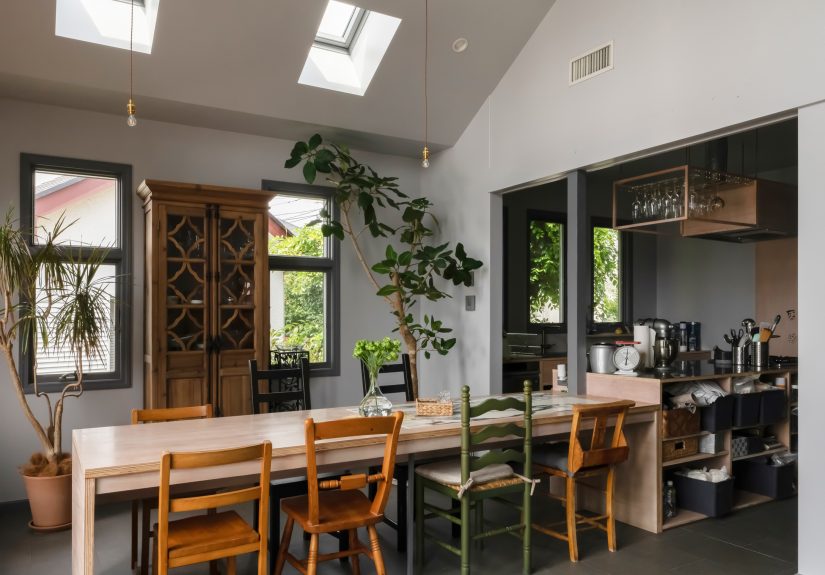
The interior uses veneered plywood cabinetry, stainless-steel surfaces, and simple brass hardware. These materials are not decorative in the fussy sense. They are durable, clean, and suited to a space where baking, flower arranging, coffee service, and family meals may all happen within the same orbit.
The kitchen island and dining table are especially important. They function as domestic furniture, work surfaces, classroom space, and baking prep zones. A marble slab can be added for kneading bread, which is a wonderfully specific detail. It says more about the project than a paragraph of design theory could. This is not a room staged to look busy. It is a room that actually gets flour on it.
Built-In Benches and the Art of Saving Space
Small-space design in Japan often rewards furniture that earns its keep. In the living area, built-in steel-framed benches line the perimeter, expanding seating without cluttering the center of the room. Instead of adding bulky chairs, the design turns the edges into useful zones. It is a simple move, but it changes how the room breathes.
Another clever touch is the suspended steel rod used in place of a traditional coat closet. This kind of detail feels almost casual, yet it reflects serious spatial intelligence. When square footage is limited, a closet can become a greedy little landlord. A rod does the job without taking over the room.
Why Japanese Cafe Culture Makes This Project Feel So Natural
Japan has a long and beloved cafe tradition, especially through kissaten, the old-school coffee shops known for rich coffee, quiet interiors, nostalgic furniture, and a slower pace. While Peace Flower Market Factory is not simply a retro kissaten, it shares some of that spirit. It values mood. It understands that a cafe is not only a place to buy caffeine. It is a place to sit, listen, pause, and become briefly more civilized before checking your phone again like the rest of us.
Traditional Japanese cafes often blend Western influences with local habits. Menus may include coffee, toast, sandwiches, sweets, pudding, and other comfort foods. The appeal is partly culinary and partly emotional. A good cafe becomes a small refuge, especially in dense urban environments where privacy can be scarce and schedules can be merciless.
Peace Flower Market Factory adds another layer by combining cafe culture with flowers and baked goods. Flowers soften the space visually. Baked goods soften it spiritually. Coffee keeps everyone upright. Together, they create a sensory triangle that is hard to resist.
The Bakery Side: Why Bread and Sweets Matter in Japan
Japanese bakery culture is wonderfully adaptable. Bread may have arrived through foreign influence, but Japan made it its own through inventions and local favorites such as anpan, melon pan, kare pan, and shokupan. Modern artisan bakers in Japan often combine Western techniques with Japanese ingredients, seasonal flavors, and a deep respect for craft.
That background matters when looking at a place like Peace Flower Market. The appeal is not just “cute cafe with muffins.” It is part of a larger Japanese appreciation for small-batch baking, seasonality, and handmade comfort. Peace Flower Market describes its baked goods as carefully handcrafted, with an emphasis on warmth and care. That philosophy fits perfectly with the architecture. The building is not polished into cold perfection; it is prepared, layered, and served like something handmade.
In many American cities, bakery-cafes are often designed around speed: grab, pay, leave, repeat. Here, the emphasis feels slower. The baked goods are not merely products. They are part of the mood of the place. A scone under a polycarbonate glow somehow tastes more intentional. Is that science? Probably not. Is it emotionally accurate? Absolutely.
Living Quarters Behind the Cafe: Privacy Without Separation Anxiety
The phrase “living quarters” can sound oddly formal, as if someone is sleeping behind a velvet rope. In reality, the private side of this project is one of its strongest ideas. The home remains a home. The cafe remains a cafe. But the two are linked by design decisions that allow them to support each other.
The kitchen and dining zone are central to this relationship. During normal domestic life, they function as a family kitchen and gathering area. During cafe operations or flower lessons, they become part of a working environment. This flexibility is one reason the project feels so relevant today. More people are rethinking how homes can support side businesses, creative work, teaching, hosting, and community-building without turning every room into an office with a sad printer in the corner.
The best mixed-use spaces are not just efficient. They protect rituals. A home-based cafe must answer practical questions: Where does the public stop? Where does the private begin? How do you store supplies? How do you clean quickly? How do you keep work from swallowing dinner? This renovation answers those questions not with dramatic gestures, but with layout, material choices, and adaptable furniture.
What Makes the Cafe Feel “Low-Key” in the Best Way
Low-key design is harder than it looks. Anyone can make a room empty. Making it calm, useful, and memorable takes judgment. This cafe succeeds because it avoids the usual traps. It does not overload the interior with fake rustic props. It does not turn minimalism into a punishment. It does not treat every corner as a photo booth.
Instead, the space feels collected. Antique chairs, vinyl records, flowers, exposed beams, wood-fiber cement panels, and handmade sweets create a lived-in atmosphere. There is personality, but not clutter. There is design, but not design yelling through a megaphone.
This is where the project becomes useful beyond Japan. For small cafe owners, home bakers, designers, and dreamers, the lesson is clear: start with what the building already has. Reuse what can be reused. Spend money where it improves daily function. Let light do some of the decorating. Leave room for the owner’s personality. A cafe without personality is just a waiting room with better muffins.
Design Lessons to Borrow From Bed and Bakery
1. Make the Entrance Work Hard
The converted front porch proves that a small threshold can become the identity of an entire business. The cafe does not need a huge storefront. It needs a clear gesture: light, warmth, and a reason to step closer.
2. Use Affordable Materials Creatively
Polycarbonate, plywood, steel, and leftover wood can feel refined when used with discipline. Budget materials are not the enemy. Confused materials are the enemy.
3. Let Furniture Serve More Than One Purpose
The dining table, kitchen island, benches, and storage zones all carry multiple responsibilities. This is essential in a live-work cafe, where every square foot needs a resume.
4. Keep the Human Story Visible
Flowers, records, handmade baked goods, antique chairs, and art by a friend make the place personal. The space feels designed around a person, not a trend forecast.
5. Respect the Neighborhood
A residential cafe must be gentle. Soft light, modest scale, and limited public-facing intensity help the business belong rather than intrude.
Experience: What It Feels Like to Spend Time in a Bed-and-Bakery Space
Imagine arriving on a quiet Yokohama street where the pace has already lowered your shoulders by half an inch. The cafe does not leap out at you. It glows. The front has that translucent softness that makes you feel as though something warm is happening inside, but no one is going to pressure you into understanding a complicated ordering system. Excellent news: your dignity is safe.
You step in and the first thing you notice is texture. Not one dramatic texture, but many small ones: the pale grain of plywood, the cool sheen of stainless steel, the faint industrial honesty of exposed materials, the soft color of flowers, the handmade irregularity of baked goods. The space smells like coffee, butter, and stems that were recently cut. Somewhere, a record collection waits like a quiet personality test. If the owner puts on something great, you are cultured. If you recognize it, you are insufferable. Either way, the scone wins.
The best part of a cafe like this is that it does not separate beauty from use. You can sense that the table is not only a table. It is where flowers are arranged, bread is kneaded, people gather, and ordinary life continues after customers leave. That makes the experience feel different from visiting a polished commercial cafe. You are not sitting inside a brand concept. You are sitting near the edge of someone’s working life, and that closeness gives the place warmth.
There is also a certain pleasure in the scale. Nothing feels oversized. The cafe does not try to impress you with a cathedral ceiling or a pastry case longer than a subway platform. Instead, it invites attention to small things: a muffin top, a chair with history, a brass handle, the way light lands on the counter. In a world where many cafes are designed to be photographed quickly and forgotten even faster, this kind of place asks you to stay awake to details.
If you were planning a similar experience at home or in a small business, the takeaway would not be “copy this Japanese cafe exactly.” That would miss the point. The real lesson is to make your own space more honest. Use materials you can maintain. Keep the layout flexible. Let your hobbies show, but do not let them mug the guests. Add plants or flowers if you can keep them alive. Bake something that smells like an apology from the universe. Give people a place to sit where they do not feel rushed.
By the time you leave, the cafe’s low-key nature becomes its strongest memory. You may not remember every architectural detail. You may remember the glow, the quiet, the sense that the building had been adapted rather than conquered. You may remember thinking that a home can hold a business without losing its soul, and that a bakery can be small without being minor. You may also remember crumbs. Crumbs are powerful historians.
Conclusion: A Small Cafe With a Big Design Lesson
Bed and Bakery: A Low-Key Cafe and Living Quarters in Japan is more than a charming renovation. It is a case study in thoughtful reuse, neighborhood-sensitive design, and the emotional power of handmade hospitality. Peace Flower Market Factory shows how a modest wooden house can become a public-private hybrid without losing its warmth. The cafe glows softly, the kitchen works hard, the living quarters remain personal, and the baked goods give everyone a reason to linger.
For readers interested in Japanese cafe design, small-space renovation, bakery interiors, or live-work homes, this project offers a refreshing alternative to overproduced commercial spaces. It proves that a cafe does not need to be loud to be memorable. Sometimes the best design is the kind that gets out of the way just enough for coffee, flowers, bread, and daily life to do the talking.






 Close
Close