Table of Contents >> Show >> Hide
- From “Home Library Computer” to “Bally Home Computer System”
- Hardware That Thought It Was an Arcade Board
- That Odd Little Keypad and the Promise of “Home Computer”
- Expansion Dreams: Keyboards, ZGRASS, and the UV-1
- Why It Never Beat the Atari 2600 (But Still Matters)
- Hackaday’s Angle: A Hacker’s Playground in Plastic
- Living with a Bally Home Computer System Today: Hands-On Experiences
Long before we were arguing about frame rates and ray tracing, there was a strange little
machine that tried to be both a game console and a “serious” home computer. It lived under
the TV, it spoke fluent Z80, and it came from a company better known for pinball machines
than productivity apps. Meet the Bally Home Computer System – the hardware star of many
a retro-computing rabbit hole and the subject of Hackaday’s deep-dive into what was really
going on under its plastic hood.
Today, most people know it by its final name, the Bally Astrocade, but throughout
its short, chaotic life it wore several badges: Bally Home Library Computer, Bally
Professional Arcade, Bally Computer System, and finally Astrocade. Underneath, though, the
hardware stayed remarkably consistent: a surprisingly capable graphics-and-sound powerhouse
that blurred the line between arcade board and home microcomputer.
From “Home Library Computer” to “Bally Home Computer System”
The story starts in the late 1970s, when Bally’s Midway division contracted Dave Nutting
Associates to design a flexible video chipset that could live both in arcade cabinets and in
a consumer machine. The result powered classic coin-op games like Gorf and
Wizard of Wor and eventually became the heart of a device originally pitched as the
Bally Home Library Computer.
Announced in 1977 as a mail-order “home library computer,” the system promised a family
entertainment and educational hub: games, learning cartridges, and eventually full-blown
computing. But production snags meant customers didn’t actually see units until 1978, by
which time Bally had rebranded it the Bally Professional Arcade and started selling it in
specialty electronics and computer shops.
The branding journey wasn’t over. In 1981 the platform changed hands, being sold to a group
that marketed it as the Bally Computer System. A year later, it picked up its final
name: Astrocade. If you’ve ever wondered why one device shows up under four different
names in retro-console collections, that’s why. It’s the same basic machine in a rotating
wardrobe.
Hardware That Thought It Was an Arcade Board
Under the hood, the Bally Home Computer System was built around a
Zilog Z80 CPU running at about 1.789 MHz – the same family of processor that powered
many contemporaries like the TRS-80 and a good chunk of the arcade scene. RAM started at
4 KB on the base console but could theoretically be expanded up to 64 KB using external
modules via its expansion port. ROM weighed in at 8 KB, with room for 8 KB game
cartridges.
The graphics hardware was the real flex. The chip supported:
- Low-resolution mode around 160×102 pixels with multiple colors
- High-resolution mode up to roughly 320×204 pixels, advanced for a late-’70s TV system
- Up to four colors per line from a palette of eight in high-res configurations
Contemporary reviewers noted that the Bally system could push some of the best graphics and
sound of any home console of its era. Compared to the Atari 2600’s trick-based graphics,
the Astrocade’s framebuffer-style approach felt much closer to a real microcomputer or even
an arcade development kit.
Sound came from a custom chip often referred to as a “music processor.” It offered three
independent tone channels plus noise and vibrato effects – essentially a small synthesizer
running right through your television’s speaker. Combined with its visual capabilities, the
machine was perfectly suited for arcade-style shooters, colorful maze games, and trippy
demo-scene graphics long before “demo scene” was a thing.
Then there was the secret weapon for hackers: a 50-pin expansion connector hiding behind
a punch-out panel on the back. That connector exposed the Z80’s bus and various I/O lines,
letting ambitious users and third parties hang all kinds of hardware off the systemdisks,
memory expansions, and experimental peripherals. In many ways, the Bally box was a
pre-assembled Z80 development board disguised as a game console.
That Odd Little Keypad and the Promise of “Home Computer”
Unlike most consoles of the day, the Bally unit came with a 24-key keypad built into the
top of the case. For casual players, it looked like a glorified game selector: you’d punch in
numbers to pick built-in games like Gunfight and Checkmate, use it as a calculator,
and occasionally tap in options from a cartridge menu.
For tinkerers, that keypad was something else entirely. With the right software, it doubled
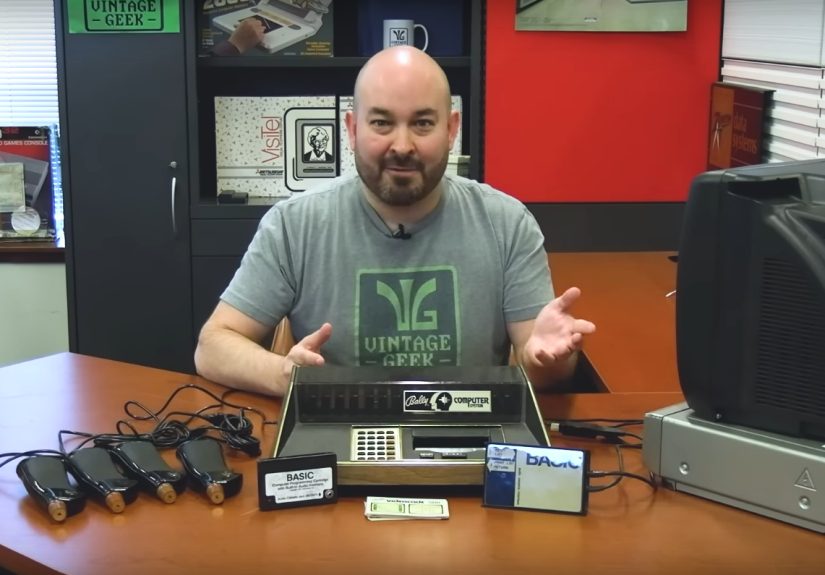
as a tiny, membrane-style keyboard. That’s where Bally BASIC came in – a plug-in
cartridge that turned the console into a programmable home computer.
Bally BASIC: When a Cartridge Becomes a Computer
The Bally BASIC cartridge did a lot of heavy lifting. Slot it into the console and suddenly
your “arcade” could:
- Run BASIC programs you typed in via the keypad or an external keyboard
- Save and load programs over cassette tape
- Draw graphics, animate sprites, and play sounds through BASIC commands
Early versions of Bally BASIC used a 300 baud cassette interface; later cartridges like
AstroBASIC bumped this up to 2000 baud and added some new commands. That might sound
glacial today, but being able to store and reload your own programs at home in 1979 was a
big deal.
Hobbyists received keyboard overlays that mapped BASIC keywords and symbols to the keypad
using shift-style modifier keys. It was clunky but clever: you could write simple games,
drawing routines, and even music demos directly on the machine and then share them on
cassette. In many living rooms, the Bally system quietly became someone’s first coding
environment years before they ever touched a dedicated home computer.
Expansion Dreams: Keyboards, ZGRASS, and the UV-1
On paper, the Bally Home Computer System was just getting started. The expansion port and
BASIC cartridge were supposed to be the first step towards a more complete computer
ecosystem – one that included:
- Full-size external keyboards
- Disk drives and printers
- Advanced graphics languages and development tools
Third-party and enthusiast projects eventually delivered some of this. Hobbyists built
keyboard kits that interfaced either with the original BASIC or later AstroBASIC cartridges,
turning the console into something that looked much more like a “real” computer in use.
Others added machine-language monitor cartridges, giving low-level access to the Z80 for
serious hacking.
Meanwhile, Bally and its partners had bigger ambitions. A planned expansion called the
ZGRASS-100 would have attached via the expansion bus and added a powerful graphics
language called ZGRASS, aimed at computer artists and high-end graphical work. Development
dragged on, corporate priorities shifted, and the add-on never really hit the mass
market. Some of its ideas did, however, live on in the Datamax UV-1, a niche graphics
workstation that used the same technology to generate high-quality visuals for videotape
and production work.
Looking back, it’s clear that the Bally platform was trying to leapfrog from “fancy console”
to “graphics-centric home computer” at a time when the market hadn’t quite decided what a
home computer should be. Between the half-released expansions and the surviving prototypes,
it feels like we’re seeing a roadmap for a product line that never got a proper chance.
Why It Never Beat the Atari 2600 (But Still Matters)
On raw specs, the Bally Home Computer System had a lot going for it. But commercial success
is about more than clock speeds and resolutions, and this is where the machine struggled.
Distribution and Marketing Problems
The Atari 2600 was everywhere: toy stores, department stores, television ads. The Bally
system, by contrast, started life as a mail-order oddity and later appeared mainly in
specialty electronics and computer shops. It also arrived late, after multiple delays, by
which time Atari had already dug in as the default choice for home gaming.
Price didn’t help either. Early units were relatively expensive, even as cheaper consoles
and simpler devices flooded the market. For a family that just wanted to play licensed
arcade hits, the Bally system’s “you can program it yourself!” pitch was less compelling
than Atari’s wall of familiar cartridges.
The Video Game Crash and a Quiet Exit
By the early 1980s, the platform had shifted hands, changed names, and tried to reposition
itself as a true home computer. But then came the video game crash of 1983, a market
implosion that wiped out many smaller players. The Astrocade line disappeared from store
shelves around 1985, leaving behind a small but passionate fanbase.
Even so, contemporary reviewers and modern retro enthusiasts agree on one thing: the Bally
Home Computer System was technically impressive and conceptually ahead of its time, even
if the commercial stars never quite aligned. It hinted at a future where consoles, arcade
boards, and home computers shared the same DNA – which is more or less exactly what we got
decades later.
Hackaday’s Angle: A Hacker’s Playground in Plastic
So why does Hackaday care about a long-discontinued hybrid console-computer? Because from a
modern hacker’s perspective, the Bally Home Computer System is basically a Z80 playground
wrapped in ’70s industrial design.
Exposed buses, expandable RAM, a flexible graphics chip, and a programmable environment via
BASIC make it ideal for:
- Reverse-engineering the video subsystem and timing quirks
- Building new cartridges and homebrew hardware on the expansion connector
- Porting modern Z80-targeted demos and games
- Exploring how early home-computer UX evolved from console-style interfaces
The Hackaday feature on the Bally system leans into that spirit: tracing its history,
examining its internals, and highlighting the work of enthusiasts who keep pushing the
platform further than Bally’s marketers ever imagined. It’s the kind of machine that
rewards probing with a logic analyzer as much as it does popping in an old game cartridge
and playing a round of Gunfight.
In other words, it’s quintessential Hackaday material: an almost-forgotten system that
reveals a lot about the messy, experimental path from dedicated game hardware to the
do-everything boxes we have today.
Living with a Bally Home Computer System Today: Hands-On Experiences
If you manage to track down a working Bally Home Computer System today – whether it’s
labeled as a Home Library Computer, Professional Arcade, Computer System, or Astrocade –
actually using it is half archeology, half magic trick.
Unboxing the Late ’70s
The first thing you notice is the industrial design. The case has that distinctly ’70s
aesthetic: faux-wood accents, rounded edges, and a top panel that mixes the built-in
keypad with storage bays for cartridges and controllers. It doesn’t look like a modern
console; it looks like something that belongs next to a hi-fi amplifier and a stack of
vinyl.
Hookup is charmingly old-school. You’re dealing with RF modulators, channel 3/4 switches,
and televisions that may or may not be happy about talking to 40-plus-year-old analog
signals. Once you get a clear picture, though, the startup sequence feels surprisingly
polished for its era: menus, built-in games, little graphical touches that hint at the
hardware’s capabilities.
From Player to Programmer
Pop in a BASIC or AstroBASIC cartridge and the vibe changes. Now you’re not just selecting
games; you’re entering commands, watching the cursor blink back at you, and feeling that
familiar mixture of excitement and mild terror that comes with typing code on limited
hardware.
The keypad is the first challenge. Without a full keyboard, you learn to lean on overlays
and key combinations for letters, numbers, and BASIC keywords. It’s slower than typing on a
modern keyboard, but it also forces you to be deliberate. Short variable names, tight loops,
and compressed logic suddenly make a lot of sense when every character is a few extra hand
movements.
Once you’ve entered a simple program – maybe a text scroller or a bouncing square – you
discover the other half of the experience: saving to cassette. The whine of analog tape,
the ritual of pressing Record/Play and hoping your levels are okay, the suspense as you
attempt to reload your creation later – it all adds a tactile drama you just don’t get
from clicking “Save” in an editor.
Exploring the Graphics and Sound
The real fun comes when you start poking at graphics and sound. Even in BASIC, you can draw
lines, fill areas, and animate simple objects on screen. Pushing the system toward its
high-resolution modes or more complex color tricks usually requires dropping into
machine-language helpers or using advanced cartridges, but even the “easy” stuff conveys
how potent the video hardware is compared to many other second-generation consoles.
Sound experiments are equally satisfying. Simple loops that sweep oscillator frequencies
can generate chiptune-style effects, while noise channels produce crunchy explosions and
retro drum hits. You quickly realize why musicians and demo coders are drawn to older
systems like this: they offer just enough control to be interesting without burying you in
complexity.
Why It Still Hooks Modern Hackers
For modern retro-computing fans, the Bally Home Computer System hits a sweet spot:
- It’s unusual enough to feel special – fewer people own one compared to, say, a Commodore
64 or an Atari 2600. - It’s hackable at every level, from BASIC programs to bus-level hardware experiments.
- It’s historically interesting, sitting right at the crossroads where game consoles started
flirting with being full-blown home computers.
When you look at it through that lens, the Bally Home Computer System becomes more than a
quirky footnote in gaming history. It turns into a case study in how ambitious hardware can
be hamstrung by timing, marketing, and market chaosand how decades later, communities like
those around Hackaday can give that hardware a second life as a beloved hacking platform.
It may never have conquered the living room, but on the workbench – wired up to modern test
gear, custom cartridges, and sometimes even emulated in development tools – the Bally Home
Computer System is finally living the deeply nerdy, highly programmable life its designers
always wanted for it.