
Table of Contents >> Show >> Hide
- What Is a Supernova?
- Why the “Brightest” Title Is Complicated
- Meet SN 2016aps: A Record-Breaking Stellar Explosion
- What Caused SN 2016aps to Shine So Brightly?
- ASASSN-15lh: The Brilliant Mystery That Refuses to Sit Quietly
- Earlier Record Holder: SN 2006gy
- How Astronomers Find These Cosmic Monsters
- Why the Brightest Supernova Ever Observed Matters
- What Makes Superluminous Supernovae Different?
- Could a Supernova Like This Threaten Earth?
- The Human Side of Watching Ancient Light
- Conclusion: The Brightest Supernova Is Also a Lesson in Scientific Caution
- Experience Section: What It Feels Like to Follow the Brightest Supernova Ever Observed
- SEO Tags
The phrase brightest supernova ever observed sounds like the kind of headline space itself would write in all caps. And honestly, fair enough. Supernovae are already the universe’s fireworks finale: massive stars collapse, shock waves rip through stellar material, and for a few weeks or months, one dying star can outshine billions of ordinary stars. But every now and then, astronomers spot an explosion so ridiculously luminous that even professional scientists have to pause, check the math, check it again, and then politely ask the universe, “Excuse me, what exactly was that?”
The current conversation about the brightest supernova ever observed comes with an important twist. For years, ASASSN-15lh was widely described as the most luminous supernova ever discovered. It appeared to shine hundreds of billions of times brighter than the Sun and far brighter than a normal supernova. Later studies, however, suggested it may not have been a supernova at all, but a tidal disruption event: a star being torn apart by a supermassive black hole. That is still spectacular, but it changes the trophy category.
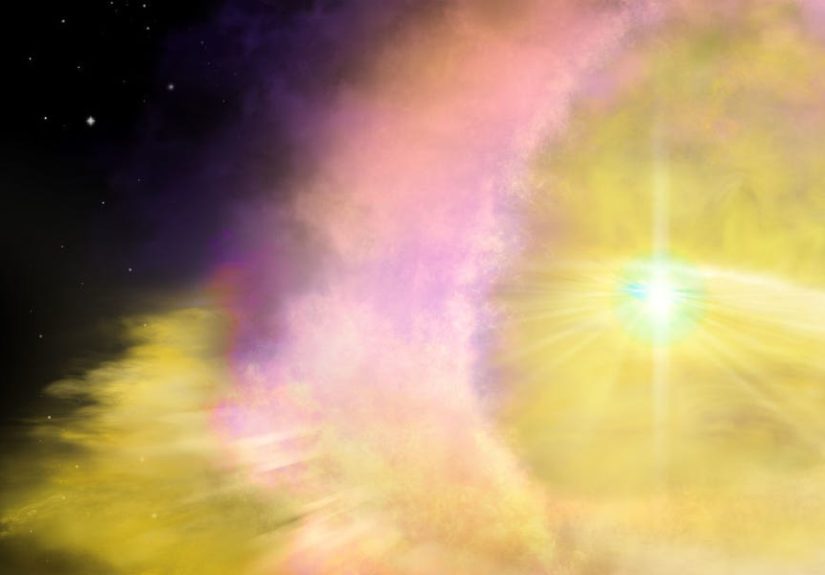
If we are talking about the brightest confirmed supernova, the star of the show is usually SN 2016aps. Observed in a galaxy billions of light-years away, SN 2016aps was not just bright; it was bright in the “please do not look directly at the cosmic receipt” sense. It released an extraordinary amount of energy as visible radiation, making it one of the most powerful stellar explosions ever studied.
What Is a Supernova?
A supernova is the explosive death of a star. In broad terms, there are two major routes to this cosmic drama. One involves a massive star running out of nuclear fuel. Without enough outward pressure from fusion, gravity wins, the core collapses, and the outer layers blast into space. The other common route involves a white dwarf in a binary system accumulating material until it ignites runaway nuclear fusion.
Either way, a supernova is not a quiet retirement party. It is a violent release of energy that creates and scatters heavy elements, sends shock waves through space, and leaves behind neutron stars, black holes, or expanding clouds of stellar debris. The iron in your blood, the calcium in your bones, and many of the heavier elements in Earth’s crust owe part of their origin story to ancient stellar explosions. In other words, we are all made of recycled star drama.
Why the “Brightest” Title Is Complicated
Astronomy rarely gives simple answers, mostly because the universe enjoys keeping its lawyers busy. “Brightest supernova” can mean several things. Are we talking about peak brightness? Total energy released? Visible light only? Intrinsic luminosity after correcting for distance? Confirmed supernova classification? Or the brightest transient that initially looked like a supernova?
This is why ASASSN-15lh and SN 2016aps are both important. ASASSN-15lh appeared brighter at peak and was initially celebrated as the most luminous supernova ever found. But its unusual location near the center of a large galaxy, its strange light curve, and later analysis led many researchers to argue that a black hole tearing apart a star may be a better explanation. SN 2016aps, meanwhile, is widely discussed as a genuine supernova whose energy output and brightness smashed expectations.
Meet SN 2016aps: A Record-Breaking Stellar Explosion
SN 2016aps was first detected in 2016 by the Pan-STARRS survey, a powerful sky-monitoring project based in Hawaii. The explosion occurred in a distant galaxy, so the light that reached Earth had been traveling across space for billions of years. By the time astronomers noticed it, the star itself had long since vanished. That is one of astronomy’s charming habits: it lets us watch ancient catastrophes as breaking news.
What made SN 2016aps extraordinary was not only its brightness but also the way it converted energy into light. In a typical supernova, only a small fraction of the explosion energy emerges as visible radiation. Much of the energy goes into expanding debris, neutrinos, and other forms that are harder to see directly. SN 2016aps, however, radiated a huge portion of its energy as light. That made it appear hundreds of times brighter than an ordinary supernova.
How Bright Was SN 2016aps?
Astronomers estimated that SN 2016aps was about 500 times brighter than a typical supernova. Its total explosion energy was also enormous, on the order of ten times greater than a standard supernova event. This placed it among the most extreme stellar deaths ever recorded.
To make that less abstract, imagine a regular supernova as a stadium full of camera flashes going off at once. SN 2016aps was more like the stadium, the parking lot, the city grid, and a suspiciously enthusiastic alien lighthouse all turning on together. It was not just another bright point in the sky; it was a laboratory for studying physics under conditions humans cannot reproduce on Earth.
What Caused SN 2016aps to Shine So Brightly?
The leading explanation involves a massive star surrounded by a thick shell of gas. Before the final explosion, the star may have shed large amounts of material into space. When the supernova blast wave slammed into that surrounding gas, kinetic energy was converted into light with unusual efficiency. In plain English: the explosion hit a cosmic wall of its own leftovers, and the collision made the whole thing glow like a celestial blowtorch.
Researchers believe the original star may have been extremely massive, possibly more than 100 times the mass of the Sun when it was born. Stars this massive live fast, burn hot, and do not get a peaceful ending. They can lose huge amounts of material through violent eruptions before they finally collapse or undergo more exotic forms of stellar destruction.
The Pair-Instability Connection
SN 2016aps may be related to a rare process known as pair-instability or pulsational pair-instability. In extremely massive stars, high-energy photons in the core can transform into pairs of particles and antiparticles. This reduces the pressure supporting the star, causing instability. The star may pulse violently, eject shells of material, or in some models, destroy itself completely.
This idea matters because pair-instability supernovae may have been more common in the early universe, when the first generations of stars were often much more massive than stars forming today. Studying events like SN 2016aps helps astronomers understand not only one explosion, but also how the first stars enriched the cosmos with heavy elements.
ASASSN-15lh: The Brilliant Mystery That Refuses to Sit Quietly
No article about the brightest supernova ever observed can ignore ASASSN-15lh. Discovered by the All-Sky Automated Survey for SuperNovae, this object was initially announced as an astonishing superluminous supernova. Its peak luminosity was so extreme that it seemed to challenge known models of how stars explode.
ASASSN-15lh appeared to be roughly 570 billion times brighter than the Sun and far brighter than the combined light of the Milky Way. Those numbers sound made up by a child negotiating bedtime: “One more story, but make it 570 billion suns.” Yet they came from real astronomical observations.
The trouble is that ASASSN-15lh did not behave exactly like other superluminous supernovae. It occurred in a large, relatively quiet galaxy, unlike the smaller, star-forming galaxies where many hydrogen-poor superluminous supernovae are found. Its ultraviolet behavior was also strange. Later studies proposed that the event may have been a tidal disruption event caused by a rapidly spinning supermassive black hole tearing apart a star.
So Was ASASSN-15lh a Supernova?
The safest answer is: maybe, but probably not in the ordinary sense. Some researchers have defended supernova-like interpretations, while others argue strongly for the black hole explanation. This is why careful science writing should avoid presenting ASASSN-15lh as the undisputed brightest supernova ever observed. It is better described as one of the most luminous optical transients ever detected and one of astronomy’s most fascinating classification puzzles.
Earlier Record Holder: SN 2006gy
Before SN 2016aps and ASASSN-15lh entered the cosmic beauty pageant, SN 2006gy was a famous record breaker. Located in the galaxy NGC 1260, about 240 million light-years away, SN 2006gy was described as the brightest and most energetic stellar explosion recorded at the time. It remained bright for months and may have come from an extremely massive star that shed material before exploding.
SN 2006gy helped push astronomers toward a broader understanding of superluminous supernovae. It suggested that some massive stars do not simply explode in one clean step. Instead, they may go through violent pre-supernova episodes, ejecting material that later interacts with the final blast. That interaction can dramatically boost brightness, turning a massive star’s death into a long-lasting cosmic flare.
How Astronomers Find These Cosmic Monsters
The brightest supernova ever observed was not found by someone casually glancing through a backyard telescope and yelling, “Found one!” Modern supernova hunting depends on automated surveys that scan the sky repeatedly. Projects like Pan-STARRS, ASAS-SN, and other wide-field surveys compare new images with old ones, looking for points of light that suddenly appear, brighten, fade, or behave suspiciously.
Once a candidate is found, astronomers use follow-up observations to determine what it is. They measure its light curve, which shows how brightness changes over time. They take spectra, which reveal chemical fingerprints. They estimate distance, host galaxy properties, temperature, expansion speed, and energy output. In short, they perform a cosmic autopsy using photons as evidence.
Why the Brightest Supernova Ever Observed Matters
A record-breaking supernova is more than a shiny headline. These explosions test the limits of stellar evolution theory. They help scientists understand how massive stars live, lose mass, collapse, and enrich galaxies. They also provide clues about the early universe, where massive stars may have been more common and where the first heavy elements were forged.
Superluminous supernovae can be seen across enormous distances, making them potential beacons for studying remote galaxies. Because they are so bright, astronomers can detect them even when they occur far back in cosmic history. That means events like SN 2016aps may help researchers investigate star formation, chemical enrichment, and galaxy evolution in eras that would otherwise be very difficult to observe.
What Makes Superluminous Supernovae Different?
Ordinary supernovae are already extreme, but superluminous supernovae are in another league. They can be 10 to 100 times brighter than typical supernovae, and some go even further. Scientists usually consider several possible power sources: interaction between supernova debris and surrounding gas, energy from a newborn magnetar, radioactive decay from large amounts of nickel, or exotic pair-instability processes.
A magnetar is a rapidly spinning neutron star with an incredibly strong magnetic field. If one forms inside an explosion, it can inject energy into the expanding debris and make the supernova much brighter. In other cases, the brightness may come from the blast wave plowing into dense material ejected before the explosion. SN 2016aps seems especially compatible with the idea of strong interaction between ejecta and surrounding gas.
Could a Supernova Like This Threaten Earth?
The good news: SN 2016aps happened billions of light-years away. That is comfortably distant, in the same way that a thunderstorm on Neptune is comfortably distant from your picnic. A nearby supernova could affect Earth if it occurred close enough, but the record-breaking explosions discussed here are far beyond any danger zone.
The more relevant local example is Eta Carinae, a massive unstable star in our own Milky Way. It may eventually explode as a spectacular supernova, but it is not expected to threaten Earth. If it goes off, it could become an extraordinary object in the sky, possibly visible even in daylight depending on the nature of the explosion. For now, it remains a dramatic reminder that the galaxy is not short on theatrical personalities.
The Human Side of Watching Ancient Light
There is something deeply humbling about the brightest supernova ever observed. We are not watching an explosion as it happens in the present moment. We are receiving old light from an event that occurred when Earth was a very different place. The star died long ago, but its light kept traveling, crossing intergalactic space until a telescope on a small rocky planet finally caught it.
That is the strange poetry of astronomy. A star can vanish, yet still introduce itself billions of years later. Its death becomes data. Its light becomes a graph. Its violence becomes a clue. And somewhere in a research paper, a scientist writes a sentence that quietly means, “We have never seen anything quite like this before.”
Conclusion: The Brightest Supernova Is Also a Lesson in Scientific Caution
The story of the brightest supernova ever observed is not just about ranking explosions. It is about how science handles uncertainty. ASASSN-15lh dazzled astronomers and may still be remembered as one of the brightest optical transients ever seen, but its identity remains debated. SN 2016aps stands as a stronger candidate for the brightest confirmed supernova, with extraordinary luminosity, immense energy, and clues pointing to a massive star surrounded by dense material.
These events remind us that the universe is not finished surprising us. Every new sky survey, every improved telescope, and every deeper look into the night brings the possibility of finding something brighter, stranger, or more stubbornly confusing than anything before. In astronomy, “brightest ever” often comes with an asterisk, and that asterisk is where the fun begins.
Experience Section: What It Feels Like to Follow the Brightest Supernova Ever Observed
Reading about the brightest supernova ever observed can feel oddly personal, even though the event happened far beyond any human scale. At first, the numbers are almost too large to mean anything. Five hundred times brighter than a normal supernova. Billions of light-years away. A star possibly more than 100 times the mass of the Sun. These facts are impressive, but they are also slippery. The human brain was built to remember where it left the car keys, not to casually visualize an explosion that can outshine a galaxy.
The experience becomes more powerful when you imagine the observation process. Somewhere, a telescope scans the sky the same way it did the night before. Software compares images. A new point of light appears. At first, it is probably just another candidate among many. Then follow-up observations come in. The brightness does not behave normally. The spectrum looks unusual. The energy estimate grows. Astronomers begin emailing, checking archives, requesting telescope time, and trying very hard not to sound too excited before the evidence is solid.
That is one of the best parts of modern astronomy: discovery often begins quietly. There is no movie soundtrack when the data arrives. No glowing portal opens over the observatory. There is just a signal, a spreadsheet, a light curve, and a group of people slowly realizing that they may be looking at one of the most powerful stellar explosions ever recorded.
For readers, the emotional experience is a mix of wonder and perspective. A supernova like SN 2016aps reminds us that stars are not permanent decorations. They are engines, factories, furnaces, and eventually, in some cases, bombs. Their deaths seed space with elements that later become planets, oceans, rocks, and living things. The same universe that produces terrifying explosions also produces chemistry, structure, and life. That is a pretty elegant trick, even if the method is somewhat loud.
There is also a useful lesson in the ASASSN-15lh debate. At first, many people wanted a clean headline: brightest supernova ever. Later, the story became more complicated. Maybe it was not a supernova. Maybe it was a black hole shredding a star. That might sound like a downgrade, but it is actually science doing exactly what it should do. Better evidence refined the explanation. The mystery did not disappear; it evolved.
Following these discoveries gives us a front-row seat to the scientific process. We see excitement, skepticism, revision, and curiosity working together. The brightest supernova ever observed is not only a cosmic event; it is a reminder that knowledge is built carefully, one observation at a time. And sometimes, the universe rewards that patience by switching on a light so bright that even galaxies seem to blink.







 Close
Close