Table of Contents >> Show >> Hide
- What “Heart Rate Monitoring via WiFi” Actually Means
- How WiFi Can “Sense” a Heartbeat: The Physics in Plain English
- What a WiFi Heart Rate Monitoring System Looks Like
- How Accurate Is Heart Rate Monitoring via WiFi?
- Why People Want WiFi-Based Heart Rate Tracking
- WiFi Heart Rate Monitoring vs Wearables: Not a Cage MatchA Tag Team
- Limitations and “Real Home” Challenges
- Privacy, Consent, and the “Please Don’t Make This Weird” Section
- The Future: WiFi Sensing Standards and Smarter Networks
- How to Evaluate WiFi Heart Rate Monitoring (Without Falling for Hype)
- Experiences With Heart Rate Monitoring Via WiFi (Realistic Scenarios)
- Conclusion
Heart rate monitoring via WiFi sounds like a magic trick: you sit on the couch, your router hums quietly in the corner, andboomyour heartbeat shows up on a screen. No watch. No chest strap. No sticky sensors trying to peel your soul off in July. But it’s not magic. It’s physics, signal processing, and a whole lot of “wow, radio waves notice everything.”
In this guide, we’ll break down how WiFi-based heart rate monitoring works, what it can (and can’t) do today, and why researchers are so excited about it for sleep tracking, elder care, and contactless health monitoring. We’ll also talk about privacybecause if your WiFi can “hear” your heartbeat, it’s fair to ask what else it can infer.
What “Heart Rate Monitoring via WiFi” Actually Means
When people say “heart rate monitoring via WiFi,” they usually mean contactless heart rate estimation using radio signals from WiFi devices. The system doesn’t read your heart electrically like an ECG, and it doesn’t shine light into your skin like many smartwatches (PPG). Instead, it detects tiny body movements associated with breathing and the mechanical motion of your heartbeatminute chest wall vibrations and micro-movements that slightly change how WiFi signals travel through a room.
Think of WiFi like a constant stream of invisible ripples bouncing around your home. When you moveeven a tiny, barely noticeable amountyou change the ripples’ patterns. With the right measurements and algorithms, those changes can be turned into estimates of vital signs such as respiration rate and heart rate.
How WiFi Can “Sense” a Heartbeat: The Physics in Plain English
WiFi uses radio waves in unlicensed bands (most commonly 2.4 GHz and 5 GHz, and increasingly 6 GHz). Those waves travel from a transmitter (like a router) to a receiver (like a laptop WiFi chip), bouncing off walls, furniture, and, yes, you.
Your body affects the signal in two main ways:
- Reflection and multipath: Signals take multiple paths to the receiver. Small changes in your position or chest movement slightly change those paths.
- Phase and frequency shifts: Micro-motions can produce tiny changes in the signal’s phase (timing) and sometimes create Doppler-like effects. Breathing is easier to see; heartbeat is subtler, but still detectable under good conditions.
The Secret Sauce: Channel State Information (CSI)
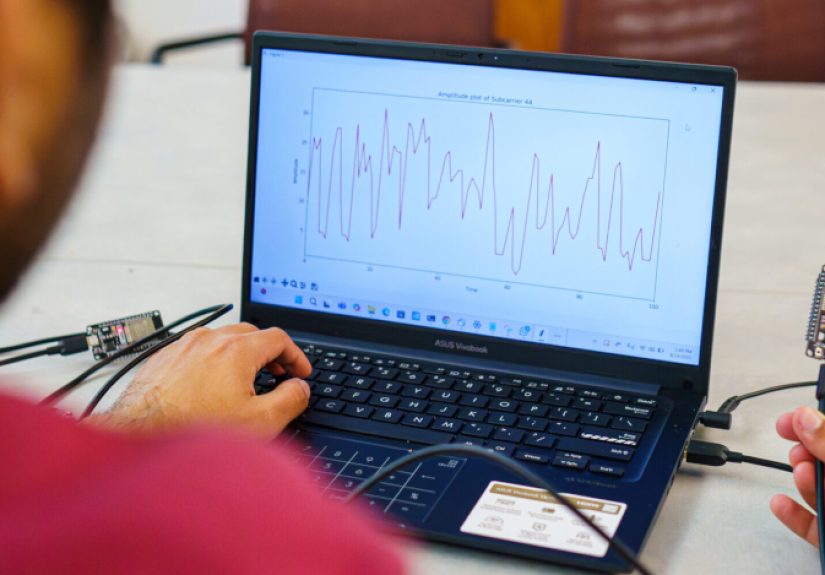
A lot of modern WiFi sensing research relies on Channel State Information (CSI). CSI is a detailed description of how a WiFi signal travels from transmitter to receiver across many subcarriers (little slices of the channel) and, with MIMO, across multiple antennas. Compared with simpler metrics like RSSI (signal strength), CSI provides richer informationmore like a full “signal fingerprint” than a single number.
That detail matters because heartbeat signals are small and can easily get buried under noise: random motion, changes in posture, a fan spinning, or your cat doing parkour at 2 a.m.
Separating Breathing from Heartbeat (Because Your Chest Is Multitasking)
Breathing is slow and relatively large. Heartbeat is faster and smaller. Many systems use frequency-based separation:
- Respiration: Often around ~0.1 to 0.5 Hz (6–30 breaths per minute, depending on age and activity).
- Heart rate: Often around ~1 to 2+ Hz (60–120+ beats per minute), higher with exercise or stress.
Algorithms typically filter the CSI signal to isolate these bands, then apply additional processinglike dimensionality reduction, phase unwrapping, denoising, or machine learningto estimate the final heart rate.
What a WiFi Heart Rate Monitoring System Looks Like
There isn’t one single “standard” setup, but most WiFi-based vital sign systems have a familiar pattern:
1) A transmitter and a receiver
Sometimes it’s a typical WiFi access point plus a receiver device. Sometimes it’s a dedicated device designed for sensing. Some research prototypes use low-cost hardware (like microcontrollers or single-board computers) to keep the system affordable and accessible.
2) CSI extraction (or another measurement method)
Not all consumer devices expose CSI data easily, which is a practical barrier. Research tools and modified drivers can access CSI on certain chipsets. Newer ecosystem efforts around “WiFi sensing” aim to make this easier and more standardized.
3) Signal processing + estimation
This is where the “boring but brilliant” stuff lives:
- Preprocessing: removing outliers, smoothing noise, compensating for hardware quirks
- Feature extraction: isolating periodic patterns, choosing subcarriers/antennas that best capture micro-motion
- Estimation: spectral analysis, peak tracking, or machine learning models that map patterns to beats per minute
Many modern approaches blend classic signal processing with machine learning. The ML part helps when real life refuses to behave like a clean lab demo (which, to be fair, is always).
How Accurate Is Heart Rate Monitoring via WiFi?
Accuracy depends heavily on conditions. In controlled setupspeople sitting, lying down, or sleepingWiFi-based systems can achieve surprisingly tight heart rate estimates. Researchers have demonstrated performance that can be close to reference devices under certain conditions, especially when motion is limited and the environment is stable.
But here’s the honest truth: movement is the boss fight. If you’re walking around, gesturing, exercising, or flopping onto the couch like a dramatic Victorian poet, the signal changes from gross body motion can overwhelm the micro-motion of a heartbeat.
Factors that affect accuracy
- Distance: Farther can work, but signal-to-noise tends to get worse.
- Orientation and posture: Your body’s angle relative to transmitter/receiver matters.
- Multipath environment: Furniture, walls, and room geometry can help or hurt.
- Interference: Other WiFi traffic and devices can add noise (though some methods are designed to cope).
- Multiple people: Separating two heartbeats in the same room is possible in research settings, but it’s harder and not always reliable.
Important medical note: WiFi heart rate monitoring is generally discussed as a wellness/monitoring tool, not a replacement for clinical diagnosis. If you have symptoms like chest pain, fainting, severe shortness of breath, or new irregular heartbeats, talk to a qualified clinician promptly.
Why People Want WiFi-Based Heart Rate Tracking
Wearables are greatuntil they aren’t. A watch can lose skin contact. A chest strap can be uncomfortable. Adhesive sensors can irritate skin. And some people simply don’t wear devices consistently. WiFi-based monitoring offers a different model: ambient, passive, and contactless.
Practical use cases
- Sleep monitoring: tracking overnight heart rate trends and respiration without wearing anything
- Elder care: passive monitoring for older adults who may forget wearables or dislike them
- Post-discharge monitoring: supporting recovery at home with fewer wires and patches
- Infant and pediatric monitoring research: exploring non-contact options where skin is sensitive (always under appropriate clinical oversight)
- Smart home health: combining motion/activity sensing with baseline vital sign trends
The big promise is continuous monitoring with low friction. If a system can run quietly in the background, it might capture trends and changes that occasional spot-checks miss.
WiFi Heart Rate Monitoring vs Wearables: Not a Cage MatchA Tag Team
It’s tempting to frame this as “WiFi monitoring replaces wearables.” In reality, they have different strengths:
Where WiFi sensing shines
- Comfort: nothing to wear, charge, or remember
- Adherence: works even if someone forgets to put on a device
- Overnight tracking: great for sleep because people are mostly still
- Skin-friendly: avoids irritation from adhesives or tight straps
Where wearables still win
- Motion robustness: better during daily activity and exercise
- Multi-sensor context: accelerometers, temperature, blood oxygen (in some devices), ECG in some cases
- Personal ownership: your data travels with you, not just in one room
A realistic future looks like hybrid monitoring: wearables for active hours, ambient WiFi sensing for sleep and home time, with software that blends both into a clearer picture.
Limitations and “Real Home” Challenges
In the lab, heart rate monitoring via WiFi can look smooth and elegant. In a real home, it meets… real home behavior.
Common “gotchas”
- Too much movement: shifting positions, talking with hands, or restless sleepers can reduce accuracy.
- Fans and HVAC airflow: moving air and spinning blades can introduce periodic signal changes.
- Pets: smaller moving bodies can add extra “motion signatures.”
- Room changes: rearranging furniture can change multipath patterns and require recalibration.
- Hardware access: CSI isn’t always readily available on consumer devices without specialized support.
These challenges don’t make the technology uselessthey just make it honest. Any system that claims “perfect heart rate tracking anywhere, anytime, through anything” deserves a raised eyebrow and a polite request for independent validation.
Privacy, Consent, and the “Please Don’t Make This Weird” Section
WiFi sensing is powerful precisely because it is passive. That raises ethical questions:
- Consent: People should know they’re being monitored and agree to it.
- Data security: Vital sign data is sensitive. Secure storage and encryption matter.
- Purpose limitation: Systems should collect only what they need (heart rate trends, not “everything about everyone”).
- Transparency: Users should understand what the system can infer and what it cannot.
In healthcare contexts, privacy and compliance requirements can be stricter. In home settings, ethical design still matters: local processing when possible, clear controls, short retention windows, and simple ways to pause or disable monitoring.
The Future: WiFi Sensing Standards and Smarter Networks
One reason interest is growing is that the WiFi ecosystem is moving toward more standardized sensing capabilities. Instead of researchers fighting drivers and chipsets to access CSI, future devices may include sensing-friendly features at the protocol level.
As standards mature, we’re likely to see:
- Better interoperability: sensing tools that work across more devices
- Improved multi-person separation: more robust identification of multiple motion signatures
- Edge processing: more on-device computation for privacy and speed
- Integration into smart home platforms: heart rate and respiration trends alongside sleep and activity analytics
The long-term vision is ambient health monitoring that is helpful, secure, and opt-innot creepy, not noisy, and definitely not a substitute for real medical evaluation when something feels wrong.
How to Evaluate WiFi Heart Rate Monitoring (Without Falling for Hype)
If you’re considering this technologywhether for research, product development, or simply curiosityhere’s a practical checklist:
- Ask about validation: Was it compared to a reference device (ECG, clinical-grade monitor, or validated wearable) in realistic settings?
- Check motion handling: Does it work only when still, or can it handle normal sleep movement?
- Understand the environment needs: Required distance, room layout assumptions, or calibration steps.
- Look for privacy-by-design: local processing, minimal data retention, strong encryption, clear consent flows.
- Be realistic about use: great for trends and passive monitoring; not a magic arrhythmia detector.
Done right, heart rate monitoring via WiFi could become a low-friction layer of “background health awareness” in the homeespecially for sleep and long-term trend tracking.
Experiences With Heart Rate Monitoring Via WiFi (Realistic Scenarios)
Because this technology is still emerging, most “experiences” people talk about come from pilots, research demos, and early-stage deploymentsnot a universal, plug-and-play gadget you can toss into your cart like paper towels. Still, there are consistent patterns in how people react to WiFi-based heart monitoring once they try it in a real space.
Sleep tracking feels surprisingly normal. In overnight tests, participants often report that the biggest change is… none. They don’t have to remember to charge a wearable, they don’t wake up with a strap mark, and they don’t get that “did my watch record this, or did it decide my wrist was a croissant?” uncertainty. The system’s value shows up the next morning as trend dataresting heart rate overnight, rough respiration patterns, and sometimes alerts when signals look unusual. When it works well, it fades into the background, which is exactly the point.
Caregivers like the “low-friction check-in,” but want control. In scenarios involving older adults, caregivers often appreciate passive monitoring that doesn’t depend on the person remembering to wear a device. The comfort advantage is real. But caregivers also tend to ask the right questions quickly: Who can see the data? Where does it live? Can we turn it off when company comes over? The most accepted setups are the ones with obvious privacy controlssimple pause buttons, clear indicators when monitoring is active, and data that stays local unless someone explicitly shares it.
Movement is where expectations get adjusted. People testing WiFi heart rate monitoring frequently notice a pattern: “It’s great when I’m still, and it gets weird when I’m not.” That’s not a failureit’s a known limitation of extracting tiny heartbeat motion from a world full of larger movements. In practical terms, users learn to treat WiFi heart tracking as a “resting and sleeping” tool, not an “I’m doing jumping jacks and want perfect BPM” tool. Some pilots even build the experience around this truth, showing confidence levels or labeling readings as “stable,” “noisy,” or “insufficient signal.” Weirdly, that honesty boosts trust.
People get curious about placementthen a little nerdy about it. Once users realize room layout matters, they start experimenting: moving a device a few feet, changing angles, testing bedroom versus living room, and trying to reduce interference (like turning off a fan for a short test). In homes, “best results” often come from consistent, predictable environments: a bedroom with fewer moving objects, stable furniture placement, and a clear sensing path. People don’t necessarily want to become RF engineers, but they do like small “setup wins” that improve reliability.
The emotional response is split: “cool” and “slightly spooky.” It’s common for first-time users to feel both impressed and uneasy. “My WiFi can see my heartbeat” is a sentence that comes with built-in drama. The systems that reduce the spooky factor are the ones that are transparent about what’s being measured (micro-motion patterns, not thoughts), explain limitations, and keep data handling simple. Once users understand it’s closer to a very sensitive motion detector than a mind reader, the novelty becomes less eerie and more practical.
Overall, the best experience comes when WiFi-based heart monitoring is presented as ambient trend trackingespecially for sleep and recoveryrather than a perfect, always-on medical oracle. It’s a helpful tool when it’s accurate about what it can do, cautious about privacy, and humble about the messy reality of real homes.
Conclusion
Heart rate monitoring via WiFi is one of the most fascinating examples of “everyday tech getting secretly smart.” By analyzing how WiFi signals change as they bounce around a room, researchers can estimate heart rate and breathing without physical contactespecially when a person is resting or sleeping. The benefits are obvious: comfort, consistency, and passive tracking. The limits are just as real: movement, multi-person complexity, hardware access, and privacy concerns.
If the future is a home that supports health quietly and respectfully, WiFi sensing could be one of its background superpowersprovided it’s built with transparency, security, and consent from day one.