Table of Contents >> Show >> Hide
- Why This Movie Still Gets People Talking
- 19 Trivia Tidbits About Team America: World Police
- 1) October 2004 wasn’t just the release — it was the starting pistol
- 2) It’s not “animated” — it’s a live-action puppet action movie
- 3) The movie proudly shows its strings (literally)
- 4) The Chiodo Brothers weren’t just hired — they basically ran puppet world
- 5) These weren’t tiny toys: the standard marionette was about 22 inches tall
- 6) Each puppet head was basically a robot face with multiple motors
- 7) Modular design let the team “re-skin” characters instead of rebuilding everything
- 8) There were hundreds of characters, but a much smaller number of “hero” mechanics
- 9) Sets were built for access, not just beauty
- 10) Camera angles had to obey the laws of string physics
- 11) The filmmakers chose “fakery” on purpose with depth of field
- 12) Anamorphic lenses were basically a no-go, so the film used Super 35
- 13) Lighting had one constant enemy: visible strings
- 14) The guiding question on set was hilariously simple: “What would Bruckheimer do?”
- 15) The pace of filming was “glacial” enough that people did crosswords
- 16) The driving and flying scenes used delightfully old-school tricks
- 17) Rewrites meant the team sometimes had to perform dialogue live on set
- 18) Yes, there was a ratings battle — and it got very real, very fast
- 19) The Matt Damon puppet became a pop-culture souvenir (and Damon noticed)
- Bonus: The Movie Is Also a Musical (Because Of Course It Is)
- How to Celebrate the Anniversary Without Getting Kicked Out of Your Own Living Room
- Extra : The Modern “Team America” Experience (What It Feels Like to Revisit It Now)
- Conclusion
Some movies age like fine wine. Some age like milk. And then there’s Team America: World Police,
which ages like a bottle of hot sauce: it never gets subtler, it just keeps showing up in your life when you least expect it.
If you’ve ever heard someone hum a suspiciously patriotic tune, if you’ve ever watched a big-budget action movie
and thought, “Why is the camera moving like it just drank three energy drinks?” — congratulations, you’re already
living in Team America’s shadow.
Released in the U.S. in October 2004, Trey Parker and Matt Stone’s marionette mega-satire hit its 19th anniversary in October 2023.
That’s nearly two decades of the film doing what it does best: roasting action-movie swagger, celebrity virtue theatrics,
and the kind of “save the world” confidence that usually comes with a leather jacket and a slow-motion explosion.
To celebrate, we’re going deep with 19 trivia tidbits — the kind you can drop at a movie night, a pop-culture trivia round,
or anytime someone says, “Wait, that movie was made with actual puppets?!” (Yes. Yes it was. And it nearly broke everyone involved.)
Why This Movie Still Gets People Talking
Team America: World Police is a satire wearing an action-movie costume. It borrows the language of big, glossy blockbusters —
heroic teams, globe-hopping missions, dramatic speeches — and then pulls the rug out from under all of it by making the heroes literal
wooden dolls on strings. The result is a strange magic trick: it looks like a loud genre movie, feels like a sharp parody, and plays like a dare.
But the real reason it endures is simpler: it commits. It doesn’t wink once and then retreat. It builds an entire world — miniature sets,
practical effects, musical numbers, and over-the-top action beats — just to make a point about how ridiculous our cultural stories can be
when we tell them with too much certainty and too little self-awareness.
19 Trivia Tidbits About Team America: World Police
1) October 2004 wasn’t just the release — it was the starting pistol
The film opened wide in U.S. theaters on October 15, 2004, with a runtime of 98 minutes and an R rating.
That puts the 19th anniversary at October 15, 2023 — old enough to feel “classic,” young enough to still feel like it should be
living in a DVD bargain bin next to questionable comedies with neon cover art.
2) It’s not “animated” — it’s a live-action puppet action movie
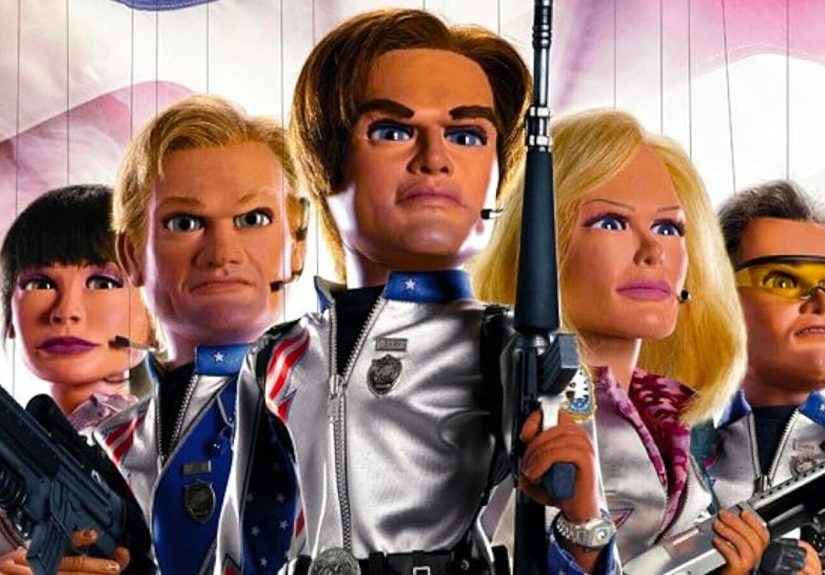
Plenty of films use CGI to create worlds. Team America used marionettes, miniature sets, and in-camera problem-solving.
It wasn’t trying to look real. It was trying to look like a serious blockbuster… starring puppets. That tension is the joke.
3) The movie proudly shows its strings (literally)
The production leaned into the old-school “Supermarionation” vibe associated with Gerry Anderson-style TV puppetry.
Instead of hiding the mechanics, the film makes the strings part of the aesthetic — a constant reminder that you’re watching
a performance and a parody at the same time.
4) The Chiodo Brothers weren’t just hired — they basically ran puppet world
The Chiodo Brothers (Stephen, Charlie, and Edward) were central to building and operating the marionette cast.
Their work spanned fabrication, mechanization, and puppeteering performance — the whole pipeline from foam latex skin to on-set movement.
It’s not an exaggeration to say the movie is as much an effects achievement as it is a comedy.
5) These weren’t tiny toys: the standard marionette was about 22 inches tall
The hero puppets were built as 22-inch, 10-string marionettes with proportions designed around a one-third scale world.
That scaling choice mattered: it opened up practical options for costumes, props, and set dressing that could feel “real”
even when everything was miniature.
6) Each puppet head was basically a robot face with multiple motors
The heads weren’t just carved smiles. They were mechanical systems: servomotors controlled key facial functions
like blinks, brows, and mouth shapes. That’s how the film gets emotional beats and punch lines out of faces that still look,
in the best way, a little “wooden.”
7) Modular design let the team “re-skin” characters instead of rebuilding everything
Here’s a behind-the-scenes cheat that’s also kind of genius: the production built a limited number of hero mechanical skulls,
then swapped faces and cosmetic pieces to create new characters. It’s like a high-tech puppet version of changing a hat and glasses
and hoping no one notices — except it worked.
8) There were hundreds of characters, but a much smaller number of “hero” mechanics
The production created roughly 300 different character looks over the course of filming, but only built a smaller set of hero mechanical
skulls that could be reused with new faces and hair. A night crew maintained, repaired, and reset puppets so the next day could even happen.
(Because puppets, like humans, do not enjoy long workdays.)
9) Sets were built for access, not just beauty
Miniature set design wasn’t just about looking good on camera. Many sets were built on raised platforms so puppeteers could operate
from below. Floors could be opened, holes could be cut, and lighting could be placed where a “normal” film set would never need it.
If you’ve ever wondered why practical effects crews are part engineer, part magician — this is your answer.
10) Camera angles had to obey the laws of string physics
A typical action movie can drop into a dramatic low angle or float overhead for a tactical view. Puppets don’t allow that freedom.
Go too low and you expose the “no ceiling” reality of the set. Go too high and strings start photobombing the frame.
Blocking and camera placement had to be planned like a puzzle.
11) The filmmakers chose “fakery” on purpose with depth of field
Cinematography tests explored how depth of field affected the illusion. A deeper focus could make the world feel more “life-sized,”
but a shallower focus made the puppets feel like puppets — and the team liked that. The movie leans into its own artificiality,
because the artifice is the point.
12) Anamorphic lenses were basically a no-go, so the film used Super 35
Classic action movies love anamorphic widescreen. But close-up puppet work needs specialized optics, and the production found that true
anamorphic macro options weren’t workable for their needs. So the film achieved its widescreen look through Super 35,
pairing the format with close-focus prime lenses to get right up in puppet personal space.
13) Lighting had one constant enemy: visible strings
Strong backlight might look cool on human heroes, but on marionettes it can turn strings into glowing neon lines.
The cinematography leaned toward softer sources and careful placement — sometimes even attaching small lights near the lens
to get eyes to read without revealing the whole string situation.
14) The guiding question on set was hilariously simple: “What would Bruckheimer do?”
According to the cinematography team, Parker and Stone used a single mantra to shape the film’s style: emulate the swagger of
Jerry Bruckheimer-style action filmmaking. When in doubt, move the camera. Add drama. Add momentum. Add absurd commitment.
Then let the fact that it’s all puppets do the punchline work.
15) The pace of filming was “glacial” enough that people did crosswords
Here’s a detail that feels like a joke but wasn’t: once a shot was set, it could take a long time to get puppeteers into position
and rehearsed. During those waiting stretches, the crew reportedly passed time with crossword puzzles printed on the backs of call sheets.
That’s filmmaking: hurry up, wait, and solve 12-across.
16) The driving and flying scenes used delightfully old-school tricks
For vehicle shots, the production built moving background rigs and treadmills to create the illusion of motion — like silent-era film craft,
but with modern precision and an intentionally exaggerated vibe. It’s a perfect match for a movie that wants to feel like a blockbuster
while also poking it in the eye.
17) Rewrites meant the team sometimes had to perform dialogue live on set
Puppets often perform to prerecorded playback for precise mouth sync. But rewrites made that difficult. In some cases, dialogue was performed
live while puppeteers coordinated facial animation systems and body movement in real time. The result: a production process that was part theater,
part robotics lab, part controlled chaos.
18) Yes, there was a ratings battle — and it got very real, very fast
Before release, the production famously clashed with the ratings board over a puppet love scene. Reports at the time described multiple submissions
and repeated requests for cuts, with the filmmakers pushing back hard because (their argument, essentially) “They’re wooden dolls.”
Whatever your stance, it became part of the movie’s legend: the behind-the-scenes drama was nearly as intense as the on-screen parody.
19) The Matt Damon puppet became a pop-culture souvenir (and Damon noticed)
Among the many celebrity parodies, the Matt Damon puppet took on a life of its own. Years later, Damon said he was initially bewildered by the portrayal
and found himself wondering if that’s how people saw him — but he also credited Parker and Stone as geniuses and noted that fans often ask him
to autograph an image of the puppet. That’s the full lifecycle of satire: mockery, meme-hood, and eventually, the autograph table.
Bonus: The Movie Is Also a Musical (Because Of Course It Is)
If you remember explosions, you’re right. If you remember songs, you’re also right. Team America uses musical numbers the way it uses
action tropes: as a straight-faced delivery system for jokes. It has rallying anthems, character spotlights, and parody montage energy — all designed
to sound like a big studio movie cranked up to an uncomfortable volume.
The smartest part is how the music works structurally. In a standard blockbuster, songs and score are there to make you feel heroic, romantic, or inspired.
Here, they often make you feel those things for half a second… and then you realize you’re feeling them about a marionette delivering a totally
overconfident speech. It’s emotional manipulation as a punchline — and it’s weirdly effective.
How to Celebrate the Anniversary Without Getting Kicked Out of Your Own Living Room
Planning a rewatch? A trivia round? A “how did they even make this?” behind-the-scenes night? Here are some ideas that keep the vibe fun and the
conversation sharp:
- Host a “Practical Effects Appreciation” watch party: Put miniatures, puppetry, and in-camera tricks on the bingo card.
- Play “Spot the Trope”: Every time the movie uses a classic action beat (dramatic entrance, globe-trotting cut, inspirational speech), call it out.
- Do a “ratings-board lore” trivia round: Behind-the-scenes battles are part of the film’s history, so treat them like bonus content.
- Keep it PG in the group chat: The movie is not shy. Your recap doesn’t have to be graphic to be funny.
Extra : The Modern “Team America” Experience (What It Feels Like to Revisit It Now)
Watching Team America: World Police in the modern streaming era feels like opening a time capsule that immediately starts doing push-ups.
The first experience most people have today isn’t the plot — it’s the texture. The miniature sets, the deliberate “movie lighting”
applied to a puppet face, the tiny costumes that somehow look like they were tailored by someone who takes their job way too seriously (a compliment, truly).
Before the satire even lands, the craftsmanship announces itself. You can practically feel the hours inside every shot.
The second experience is realizing how the film is built like an action movie you’ve seen a hundred times — and how it uses that familiarity as a trap.
Modern audiences are fluent in blockbuster language: the heroic team shot, the urgent mission briefing, the swelling music cue that says, “This matters.”
Team America feeds you those beats and then forces you to notice how quickly “serious movie logic” can become absurd when it stops being questioned.
It’s a rewatch that turns into a conversation about storytelling habits: not just what the movie is mocking, but how movies teach us to feel certain emotions on command.
Then there’s the social experience — the way this film behaves in a group setting. In a room of friends, the laughter often starts as shock-laughter:
“I can’t believe they did that.” After a while, it becomes craft-laughter: “I can’t believe they pulled that off.” And eventually,
it becomes recognition-laughter: “I can’t believe this is still how people act in real life.” That arc is why the movie remains such a reliable
movie-night pick for people who like their comedy loud but their satire pointed.
A modern rewatch also invites a new kind of appreciation: the behind-the-scenes curiosity spiral. People finish the movie and immediately want to know
how many puppets existed, how facial movement worked, how lighting avoided revealing strings, and how the crew managed action sequences without leaning on
digital fixes. That curiosity is part of the experience now. The film doesn’t just entertain; it dares you to admire it as a practical-effects project.
In a landscape filled with clean, polished, computer-perfect spectacle, Team America feels stubbornly handmade — and that handmade quality makes the jokes hit harder,
because you sense the artists sweating for the punchline.
Finally, there’s the cultural aftertaste. Some comedies fade because their references get dusty. Team America stays alive because it’s less interested
in predicting the future than in exposing a recurring pattern: how quickly people can become performative, self-serious, and certain they’re the hero of the story.
That pattern doesn’t retire. So the experience of revisiting the film today is part nostalgia, part craft admiration, and part “oh wow, this is still a thing,”
delivered by marionettes with a blockbuster soundtrack and the confidence of a movie that knows exactly what it is.
Conclusion
Nineteen years later, Team America: World Police remains one of the most aggressively committed satires ever built — not just written, but engineered.
It’s a movie that put real craftsmanship behind the dumbest possible premise on purpose, because that contrast is where the comedy lives.
Whether you love it, hate it, or mostly just stare in disbelief at how much work went into making puppets look like action heroes, the film still does what great satire does:
it makes you laugh, then makes you think, then makes you laugh again because you realized the thinking part was also a joke.