
Table of Contents >> Show >> Hide
- What Is a Rotating Detonation Engine?
- Detonation vs. Deflagration: Why the Burn Matters
- How a Rotating Detonation Rocket Engine Works Step by Step
- Why Engineers Care About Rotating Detonation Engines
- Real-World Progress in RDRE Testing
- The Main Engineering Challenges
- RDRE vs. Conventional Rocket Engine
- Where Rotating Detonation Engines Could Be Used
- Why the Annular Chamber Is So Important
- The Future of Rotating Detonation Rocket Engines
- Experience-Based Insights: What Learning About RDREs Teaches Us
- Conclusion
- SEO Tags
A rotating detonation engine sounds like something a sci-fi mechanic would install on a spaceship right before saying, “Don’t worry, I tested it once.” In reality, it is one of the most serious ideas in advanced propulsion. Engineers are studying it because it could make rocket engines smaller, lighter, and more efficient by changing the way fuel releases energy.
The big idea is simple enough to say and difficult enough to make aerospace engineers lose sleep: instead of burning propellant in a steady flame, a rotating detonation rocket engine uses a supersonic combustion wave that races around a ring-shaped chamber. That wave compresses and burns fresh propellant again and again, producing high-pressure exhaust that can be expanded through a nozzle to create thrust.
In other words, a conventional rocket engine is like a powerful furnace with excellent manners. A rotating detonation engine is more like a perfectly trained thunderclap running laps around a circular hallway.
What Is a Rotating Detonation Engine?
A rotating detonation engine, often shortened to RDE, is an engine that uses pressure-gain combustion. When the same concept is applied specifically to rockets, it is commonly called a rotating detonation rocket engine, or RDRE.
The heart of the system is an annular combustor. “Annular” simply means ring-shaped. Imagine two cylinders, one inside the other, with a narrow circular channel between them. Fuel and oxidizer enter this channel from one side. After ignition, one or more detonation waves travel around the ring at supersonic speed. As fresh propellant flows into the chamber, the wave consumes it, creating hot, high-pressure gas that exits through the engine nozzle.
The engine does not need pistons, crankshafts, or rotating turbine blades inside the combustor. The “rotating” part refers to the detonation wave moving around the chamber, not to a spinning mechanical part. That detail matters, because fewer moving parts can mean lower mechanical complexity. Of course, “lower mechanical complexity” does not mean “easy.” The physics inside the chamber are about as relaxed as a squirrel in a drumline.
Detonation vs. Deflagration: Why the Burn Matters
To understand how a rotating detonation engine works, you need to know the difference between deflagration and detonation.
Deflagration: The Traditional Rocket Flame
Most conventional chemical rocket engines rely on deflagration. In deflagration, the flame front moves through the fuel and oxidizer mixture at subsonic speed. The propellants burn rapidly, but the combustion wave is slower than the speed of sound in the mixture. The resulting hot gas expands and exits through a nozzle, producing thrust.
This method works extremely well. It has powered satellites, crewed spacecraft, lunar missions, planetary probes, and enough launch livestreams to make everyone suddenly become an amateur trajectory analyst. But traditional combustors usually experience a pressure loss during combustion. The turbopumps and feed systems must work hard to push propellants into the chamber at high pressure.
Detonation: A Supersonic Combustion Wave
In detonation, the combustion wave travels faster than sound. A shock wave and chemical reaction zone are coupled together. The shock compresses the unburned mixture, and the mixture releases energy almost immediately behind the shock. This creates a sharp rise in pressure and temperature.
That pressure rise is what makes detonation attractive for propulsion. A rotating detonation engine aims to use this pressure-gain effect in a controlled, continuous way. Instead of letting one explosion happen and then resetting the chamber, the engine keeps the detonation wave circulating. It is not a random blast. It is a self-sustaining combustion pattern that, in successful operation, behaves like a high-speed circular conveyor belt of energy release.
How a Rotating Detonation Rocket Engine Works Step by Step
The working cycle of an RDRE can be explained in several stages. This is a conceptual overview, not a garage project. Rocket engines are test-stand-level machines, not weekend lawn equipment with attitude.
1. Propellant Enters the Annular Chamber
Fuel and oxidizer are injected into the ring-shaped combustor. In rocket versions, the oxidizer is carried onboard, unlike air-breathing engines that pull oxygen from the atmosphere. Research programs have tested different propellant combinations, including oxygen with hydrogen or methane, depending on the performance goals and test architecture.
The injector is critical because the propellants must enter the chamber quickly, evenly, and in a way that supports stable detonation. If the mixture is poor, the wave may weaken, split unpredictably, or fail to sustain itself. Think of it like feeding a race car while it is already going full speed, except the race car is made of fire and pressure waves.
2. Ignition Starts the First Detonation Wave
At startup, the engine must create the initial detonation. Once that wave forms, the goal is for it to continue traveling around the annulus without needing repeated ignition pulses. In a well-behaved rotating detonation engine, the wave moves circumferentially around the chamber while fresh propellant enters behind it.
This continuous wave is one of the main differences between rotating detonation engines and pulse detonation engines. A pulse detonation engine produces repeated detonation events in cycles. A rotating detonation engine aims for a continuous process, which can provide steadier thrust and potentially better integration with rocket nozzles or turbine systems.
3. The Wave Compresses and Burns Fresh Mixture
As the detonation wave circles the chamber, it encounters newly injected propellant. The shock front compresses the mixture, and combustion follows almost instantly. Because the process happens so quickly, energy is released in a compact volume.
This is where pressure-gain combustion becomes important. In a conventional combustor, pressure generally drops as air or propellant flows through the chamber. In a rotating detonation combustor, the detonation process can create a pressure increase across the combustion event. More pressure can mean more useful work from the same propellant, which is the aerospace version of getting extra fries at the bottom of the bag.
4. Hot Gas Expands Toward the Nozzle
After the wave passes, the burned gas expands and flows out of the chamber. In a rocket engine, this gas moves through a nozzle, where thermal energy and pressure are converted into high-speed exhaust. The exhaust shoots backward; the rocket moves forward. Newton’s third law remains undefeated.
The challenge is that the flow inside an RDRE is highly unsteady. Pressure varies around the annulus. Detonation waves may interact with fresh propellant, chamber walls, injectors, and exhaust flow. Engineers must design the system so those interactions support performance instead of turning into a chaotic pressure concert nobody bought tickets for.
Why Engineers Care About Rotating Detonation Engines
The appeal of rotating detonation engine technology comes from several possible advantages: higher efficiency, compact size, reduced engine mass, and high power density. These benefits are especially attractive in spaceflight, where every pound of hardware matters and every bit of propellant performance can affect mission design.
Higher Efficiency Potential
Because detonation can raise pressure during combustion, RDREs may extract more useful energy from the same propellant. That could improve specific impulse, the rocket engineer’s favorite way of asking, “How much push do I get for the propellant I carry?”
A modest improvement in efficiency can matter enormously in space missions. A few percentage points can translate into more payload, smaller tanks, longer mission life, or additional maneuvering capability. In deep-space mission planning, “a little better” is sometimes the difference between “we can bring the instrument” and “the instrument stays home and sulks.”
Compact Combustion
Rotating detonation combustion happens quickly and in a relatively small chamber. Since the detonation wave travels around the annulus and burns propellant in a thin region, the combustor can be more compact than some conventional designs. A smaller combustion system may reduce mass and free up space for payload, tanks, cooling systems, or other mission hardware.
Fewer Combustor Moving Parts
An RDE combustor has no spinning rotor inside the chamber. The wave rotates; the metal does not. This does not remove the need for valves, pumps, tanks, controls, sensors, or cooling, but it does make the basic combustion device mechanically elegant. Aerospace engineers like elegance. They also like safety factors, redundant sensors, and coffee strong enough to qualify as structural adhesive.
Real-World Progress in RDRE Testing
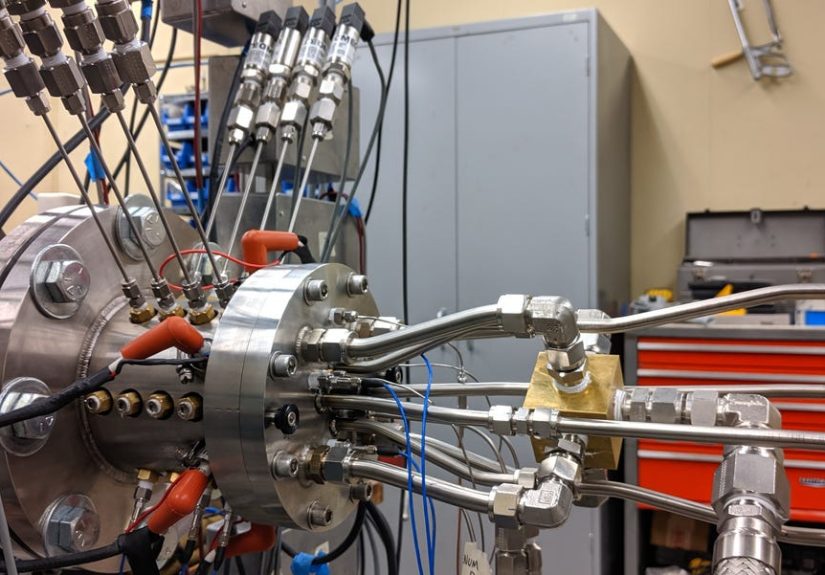
Rotating detonation rocket engines are no longer just an equation on a whiteboard. NASA, universities, government labs, and private aerospace companies have moved the concept into serious hot-fire testing.
NASA’s work has shown important progress in full-scale RDRE testing. At Marshall Space Flight Center, engineers tested a 3D-printed rotating detonation rocket engine combustor for more than four minutes, producing thousands of pounds of thrust. NASA has also studied advanced materials such as GRCop-42, a copper alloy designed to handle the intense thermal environment of rocket combustion hardware.
Purdue University has been deeply involved in rotating detonation research, including experiments and analysis of how detonation waves behave in annular channels. University research is valuable because RDEs are not just hardware problems; they are physics problems, combustion problems, fluid dynamics problems, manufacturing problems, and “why did the pressure sensor just do that?” problems all at once.
Private industry is also moving quickly. Astrobotic’s Chakram RDRE testing has drawn attention because extended-duration firing is a key milestone for practical space propulsion. A detonation engine that works briefly is interesting. One that survives longer burns, reaches thermal steady state, and can be inspected afterward without looking like modern art made by a flamethrower is much more useful.
The Main Engineering Challenges
If rotating detonation engines offer so much promise, why are they not already pushing every rocket into orbit? Because controlled detonation is difficult. Extremely difficult. “Teaching lightning to jog in circles” difficult.
Stable Wave Control
The detonation wave must remain stable as propellant flows in and exhaust flows out. Sometimes one wave forms. Sometimes multiple waves appear. Waves can change speed, interact, merge, or weaken. Engineers need to understand and control these behaviors to make the engine predictable.
Predictability is everything in rocketry. A rocket engine is not allowed to have a quirky personality. It must perform on command, under load, within limits, and preferably without surprising everyone in the control room.
Injector Design
The injector must feed propellants into a violent pressure environment. If chamber pressure pushes backward into the injector, performance can suffer. If mixing is uneven, the wave may not consume the propellant efficiently. If the injector cannot survive heat and pressure cycling, the design is not ready for flight.
This is why modern RDRE research often focuses heavily on injector geometry, advanced manufacturing, and thermal management. The injector is not just a plumbing part. It is the dinner service for a supersonic flame front with no patience.
Heat Management
Rocket engines are thermal nightmares with excellent branding. RDREs are no exception. The combustor walls must survive intense heat flux, pressure oscillations, and repeated exposure to detonation products. Cooling channels, heat-resistant alloys, additive manufacturing, and careful chamber design all matter.
Materials such as advanced copper alloys are attractive because they combine high thermal conductivity with strength at elevated temperatures. Additive manufacturing also helps engineers build complex internal cooling paths that would be difficult or expensive using older manufacturing methods.
Scaling From Lab to Flight
A small test combustor can demonstrate physics. A flight engine must demonstrate reliability, repeatability, manufacturability, integration, and mission value. Scaling up an RDRE changes the flow field, wave dynamics, heat load, and structural requirements. What behaves nicely in a lab can become stubborn at larger scale.
This is why ground testing matters so much. Long-duration hot-fire campaigns help engineers learn whether the engine can maintain stable operation, survive thermal loads, and deliver useful thrust over mission-relevant time periods.
RDRE vs. Conventional Rocket Engine
A conventional liquid rocket engine typically uses pumps or pressure-fed systems to deliver fuel and oxidizer into a combustion chamber. The mixture burns in a controlled flame, producing hot gas that expands through a nozzle. These engines are mature, powerful, and reliable when properly designed.
A rotating detonation rocket engine changes the combustion process. Instead of relying on steady deflagration, it uses a detonation wave that travels around the annular chamber. The potential advantage is pressure gain, faster heat release, and a smaller combustor for a given performance target.
However, conventional engines have decades of flight heritage. RDREs still need more validation before they can become routine spacecraft hardware. It is not enough to be clever. In spaceflight, clever must also be testable, inspectable, repeatable, and boring in the best possible way.
Where Rotating Detonation Engines Could Be Used
RDREs could be useful in several areas of space propulsion. Upper-stage engines are one possibility because improved efficiency could help deliver payloads to higher or more demanding orbits. In-space propulsion is another possibility, especially for orbital transfer vehicles, lunar logistics, and deep-space missions.
Rotating detonation combustion is also being studied for air-breathing propulsion, power generation, and hypersonic systems. Those versions are not identical to rocket RDREs, but they share the same core attraction: pressure-gain combustion in a compact device.
For rockets, the biggest attraction is mission flexibility. If an RDRE can deliver higher performance with lower mass, spacecraft designers gain options. They may carry more payload, reduce tank size, extend maneuvering capability, or design more efficient transfer stages.
Why the Annular Chamber Is So Important
The ring-shaped chamber is not a decorative choice. It is what allows the detonation wave to keep moving continuously. Once the wave travels around the full circle, it returns to a region where fresh propellant has entered. That makes the engine capable of continuous detonation rather than isolated pulses.
The chamber shape also affects wave speed, pressure distribution, cooling, mixing, and exhaust behavior. Small changes in geometry can influence whether the engine supports one dominant wave, several waves, or unstable operation. This is why computational modeling and high-speed diagnostics are central to RDRE development.
In simple terms, the annulus is the racetrack, the detonation wave is the race car, and the injected propellant is the track being rebuilt just in time before the car arrives again. If the timing is off, the whole race gets weird.
The Future of Rotating Detonation Rocket Engines
The future of rotating detonation rocket engines depends on proving that their theoretical advantages can become practical flight benefits. That means more hot-fire testing, better modeling, stronger materials, improved injectors, and integration with real vehicle systems.
The technology is promising because it attacks one of rocketry’s central problems: how to get more performance from the same chemical energy. Conventional engines are already highly optimized, so dramatic gains are hard to find. RDREs offer a different thermodynamic path rather than just a better version of the same old flame.
Still, the most realistic outlook is not that RDREs will magically replace all rocket engines overnight. Instead, they may first appear in specialized roles where compact size, efficiency, and high thrust density justify the added development effort. Upper stages, lunar vehicles, orbital transfer systems, and experimental propulsion platforms are plausible stepping stones.
Experience-Based Insights: What Learning About RDREs Teaches Us
Studying how a rotating detonation engine works is a useful reminder that the future of rocket propulsion is not always about making engines bigger. Sometimes the breakthrough comes from changing the rhythm of the energy release. Traditional rocket combustion is already impressive, but RDRE research asks a more aggressive question: what if the engine could use the pressure spike of detonation instead of fighting it?
One practical lesson from this topic is that engineering progress rarely looks like a single “eureka” moment. It looks more like a long chain of careful tests. A team builds a combustor, fires it for a short duration, studies pressure traces, inspects the hardware, changes the injector, improves cooling, updates the model, and then does it again. From the outside, that may sound repetitive. From the inside, that repetition is the road to reliability.
Another experience-related takeaway is that advanced propulsion depends on teamwork across specialties. A combustion scientist may understand detonation chemistry. A fluid dynamicist may model shock waves and mixing. A materials engineer may focus on alloys and thermal fatigue. A manufacturing specialist may design 3D-printed cooling channels. A test engineer may care most about sensors, safety margins, and whether the stand can survive the next firing. RDRE development needs all of them. No single genius strolls into the lab, tightens one bolt, and invents the future before lunch.
For students, writers, and space enthusiasts, RDREs are also a great example of why basic physics matters. The topic touches Newton’s laws, compressible flow, thermodynamics, combustion chemistry, heat transfer, acoustics, and structural design. That sounds intimidating, but it also makes the engine fascinating. Every part of the machine is connected. Change the propellant injection, and the wave behavior may change. Change the chamber size, and cooling may change. Change the nozzle interaction, and thrust performance may change.
There is also a communication lesson here. The phrase “rotating detonation engine” can scare people because “detonation” sounds uncontrolled. In aerospace engineering, however, the point is control. The engine is not supposed to explode randomly; it is supposed to guide a detonation wave through a predictable path. Explaining that difference clearly helps readers understand why researchers are excited rather than alarmed.
Finally, RDREs show why experimental humility matters. A concept can be mathematically beautiful and still behave badly when hot gas meets real metal. Long-duration testing, inspection, and repeatability are what separate exciting prototypes from useful engines. That is not a weakness of the technology; it is how aerospace earns trust. Rockets do not care about hype. They care about physics, margins, and whether the hardware works when the countdown reaches zero.
Conclusion
A rotating detonation engine works by sending one or more supersonic detonation waves around a ring-shaped combustor. Fresh fuel and oxidizer enter the annulus, the wave compresses and burns the mixture, and the resulting high-pressure gas exits through a nozzle to produce thrust. Compared with conventional rocket engines, the potential advantage is pressure-gain combustion, which could improve efficiency, reduce engine size, and increase mission flexibility.
The technology is not simple, and it is not ready to replace every rocket engine tomorrow morning. Engineers still need to master stable wave control, injector design, thermal management, scaling, and long-duration operation. But recent tests by NASA, universities, and private companies show that rotating detonation rocket engines are moving from theory toward practical propulsion.
If conventional rocket engines are the reliable veterans of spaceflight, RDREs are the ambitious newcomers with a wild résumé and serious potential. They may not be magic, but in the world of rocket science, a controlled ring of supersonic combustion is about as close to magic as metal, math, and hot gas are allowed to get.







 Close
Close