Table of Contents >> Show >> Hide
- A brief, respectful recap of the case
- Why glitter matters in forensic science
- The “glitter trail” in the Barroso investigation
- How glitter is collected (without turning the lab into a disco)
- What glitter can proveand what it can’t
- The glitter “safety tip” trend: helpful idea, wrong promise
- Why this story still matters for modern forensics
- Field & life experiences: what glitter teaches ()
- SEO Tags
Glitter is supposed to be fun. It’s the party favor you find in your hair a week later, the craft supply that migrates from one drawer to the entire planet, the shiny “why is this on my hoodie?” surprise.
But in one California investigation, glitter became something else entirely: a stubborn, microscopic witness that refused to leave the scenethen helped investigators connect a victim, a vehicle, and a suspect when other answers were limited.
This is a forensic story, not a sensational one. The crimes tied to the “Simi Valley Rapist” harmed real people, and any telling should keep the focus where it belongs: on the survivors, the victim’s loved ones, and the careful work that helped bring accountability.
A brief, respectful recap of the case
In the late 1990s and early 2000s, Simi Valley and nearby communities in Ventura County were shaken by a series of home-invasion sexual assaults. Investigators had DNA from multiple crime scenes, but it didn’t match anyone in the system at the time. The attacker was masked, careful, anduntil he wasn’thard to identify.
In the early hours after a Fourth of July celebration in 2001, 20-year-old college student Megan Barroso disappeared after turning back to return a friend’s cellphone. Her rental car was found soon after with clear signs of violence. A month later, her body was discovered in a ravine area.
Investigators began to suspect a connection between Barroso’s disappearance and the ongoing serial assaults. A major break came later that month when the suspectVincent Henry Sanchezwas arrested in connection with a burglary, and items discovered by roommates were linked to unsolved attacks. Prosecutors would ultimately build a case that combined multiple types of evidence, including trace materials, to establish what happened and why.
In 2003, a jury convicted Sanchez of first-degree murder, kidnapping, and attempted rape related to Barroso’s death, along with other charges connected to his crimes. He was later sentenced to death under California law at the time.
Why glitter matters in forensic science
Forensic science doesn’t always hinge on a dramatic DNA match or a single “aha” moment. Sometimes it’s about small transfersmaterials that move between people, objects, and environments during contact. This is the logic behind trace evidence: if two things touch, something can travel.
Glitter is unusually good at this for three simple reasons:
- It transfers easily. Tiny, lightweight particles move with casual contacthair, clothing, car seats, blankets, upholstery.
- It persists. Glitter clings, hides in seams, and survives “cleaning” attempts that would remove more obvious traces.
- It’s surprisingly discriminating. Glitter isn’t one thing. It varies by color, shape, thickness, layering, and composition.
That last point is the key. Glitter generally cannot “individualize” a person the way a fingerprint or a single-source DNA profile can. But it can be highly useful associative evidence: it can support the idea that a person was in a particular environment, in a particular vehicle, or in contact with a particular itemespecially when the glitter’s characteristics are uncommon and the circumstances make innocent transfer unlikely.
What glitter is made of (and why that helps)
Many glitter products are engineered from layered filmsoften polymers with thin metallic coatings and protective layers. Think of it like a microscopic club sandwich: shiny layer, plastic layer, coating layer, sometimes with special optical effects. Because manufacturers use different materials and processes, glitter can show meaningful variation under a microscope and through lab instruments.
Professional trace evidence guidance describes a typical analytical “ladder” that starts with the simplest comparisons and moves to more technical methods only as needed: physical characteristics (color, size, shape, thickness, layers), then tools like FTIR (to characterize polymers), specialized color measurements, and SEM/EDS (to examine elemental composition in layers).
Research funded and cataloged through U.S. justice and forensic organizations has explored how techniques like SEM-EDS can group and differentiate cosmetic glitter and shimmer particlesimportant in cases involving close contact where these particles may transfer without either person noticing.
The “glitter trail” in the Barroso investigation
On the surface, glitter might seem like the least serious evidence imaginable. In this case, it was taken seriously because of context: Barroso had been at a Fourth of July gathering where red glitter was sprinkled as part of the celebration. That detail mattered later, because trace analysts were able to recover small red glitter particles from her hair and compare them to glitter recovered from places investigators believed she had been.
A forensic scientist at the Ventura County crime labEdwin Jonesworked the trace evidence side of the case. The comparison wasn’t about “glitter in general.” It was about whether glitter from a known source (the party glitter connected to Barroso) was consistent with glitter recovered from locations and items linked to the suspect.
Investigators ultimately found glitter in multiple relevant places, including areas of Sanchez’s truck and a jacket tied to Barroso. Those findings mattered because they supported a broader narrative: despite cleanup efforts and the passage of time, glitter persisted where investigators would expect it if Barroso had been in the vehicle and in contact with certain items.
In other words, glitter didn’t “solve” the case by itself. It strengthened the web of evidenceespecially around what happened before and during the abductionat a time when other forensic tools (including DNA) could not answer every question about sequence, movement, or intent.
How glitter is collected (without turning the lab into a disco)
Trace evidence collection is a balancing act: gather enough material to test, avoid contamination, and document exactly where it came from. With glitter, analysts often rely on methods designed for tiny particles:
- Tape lifts from seats, carpets, clothing, and fabric surfaces to capture particles without destroying them.
- Targeted picking with fine tools under magnification when individual particles need to be isolated for comparison.
- Careful packaging (separate bags, sealed containers, clear labeling) to prevent cross-transfer.
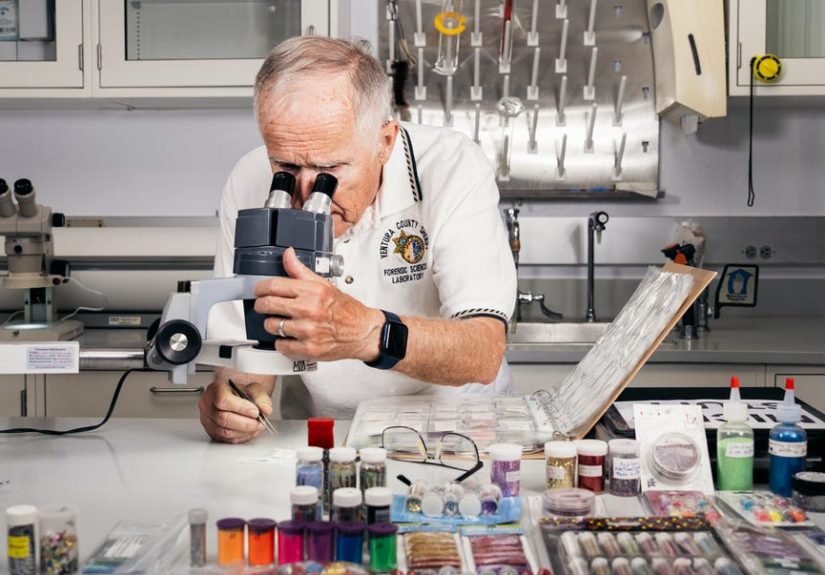
Then comes the comparison workoften starting with microscopy. Under magnification, glitter becomes less “sparkly confetti” and more “engineered material”: edges, notches, layers, striations, coatings, and other traits that can help categorize it into narrower and narrower subclasses.
Some glitters (including holographic varieties) have micro-structured features that can be measured and documented with high-powered light microscopy. Those tiny optical structures can add discriminating power when comparing questioned particles to known sources.
What glitter can proveand what it can’t
The strongest forensic testimony is honest about limits. Glitter evidence is typically used to support associations, not to declare certainty on its own. A single matching glitter particle rarely means muchglitter is common, and transfer can be innocent.
But the evidentiary value rises when:
- Multiple particles are recovered and share consistent features.
- Multiple locations show the same consistent glitter type (for example, victim + vehicle + item).
- The context makes an innocent explanation unlikely (timing, access, opportunity, and other corroborating evidence).
In the Barroso case, glitter was part of a larger evidentiary mosaic that included investigative leads, physical evidence, and admissions. That’s how trace evidence is meant to work: not as magic, but as a set of small, independent supports thattogethermake the overall story harder to deny.
The glitter “safety tip” trend: helpful idea, wrong promise
In recent years, social media has revived this case with a provocative suggestion: “Wear glitter so you’ll be traceable if something happens.”
There’s a grain of forensic logic in thatglitter transfers and persists. But it can also oversell what trace evidence can do. Glitter is not a force-field. It doesn’t prevent harm. And it’s not a guarantee investigators will recover it (or recover it in usable condition) later.
If you want practical, real-world safety habits, focus on things that reduce risk now: staying connected with friends, using trusted transportation, sharing your location with someone you trust, keeping your phone charged, and listening to your instincts. Trace evidence helps after the fact; prevention helps before it.
Why this story still matters for modern forensics
This case is a reminder that while DNA is powerful, it’s not the only tooland it doesn’t answer every investigative question. Trace evidence can fill gaps: how contact happened, where someone sat, whether an item moved, whether a “cleaned” space still holds hidden history.
It also highlights something less glamorous but critical: the value of specialists. Glitter isn’t “obvious” evidence unless someone is trained to look for it, collect it correctly, and compare it carefully. A small oversight can erase a tiny particle; a careful analyst can turn that particle into a meaningful connection.
Glitter didn’t catch the Simi Valley Rapist alone. People didsurvivors who reported, investigators who persisted, analysts who paid attention to the microscopic, and prosecutors who built a case brick by brick. Glitter simply refused to be ignored.
Field & life experiences: what glitter teaches ()
Ask anyone who has ever cleaned up after a school play, a holiday party, or a craft project: glitter doesn’t leave. It relocates. It resettles. It starts a new life in your laundry basket and sends postcards from your couch cushions. That everyday annoyance is basically the first lesson a trace evidence examiner learnspersistence is power.
In real casework, the “experience” of working with glitter often begins at the most unglamorous place possible: the evidence packaging table. Clothing arrives folded in paper, tape lifts come in labeled sheets, and everything is treated like it might contain a universe of tiny transfers. Analysts talk about learning to slow downbecause a speck that looks like lint at arm’s length can be a highly structured, layered particle under magnification.
Then there’s the microscope time. If you’ve never stared through a microscope for hours, it’s hard to explain the mix of patience and stubborn curiosity it demands. Your posture complains. Your eyes adjust. And you develop a weird talent for spotting the “one thing” that doesn’t match the background. Glitter can be that “one thing,” because it catches light in a way fibers and dust often don’t. Examiners describe it as both delightful and maddening: delightful because it’s visually complex; maddening because it can be everywhere, and “everywhere” is not the same as “meaningful.”
That’s where experience matters most: deciding what questions to ask. Is the glitter on a jacket consistent with a specific event? Does it appear in multiple places that would be hard to explain by chance? Are the particles the same size and shape? Do they share a layer sequence? If it’s holographic, do the micro-striations show a similar spacing? Each step narrows the comparison from “sparkly” to “specific,” and good analysts learn to document every observation so another examiner can follow the logic.
There’s also an underrated “experience” piece that never makes TV: contamination anxiety. Glitter is notorious for accidental transfer. It can hitchhike on gloves, lab coats, tape rolls, even the air currents created by opening a paper bag. Labs build habits to reduce that riskclean work surfaces, change gloves, separate items, control workflowsbecause the credibility of trace evidence depends on proving it was collected and handled responsibly.
Finally comes the courtroom translation problem. Jurors understand DNA and fingerprints because pop culture has taught them the vocabulary. Glitter requires a different kind of explanation: not “This proves identity,” but “This supports contact in a way that fits the rest of the evidence.” The best testimony doesn’t oversell. It respects uncertainty. It treats glitter like what it is: a strong associative clue when the context is right.
And that may be the most human takeaway of all. Glitter is tiny, persistent, and easy to dismissuntil you realize the smallest things can carry the weight of truth when people do the careful work to read them.