Table of Contents >> Show >> Hide
- What counts as a pop-up in Chrome (and what doesn’t)
- Best practice: allow pop-ups only for a site you trust
- How to allow pop-ups from Chrome Settings (Windows or Mac)
- Pop-ups still not working? Here’s what usually causes it
- Safety first: allowing pop-ups without inviting scams to dinner
- Quick FAQ
- Wrap-up
- Extra: Real-world experiences (the “why is nothing happening?” edition)
Pop-ups get a bad rapand, honestly, they earned it. Nobody wakes up thinking, “Wow, I hope 14 coupon windows chase me around the internet today.”
But sometimes a pop-up is actually the useful kind: a bank login window, a file preview, a payment verification screen, or the one tiny dialog box
that contains the “Download” button you’ve been politely waiting for like a normal person.
The good news: Google Chrome lets you allow pop-ups in a way that doesn’t turn your browser into a carnival of flashing rectangles. The best approach is
to allow pop-ups only for the specific site you trust, instead of enabling them for every website on Earth (including the sketchy ones that still think
“FREE iPhone!!!” is a convincing argument).
What counts as a pop-up in Chrome (and what doesn’t)
In Chrome, “pop-ups” generally means new windows or tabs that a site tries to open automaticallyoften without you clicking anything. Chrome groups
these under “Pop-ups and redirects”. That “redirects” part matters, because some sites also try to bounce you through extra pages
(sometimes legit, sometimes not).
A few things people call “pop-ups” aren’t technically pop-ups:
- Cookie banners (the “Accept cookies” box) are page overlays.
- Notification requests (“Allow notifications?”) are browser permissions, not pop-ups.
- New-tab ads may be caused by extensions or adware, not the site itself.
- Login windows for Google/Microsoft/SSO sometimes open as a pop-upand that’s often the one you actually need.
Best practice: allow pop-ups only for a site you trust
If you only need pop-ups for one website (a school portal, your bank, a scheduling tool, a state government form site, etc.), do it the targeted way.
This keeps your browser calm, quiet, and far less likely to surprise you with a “Congratulations, you won!” message that you definitely did not win.
Option A: allow a blocked pop-up directly from the address bar (fastest)
- Open the website that’s trying to show a pop-up.
- Trigger the action that should open the pop-up (for example: Print, Pay Now, Sign in, or Download).
- If Chrome blocks it, look near the right side of the address bar for a small pop-up blocked icon/message.
Click it. - Choose something like “Always allow pop-ups and redirects from [site]” (wording can vary slightly).
- Click Done (if prompted), then refresh the page and try again.
This method is great because it’s basically Chrome saying: “Hey, I stopped a thing. Was this a good thing or a bad thing?” And you get to answer
like a responsible adult.
Option B: use the site’s permission panel (quick and tidy)
- Go to the site.
- Click the icon to the left of the website address (often a slider/tune icon, lock, or site info symbol).
- Select Site settings.
- Find Pop-ups and redirects and set it to Allow.
- Reload the page and try the action again.
How to allow pop-ups from Chrome Settings (Windows or Mac)
If you prefer doing things from the control center (or you want to add/remove multiple sites), Chrome’s Settings is the place.
The menu labels may look slightly different depending on your Chrome version, but the path is typically consistent.
Step-by-step: open Pop-ups and redirects settings
- Open Chrome on your computer.
- Click the three dots in the top-right corner.
- Click Settings.
- Click Privacy and security.
- Click Site settings.
- Click Pop-ups and redirects.
Tip for speed-lovers: you can often jump straight there by typing this in the address bar:
chrome://settings/content/popups
and pressing Enter.
Choose your approach: block most pop-ups, allow the good sites
On the Pop-ups and redirects page, you’ll typically see a default behavior and then a “customized behaviors” section with two lists:
sites that are allowed and sites that are not allowed.
- Recommended: Keep blocking as the default, and add only trusted sites to the Allowed list.
- Not recommended (but possible): Allow pop-ups for all sites. This can be useful for short-term troubleshooting, but it’s like
leaving your front door open because you’re expecting a pizza delivery.
How to add a site to the “Allowed” list
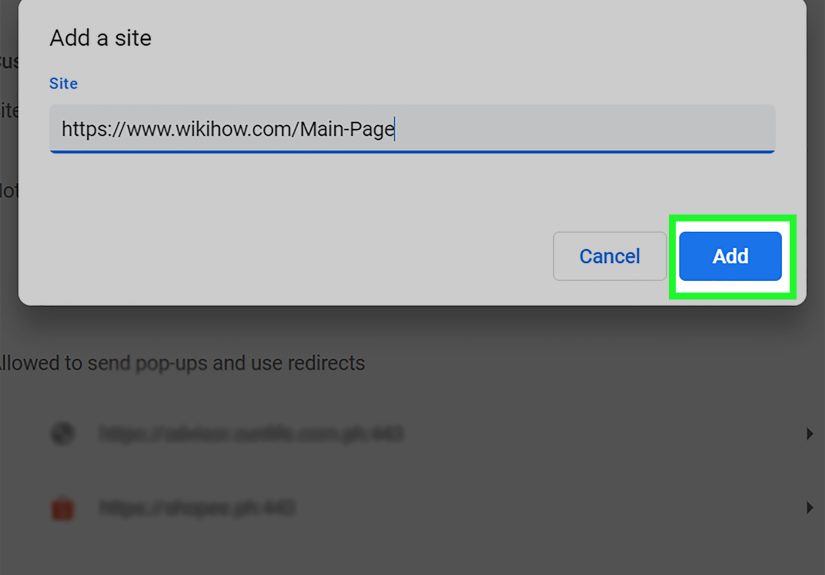
- Under Allowed to send pop-ups and use redirects, click Add.
- Type the site’s address (for example: https://www.yourbank.com).
- Click Add to save.
- Return to the site and try again.
Example: If a healthcare portal opens lab results in a separate window, add that portal to the Allowed list.
Then when you click “View Results,” Chrome won’t block it like it’s a surprise party you didn’t RSVP to.
How to remove or change a site exception
- Go back to Settings > Privacy and security > Site settings > Pop-ups and redirects.
- Find the site under Allowed or Not allowed.
- Click the three dots next to the site.
- Choose Remove (or change the setting, depending on the menu options shown).
Pop-ups still not working? Here’s what usually causes it
If you allowed pop-ups and still get nothing, don’t panic. Chrome isn’t being stubborn “for fun.” (Chrome doesn’t have hobbies.)
Most issues fall into a few predictable buckets.
1) The “pop-up” is actually being blocked by an extension
Ad blockers, privacy extensions, script blockers, and security tools can prevent new windows from openingsometimes even on trusted sites.
Try this quick test:
- Open an Incognito window (Ctrl+Shift+N on Windows, Command+Shift+N on Mac).
- Visit the site and try again.
If it works in Incognito, an extension is the likely culprit. You can disable extensions one by one (or allowlist the site inside your blocker) until
you find the one acting like an overprotective bodyguard.
2) The site needs third-party cookies for its login pop-up
Some sign-in flows (especially “Sign in with Google/Microsoft” or older SSO systems) use a pop-up window that depends on cookies to complete
authentication. If the pop-up opens but looks blank, loops, or fails to log you in, check your cookie settings:
- Go to Settings > Privacy and security.
- Look for Third-party cookies (or cookie controls).
- If you’re blocking third-party cookies, try allowing them temporarily for that site, then re-test the login.
After you’re done, switch back to your preferred privacy level.
You don’t need to live permanently in “cookies everywhere” modejust long enough to finish what you’re doing.
3) Chrome is blocking abusive behavior (even when pop-ups are “allowed”)
Chrome may still restrict pop-ups if a site behaves like a whack-a-mole machine (multiple windows, rapid redirects, or patterns associated with spam).
If this is happening on a site you truly trust, confirm you added the correct domain (not a lookalike) and try again after clearing the site’s
permission settings and re-allowing it.
4) You’re on a managed browser (work/school device)
If your Chrome is managed by an organization, some settings may be enforced and not changeable. You can check quickly:
- Click the three dots menu and look at the bottom for a “Managed by your organization” message.
- Or type chrome://management in the address bar and press Enter.
If it’s managed, you may need your IT/admin team to allow pop-ups for specific sites. On personal devices, “managed” can sometimes indicate that a
work profile or policy is attachedso it’s worth reviewing your Chrome profiles and installed extensions.
Safety first: allowing pop-ups without inviting scams to dinner
The fastest way to ruin your day is to allow pop-ups everywhere and then click the one that screams, “YOUR COMPUTER IS INFECTEDCALL NOW.”
Real security warnings don’t recruit you through pop-up windows with urgent phone numbers.
Red flags that a pop-up is bad news
- It claims you have a virus and demands immediate action.
- It includes a phone number and tells you to call for “support.”
- It won’t let you close the tab normally (or tries to go full-screen to trap you).
- It pressures you with countdowns, threats, or “account locked” drama.
How to close a suspicious pop-up safely
- Press Esc to exit full-screen or dismiss overlays.
- Close the tab/window without clicking inside the pop-up.
- If Chrome becomes unresponsive, force quit the browser (Task Manager on Windows, Force Quit on Mac).
- Reopen Chrome, then check extensions and run a security scan if the behavior persists.
If you keep seeing pop-ups on sites you don’t recognizeor you’re getting redirected to random pagestreat it as a warning sign:
you may have an unwanted extension, adware, or a notification permission you didn’t mean to grant.
Quick FAQ
Should I allow pop-ups for all sites?
Usually, no. It’s better to allow pop-ups only for specific sites you trust. That way, legitimate tools work and the junk stays locked outside.
Why does my pop-up open as a new tab instead of a window?
Some sites open content in new tabs by design. Also, browser settings, extensions, or your operating system can influence whether a new page appears
as a separate window or a tab.
Why do pop-ups work in another browser but not in Chrome?
Chrome’s site-permission system may be stricter, or an extension may be interfering. Test in Incognito, then review extensions and site settings.
I allowed pop-ups, but the site still says “Please enable pop-ups.” Why?
Common reasons include: you allowed the wrong domain (the site uses a different login domain), an extension blocks scripts/windows, or the pop-up is
failing due to cookie restrictions during login.
Wrap-up
Allowing pop-ups in Chrome on a computer is simple once you know where to look. The smartest move is to keep pop-up blocking on by default and only
allow the sites you trustso your important login windows can open without turning your browser into an internet haunted house.
Extra: Real-world experiences (the “why is nothing happening?” edition)
The first time I had to allow pop-ups in Chrome, it wasn’t for anything glamorous. It was for a totally normal, very adult task:
downloading a PDF receipt. I clicked “Download Receipt,” and… nothing. No error, no warning, no dramatic trumpet. Just silence.
The kind of silence that makes you click the button again, then again, and then aggressively question your life choices.
That’s the thing with pop-ups: when they’re blocked, the website often acts like it did its job. In the site’s mind, it tossed the file into a new
window like a waiter placing a plate on your table. But Chrome intercepted it at the door like, “Absolutely not. We don’t know that plate.”
Once I spotted the tiny pop-up blocked icon in the address bar and allowed it for that site, the receipt appeared instantlyas if the browser had been
holding it hostage out of pure principle.
Another classic scenario: sign-in pop-ups. Some services (especially older portals, training sites, and certain payment verification steps) open a login
window in a pop-up. If Chrome blocks it, you’ll click “Sign In,” see a spinner, and then get dumped right back where you started. It feels like being
politely rejected by a door that keeps closing itself. The fix is usually to allow pop-ups for that specific domain. But here’s the twist:
sometimes the pop-up is coming from a different domain (for example, an authentication provider).
So you might allow pop-ups for the main site, and it still won’t work until you allow the sign-in domain too.
The most confusing experience I’ve seen is when the pop-up opens, but it’s blank. That’s when cookies (especially third-party cookies) can get involved.
The login window appears, but it can’t “remember” the session, so it loops or shows an empty page. In those cases, temporarily relaxing cookie settings
for the site can solve it. The key word is temporarily. You’re not moving into a cookie factory; you’re just borrowing a cup of sugar.
Pop-ups also show up in unexpected places: scheduling tools that open a calendar picker in a new window, HR sites that generate forms in a separate tab,
and some education portals that launch quizzes or training modules as pop-ups. These are often legitimateannoying, yes, but legitimate. What helps is
creating a habit: the moment something “should have opened” and didn’t, glance at the address bar for that blocked pop-up notice. It’s usually the
biggest clue Chrome gives you, and it’s easy to miss if you’re staring at the middle of the page like it owes you money.
Finally, the not-fun experience: scam pop-ups. If you ever land on a page that screams your device is infected and tells you to call a number, treat it
like a prank call from the internet. Don’t click inside it. Don’t “accept” anything. Close the tab, press Esc, or force quit the browser if needed.
Afterward, check your extensionsbecause many recurring pop-up problems aren’t from Chrome settings at all, but from an extension that’s acting like it
got hired by chaos.
The overall lesson from these experiences is simple: allow pop-ups with a scalpel, not a flamethrower. Add trusted sites to the allow list, test, and
keep your default protection in place. That way, the next time a legitimate window needs to appear, it can do its jobwithout opening the floodgates
for every sketchy “You’re today’s lucky visitor!” message on the web.