Table of Contents >> Show >> Hide
- Table of contents
- What normality means (and why it’s reaction-dependent)
- Step 1: Write the reaction and choose the n-factor
- Step 2: Convert solute amount to equivalents
- Step 3: Convert solution volume to liters
- Step 4: Compute normality and sanity-check it
- Worked examples (acid-base + redox)
- Normality in titrations (N1V1 = N2V2)
- Common pitfalls and pro tips
- 1) Forgetting that normality depends on the reaction
- 2) Using the wrong n-factor for polyprotic acids/bases
- 3) Mixing up volume of solution vs volume of aliquot
- 4) Treating “N” like a permanent label
- 5) Notation tip: write what the normality is “with respect to”
- Mini cheat sheet (common acid-base n-factors)
- Experiences & real-world lessons (extra section)
- Conclusion
- SEO tags (JSON)
“Normality” sounds like a personality trait (“I’m very normal, thanks for asking”), but in chemistry it’s a concentration unit:
equivalents per liter. If molarity is “how many moles,” normality is “how many moles of reactive power.”
That’s why it’s still common in titrations and older method manuals, even though many modern texts call it “less common” or “obsolete”
because it can change depending on the reaction you’re doing.
This guide shows you a clear, repeatable way to compute normality in four steps, with examples for acids, bases,
and redox reactionsplus a “been-there-done-that” section at the end so you can dodge the most common facepalm mistakes.
(No lab coat required, but if you’re in an actual lab, follow your instructor’s safety rules.)
What normality means (and why it’s reaction-dependent)
Normality (N) is defined as:
N = equivalents of solute / liters of solution (Eq/L)
An equivalent is the amount of a substance that reacts stoichiometrically with a fixed amount of something elseoften
1 mole of H+ in acid-base chemistry, 1 mole of OH− in base reactions, or 1 mole of electrons in redox reactions.
Here’s the plot twist: the number of equivalents per mole depends on the reaction. That’s why normality can change
based on conditions (especially in redox). Many educational and lab references emphasize that if you use normality, you must tie it to
the specific reaction context.
You’ll also see normality connected to molarity with a reaction-specific multiplier:
N = M × n-factor, where the n-factor is “equivalents per mole.”
Step 1: Write the reaction and choose the n-factor
Before you touch a calculator, write the balanced reaction (or at least identify the reactive unit). Your job in Step 1 is to determine
how many equivalents correspond to 1 mole of the solute in this reaction.
Acid-base reactions: count H+ or OH− actually involved
- Monoprotic acids (like HCl): n = 1 (one H+ per mole donated).
- Diprotic acids (like H2SO4): often n = 2 if both protons react completely.
- Triprotic acids (like H3PO4): n can be 1, 2, or 3 depending on how far neutralization goes.
- Bases: n equals the number of OH− the base can supply per mole (NaOH → n = 1; Ca(OH)2 → n = 2).
This is why a single “normality of phosphoric acid” without context can be… suspiciously incomplete.
Redox reactions: count electrons transferred (and note the conditions)
For redox, the n-factor is based on the number of electrons exchanged per mole of oxidizing/reducing agent in the balanced redox equation.
The same chemical can have different n-factors in acidic vs. basic mediaso don’t skip writing the actual redox half-reactions.
MIT and other lab-focused references emphasize tying “equivalents” directly to stoichiometry for the reaction at hand.
Step 2: Convert solute amount to equivalents
Once you know the n-factor, turn whatever you were given (moles, grams, molarity, or a titration relationship) into equivalents.
You have a few common routes:
Route A: If you have moles
equivalents = moles × n-factor
Route B: If you have molarity
Molarity is moles per liter. So:
N = M × n-factor (this is the fast lane when n-factor is clear).
Route C: If you have mass (grams)
Use equivalent weight:
equivalent weight (g/eq) = molar mass / n-factor.
Then:
equivalents = grams / equivalent weight.
Universities and lab education resources frequently present normality calculations this way because it matches how solutions are weighed and prepared in practice.
Step 3: Convert solution volume to liters
Normality is “per liter of solution.” So convert the final solution volume to liters:
1000 mL = 1.000 L.
Tiny but important: if the problem says “diluted to a final volume of 250 mL,” use 0.250 L (the final volume), not “about how much water you poured.”
(Chemistry problems love clarity; reality sometimes loves chaos.)
Step 4: Compute normality and sanity-check it
Now apply the definition:
N = equivalents / liters of solution
Sanity checks that save you from heartbreak
- Check units: equivalents should be dimensionless “amount,” liters in L, so N becomes Eq/L.
- Compare to molarity: if you know M, N should be M multiplied by a small whole number for many acid-base cases (1, 2, 3…).
- Ask “which reaction?” If someone hands you a normality value without stating what it’s normal for, that’s a clue the question is incomplete.
Worked examples (acid-base + redox)
Example 1: Convert molarity to normality (H2SO4)
You have 0.050 M sulfuric acid, and in this titration it donates both protons (n = 2).
Then:
N = M × n = 0.050 × 2 = 0.100 N.
This “N is a multiple of M” relationship for reactive units shows up in multiple US lab education references and titration notes.
Example 2: Normality from mass and volume (NaOH)
Dissolve 4.00 g of NaOH and make the final volume 500 mL.
For NaOH in acid-base neutralization, n = 1. Molar mass ≈ 40.00 g/mol, so moles = 4.00 / 40.00 = 0.100 mol.
Equivalents = moles × n = 0.100 × 1 = 0.100 eq.
Volume = 500 mL = 0.500 L.
N = eq / L = 0.100 / 0.500 = 0.200 N.
Similar worked examples appear in general chemistry instructional material discussing normality vs molarity.
Example 3: Normality of Ca(OH)2 (watch that n-factor)
Suppose you have 0.010 M Ca(OH)2 for an acid-base titration.
Ca(OH)2 provides 2 OH− per formula unit, so n = 2.
N = 0.010 × 2 = 0.020 N.
Example 4: Same substance, different normality (oxalic acid as acid vs reducing agent)
One reason educators warn that normality is reaction-dependent: the same compound can have different equivalents depending on what it’s doing.
Analytical chemistry examples show oxalic acid can be treated as an acid in neutralization or as a reducing agent in redox, changing the relevant “reactive unit.”
Takeaway: always label normality with the reaction context (acid-base vs redox) when it matters.
Example 5: Redox normality (conceptual KMnO4 note)
In redox titrations, the n-factor is the number of electrons transferred per mole of titrant in the balanced redox equation.
For oxidizers like permanganate, the electron count differs by medium (acidic vs neutral/basic), so the same molarity can imply different normality.
That’s why lab manuals emphasize writing the correct reaction conditions before computing equivalents.
Normality in titrations (N1V1 = N2V2)
If you’re doing a titration and everything is expressed in equivalents, the key idea is:
equivalents of acid = equivalents of base at the equivalence point.
That often simplifies to:
NacidVacid = NbaseVbase
(as long as N is defined using the correct equivalents for the reaction).
Quick titration example
If 25.00 mL of an acid is neutralized by 30.00 mL of 0.100 N NaOH, then:
Nacid = (0.100 N × 30.00 mL) / 25.00 mL = 0.120 N.
This equivalence-based framing is common in titration-focused resources and lab notes.
Common pitfalls and pro tips
1) Forgetting that normality depends on the reaction
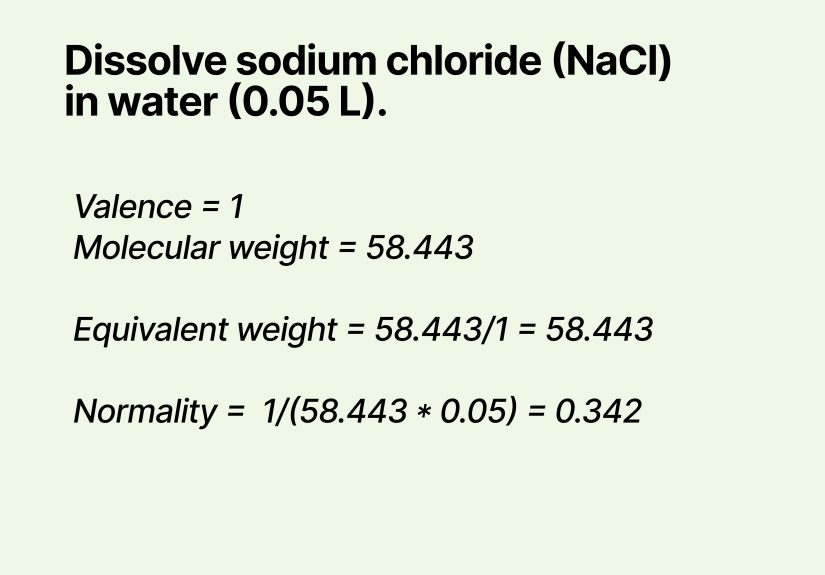
A solution of NaCl has one molarity, but normality only makes sense when you define what “equivalent” means for the reaction you care about.
Educational resources explicitly highlight this dependence because it’s the #1 source of confusion.
2) Using the wrong n-factor for polyprotic acids/bases
H3PO4 isn’t always “3 equivalents per mole.” If the reaction only neutralizes the first proton (common in some buffer regions),
n might be 1. State your assumption.
3) Mixing up volume of solution vs volume of aliquot
If you titrate a 10.00 mL aliquot taken from a 250 mL solution, your titration math gives the concentration of the original solution,
but don’t accidentally swap 10.00 mL in where 250 mL belongs (unless you enjoy dramatic plot twists).
4) Treating “N” like a permanent label
In many labs, solutions are standardized because the actual reacting strength can drift (for example, bases can react with CO2 from air).
That’s why method documents and lab instructions often emphasize standardization/verification instead of assuming the label is gospel.
5) Notation tip: write what the normality is “with respect to”
In professional contexts (and in some reference discussions), you may see normality accompanied by an equivalence factor or clearly stated reaction basis.
Even if you don’t write a formal equivalence factor, at least note “for complete neutralization” or “in acidic medium redox,” etc.
Mini cheat sheet (common acid-base n-factors)
| Solute | Typical reaction context | n-factor (eq/mol) | Fast conversion |
|---|---|---|---|
| HCl | Acid-base (1 H+) | 1 | N = M |
| H2SO4 | Complete neutralization | 2 | N = 2M |
| NaOH | Base (1 OH−) | 1 | N = M |
| Ca(OH)2 | Complete neutralization | 2 | N = 2M |
These relationships are consistent with standard titration references and university teaching notes that connect normality to “equivalents per mole.”
Experiences & real-world lessons (extra section)
If you’ve ever learned normality from a textbook and then met it in the wild (a lab manual, an older SOP, or a method sheet),
you probably had the same reaction many students have: “Why does this feel both helpful and mildly chaotic?”
That’s normal. Ironically.
One common experience is seeing a bottle labeled “0.1 N” and assuming it’s as universally meaningful as “0.1 M.”
Then you read the method and realize the normality is tied to a specific reactionneutralization, oxidation, or something more specialized.
US lab and method documents often define normality as equivalents per liter and then immediately connect it to what’s reacting (protons, hydroxide,
functional groups, electrons). Once you notice that pattern, normality stops feeling like a random letter and starts feeling like a shortcut with terms and conditions.
Another “classic” moment: you calculate normality perfectly… for the wrong n-factor. For example, you treat sulfuric acid as if it always provides
2 equivalents per mole, but the chemistry context only uses one proton (or you’re working in a region where the second dissociation isn’t the star of the show).
The math will look clean and still be wrong. The fix is boring but powerful: write the reaction first. It feels slower, but it saves time because you don’t
have to redo everything later while whispering “I swear I knew this” at your calculator.
Students also run into normality when they’re learning titrations. The equation N1V1 = N2V2 feels like magic
because it collapses stoichiometry into a single line. But it only works smoothly when “N” is defined using the correct equivalents for the reaction.
In well-written titration instructions, you’ll see repeated reminders that equivalence is the point where equivalents of titrant match equivalents of analyte.
That’s the real principle; the equation is just a convenient outfit it wears to class.
There’s also a practical lesson hiding in “standardization” procedures: concentration labels can drift. Many lab learning materials emphasize verifying the
reacting strength of solutions rather than assuming the nominal concentration is exact. You don’t need a horror story to appreciate the pointchemistry is
picky, and solutions can change subtly over time. So, in real lab workflows, the “experience” of normality is often intertwined with careful records:
what reaction basis you’re using, what the standardization result was, and what temperature/conditions apply (especially for redox systems).
Finally, one of the most useful experiences is learning to translate between “human language” and “chemistry language.”
When someone says, “We need 0.1 normal acid,” what they often mean is, “We need a solution that provides 0.1 equivalents per liter for the specific reaction in this method.”
That’s a mouthfulso normality becomes a shorthand. Your superpower is remembering the full sentence behind the shorthand.
Do that, and normality turns from a confusing label into a fast, reaction-aware tool you can use confidently.
Conclusion
Calculating normality is straightforward once you treat it as what it is: equivalents per liter.
The whole process fits into four dependable steps:
- Write the reaction and pick the correct n-factor (equivalents per mole).
- Convert solute amount to equivalents (moles × n, or grams ÷ equivalent weight).
- Convert volume to liters (final solution volume).
- Compute N = eq/L, then sanity-check with molarity if possible.
Do those steps in order, and you’ll get the right numberand, more importantly, a number that actually matches the chemistry you’re doing.