Table of Contents >> Show >> Hide
- What the Enthalpy of Moist Air Really Means
- The Standard Formula for Moist Air Enthalpy
- Before You Can Calculate Enthalpy, You Need Humidity Ratio
- Step-by-Step Example in SI Units
- Step-by-Step Example in IP Units
- How to Calculate Enthalpy from Dew Point
- How to Calculate Enthalpy from Wet-Bulb Temperature
- Why Engineers and HVAC Designers Care About Enthalpy
- Common Mistakes When Calculating Moist Air Enthalpy
- Shortcut Formulas vs. High-Accuracy Models
- A Fast Mental Check
- Conclusion
- Field Experiences and Practical Lessons Related to Calculating Moist Air Enthalpy
Note: This article is based on real psychrometric and HVAC guidance, rewritten in plain American English for web readers who want the math without the migraine.
If you have ever looked at a psychrometric chart and thought, “This seems like a weather map designed by a sleep-deprived engineer,” you are not alone. Moist air enthalpy sounds intimidating, but the idea is actually pretty friendly once you strip away the dramatic vocabulary. In simple terms, the enthalpy of moist air is the total heat content of an air-and-water-vapor mixture. It combines the sensible heat in the dry air with the latent and sensible energy carried by the water vapor.
That makes enthalpy a big deal in HVAC, dehumidification, drying, ventilation, energy recovery, and building performance. If you know how to calculate it, you can estimate cooling loads, compare indoor and outdoor air streams, predict dehumidification performance, and make better decisions instead of pointing at a duct and saying, “Well, it feels humid.”
In this guide, you will learn the moist air enthalpy formula, what humidity ratio has to do with it, how to calculate enthalpy in SI and IP units, and where people usually make mistakes. Then, because real-world engineering is never as clean as the textbook version, you will also get a longer section on field-style experiences and practical lessons.
What the Enthalpy of Moist Air Really Means
Moist air is a mixture of dry air and water vapor. Its enthalpy is usually expressed per unit mass of dry air, not per unit mass of the whole moist mixture. That detail matters because many HVAC equations are built around dry-air mass flow.
In plain English, moist air enthalpy answers this question: How much total energy is packed into this air stream? That energy comes from two sources:
The first is the heat tied to the air temperature itself. That is the sensible part. The second is the energy carried by the water vapor mixed into the air. That is where the latent heat shows up, and it is the reason muggy air often has a much higher enthalpy than dry air at the same temperature.
So if two rooms both sit at 75°F, but one feels like a desert and the other feels like a steamed dumpling, the steamy room usually has the higher moist-air enthalpy.
The Standard Formula for Moist Air Enthalpy
SI Units Formula
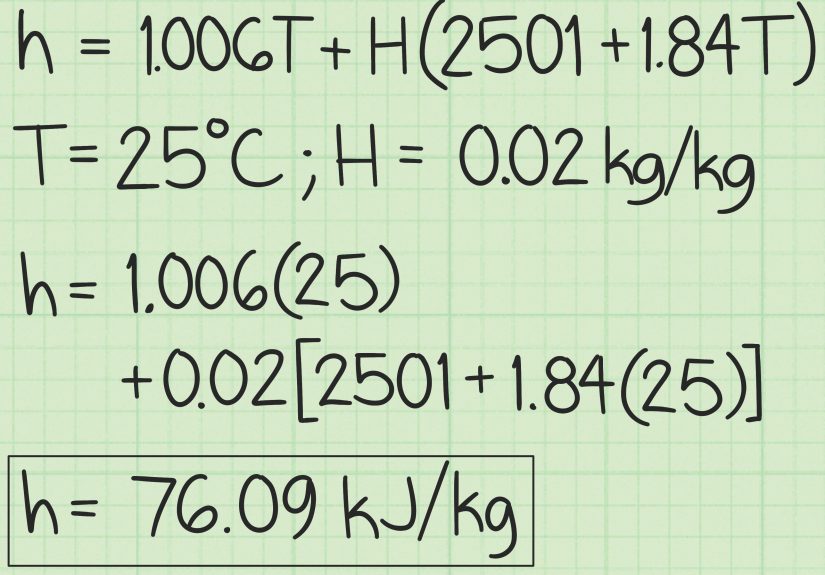
For many engineering and HVAC calculations, the standard simplified SI formula is:
h = 1.006T + W(2501 + 1.86T)
Where:
h = enthalpy of moist air in kJ/kg of dry air
T = dry-bulb temperature in °C
W = humidity ratio in kg water vapor / kg dry air
IP Units Formula
If you work in Imperial or inch-pound units, the familiar form is:
h = 0.240T + W(1061 + 0.444T)
Where:
h = enthalpy of moist air in Btu/lb of dry air
T = dry-bulb temperature in °F
W = humidity ratio in lb water vapor / lb dry air
These formulas are the workhorses of practical psychrometrics. They are not the only way to calculate moist-air properties, but they are the shortcut most HVAC people use when they want a dependable answer without launching a full thermodynamic software package.
Before You Can Calculate Enthalpy, You Need Humidity Ratio
The secret ingredient is not magic. It is humidity ratio.
Humidity ratio tells you the actual mass of water vapor mixed with a given mass of dry air. Once you know that, enthalpy becomes much easier to calculate.
The standard relation is:
W = 0.621945 Pv / (P - Pv)
Where:
W = humidity ratio
Pv = partial pressure of water vapor
P = total atmospheric pressure
If you know relative humidity, then you usually find vapor pressure with:
Pv = RH × Psat(T)
Where:
RH = relative humidity expressed as a decimal
Psat(T) = saturation vapor pressure at the dry-bulb temperature
That means a full enthalpy calculation often follows this order:
First, measure dry-bulb temperature. Second, determine relative humidity, wet-bulb temperature, or dew point. Third, calculate or read the humidity ratio. Fourth, plug the humidity ratio into the enthalpy equation. Nice and civilized.
Step-by-Step Example in SI Units
Let’s calculate the enthalpy of moist air at these conditions:
Dry-bulb temperature: 30°C
Relative humidity: 60%
Pressure: 101.325 kPa
Step 1: Find Saturation Vapor Pressure
At 30°C, the saturation vapor pressure of water is about 4.24 kPa.
Step 2: Find Actual Vapor Pressure
Pv = 0.60 × 4.24 = 2.54 kPa
Step 3: Calculate Humidity Ratio
W = 0.621945 × 2.54 / (101.325 - 2.54)
W ≈ 0.0160 kg/kg dry air
Step 4: Plug into the Enthalpy Formula
h = 1.006(30) + 0.0160(2501 + 1.86 × 30)
h = 30.18 + 0.0160(2556.8)
h = 30.18 + 40.98
h ≈ 71.2 kJ/kg dry air
That is your answer. The moist air enthalpy is about 71.2 kJ/kg of dry air.
Notice something important: the water-vapor term contributes a huge chunk of the total. That is why humidity is such an energy bully in cooling and dehumidification problems.
Step-by-Step Example in IP Units
Now let’s do an HVAC-style example in Imperial units.
Dry-bulb temperature: 75°F
Relative humidity: 50%
Pressure: 14.696 psia
Using the same logic, the humidity ratio comes out to about:
W ≈ 0.00923 lb water / lb dry air
Now use the IP enthalpy equation:
h = 0.240(75) + 0.00923(1061 + 0.444 × 75)
h = 18.0 + 0.00923(1094.3)
h = 18.0 + 10.1
h ≈ 28.1 Btu/lb dry air
So under these conditions, the moist-air enthalpy is about 28.1 Btu/lb of dry air.
How to Calculate Enthalpy from Dew Point
If you know dry-bulb temperature and dew point instead of relative humidity, the process is often easier.
The dew point tells you the temperature at which the air would become saturated if cooled at constant pressure. That means the vapor pressure of the air is equal to the saturation pressure at the dew-point temperature.
So the workflow is:
Find Psat(Tdp). Set that equal to Pv. Use the humidity-ratio formula to calculate W. Then use the enthalpy formula.
This approach is popular because dew point is tied directly to the actual moisture content of the air. Relative humidity, by contrast, changes when temperature changes, even if the actual water vapor stays the same. Relative humidity can be a bit of a drama queen.
How to Calculate Enthalpy from Wet-Bulb Temperature
If you have dry-bulb temperature and wet-bulb temperature, you can determine the air state with a psychrometric chart or a psychrometric calculator. In ordinary HVAC work, this is often the fastest route.
On a psychrometric chart, you locate the dry-bulb temperature on the horizontal axis. Then you move along the line associated with the wet-bulb temperature. The intersection gives the state point. From there, you can read humidity ratio and enthalpy directly.
Wet-bulb lines and enthalpy lines are close cousins on the chart, which is why technicians often use wet-bulb measurements in field diagnostics. If you have ever seen someone carrying a sling psychrometer and looking far too pleased with themselves, this is the reason.
Why Engineers and HVAC Designers Care About Enthalpy
Enthalpy is not just a classroom exercise. It shows up in practical work all the time.
In air-conditioning systems, enthalpy helps estimate how much total energy must be removed from incoming air. In dehumidification, it helps separate sensible cooling from latent moisture removal. In energy recovery ventilation, it helps compare outdoor air and exhaust air streams. In drying applications, it helps evaluate the energy carried into and out of the process air. In weather-based design, it helps interpret hot-humid conditions more realistically than temperature alone.
If your job touches HVAC controls, dedicated outdoor air systems, cooling coils, heat recovery wheels, or building moisture performance, moist-air enthalpy is not optional trivia. It is the number behind many expensive decisions.
Common Mistakes When Calculating Moist Air Enthalpy
Using Relative Humidity Instead of Humidity Ratio
This is the classic mistake. The enthalpy formula uses W, not relative humidity. Relative humidity must first be converted into vapor pressure and then into humidity ratio.
Mixing SI and IP Units
Using °F with the SI equation is a wonderful way to get a terrible answer. Pick one unit system and stay loyal to it until the calculation is done.
Ignoring Atmospheric Pressure
At higher elevations, pressure drops, and that changes the humidity ratio. If you are working in Denver, pretending you are at sea level is like calculating swimming speed while ignoring the fact that the pool is missing half its water.
Confusing Per Pound of Dry Air with Per Pound of Moist Air
Most HVAC psychrometric formulas express enthalpy per unit mass of dry air. If a software tool uses a different basis, your results may not match unless you convert carefully.
Comparing Chart Values Without Checking the Reference State
Some psychrometric charts use different zero references for enthalpy. That can shift the displayed state-point enthalpy values. The good news is that enthalpy differences remain valid, which is usually what matters in heat-transfer calculations.
Shortcut Formulas vs. High-Accuracy Models
The simplified formulas in this article are excellent for most HVAC and building calculations. They assume ideal-gas behavior and nearly constant specific heats over the temperature range of interest. For normal air-conditioning problems, that is a reasonable engineering shortcut.
But for high-accuracy work, wide pressure ranges, unusual gas mixtures, research-grade analysis, or nonstandard environments, more advanced property models are available. These real-humid-air methods are the thermodynamic equivalent of switching from a pocket calculator to a laboratory instrument. Both are useful. One just costs more and judges your rounding habits.
A Fast Mental Check
Here is a handy sanity check. At a fixed dry-bulb temperature, enthalpy goes up as humidity ratio goes up. If your math says air became much wetter but the enthalpy somehow dropped, something went sideways. Likewise, warm humid air should usually have noticeably higher enthalpy than cool dry air. If your result claims otherwise, the units may have staged a rebellion.
Conclusion
To calculate the enthalpy of moist air, you need two things: the dry-bulb temperature and the humidity ratio. Once you have them, the math is straightforward. Use the SI formula if your temperature is in Celsius and the IP formula if you work in Fahrenheit and Btu per pound of dry air. If you are starting from relative humidity, dew point, or wet-bulb temperature, first convert those conditions into humidity ratio. Then plug the value into the enthalpy equation.
That is the whole game. Moist air enthalpy is simply a practical way to describe the total energy content of air. Learn that one idea well, and psychrometrics stops looking like a wall of diagonal chaos and starts looking like a useful decision tool.
Field Experiences and Practical Lessons Related to Calculating Moist Air Enthalpy
In real-world work, the most memorable experiences with moist-air enthalpy usually happen when someone focuses only on dry-bulb temperature and gets fooled by humidity. A room can be “cool enough” on a thermostat and still feel miserable because the latent load is doing most of the damage. That is where enthalpy becomes more than a classroom number. It becomes the explanation for why occupants are uncomfortable, why a coil seems overworked, or why a ventilation strategy that looked good on paper is underperforming in July.
A common practical lesson is that outdoor air can carry a surprising amount of total energy even when the dry-bulb temperature does not look extreme. In hot-humid climates, technicians often discover that a modest change in humidity ratio can push enthalpy much higher than expected. Suddenly, that “fresh air” load is not so fresh. It is more like inviting a warm wet blanket into the building and asking the cooling coil to be polite about it.
Another frequent experience comes from troubleshooting economizers. People sometimes assume that if outdoor air is cooler than return air, bringing in more outdoor air will always help. Then enthalpy enters the room like the grown-up in the meeting. If the outdoor air is cooler but much wetter, the total energy can still be higher than the return air. The result is an economizer that looks smart on temperature alone but behaves like it is trying to sabotage the utility bill.
On the measurement side, field experience teaches humility very quickly. A small error in relative humidity, wet-bulb reading, or barometric pressure can ripple through the humidity-ratio calculation and affect enthalpy. Cheap sensors, poor calibration, dirty probes, bad placement near coils, and rushed measurements can all produce numbers that look precise but are not trustworthy. The math may be perfect while the inputs are nonsense. That is a classic engineering trap.
People also learn that psychrometric charts are excellent for intuition, but spreadsheets and software are better for repeatable calculations. The chart helps you understand the direction of a process: sensible cooling moves left, humidification moves up, cooling and dehumidification slide down and left. But once you need submittal-quality values or system comparisons, algebra and digital tools are the safer choice. Eyeballing a chart is fine for quick judgment. Basing a large equipment decision on eyeballing alone is how legends of preventable mistakes begin.
Perhaps the most useful practical lesson is this: enthalpy is a better conversation starter between design, controls, and operations teams than temperature by itself. Temperature tells you how hot the air feels right now. Enthalpy tells you how much total work the system must do. When a project team starts talking in enthalpy terms, discussions about ventilation, dehumidification, energy recovery, and comfort usually become sharper, faster, and less theatrical. And that may be the most beautiful psychrometric outcome of all.