Table of Contents >> Show >> Hide
- Why Knowing This Conversion Matters
- The Basic Formula
- How to Convert Metric Weight to Pounds: 7 Steps
- Examples of Metric Weight to Pounds Conversions
- Common Mistakes to Avoid
- Quick Reference Conversion Chart
- When to Use a Calculator Instead of Mental Math
- Real-Life Experiences With Converting Metric Weight to Pounds
- Final Thoughts
If you have ever stared at a suitcase tag, a gym machine, a baby growth chart, or a recipe package and thought, “Cool, but what does this weigh in pounds?” welcome to the club. Converting metric weight to pounds sounds like one of those things you learned once, forgot twice, and now have to Google forever. The good news: it is actually simple once you know the formula, understand when to round, and avoid a few classic mistakes.
In everyday American English, people often say “weight” when they really mean “mass,” and that is normal. For practical purposes, if you are converting kilograms or grams to pounds for shopping, travel, fitness, health forms, shipping, or cooking, you just need the right conversion factor and a repeatable method. This guide walks you through the process in a way that is easy to remember, accurate enough for real life, and not nearly as scary as middle-school math tried to make it seem.
Why Knowing This Conversion Matters
Metric and U.S. customary units still bump into each other all the time. You may buy dumbbells labeled in kilograms, see a person’s weight listed in kg on a medical record, or get luggage limits in kilograms when flying internationally. Meanwhile, plenty of Americans still think in pounds. That means knowing how to convert metric weight to pounds is one of those oddly useful life skills, like knowing how to fold a fitted sheet or pretend you understand your Wi-Fi router.
This conversion is especially useful in these situations:
- Travel: Airlines often list baggage limits in kilograms.
- Health and fitness: Medical charts, BMI tools, and gym equipment may use metric units.
- Shopping: Imported products often list weight in kilograms or grams.
- Cooking and meal prep: Recipes and food packaging may mix systems.
- Shipping and business: Parcel weights are often shown in both metric and standard units.
The Basic Formula
Here is the main formula you need:
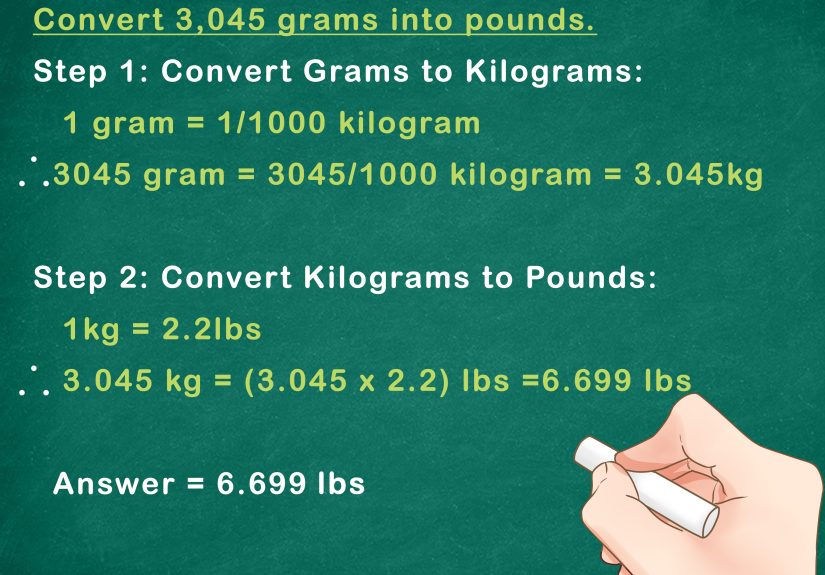
Pounds = kilograms × 2.204623
For quick mental math, many people use this simplified version:
Pounds ≈ kilograms × 2.2
That quick method is usually good enough for everyday use. If you need more precision, such as for technical work, medical calculations, or detailed shipping records, use the longer factor.
If the starting unit is grams instead of kilograms, convert like this:
Pounds = grams × 0.00220462
And if you are dealing with metric tons:
Pounds = metric tons × 2,204.623
How to Convert Metric Weight to Pounds: 7 Steps
Step 1: Identify the metric unit you are starting with
Before you do any math, make sure you know whether the number is in kilograms (kg), grams (g), or metric tons (t). This matters because each unit uses a different multiplier.
For example:
- 5 kg is not the same as 5 g.
- 750 g is less than 1 kg.
- 1 metric ton is much, much larger than 1 kg.
This may sound obvious, but unit confusion is one of the easiest ways to get a ridiculous answer. If your “small package” suddenly weighs 1,653 pounds, something has gone very wrong.
Step 2: Choose the correct conversion factor
Once you know the metric unit, match it with the right conversion factor:
- Kilograms to pounds: multiply by 2.204623
- Grams to pounds: multiply by 0.00220462
- Metric tons to pounds: multiply by 2,204.623
If you only need a fast estimate, you can round the kilograms-to-pounds factor to 2.2. That is why people often say, “Just double it and add a little.” It is not poetry, but it works.
Step 3: Set up the equation
Write the number clearly and place the multiplier next to it. This keeps the calculation neat and helps you avoid using the wrong factor halfway through.
For example, if you want to convert 12 kilograms to pounds:
12 × 2.204623 = ?
If you want to convert 500 grams to pounds:
500 × 0.00220462 = ?
Simple setup, fewer mistakes. Math likes structure almost as much as people like pretending they can estimate perfectly in their head.
Step 4: Multiply
Now do the actual calculation. Use a calculator if you want speed, or do it by hand if you are feeling ambitious.
Example: 12 kg × 2.204623 = 26.455476 lb
Example: 500 g × 0.00220462 = 1.10231 lb
If you are using the quick conversion factor, 12 kg × 2.2 = 26.4 lb, which is close enough for many everyday situations.
Step 5: Round to a practical number
After multiplying, round your answer based on how precise you need to be.
- Everyday use: round to the nearest tenth, or even the nearest whole number
- Shipping or product labels: one or two decimal places may be useful
- Health or technical settings: follow the required standard exactly
For example:
- 26.455476 lb becomes 26.5 lb to the nearest tenth
- 1.10231 lb becomes 1.10 lb to two decimal places
The golden rule is simple: do not round too early. Finish the calculation first, then round. Early rounding can create small errors that become annoying later, especially in repeated calculations.
Step 6: Do a quick sanity check
Before you trust the answer, ask whether it makes sense.
Here is the easy logic:
- If you convert kilograms to pounds, the number should get bigger.
- If you convert grams to pounds, the result should usually be a smaller number unless you started with a very large number of grams.
- If the answer seems wildly large or tiny, recheck the unit and decimal point.
For instance, 10 kg should be about 22 lb. If your answer is 2.2 lb or 220 lb, the calculator did not betray you; the setup did.
Step 7: Match the method to the real-life situation
Not every conversion needs the same level of precision. That is what makes this skill practical rather than purely academic.
Use the 2.2 shortcut for:
- gym weights
- rough luggage estimates
- casual shopping
- quick comparisons
Use the full factor for:
- medical calculations
- technical reports
- detailed shipping records
- professional documents
That is the real secret: conversion is not just about math. It is about using the right amount of accuracy for the job in front of you.
Examples of Metric Weight to Pounds Conversions
Example 1: Convert 5 kg to pounds
5 × 2.204623 = 11.023115
Answer: 5 kg = 11.02 lb, or about 11 lb
Example 2: Convert 68 kg to pounds
68 × 2.204623 = 149.914364
Answer: 68 kg = 149.9 lb, which most people would call 150 lb
Example 3: Convert 750 g to pounds
750 × 0.00220462 = 1.653465
Answer: 750 g = 1.65 lb
Example 4: Convert 1.5 metric tons to pounds
1.5 × 2,204.623 = 3,306.9345
Answer: 1.5 metric tons = 3,306.93 lb
Common Mistakes to Avoid
Even easy conversions can go sideways when people rush. Here are the biggest mistakes:
- Using the wrong direction: To go from kg to lb, multiply. To go from lb to kg, divide.
- Mixing up grams and kilograms: 1,000 g = 1 kg. Missing that detail can wreck the result.
- Rounding too early: Keep full digits until the end.
- Forgetting the unit label: A number without “lb” or “kg” is just a lonely number.
- Using rough estimates when precision matters: “Close enough” is fine for groceries, less fine for clinical dosing.
Quick Reference Conversion Chart
- 1 kg = 2.204623 lb
- 2 kg = 4.409246 lb
- 5 kg = 11.023115 lb
- 10 kg = 22.04623 lb
- 20 kg = 44.09246 lb
- 50 kg = 110.23115 lb
- 100 kg = 220.4623 lb
If you only remember one thing, remember this: 1 kilogram is a little more than 2.2 pounds.
When to Use a Calculator Instead of Mental Math
Mental math is great for rough estimates, but calculators earn their keep when decimals start multiplying like rabbits. Use a calculator when:
- you need two or more decimal places
- you are converting grams or metric tons
- the number will be used in health, finance, shipping, or technical work
- you are tired, distracted, or one coffee behind schedule
There is no medal for doing 37.6 × 2.204623 in your head while standing in an airport line.
Real-Life Experiences With Converting Metric Weight to Pounds
One of the reasons this topic stays useful is that it shows up in very ordinary, very human moments. Travelers run into it first. A suitcase allowance of 23 kilograms does not mean much if you think in pounds, but once you convert it, you realize it is about 50.7 pounds. That little number suddenly matters when you are kneeling on the hotel floor trying to decide whether three pairs of shoes are “essential.” This is where many people learn the hard way that “close enough” is sometimes close enough to trigger an overweight baggage fee.
Fitness is another place where metric-to-pound conversion becomes surprisingly personal. Someone new to a gym may see a barbell loaded with 20 kg plates and want to know what that means in pounds before deciding whether today is a “crush it” day or a “pretend to stretch near the mirror” day. A 20 kg plate is about 44 pounds, so two of them add up fast. Converting the weight helps people compare what they lift in one gym system with what they lifted somewhere else. It also makes workout logs easier to understand, especially when gym equipment mixes kilograms and pounds like they are trying to keep everyone humble.
Health settings create another common experience. Medical records, BMI tools, and patient forms often accept metric measurements even when patients think in pounds. Someone may know they weigh 165 pounds but see 74.8 kilograms on a chart and briefly wonder whether they lost half their body overnight. Understanding the conversion makes those forms less confusing and helps people follow instructions more confidently. In clinical environments, accuracy matters more than convenience, which is why precise conversions and careful rounding are treated seriously.
Shopping and cooking have their own conversion adventures. Imported food packages may list meat, flour, or produce in grams or kilograms. A shopper trying to compare prices may see a 1 kg bag of rice and need to know quickly that it is about 2.2 pounds. In the kitchen, a recipe written with metric ingredients can feel intimidating until you realize the numbers are not mysterious at all. They are just waiting to be translated into the unit system your brain prefers before dinner gets cold.
Small business owners and online sellers also get very familiar with weight conversions. Shipping costs often depend on package weight, and inventory may come labeled in metric units while customers expect pounds. A seller who understands conversions can price items more accurately, describe products more clearly, and avoid expensive mistakes. It is not glamorous, but neither is explaining to a customer why the “lightweight” item they bought turns out to weigh almost 11 pounds.
Even parents run into this skill. Baby weights are often discussed in pounds and ounces in casual conversation, while charts and health references may use kilograms. That means conversion becomes part of everyday parenting language. And suddenly, a sleepy adult with a diaper bag is doing unit math at 2 a.m., which is a powerful reminder that math is not confined to classrooms. It lives among real decisions, real people, and real moments when an accurate number actually helps.
In other words, learning how to convert metric weight to pounds is not just about passing time with a calculator. It is about moving more smoothly through the modern world, where measurements switch systems whenever they feel like being difficult.
Final Thoughts
Converting metric weight to pounds is one of those practical skills that pays off far more often than you expect. Once you know the formula, the process becomes simple: identify the unit, choose the right factor, multiply, round sensibly, and check whether the answer makes sense. That is it. No drama. No advanced math degree. No ceremonial sacrifice to the calculator gods.
If you remember the shortcut that 1 kilogram is about 2.2 pounds, you can handle most everyday situations with confidence. And when accuracy really matters, use the full conversion factor and keep your rounding until the very end. With that habit in place, you can read metric labels, compare products, manage travel weights, and understand health information without blinking.