
Table of Contents >> Show >> Hide
If the phrase distance formula makes you want to hide behind your calculator, you’re not alone. The good news? This is one of the most useful and most predictable formulas in math. Once you see how it works, it stops feeling like a mysterious spell and starts feeling like a shortcut you’ll use again and again.
In this guide, you’ll learn exactly how to find the distance between two points on a coordinate plane in 6 simple steps. We’ll walk through the formula, show why it works (hello, Pythagorean theorem), solve examples step by step, and cover the most common mistakes students make. We’ll also look at real-world uses, because yes, this actually shows up outside math class.
Whether you’re studying analytic geometry, brushing up for a test, or helping someone else learn it, this guide gives you a clear, no-drama way to calculate the straight-line distance between coordinates.
The Distance Formula at a Glance
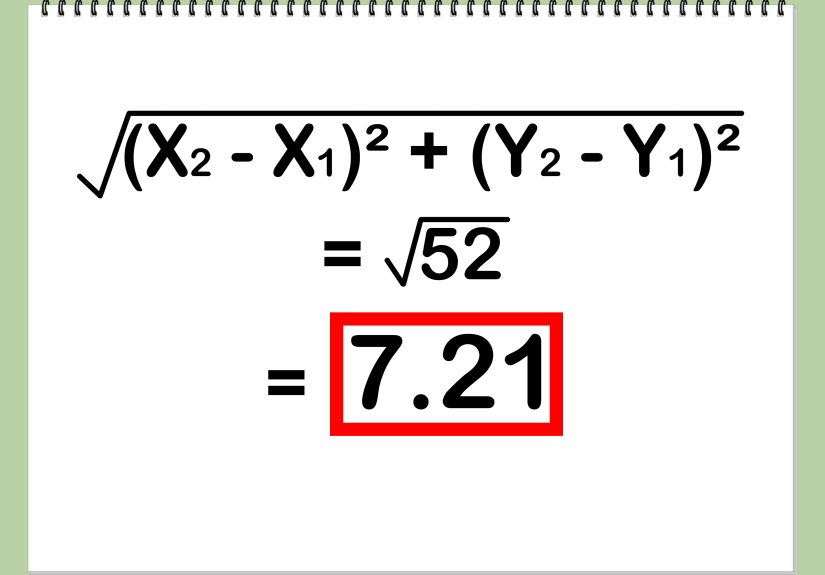
To find the distance between two points on a coordinate plane, use:
d = √[(x2 – x1)² + (y2 – y1)²]
Here’s what the symbols mean:
- (x1, y1) = the first point
- (x2, y2) = the second point
- d = the distance between the points
This formula gives you the Euclidean distance, which is the straight-line distance between two points (not the “walk around the block” distance).
How to Find the Distance Between Two Points in 6 Steps
Step 1: Write down the coordinates of both points
Start by identifying your two points and labeling them clearly. This sounds obvious, but it’s where a lot of mistakes begin. If you accidentally swap an x-value with a y-value, the rest of the problem turns into a math-themed mystery movie.
Example:
- Point A = (2, 1)
- Point B = (6, 4)
Label them as:
- (x1, y1) = (2, 1)
- (x2, y2) = (6, 4)
Pro tip: You can label either point as the first point. The final distance will be the same either way because squaring removes negatives.
Step 2: Find the horizontal and vertical changes
Next, subtract the x-values and subtract the y-values:
- x2 – x1 = 6 – 2 = 4
- y2 – y1 = 4 – 1 = 3
These two values represent how far you move horizontally and vertically between the points. If you draw the points on a graph, those changes form the legs of a right triangle. That triangle is the whole reason the distance formula works.
If you get a negative difference, don’t panic. Negative values are normal here. You’ll square them in the next step.
Step 3: Square each difference
Now square the horizontal and vertical changes:
- 4² = 16
- 3² = 9
Squaring is important because distance is never negative. It also matches the Pythagorean theorem pattern: a² + b² = c².
Watch out for a very common mistake here: if your difference is negative, always use parentheses before squaring.
Example:
- Correct: (-5)² = 25
- Incorrect: -5² = -25
Parentheses save grades. That’s not a slogan, but it should be.
Step 4: Add the squared values
Add the two squared results:
16 + 9 = 25
This gives you the value inside the square root. In geometry terms, you’ve found the sum of the squares of the two legs of the right triangle.
If you’re using a graphing calculator or calculator app, it’s still smart to do this part slowly. Most errors happen from sign mistakes, not hard math.
Step 5: Take the square root
Take the square root of the sum:
d = √25 = 5
So the distance between (2, 1) and (6, 4) is 5 units.
Sometimes your answer will be a perfect square, like 25 or 49. Other times it won’t, and that’s okay. You may leave the answer in exact form (like √41) or convert it to a decimal, depending on the instructions.
Example:
- Exact form: √41
- Approximate decimal: 6.4 (rounded to the nearest tenth)
Step 6: Check your answer and interpret the result
Before moving on, do a quick reasonableness check:
- Is the distance positive? (It should be.)
- Does the answer make sense based on the graph?
- Did you accidentally use the midpoint formula instead?
For our example, the horizontal change is 4 and the vertical change is 3, so a distance of 5 fits the classic 3-4-5 right triangle. Nice and clean.
If your problem is from a real-world context (maps, motion, design, gaming, etc.), remember to include units: feet, meters, miles, grid units, or whatever the problem uses.
Why the Distance Formula Works
The distance formula is really just the Pythagorean theorem wearing a coordinate-geometry outfit.
When you plot two points on a coordinate plane, you can draw a right triangle between them:
- The horizontal leg has length |x2 – x1|
- The vertical leg has length |y2 – y1|
- The hypotenuse is the distance between the two points
Then apply:
a² + b² = c²
Replace a and b with the horizontal and vertical changes, and c with distance d:
d² = (x2 – x1)² + (y2 – y1)²
Take the square root of both sides, and you get the distance formula.
One bonus detail students often like: the order of subtraction doesn’t matter in the final answer. Whether you use (x2 – x1) or (x1 – x2), squaring makes the result the same.
Worked Examples
Example 1: Basic integer coordinates
Find the distance between (-3, -1) and (2, 3).
Step 1: Label the points
- (x1, y1) = (-3, -1)
- (x2, y2) = (2, 3)
Step 2: Subtract coordinates
- x2 – x1 = 2 – (-3) = 5
- y2 – y1 = 3 – (-1) = 4
Step 3: Square each difference
- 5² = 25
- 4² = 16
Step 4: Add
25 + 16 = 41
Step 5: Square root
d = √41
Step 6: Interpret
The exact distance is √41 units, which is approximately 6.4 units.
Example 2: Coordinates with negatives and decimals
Find the distance between (1.5, -2) and (4.5, 6).
Step 1: Label the points
- (x1, y1) = (1.5, -2)
- (x2, y2) = (4.5, 6)
Step 2: Subtract coordinates
- x2 – x1 = 4.5 – 1.5 = 3
- y2 – y1 = 6 – (-2) = 8
Step 3: Square each difference
- 3² = 9
- 8² = 64
Step 4: Add
9 + 64 = 73
Step 5: Square root
d = √73
Step 6: Interpret
The exact distance is √73 units, which is about 8.5 units to the nearest tenth.
Common Mistakes to Avoid
The distance formula is friendly, but it still catches people with the same few traps. Here are the big ones:
1) Mixing up x and y values
Keep x-values with x-values and y-values with y-values. Don’t cross the streams.
2) Forgetting parentheses with negative numbers
This is the #1 sign error. Always write:
(-3 – 2)² instead of -3 – 2²
3) Using the midpoint formula by accident
Midpoint uses addition and division by 2. Distance uses subtraction, squaring, adding, and square root. If you see a square root, you’re probably on the right track.
4) Rounding too early
If you convert to decimals too soon, your final answer can drift. Keep the answer in exact form (like √41) until the end, then round if needed.
5) Forgetting units
In word problems, the number is not the full answer. If the grid is in miles, your answer should be in miles. If it’s in feet, use feet.
Where This Shows Up in Real Life
The distance between two points is not just a classroom exercise. It shows up in plenty of practical places:
- Maps and navigation: estimating straight-line distance between two locations on a grid map
- Construction and design: checking diagonal measurements for layouts, framing, or floor plans
- Game development: calculating how far a character or object is from another object
- Data science and machine learning: measuring similarity with Euclidean distance in multi-dimensional data
- Physics and engineering: finding displacement between coordinates in a model or diagram
The same idea also extends beyond 2D. In 3D, you add a z-term, and in higher dimensions, the pattern continues. So yes, this little formula grows up and gets a very serious job.
Experiences Related to Learning the Distance Formula (Extended Section)
One of the most common experiences students have with the topic “How to Find the Distance Between Two Points” is that it feels harder than it actually isat first. The formula looks busy, especially when there are subscripts, parentheses, and square roots all hanging out together like they own the place. But once students work through a few problems step by step, the anxiety usually drops fast. The pattern becomes familiar, and then the whole thing starts to feel more like a checklist than a challenge.
In classrooms, a lot of learners have an “aha” moment when they see the triangle drawn on the coordinate plane. Before that, the distance formula can seem random, like something a textbook invented just to be dramatic. But when a teacher or tutor shows the horizontal change, the vertical change, and the diagonal line between the points, suddenly it clicks: this is just the Pythagorean theorem in disguise. That visual connection is a game changer, especially for students who learn better with diagrams than with pure symbols.
Another common experience happens with negative numbers. Students often do everything correctly until they reach a subtraction like 3 – (-2), and then the signs start a small rebellion. This is why writing neatly matters so much here. People who slow down and use parentheses usually get the right answer. People who rush tend to create “creative” math that no one asked for. It’s not a lack of abilityit’s usually just a formatting problem.
Students also report that the distance formula feels much easier after they compare it with the midpoint formula. At first, those two formulas blur together because both use x1, x2, y1, and y2. But after a few practice questions, the difference becomes clear: midpoint is the average (add and divide by 2), while distance is the diagonal (subtract, square, add, square root). That comparison helps reduce confusion and improves test performance.
In practical settings, people often encounter this concept without calling it the “distance formula.” For example, someone designing a room layout might measure a diagonal to check if a rectangular space is square. A student learning coding might use point-to-point distance to detect collisions in a simple game. A robotics project might calculate how far a robot is from a target coordinate. In all of these cases, the same math shows up quietly in the background, doing the heavy lifting.
A final experience many learners share is confidence growth. The distance formula is one of those topics that starts as “I’ll never remember this” and quickly turns into “Wait, that’s it?” Once students solve a few problems successfully, they begin trusting their process more. And that matters. Math confidence often grows from repeated wins, not giant breakthroughs. The distance formula is a great example of a skill that looks advanced, teaches careful habits, and gives quick resultsexactly the kind of topic that helps people feel stronger in geometry and algebra.
Conclusion
Finding the distance between two points is a core skill in coordinate geometry, and it gets much easier when you follow a consistent process. The 6-step method keeps everything organized: label the coordinates, subtract, square, add, square root, and check your answer. That’s it.
Once you understand that the formula comes from the Pythagorean theorem, it stops being something to memorize blindly and becomes something you can actually explain. And when you can explain a formula, you can use it with confidence.
If you’re studying analytic geometry, graphing, circles, or even introductory data science, this formula will come up again. The good news is that now you know exactly how to handle itwithout guessing, panicking, or turning your notebook into a subtraction crime scene.







 Close
Close