Table of Contents >> Show >> Hide
- What Is the Range of a Data Set?
- How to Find the Range of a Data Set: 4 Steps
- Example 1: Finding the Range of Test Scores
- Example 2: Finding the Range with Negative Numbers
- Example 3: Finding the Range in a Real-Life Data Set
- Why Is the Range Useful?
- Limitations of the Range
- Range vs. Interquartile Range
- Common Mistakes When Finding the Range
- How to Find the Range in Excel or Google Sheets
- How to Explain the Range in a Sentence
- Practice Problems
- Experiences and Practical Tips for Finding the Range of a Data Set
- Conclusion
Finding the range of a data set is one of the simplest ways to understand how spread out your numbers are. It is quick, clean, and refreshingly low-drama. No complicated formulas, no calculator gymnastics, and no suspicious-looking Greek letters hiding in the corner. Just two numbers doing all the work: the largest value and the smallest value.
In statistics, the range tells you the distance between the highest and lowest values in a data set. If your numbers are test scores, the range shows the gap between the best and lowest score. If they are daily temperatures, the range shows how much the temperature changed from the coolest reading to the warmest. If they are prices, the range shows how wide the price spread is. In short, range gives you a fast snapshot of variation.
The basic formula is:
Range = Maximum Value − Minimum Value
That is it. Really. Statistics occasionally gives us a gift basket, and this is one of those moments.
However, simple does not mean useless. The range is often the first measure of spread students learn because it builds the foundation for understanding more advanced concepts such as interquartile range, variance, standard deviation, box plots, and data distribution. This guide explains how to find the range of a data set in four easy steps, when to use it, what mistakes to avoid, and how to interpret your answer like someone who does not panic when a spreadsheet opens.
What Is the Range of a Data Set?
The range of a data set is the difference between the largest number and the smallest number. It measures the total spread from one end of the data to the other.
For example, look at this data set:
4, 8, 10, 15, 20
The smallest value is 4. The largest value is 20. So the range is:
20 − 4 = 16
The range is 16. This means the data values stretch across 16 units from the lowest point to the highest point.
Range is a measure of variability, also called a measure of spread or dispersion. It does not tell you where most values are located. It does not tell you the average. It does not tell you whether the numbers are evenly spaced. It simply answers one important question: How far apart are the extremes?
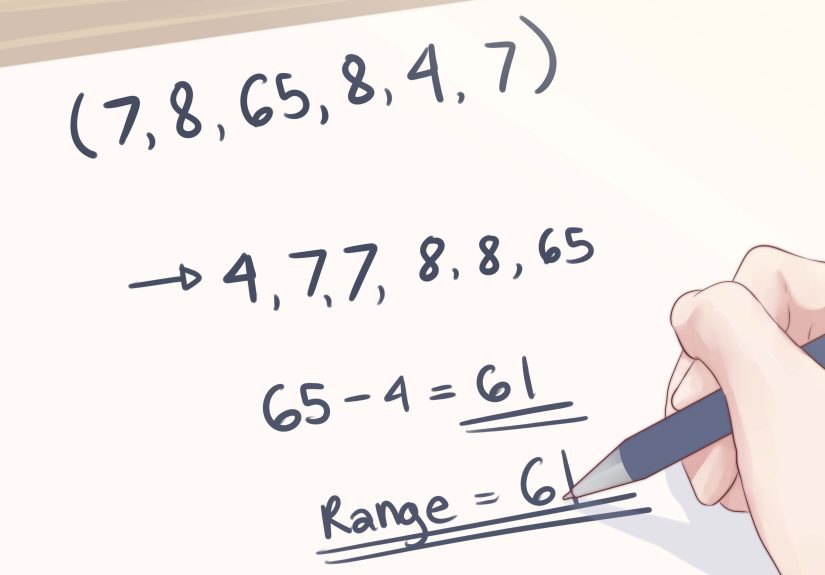
How to Find the Range of a Data Set: 4 Steps
Step 1: List All the Values in the Data Set
Start by writing down every value clearly. This may sound obvious, but many range mistakes begin with messy data. A missing number, copied value, or accidental typo can change the result faster than a cat walking across a keyboard.
Suppose a teacher records the following quiz scores:
72, 88, 91, 67, 84, 95, 79
This is your complete data set. Before calculating anything, check that all values belong in the same group and use the same unit. Do not mix dollars with percentages, inches with centimeters, or Monday’s sales with “that one random number from a different worksheet.” A data set should be consistent.
For small data sets, listing the numbers by hand is easy. For larger data sets, you may use spreadsheet tools such as sorting, minimum, and maximum functions. The idea is the same: make sure the numbers are complete, clean, and ready to compare.
Step 2: Identify the Smallest Value
Next, find the minimum value. The minimum is the smallest number in the data set.
Using the quiz scores:
72, 88, 91, 67, 84, 95, 79
The smallest value is 67.
One helpful habit is to circle or highlight the minimum value before moving on. This reduces the chance of grabbing the wrong number later. In a sorted list, the minimum appears at the beginning. In an unsorted list, you must compare each value carefully.
If the data set contains negative numbers, remember that the smallest value is the most negative number. For example, in the data set -3, 5, -10, 2, the minimum is -10, not -3. Negative numbers enjoy causing tiny moments of confusion, but they follow the same rules.
Step 3: Identify the Largest Value
Now find the maximum value. The maximum is the largest number in the data set.
Using the same quiz scores:
72, 88, 91, 67, 84, 95, 79
The largest value is 95.
Again, mark it clearly. At this point, you have the only two values needed to calculate the range: the maximum and the minimum.
This is also a good time to check whether the maximum value makes sense. If you are working with test scores out of 100 and one value says 950, that is probably not a brilliant student breaking the laws of grading. It may be a data entry error. The range is highly sensitive to extreme values, so one incorrect maximum or minimum can distort the answer.
Step 4: Subtract the Smallest Value from the Largest Value
Finally, subtract the minimum from the maximum:
Range = Maximum − Minimum
For the quiz scores:
95 − 67 = 28
The range is 28.
This means the difference between the highest quiz score and the lowest quiz score is 28 points. The class scores stretch across a 28-point span.
Here is the full four-step process in one quick view:
- List the data values.
- Find the smallest value.
- Find the largest value.
- Subtract: largest value minus smallest value.
Example 1: Finding the Range of Test Scores
Imagine a student group receives these math test scores:
81, 76, 90, 88, 70, 95, 84
The smallest score is 70. The largest score is 95.
Range = 95 − 70 = 25
The range is 25 points. This tells us that the highest and lowest scores are separated by 25 points.
What does that mean in plain English? The scores are not all clustered tightly together. There is a noticeable gap between the top and bottom performance. However, the range alone does not tell us whether most students scored near 90 or near 75. For that, we would need measures such as the mean, median, or standard deviation.
Example 2: Finding the Range with Negative Numbers
Now let’s use temperatures:
-4, 2, 6, -1, 10
The smallest value is -4. The largest value is 10.
Range = 10 − (-4)
Subtracting a negative becomes addition:
10 + 4 = 14
The range is 14 degrees.
This is where students often trip. When the minimum is negative, use parentheses so the subtraction stays clear. The range cannot be negative because it measures distance between two values. A negative range would be like saying your backpack weighs “minus three pounds,” which would be impressive but suspicious.
Example 3: Finding the Range in a Real-Life Data Set
Suppose you track the number of minutes you spend studying each day for one week:
35, 40, 25, 60, 45, 30, 50
The minimum is 25. The maximum is 60.
Range = 60 − 25 = 35
The range is 35 minutes. This means your study time varied by 35 minutes between your shortest and longest study days.
This kind of range can be useful for personal planning. If your study range is very large, your schedule may be inconsistent. That does not automatically mean bad. Maybe one day was packed with soccer practice, errands, and a dramatic search for a missing charger. But the range helps you notice the pattern.
Why Is the Range Useful?
The range is useful because it gives a quick estimate of spread. It is easy to calculate, easy to explain, and easy to compare across similar data sets.
For example, compare these two data sets:
Data Set A: 80, 82, 84, 86, 88
Data Set B: 60, 70, 80, 90, 100
Both sets have a middle value of 84 or 80 depending on the comparison you make, but their ranges are very different.
Range of A = 88 − 80 = 8
Range of B = 100 − 60 = 40
Data Set B is much more spread out. The range shows that right away.
Range is especially helpful when you want a fast answer to questions like:
- How much did temperatures vary this week?
- What is the price difference between the cheapest and most expensive product?
- How far apart are the highest and lowest test scores?
- What is the difference between the shortest and longest delivery time?
In everyday life, range is often the first number people want because it feels practical. If someone says hotel rooms cost between $90 and $240, you instantly understand the price range. If a weather forecast says temperatures will range from 52°F to 78°F, you know whether to bring a jacket, sunglasses, or both because spring enjoys being confusing.
Limitations of the Range
The range is simple, but it has one major weakness: it only uses two values. It ignores every number between the minimum and maximum.
Consider these two data sets:
Data Set A: 10, 11, 12, 13, 50
Data Set B: 10, 20, 30, 40, 50
Both have the same range:
50 − 10 = 40
But the data sets are clearly different. In Data Set A, most values are close together, with one high value at 50. In Data Set B, the values are evenly spread out. The range does not show that difference.
This is why range should often be used with other statistics. The mean, median, interquartile range, and standard deviation can provide a fuller picture. Range is a great first look, but it is not the whole movie. It is more like the trailer: useful, quick, and occasionally missing important plot details.
Range vs. Interquartile Range
The range measures the spread from the lowest value to the highest value. The interquartile range, often called the IQR, measures the spread of the middle 50% of the data.
The IQR is less affected by outliers because it focuses on the middle portion instead of the extremes. If one unusually high or low value appears in a data set, the range may change dramatically. The IQR may stay more stable.
For example:
5, 6, 7, 8, 100
The range is:
100 − 5 = 95
That range is huge because of the value 100. But most of the numbers are actually between 5 and 8. In this situation, the range is mathematically correct, but it may exaggerate how spread out the typical values are.
This does not mean range is bad. It means range should be interpreted carefully. Outliers matter, and range notices them immediately. Sometimes that is exactly what you need. Other times, you need a more balanced measure.
Common Mistakes When Finding the Range
Mistake 1: Subtracting in the Wrong Order
The correct formula is maximum minus minimum. Do not subtract the largest value from the smallest value. The range should not be negative.
Mistake 2: Confusing Range with Mean
The mean is the average. The range is the spread between the largest and smallest values. They answer different questions.
Mistake 3: Forgetting Negative Numbers
When the minimum value is negative, use parentheses. For example, 12 − (-3) equals 15, not 9.
Mistake 4: Ignoring Units
If your data is measured in dollars, the range is in dollars. If your data is measured in inches, the range is in inches. Always include the correct unit when explaining your result.
Mistake 5: Trusting an Outlier Too Quickly
An extreme value may be real, but it may also be a typo or measurement error. If the range looks surprisingly large, check the minimum and maximum values before announcing your answer with confidence and a victory snack.
How to Find the Range in Excel or Google Sheets
If your data is in a spreadsheet, you can calculate the range with two simple functions:
=MAX(A1:A10)-MIN(A1:A10)
This formula finds the largest value in cells A1 through A10, finds the smallest value in the same group, and subtracts the two.
You can also calculate the values separately:
=MAX(A1:A10)
=MIN(A1:A10)
Then subtract the minimum from the maximum. This approach is useful when you want to show each step clearly, especially in homework, reports, or presentations.
How to Explain the Range in a Sentence
After calculating the range, do not stop at the number. Explain what it means.
Weak explanation:
The range is 28.
Better explanation:
The range is 28 points, meaning the highest quiz score is 28 points greater than the lowest quiz score.
That sentence gives context. It tells the reader what the number measures and why it matters.
Practice Problems
Problem 1
Find the range of this data set:
12, 18, 9, 25, 14
Minimum: 9
Maximum: 25
Range: 25 − 9 = 16
Problem 2
Find the range:
101, 98, 115, 120, 105
Minimum: 98
Maximum: 120
Range: 120 − 98 = 22
Problem 3
Find the range:
-8, -2, 4, 11, 15
Minimum: -8
Maximum: 15
Range: 15 − (-8) = 23
Experiences and Practical Tips for Finding the Range of a Data Set
One of the best experiences students can have with range is using it on data they actually care about. Textbook numbers are useful, but real numbers make the concept click. For example, a student who tracks daily screen time for a week may see values like 95, 120, 85, 180, 140, 110, and 200 minutes. The range is 200 minus 85, which equals 115 minutes. Suddenly, range is not just a math term. It becomes a mirror showing how much habits change from day to day.
In classrooms, range is often easiest to teach with physical examples. Ask students to write down the number of books in their backpacks, the number of steps from the classroom door to their desk, or the number of minutes they spend on homework each night. When learners collect the data themselves, the minimum and maximum feel more meaningful. The range becomes a story about real variation, not just a number floating around looking for attention.
Another practical experience comes from sports. Imagine a basketball player scores 8, 12, 10, 25, and 9 points across five games. The range is 25 minus 8, or 17 points. That large range shows inconsistency in scoring. But it also opens a smarter discussion: Was the 25-point game an improvement, an outlier, or the result of easier competition? This is where range becomes more than arithmetic. It becomes analysis.
Weather data is also excellent for learning range. If the daily high temperatures for a week are 68, 70, 72, 69, 85, 71, and 73 degrees, the range is 85 minus 68, or 17 degrees. Most of the week was mild, but one warm day widened the range. That helps students understand why outliers matter. One unusual value can make the range look larger than the everyday pattern suggests.
A helpful habit is to sort the data before calculating the range, especially when the list is long. Sorting is not required, but it makes the smallest and largest values easier to spot. For example, the data set 42, 17, 39, 88, 21, 56 is easier to handle when arranged as 17, 21, 39, 42, 56, 88. The minimum and maximum practically wave hello.
When working with spreadsheets, use range as a quick data check. If you expect values between 0 and 100 but your calculated range is 3,000, something may be wrong. Maybe a decimal was misplaced, a value was entered in the wrong unit, or someone typed a phone number into the quiz score column. It happens. Spreadsheets are powerful, but they do not have common sense installed by default.
The biggest lesson from experience is this: range is easy to calculate, but interpretation matters. A small range usually means values are close together. A large range usually means values are spread out. But before drawing conclusions, always ask what caused the spread. Was it normal variation? An outlier? A mistake? A meaningful change? That question turns a basic calculation into useful thinking.
Conclusion
Finding the range of a data set takes four simple steps: list the values, identify the smallest value, identify the largest value, and subtract the smallest from the largest. The formula is easy: Range = Maximum − Minimum.
The range is useful because it gives a fast look at how spread out a data set is. It works well for test scores, prices, temperatures, times, measurements, and many other kinds of numerical data. However, because it only uses the minimum and maximum values, it can be strongly affected by outliers. That is why range is best used as a quick starting point, not the final word on a data set.
Once you understand range, you are better prepared to study other statistics such as mean, median, interquartile range, variance, and standard deviation. Not bad for a formula that only asks two numbers to show up for work.