
Table of Contents >> Show >> Hide
- First: Are You Sure They’re Fungus Gnats?
- Why Fungus Gnats Love Your Houseplants
- The Fungus Gnat Life Cycle (Why Adults Aren’t the Real Problem)
- Quick Diagnosis: Find the “Source Pot” in 5 Minutes
- Treatment: The 3-Part Plan That Actually Works
- When to Repot (AKA: The Great Soil Reset)
- Prevention: Keep Gnats From Coming Back
- FAQ: Quick Answers to Common Fungus Gnat Questions
- Real-Life “Plant Parent” Experiences ( of Been-There Energy)
- Conclusion
You bought a gorgeous new houseplant. You watered it lovingly. You named it something dramatic (as one does).
And now… tiny little flies are doing laps around your living room like they pay rent.
If you’ve got gnats hovering near your potted plants, you’re most likely dealing with fungus gnatsthe
uninvited guests who show up when potting mix stays a little too cozy and moist.
The good news: fungus gnats are usually more annoying than dangerous. The better news: you can get rid of them without
turning your home into a chemical lab. This guide walks you through what works, what’s overhyped,
and how to keep gnats from coming back for an encore performance.
First: Are You Sure They’re Fungus Gnats?
“Gnats” is basically the word we use for “tiny flying things that have no business in my house.” But different pests need
different strategies. Fungus gnats have a few telltale signs:
- They hang out near plant soil (especially the top of the pot).
- They’re attracted to moisture and may gather near windows because they’re drawn to light.
- They look like teeny mosquitoesslender bodies, long legs, and a delicate vibe.
- Adults are mostly a nuisance, but larvae can bother roots when populations get high.
Not fungus gnats? Fruit flies usually orbit fruit, trash, or recycling (not potting soil). Drain flies
like sinks and shower drains. If you’re unsure, put a yellow sticky trap in a pot and see what you catch in 24–72 hours.
Why Fungus Gnats Love Your Houseplants
Fungus gnats thrive when potting mix stays consistently damp and rich in organic material. Moist soil supports
fungi and decomposing bits (their favorite buffet), and it also gives females a comfy place to lay eggs. Overwatering and
poor drainage are the usual root causes (pun fully intended).
Here’s what often sets the stage:
- Watering too often (especially in cooler months when plants use less water).
- Pots without drainage holes or saucers holding standing water.
- Old, broken-down potting mix that holds moisture longer than it should.
- Bringing home infested plants or soil (yes, it happens).
The Fungus Gnat Life Cycle (Why Adults Aren’t the Real Problem)
If you only swat the adults, it can feel like you’re losing a very tiny war. That’s because most of the action is happening
in the soil:
- Eggs are laid on or near moist soil. They can hatch in just a few days.
- Larvae live in the top layer of potting mix, feeding on fungi and organic matter (and sometimes nibbling roots).
- Pupae develop near the soil surface.
- Adults emerge, fly around, and lay more eggsusually living about a week.
Under ideal indoor conditions, fungus gnats can go from egg to adult in roughly 3–4 weeks, which is why
your “I fixed it!” moment can turn into a “wait, why are they back?” moment if you don’t target the larvae.
Quick Diagnosis: Find the “Source Pot” in 5 Minutes
If you have multiple plants, don’t treat everything blindly. Find the main culprit first:
- Check moisture: Press a finger into the soil. If the top 1–2 inches never dry out, gnats are living their best life.
- Look for adults: Tap the pot or gently shake foliage. Do tiny flies pop up from the soil?
-
Try the potato test: Place a thin slice of raw potato on the soil surface for 1–2 days.
Larvae will often gather underneath to feed. (Yes, you’re baiting bugs with a snack. Parenting is weird.) - Use a yellow sticky trap: Stick one in the pot and monitor the catch rate.
Treatment: The 3-Part Plan That Actually Works
The fastest, most reliable approach combines (1) drying the soil surface, (2) trapping adults, and (3) targeting larvae.
Do all three and you’ll break the cycle.
1) Change Your Watering Strategy (The “No Wet Nursery” Rule)
The single most effective long-term fix is to stop giving fungus gnats the moist topsoil they need. For many houseplants,
letting the top 1–2 inches dry between waterings dramatically reduces egg-laying and larval survival.
- Let the top layer dry: Check before you waterdon’t go by calendar vibes.
- Empty saucers: Standing water is basically a gnat spa.
- Improve drainage: Use pots with holes and a well-aerated potting mix.
- Adjust seasonally: Plants often drink less in fall/winter indoors, so “same schedule” can become “too much.”
Pro move: Try bottom watering for a few weeks. Set the pot in a tray of water and let it wick up
through the drainage holes, then remove it and let it drain. This keeps the soil surface drierless appealing for egg-laying.
Important: Some plants (like ferns or moisture-loving tropicals) don’t love drying out too much. If your plant needs
consistently moist soil, lean harder on traps and larval treatments instead of extreme drying.
2) Trap (and Reduce) Adults So They Stop Laying Eggs
Adults don’t usually damage plants, but they do create the next generation. Your best friend here is the humble
yellow sticky trap.
- Place traps near the soil line (or under the canopy) where adults hang out.
- Replace when covered or dustysticky traps are not forever traps.
- Vacuum bonus: A quick pass with a handheld vacuum around the plant can remove a bunch of adults instantly.
A note on vinegar traps: they work great for fruit flies, but they’re often disappointing for fungus gnats because fungus gnats
are primarily keyed into soil moisture and plant medianot your DIY salad dressing cocktail.
3) Target Larvae in the Soil (This Is Where You Win)
Larvae are the “engine” of the infestation. Remove or kill larvae, and adult numbers drop steadily over the next few weeks.
These options are commonly used because they target larvae without nuking your entire home ecosystem:
Bti Soil Drench (A Go-To Biological Option)
Bti (Bacillus thuringiensis var. israelensis) is a naturally occurring bacterium used as a larvicide.
It’s widely known for mosquito control products, and it can also help reduce fungus gnat larvae when applied to the potting mix
as a soil drench. Follow label directions, reapply as directed, and expect gradual improvement as the life cycle breaks.
- What it does: Targets larvae in the soil.
- What it doesn’t do: Immediately eliminate flying adults (that’s the sticky trap’s job).
- Best for: Persistent infestations, especially when you can’t dry out soil aggressively.
Beneficial Nematodes (Tiny Allies, Big Attitude)
Beneficial nematodes (often Steinernema feltiae) are microscopic organisms that seek out larvae in the growing medium.
They’re especially useful for heavy infestations or plant collections where gnats keep hopping from pot to pot.
- What they do: Infect and kill fungus gnat larvae in the soil.
- Best for: Multiple plants, repeated outbreaks, and people who enjoy the phrase “biological control program.”
- Tip: The growing medium generally needs to be moist at application time for best resultsfollow product instructions closely.
Predatory Mites (For the “I Want Nature to Handle This” Crowd)
Soil-dwelling predatory mites (like Stratiolaelaps scimitus, sometimes sold under older names) can feed on fungus gnat larvae near the
soil surface. They’re commonly used preventatively or early in an infestation, and they’re especially popular in greenhouse-style setups.
Hydrogen Peroxide Drench (Use With Care)
A diluted 3% hydrogen peroxide drench is sometimes used to reduce larvae in the top layer of soil. It can fizz dramatically, which feels
satisfyinglike your soil is doing science. But peroxide can also affect beneficial soil microbes, so it’s best treated as an occasional tactic,
not a forever habit.
If you choose this route, use a mild dilution and avoid repeated overuse. Always test on a single plant first, especially if the plant is
sensitive or already stressed.
Top-Dressing the Soil (Make the Surface Unwelcoming)
Creating a dry barrier on top of the pot can discourage egg-laying and reduce larval survival near the surface. Options include
coarse sand, gravel, or diatomaceous earth (DE).
- Coarse sand/grit: Helps dry the surface and makes egg-laying harder.
-
Diatomaceous earth: Works when kept dry, but avoid breathing the dust. Apply carefully and keep it away from fans,
kids, and pets who like to “investigate” with their faces.
When to Repot (AKA: The Great Soil Reset)
Sometimes the infestation is so establishedor the potting mix is so moisture-retentivethat you’ll save time by repotting.
Consider repotting when:
- You can’t keep the top layer dry without the plant sulking dramatically.
- The soil is old, compacted, and stays wet forever.
- You see signs of root trouble (wilting despite wet soil, poor vigor, yellowing).
- Gnats keep returning after 3–4 weeks of consistent treatment.
Repotting checklist:
- Remove the plant and gently knock off as much old soil as possible.
- Trim dead or rotting roots (if present) with clean scissors.
- Wash the pot (or use a clean one) to remove clinging organic residue.
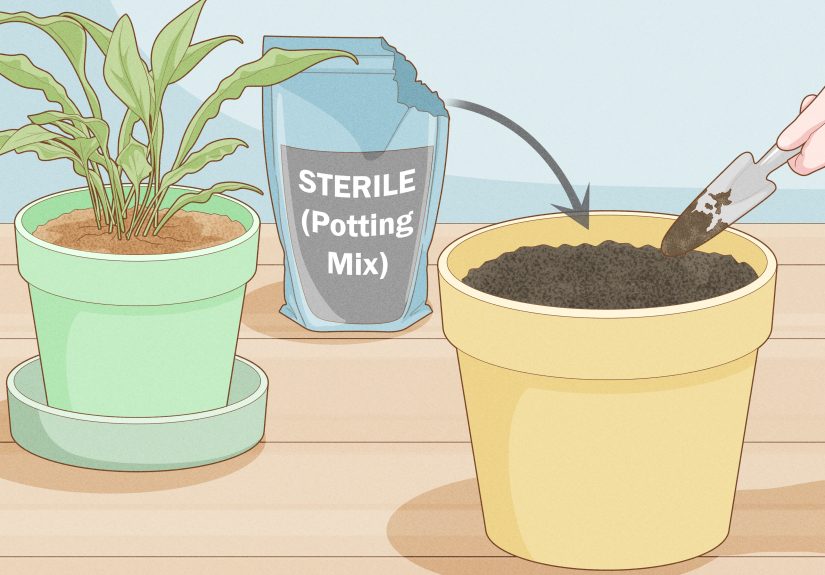
- Repot into fresh, well-draining mix. Avoid keeping it overly wet right after repotting.
- Add a sticky trap and monitor for two weeks while you adjust watering.
Prevention: Keep Gnats From Coming Back
Fungus gnats are common, but repeat infestations usually mean one thing: the environment is still too gnat-friendly.
Here’s how to make your houseplants less like a gnat resort and more like a “sorry, we’re fully booked” sign.
Water Like a Plant Whisperer, Not a Plant Sprinkler
- Check before watering: Top inch dry is a good general cue for many plants.
- Use the right pot: Drainage holes matter. A lot.
- Don’t let water sit: Empty saucers and cache pots.
- Go easy on organic “extras”: Excess organic debris and constantly wet amendments can feed the fungus layer larvae love.
Quarantine New Plants (Yes, Even the Cute One)
New plants can bring hitchhikers. Keep them separate from your collection for 1–2 weeks, add a sticky trap, and watch for flyers.
It’s not paranoiait’s plant-parent due diligence.
Store Potting Mix Like It’s Valuable (Because It Is)
Keep potting soil sealed and dry. Open bags left in humid areas can become a breeding site. If you suspect a bag is infested,
don’t use it indoors unless you’re prepared to treat the pots proactively.
Don’t Ignore Non-Plant Moisture Sources
Fungus gnats love moisture. If you have persistent gnats and your plants look innocent, check for damp areas, leaks, or constantly wet
organic debris (like wet mulch stored indoors, damp compost buckets, or a chronically moist corner near a sink).
FAQ: Quick Answers to Common Fungus Gnat Questions
Do fungus gnats harm people or pets?
Generally, no. Adults don’t bite and are mostly a nuisance. The bigger issue is what they indicate: overly wet soil conditions that can also
contribute to root problems.
How long does it take to get rid of them?
If you combine drying practices + sticky traps + larval control, you’ll often see a noticeable drop in adults within 1–2 weeks,
with major improvement over 3–4 weeks as the life cycle collapses.
Why are they worse in winter?
Many indoor plants use less water in cooler, darker months. If your watering doesn’t change, soil stays wet longerexactly what gnats want.
Is one method enough?
Sometimes, light infestations resolve with better watering alone. But if you’re seeing daily flyers, a combined plan is faster and more reliable.
Real-Life “Plant Parent” Experiences ( of Been-There Energy)
Let’s talk about how fungus gnats actually show up in normal homesbecause most infestations aren’t caused by “bad plant care,”
they’re caused by very relatable optimism.
The Overwatering Love Language
You water because you care. Your plant looks a little sad, so you water more because you care harder. Suddenly, gnats appear,
and it feels personallike the universe is punishing compassion. The reality is simpler: consistently damp topsoil becomes a daycare center
for fungus gnat eggs and larvae. Once you switch to “water when the plant needs it” (finger test, moisture meter, or lifting the pot to feel its weight),
the gnat population often drops dramatically. Add sticky traps and you’ll watch the adult numbers fall like a reality show elimination round.
The “It Must Be This One Plant” Plot Twist
You see gnats in the living room and blame the biggest plant because it looks guilty. Then you realize the real source is a tiny pothos in the kitchen
that sits in a decorative pot with no drainage hole, quietly marinating in its own runoff. This is extremely common. The fix is rarely dramatic:
empty the cache pot, let the top layer dry, and stop leaving standing water. It’s less “pest battle” and more “tiny plumbing correction.”
The Bag of Soil That Chose Chaos
You repot a few plants, feeling productive and powerful. Two weeks later, gnats everywhere. Was it the new plant? The air? A curse?
Sometimes it’s just the potting mix: if a bag has been stored warm and humid (or already had eggs), it can introduce fungus gnats.
This is where proactive strategies shine: use sticky traps right after repotting, let the surface dry between waterings, and consider a biological
larval treatment if you’re seeing consistent flyers. The goal isn’t to “panic treat” every pot; it’s to break the cycle before it becomes a household hobby.
The Vacation Comeback
You go away for a week and ask a friend to water your plants. You return to a jungle… and a cloud of gnats. (Your plants survived, so your friend
feels like a hero. Your sanity disagrees.) This is the moment to simplify: isolate the worst pots, add sticky traps, and adjust watering immediately.
If drying out isn’t possible for a moisture-loving plant, use a larval treatment so the pot can stay healthy without becoming an insect nursery.
In a month, the infestation usually feels like a strange dream you once had.
The “I Tried One Thing for Two Days” Trap
Fungus gnats are excellent at making you believe nothing worksbecause you can kill adults today and still see new adults tomorrow.
That doesn’t mean failure. It means the larvae were already in the soil. The winning move is consistency: traps + better watering + larval control,
repeated long enough to outlast the life cycle. It’s not flashy, but it’s effective. Think of it as plant care with a tiny dash of patience and a big
scoop of “I’m not letting insects run my home.”
Conclusion
Fungus gnats are annoying, persistent, and weirdly confident for something the size of a sesame seed. But once you understand what they want
(moist soil + organic food + a place to lay eggs), the solution becomes straightforward: dry the surface, trap the adults, and target the larvae.
Do that consistently for a few weeks, and your houseplants can go back to being plantsnot insect nurseries.






 Close
Close