
Table of Contents >> Show >> Hide
- What “Body Fat” Actually Means (and Why Location Matters)
- The “Accuracy Ladder”: From Lab-Grade to Living-Room Friendly
- Most Accurate Methods (When You Want the Best Possible Number)
- Practical Methods (What Most People Actually Use)
- 4) Bioelectrical Impedance (BIA): Smart Scales, Gym Scanners, and Their Mood Swings
- 5) Skinfold Calipers: Cheap, Effective… and Extremely Dependent on Who’s Holding Them
- 6) Circumference Measurements: Not a Body Fat %But Powerful Context
- 7) 3D Body Scans and “Optical” Apps: New, Promising, Still Evolving
- So… Which Method Should You Choose?
- Body Fat Percentage Ranges: Common Categories (Adults)
- How to Measure Body Fat Like a Sane Person (A Repeatable Routine)
- Common Mistakes That Make Good Methods Look Bad
- When to Talk to a Professional
- Experiences That Make Body Fat Measurement “Click” (Real-World Scenarios)
- Conclusion
Your bathroom scale is great at one thing: telling you how hard gravity is pulling on you today. But if you want
a clearer picture of health, performance, and progress, body fat percentage (and where that fat
is stored) can be more informative than weight alone. The catch? Body fat is tricky to measure, and every method
has trade-offs. Some are highly accurate but pricey. Others are convenient but moodyespecially if you drank water,
ate salty food, or simply looked at a treadmill and started sweating.
This guide breaks down the most accurate ways to measure body fat, how to get consistent results, and the most
commonly used body fat rangeswithout turning your life into a laboratory experiment.
What “Body Fat” Actually Means (and Why Location Matters)
“Body fat” includes more than the stuff you’d love to evict from your waistband. You have:
- Essential fat: supports normal body function (hormones, organs, nerves, insulation).
- Subcutaneous fat: sits under the skin (what calipers pinch).
- Visceral fat: stored deeper around organs; it’s strongly linked with cardiometabolic risk.
Two people can share the same weight and even the same body fat percentage, but carry fat differently. That’s why
measurements like waist circumference (a proxy for central fat) can add valuable context.
The “Accuracy Ladder”: From Lab-Grade to Living-Room Friendly
Think of body fat methods like maps. A satellite image is detailed, but you don’t always need one to find the coffee shop.
The best method is the one you can do consistently and interpret correctly.
Quick Comparison: Common Methods at a Glance
| Method | Typical Use | Pros | Cons | Best For |
|---|---|---|---|---|
| DEXA (DXA) scan | Clinic / testing center | High precision; regional data (fat distribution) | Cost; access; low-dose X-ray | Most accurate tracking over time |
| Hydrostatic (underwater) weighing | Lab / specialty facility | Very accurate body density estimate | Not convenient; technique dependent | High-accuracy testing when available |
| Air displacement (Bod Pod) | Lab / sports facilities | Accurate; fast; no water dunking | Cost; access; sensitive to clothing/hair | Accurate, repeatable assessments |
| Multi-frequency BIA (InBody-style) | Gyms / clinics | Fast; accessible; decent for trends | Hydration and timing can skew results | Regular check-ins and trend tracking |
| Smart scale BIA | Home | Convenient; frequent data | Least accurate for absolute % | Habit-friendly trend monitoring |
| Skinfold calipers | Gym / sports setting | Affordable; good when done well | Skill dependent; equations vary | Field testing by a trained measurer |
| Waist + circumference measures | Home / clinic | Cheap; strong health context | Not a direct % body fat measure | Health risk context + progress |
Most Accurate Methods (When You Want the Best Possible Number)
1) DEXA (DXA) Scan: The Go-To “Criterion” Method in Practice
A DEXA scan uses low-dose X-rays to estimate bone mineral content and soft tissue composition.
Many clinicians and researchers treat it as a leading reference method for practical body composition testing.
A major advantage is that it can show regional estimatesfor example, differences in trunk vs. limb
fat and lean masshelpful for athletes and for health risk context.
- Strengths: high repeatability, detailed breakdown, useful over time.
- Limitations: can be costly; availability varies; not appropriate for everyone (e.g., pregnancy).
Example: If you’re doing a strength program and the scale isn’t budging, a DEXA can show whether you’re
losing fat while gaining lean massso you don’t accidentally “panic diet” a good training phase into the ground.
2) Hydrostatic Weighing: Underwater, Overachieving Accuracy
Hydrostatic weighing estimates body density by comparing your weight on land to your weight underwater (because fat is less
dense than water and lean tissue is denser). It has a long history in body composition research and can be very accurate
when the protocol is done well.
- Strengths: excellent accuracy; established method.
- Limitations: access is limited; results depend on technique and estimating lung volume.
Translation: it’s greatif you can find it and don’t mind feeling like a human submarine for 30 seconds.
3) Air Displacement Plethysmography (Bod Pod): Accuracy Without the Pool
The Bod Pod uses air displacement to estimate body volume and density. It’s quick, noninvasive, and
generally agrees well with other high-quality methods when testing conditions are standardized (clothing, hair, posture).
- Strengths: fast; accurate; comfortable for most people.
- Limitations: availability; cost; sensitivity to testing setup.
Practical Methods (What Most People Actually Use)
4) Bioelectrical Impedance (BIA): Smart Scales, Gym Scanners, and Their Mood Swings
BIA estimates body composition by sending a tiny electrical current through the body and measuring
impedance. Because water conducts electricity better than fat, the device estimates total body water and infers fat-free
mass and fat mass.
How accurate is BIA?
BIA can be useful for trends, but absolute accuracy varies widely by device and conditions. Hydration,
recent exercise, alcohol, high-salt meals, time of day, and menstrual cycle changes can all shift readings.
How to get more consistent BIA results
- Measure at the same time of day (morning is often best).
- Use the bathroom first, then measure before eating or drinking.
- Avoid measuring right after exercise, sauna time, or a big meal.
- Track a weekly average rather than obsessing over one reading.
Example: If your smart scale says you gained 3% body fat overnight, you didn’t suddenly become a different
species. More likely: you’re retaining water, or the device is reacting to changed hydration.
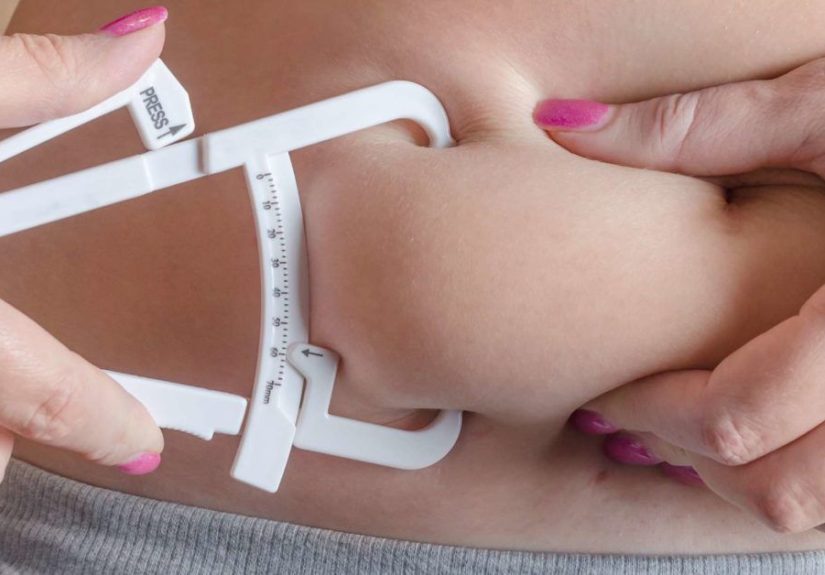
5) Skinfold Calipers: Cheap, Effective… and Extremely Dependent on Who’s Holding Them
Calipers measure the thickness of a “pinch” of skin and underlying fat at specific sites. Those measurements go into
equations that estimate body density and body fat percentage.
- Strengths: affordable; portable; can be quite good in trained hands.
- Limitations: technique matters a lot; equations assume “typical” fat distribution; not ideal for everyone.
If you choose calipers, the best upgrade isn’t a fancier caliperit’s a measurer who follows a standardized protocol and
repeats measurements consistently.
6) Circumference Measurements: Not a Body Fat %But Powerful Context
A tape measure can’t tell you “23% body fat,” but it can tell you something arguably more useful: whether your
central adiposity is trending up or down. Waist circumference is commonly used in clinical settings because
it correlates with health riskespecially when paired with other information.
How to measure your waist (consistently)
- Stand tall with feet about hip-width apart.
- Find your hip bones (iliac crest). Many medical protocols measure at or near this level.
- Wrap the tape so it’s horizontal and snug, but not compressing skin.
- Exhale normally and take the measurement.
- Repeat 2–3 times and use the average.
Commonly used risk thresholds (adults)
In many U.S. clinical references, a waist circumference above 40 inches in men or 35 inches
in women is associated with increased health risk. (These are adult guidelines and can differ by population and clinical context.)
Pro tip: If you’re tracking progress, consistency beats perfection. Pick one measurement location and stick
with it. A waist trend over 8–12 weeks often tells a clearer story than a single number.
7) 3D Body Scans and “Optical” Apps: New, Promising, Still Evolving
3D scanners and phone-based systems estimate circumferences and sometimes infer body composition. Some are improving fast,
but accuracy depends on device quality, calibration, posture, lighting, and algorithms.
- Strengths: easy, visual, great for circumference tracking.
- Limitations: body fat % estimates can be inconsistent across products and updates.
So… Which Method Should You Choose?
Start with your goal:
- Highest accuracy: DEXA, Bod Pod, or hydrostatic weighing (choose what you can repeat).
- Most practical for trends: multi-frequency BIA + waist measurement.
- Budget-friendly field option: calipers (with a trained measurer) + waist measurement.
- At-home habit building: smart scale BIA + waist + photos (same lighting/angle).
If you do one thing right, do this: don’t compare numbers from different methods as if they’re interchangeable.
A DEXA result and a smart-scale result can differ by several percentage points even when both are “working as designed.”
Pick a method and track the trend.
Body Fat Percentage Ranges: Common Categories (Adults)
Body fat ranges vary by organization and by individual factors (age, genetics, training history, hormonal status, and medical conditions).
The categories below are widely used as general adult guidelinesuse them as a reference, not a verdict.
| Category | Women | Men |
|---|---|---|
| Essential fat | 10–13% | 2–5% |
| Athletes | 14–20% | 6–13% |
| Fitness | 21–24% | 14–17% |
| Average | 25–31% | 18–24% |
| Obesity | 32%+ | 25%+ |
Important caveats about “ranges”
- Age matters: healthy body fat often increases modestly with age.
- Performance matters: some athletes carry higher body fat and perform exceptionally well.
- Extremes aren’t automatically better: very low body fat can affect hormones, mood, bone health, and recovery.
- If you’re still growing: body composition interpretation should be done with a clinician trained in youth growth and development.
How to Measure Body Fat Like a Sane Person (A Repeatable Routine)
Want results that actually mean something? Use a simple, standardized plan:
- Pick your primary method: DEXA, Bod Pod, BIA, or calipers.
- Add one context measure: waist circumference is a strong companion metric.
- Standardize conditions: same time of day, similar hydration, similar clothing.
- Measure at the right frequency: daily BIA is fine if you use weekly averages; DEXA is often 2–4 times per year.
- Look for trends: 4–12 week patterns beat day-to-day noise.
Common Mistakes That Make Good Methods Look Bad
- Switching methods midstream: you’ll mistake method differences for body changes.
- Chasing single readings: hydration can mimic fat gain/loss on BIA.
- Measuring after a hard workout: fluid shifts can skew results.
- Using calipers without training: inconsistent pinches = inconsistent estimates.
- Turning a health tool into a self-worth score: body composition is data, not a personality test.
When to Talk to a Professional
If you have a medical condition affecting fluid balance, are pregnant, are recovering from an eating disorder,
or have concerns about growth or development, it’s best to get guidance from a qualified healthcare professional.
For many people, the healthiest move is using body composition as one small piece of a bigger picture that includes
strength, energy, sleep, labs when appropriate, and how you feel day to day.
Experiences That Make Body Fat Measurement “Click” (Real-World Scenarios)
Here’s the part nobody tells you when you first decide to “get serious” about body composition: the first few measurements
are less about discovering the Truth With a Capital T and more about learning how your body behaves under different
testing conditions. Many people start with a smart scale, step on it like it’s a judge in a reality show, and then wonder
why it hands out plot twists every other morning.
A common experience is seeing body fat percentage jump after a late dinner or salty meal. That’s not the scale “catching”
your midnight snackit’s usually hydration. BIA devices estimate body composition based on water, and your body’s water
balance changes constantly. Once people switch to a simple routine (same time, same conditions, weekly average), the drama
drops and the trend becomes readable. It’s like upgrading from watching one stock tick to looking at a 30-day chart.
Another frequent aha moment happens when someone compares two methods for the first timesay, a gym-grade BIA scanner and a
DEXA scan. The numbers may differ by several percentage points, and that can be unsettling until you realize both can be
“right” within their own assumptions and error ranges. The lesson many people take away is: don’t method-hop.
Pick one method for tracking, and use a higher-accuracy method occasionally if you want a deeper check-in.
People who try calipers often discover a surprising truth: the tool is cheap, but the skill isn’t. When a trained coach
repeats the same protocol, calipers can be consistent and useful. When an untrained friend pinches a different spot each time
(with the enthusiasm of a toddler grabbing Play-Doh), the results become random. The “experience” here isn’t just the number
it’s learning that measurement quality depends on technique and standardization, not the price tag of the gadget.
Waist measurement experiences can be even more eye-opening because the tape measure reflects how lifestyle patterns show up
in the middle over time. Many people notice that strength training can change their shape even when weight doesn’t move much.
Others see that stress and sleep disruptions can go along with waist changes, even when workouts are consistent. The tape measure
isn’t magic; it’s just honest in a way that body weight sometimes isn’tespecially for people gaining muscle or holding extra water.
Finally, for those who do a DEXA (or Bod Pod) a couple of times a year, the experience often feels like switching from a
flashlight to a full room light. The value isn’t just “a more accurate number,” but the context: where changes are happening,
whether lean mass is holding steady, and whether progress matches the training plan. Many people find this reduces anxiety because
they stop guessing. Instead of reacting to daily noise, they use periodic high-quality check-ins and let weekly habits do the work.
The biggest real-world takeaway: the best measurement method is the one that helps you make calm, sustainable decisions.
If a tool pushes you toward obsessive check-ins or harsh self-judgment, it’s not “motivating”it’s distracting. Pick a method
that supports consistency, track trends, and treat the numbers like a dashboard light: information that helps you steer, not a verdict
on your worth.
Conclusion
Measuring body fat can be incredibly usefulwhen you use the right tool for the right job. If you want top-tier accuracy and
detailed insights, consider DEXA, Bod Pod, or hydrostatic weighing. If you want a practical routine, pair a consistent BIA approach
with waist measurements and look for trends over time. Most importantly, remember that body composition is just one metric: the goal
is better health, performance, and well-beingnot winning an argument with a scale before breakfast.






 Close
Close