
Table of Contents >> Show >> Hide
- First, Choose Your Portuguese Accent
- How to Pronounce the Word “Portuguese” in English
- Portuguese Vowels: The Heart of the Accent
- Nasal Sounds: The Signature Portuguese Challenge
- Important Portuguese Consonants
- Portuguese Stress Rules
- Portuguese Accent Marks and What They Do
- Brazilian Portuguese vs. European Portuguese Pronunciation
- Common Portuguese Words With Pronunciation Tips
- How to Practice Portuguese Pronunciation
- Common Mistakes English Speakers Make
- Experience-Based Tips for Learning How to Pronounce Portuguese
- Conclusion
Portuguese pronunciation can feel like a friendly musical puzzle: familiar enough to invite you in, mysterious enough to make your tongue wonder whether it signed up for cardio. If you speak English, Spanish, French, or Italian, you may recognize many Portuguese words on the page. Then a native speaker says them out loud, and suddenly bom dia sounds smoother, warmer, and far more nasal than expected.
The good news? You do not need a magic accent wand to pronounce Portuguese clearly. You need a practical ear, a few reliable sound rules, and permission to sound a little silly while practicing. This guide explains how to pronounce Portuguese vowels, consonants, nasal sounds, stress patterns, accent marks, and the biggest differences between Brazilian Portuguese and European Portuguese. By the end, you will know why pão is not “pow,” why lh is not just “l,” and why the letter r deserves its own dramatic entrance.
First, Choose Your Portuguese Accent
Before learning how to pronounce Portuguese, decide which variety you want to focus on first. Portuguese is spoken in Brazil, Portugal, Angola, Mozambique, Cape Verde, Guinea-Bissau, São Tomé and Príncipe, East Timor, and many communities around the world. The two varieties most learners compare are Brazilian Portuguese and European Portuguese.
Brazilian Portuguese is usually more open and vowel-friendly. Many learners find it easier to hear because syllables are pronounced more fully. European Portuguese often reduces unstressed vowels, giving it a faster, more compact sound. That is why some beginners joke that Brazilian Portuguese sings while European Portuguese whispers in cursive.
Neither version is “better.” Choose Brazilian Portuguese if you plan to visit Brazil, watch Brazilian media, or speak with Brazilian friends. Choose European Portuguese if your goal is Portugal or Portuguese-speaking communities connected to Portugal. The core spelling system is shared, but pronunciation changes enough that picking one target accent will save you confusion.
How to Pronounce the Word “Portuguese” in English
Since the title is “How to Pronounce Portuguese,” let’s start with the English word itself. In American English, Portuguese is commonly pronounced:
POR-chuh-geez or por-chuh-GEEZ
The stress falls strongly on the final syllable: geez. Avoid saying “Port-you-geese” as if you are discussing international birds with passports. The word refers to the language, the people, and things related to Portugal.
Portuguese Vowels: The Heart of the Accent
If consonants are the bones of Portuguese pronunciation, vowels are the dancing shoes. Portuguese has oral vowels and nasal vowels, plus open and closed versions of several vowel sounds. English speakers often struggle because Portuguese vowels are usually cleaner and more consistent than English vowels, but they can change depending on stress and accent.
The Basic Oral Vowels
Portuguese uses the letters a, e, i, o, u, but they do more than five jobs. Here is a simple beginner-friendly guide:
- a often sounds like “ah” in father: casa sounds close to “KAH-zah” in Brazilian Portuguese.
- e can sound like “eh” in bed, “ay” in say, or a lighter “ee” sound at the end of some Brazilian words.
- i usually sounds like “ee” in see: vida sounds like “VEE-dah.”
- o can sound like “oh,” “aw,” or sometimes “oo” in unstressed positions.
- u usually sounds like “oo” in food: lua sounds like “LOO-ah.”
The biggest tip: do not drag Portuguese vowels the way English often does. English speakers turn one vowel into a mini road trip. Portuguese vowels are shorter, cleaner, and less wobbly.
Open vs. Closed Vowels
Portuguese has open and closed vowel sounds, especially with e and o. An open é sounds like “eh” in bed. A closed ê sounds more like “ay,” but without the long English glide. An open ó sounds like “aw,” while a closed ô sounds closer to “oh.”
For example:
- pé means “foot” and has an open “eh” sound.
- você means “you” in Brazilian Portuguese and ends with a closed “eh/ay-like” sound.
- avó means “grandmother” and uses an open “aw” sound.
- avô means “grandfather” and uses a closed “oh” sound.
Those accent marks are not decoration. They are tiny pronunciation traffic signs.
Nasal Sounds: The Signature Portuguese Challenge
If Portuguese had a pronunciation mascot, it might be the nasal vowel wearing sunglasses. Nasal sounds are one of the most distinctive features of the language. They happen when air flows partly through the nose as you pronounce the vowel.
You will often see nasal sounds written with:
- ã as in mãe meaning “mother”
- õ as in põe meaning “puts”
- ão as in pão meaning “bread”
- am and em at the end of words
- vowels followed by m or n in many contexts
The classic word is pão. It means “bread” and is not pronounced like “pow.” A closer beginner approximation is “pown,” but even that is imperfect. The sound begins with an open “pah” shape and finishes through the nose. Try saying “pah,” then gently hum at the end without fully closing your mouth. Congratulations, you have entered the nasal zone.
Another useful word is não, meaning “no” or “not.” It sounds somewhat like “nowng,” but softer and more nasal. Do not overdo the final “ng.” The goal is not to turn every nasal vowel into a foghorn.
Important Portuguese Consonants
Many Portuguese consonants look familiar to English speakers, but several behave differently. Here are the most important ones to master.
R: The Letter With Main Character Energy
The Portuguese r changes depending on where it appears and which accent you are learning.
At the beginning of a word, r often sounds like an English “h” in Brazilian Portuguese. For example, Rio may sound like “HEE-oo.” Double rr also often has this stronger “h” sound, as in carro, meaning “car.”
Between vowels, a single r is usually tapped, somewhat like the quick “tt” sound in the American English pronunciation of butter. For example, caro, meaning “expensive,” has a quick tapped r, not the strong sound in carro.
In European Portuguese, the r can sound more guttural, especially at the beginning of words or in double rr. In some Brazilian accents, final r may sound like “h,” be lightly pronounced, or disappear in casual speech.
LH and NH
Two Portuguese letter combinations deserve special attention:
- lh sounds somewhat like “lli” in million. Example: filho means “son.”
- nh sounds like “ny” in canyon. Example: vinho means “wine.”
Do not pronounce filho as “fill-ho.” It is closer to “FEEL-yoo” in Brazilian Portuguese. And vinho is not “veen-ho”; it is closer to “VEEN-yoo.” Wine deserves respect. Pronounce it nicely.
Ç: The Cedilla Sound
The letter ç, called cê cedilha, sounds like “s.” It never sounds like “k.” For example:
- açaí sounds like “ah-sah-EE.”
- coração, meaning “heart,” sounds roughly like “koh-rah-SOWN” in Brazilian Portuguese.
The cedilla appears only under the letter c and only before a, o, or u.
S and Z
The letter s can sound like “s,” “z,” “sh,” or “zh,” depending on position and accent. In Brazilian Portuguese, s between vowels often sounds like “z.” For example, casa sounds like “KAH-zah.” At the end of syllables, pronunciation varies by region. In Rio de Janeiro and much of Portugal, final s can sound like “sh.”
The letter z usually sounds like English “z” in Brazil, but in European Portuguese it may sound more like “zh” at the end of words.
D and T Before I
In much of Brazil, d and t become softer before an “ee” sound. This is why dia may sound like “JEE-ah,” and tio may sound like “CHEE-oo.” In Portugal, these sounds are usually less softened.
This rule is one reason Brazilian Portuguese can sound especially smooth to English speakers. It also explains why spelling alone can mislead beginners.
Portuguese Stress Rules
Stress means which syllable gets the most emphasis. In Portuguese, stress matters because it can change rhythm, clarity, and sometimes meaning.
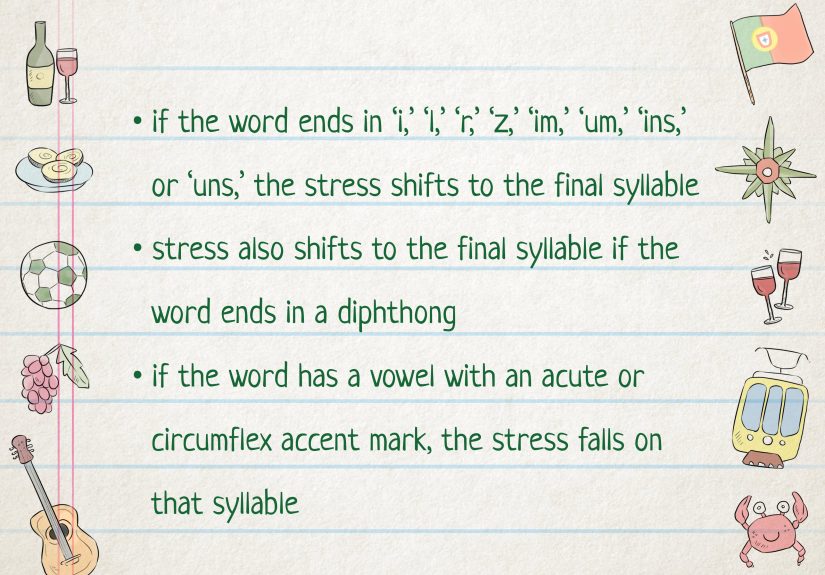
As a general rule, words ending in a, e, o, em, or ens are often stressed on the second-to-last syllable. Words ending in many other consonants, such as l, r, z, are often stressed on the final syllable. Accent marks override the default pattern.
Examples:
- casa = CA-sa
- amigo = a-MI-go
- falar = fa-LAR
- café = ca-FÉ
- música = MÚ-si-ca
When in doubt, look for an accent mark. It is the language’s way of saying, “Put the spotlight here.”
Portuguese Accent Marks and What They Do
Portuguese accent marks are practical. They help with stress, vowel quality, and nasal pronunciation.
Acute Accent: á, é, í, ó, ú
The acute accent usually marks stress and often signals an open vowel for é and ó. Examples include café, avó, and difícil.
Circumflex: â, ê, ô
The circumflex marks stress and usually signals a closed vowel. Examples include você, avô, and pôr.
Tilde: ã, õ
The tilde marks nasal pronunciation. You see it in words like mãe, pão, não, and corações.
Grave Accent: à
The grave accent appears mainly in contractions, such as à, meaning “to the” or “at the” before a feminine noun. It does not work like the acute accent.
Brazilian Portuguese vs. European Portuguese Pronunciation
Brazilian and European Portuguese share the same foundation, but they can sound surprisingly different. Here are the major pronunciation differences beginners should know.
Vowel Reduction
European Portuguese reduces unstressed vowels much more strongly. A word like telefone may sound more compressed in Portugal, while Brazilian Portuguese tends to pronounce the vowels more clearly.
Rhythm
Brazilian Portuguese often feels more syllable-friendly, with a flowing rhythm. European Portuguese can feel more stress-timed, with unstressed vowels becoming very short or nearly disappearing.
Final S Sounds
In many Brazilian accents, final s sounds like “s.” In Rio and Portugal, it often sounds like “sh.” So dois, meaning “two,” may sound closer to “doyss” in some places and “doysh” in others.
Final R Sounds
In Brazil, final r varies widely. It may sound like “h,” a light tap, or be dropped in casual speech. In Portugal, final r is generally more pronounced.
Common Portuguese Words With Pronunciation Tips
Here are useful beginner words and phrases with simple pronunciation hints. These are approximations, not perfect phonetic transcriptions, but they will help you get started.
- Olá = hello oh-LAH
- Bom dia = good morning bom JEE-ah in many Brazilian accents
- Boa tarde = good afternoon BOH-ah TAR-jee in many Brazilian accents
- Boa noite = good evening/good night BOH-ah NOY-chee in many Brazilian accents
- Obrigado = thank you, said by a man oh-bree-GAH-doo
- Obrigada = thank you, said by a woman oh-bree-GAH-dah
- Por favor = please por fah-VOR
- Desculpa = sorry des-KOOL-pah
- Sim = yes nasal “seem,” without a strong final m
- Não = no/not nasal “now” sound
Try not to memorize these as English spellings. Use them as training wheels, then gradually replace them with listening and imitation.
How to Practice Portuguese Pronunciation
1. Listen Before You Speak
Spend time listening to native Portuguese before forcing yourself to repeat everything. Your brain needs a sound map. Watch short videos, listen to podcasts, play songs, and repeat small pieces. If you are learning Brazilian Portuguese, choose Brazilian audio. If you are learning European Portuguese, choose speakers from Portugal.
2. Practice Minimal Pairs
Minimal pairs are words that differ by one sound. They train your ears to notice differences. Try pairs like avó and avô, or pão and pau. These small contrasts can make a big difference.
3. Record Yourself
Your mouth may think it is speaking Portuguese while your recording politely disagrees. That is normal. Record one sentence, compare it with native audio, and adjust one sound at a time. Do not fix everything at once. That way lies madness and possibly an argument with your own tongue.
4. Shadow Native Speakers
Shadowing means speaking along with a native speaker, almost like karaoke without the disco ball. Choose a short clip, slow it down if needed, and copy the rhythm, melody, and pauses. This improves pronunciation faster than reading word lists alone.
5. Focus on Rhythm, Not Perfection
Clear Portuguese pronunciation is not only about individual sounds. Rhythm matters. Portuguese has musical rises and falls, especially in Brazilian speech. A sentence with imperfect consonants but good rhythm may sound more natural than a sentence with perfect sounds spoken like a robot reading tax instructions.
Common Mistakes English Speakers Make
Pronouncing Every Letter Like English
Portuguese spelling is not English spelling wearing a vacation hat. Letters like r, s, x, d, and t have rules that change by position and accent.
Ignoring Nasal Vowels
Nasal vowels are essential. If you pronounce pão like pau, you may change the word completely. Context helps, but pronunciation still matters.
Overusing Spanish Pronunciation
Spanish can help with vocabulary, but it can also trick you. Portuguese has nasal vowels, different r sounds, vowel reduction, and softer consonants in many Brazilian accents. Similar spelling does not guarantee similar pronunciation.
Forgetting Word Stress
Misplaced stress can make a familiar word sound confusing. Learn words with their stress from the beginning. Say café as ca-FÉ, not CA-fe.
Experience-Based Tips for Learning How to Pronounce Portuguese
One of the most helpful experiences when learning Portuguese pronunciation is realizing that your mouth needs training, not criticism. Many beginners start by trying to “understand the rules” before they let themselves speak. Rules help, but pronunciation is physical. It lives in your jaw, lips, tongue, throat, and breath. Reading about nasal vowels is useful; saying não twenty times while trying not to sound like a confused goose is where the real learning begins.
A practical experience is to choose five everyday words and make them your pronunciation gym. Good examples are não, pão, obrigado, trabalho, and coração. These words train several important sounds: nasal vowels, tapped or strong r, lh, open vowels, and stress. Instead of learning fifty words badly, learn five words carefully. Listen, repeat, record, compare, and repeat again. It may feel slow, but it builds muscle memory.
Another useful experience is practicing with music. Portuguese-language music is excellent for rhythm. Brazilian songs can help learners feel vowel flow and sentence melody, while Portuguese music from Portugal can sharpen listening skills for reduced vowels. Do not worry if you cannot understand every lyric. First, copy the sound. Later, study the meaning. Pronunciation often improves when you stop treating language like a spreadsheet and start treating it like sound.
Speaking with native speakers is also powerful, but it helps to ask for targeted feedback. Instead of saying, “How is my Portuguese?” ask, “Does my ão sound clear?” or “Am I saying caro and carro differently?” Specific questions get specific answers. General questions often get polite encouragement, which is kind, but not always useful.
One experience many learners share is the shock of understanding textbook Portuguese but freezing during real conversation. That happens because natural speech is faster, messier, and full of regional flavor. The solution is exposure. Listen to different speakers, but practice with one accent first. If you mix Rio, São Paulo, Lisbon, and Salvador pronunciation on day one, your brain may file a formal complaint.
Finally, accept that accent is not the enemy. The goal is not to erase your identity. The goal is to be understood and to show respect for the language. Clear pronunciation comes from curiosity, repetition, and patience. Portuguese rewards learners who listen closely. It may tease you with nasal vowels and surprise r sounds, but once the rhythm clicks, the language becomes wonderfully satisfying to speak.
Conclusion
Learning how to pronounce Portuguese is a journey through clean vowels, nasal sounds, lively rhythm, and regional personality. Start by choosing Brazilian or European Portuguese as your main accent. Then focus on the sounds that matter most: open and closed vowels, nasal endings like ão, consonant pairs like lh and nh, and the many moods of the letter r.
You do not need perfect pronunciation to begin speaking. In fact, speaking is how pronunciation improves. Listen carefully, imitate native audio, record yourself, and practice small phrases every day. Portuguese may look familiar on the page, but its real charm lives in the sound. Treat it like music, and your pronunciation will become clearer, smoother, and much more confident.
Note: This article synthesizes pronunciation guidance from reputable dictionary, language-learning, and linguistic references, then rewrites it in original, web-ready language for publication.







 Close
Close