Table of Contents >> Show >> Hide
- Why shredding vegetables is a kitchen superpower
- Pick your tool: the best ways to shred vegetables
- 1) Box grater (the classic “four-sided workhorse”)
- 2) Food processor with shredding disc (the “I have 6 pounds of vegetables” button)
- 3) Mandoline slicer (the speed demonhandle with respect)
- 4) Julienne peeler / julienne blade (matchsticks with minimal fuss)
- 5) Knife cuts (julienne, chiffonade, fine shred)
- 6) Microplane/rasp grater (the “cloud of flavor” tool)
- The universal shredding method (works for almost everything)
- Vegetable-by-vegetable cheat sheet
- Moisture management: the secret to non-soggy shreds
- Smart food safety and storage for shredded vegetables
- Cleanup and maintenance (because future-you deserves nice things)
- Troubleshooting: common shredding problems (and fixes)
- Bring it all together
- of Real-Life Shredding Experience (A.K.A. How I Learned to Respect the Box Grater)
Shredding vegetables is one of those kitchen skills that looks suspiciously “chef-y” but is actually
just “owning a sharp object and having a plan.” It’s how you turn a lonely carrot into a slaw, a
stubborn potato into crispy hash browns, and a whole head of cabbage into the kind of salad base
that makes you feel like you have your life togethereven if your junk drawer says otherwise.
This guide will show you exactly how to shred (or grate, or julienne, or ribbon-cut) basically any
vegetable you’ve got: the easy tools, the right technique, the “why is my zucchini leaking?” fixes,
and the best uses for every shred size. No fancy culinary degree requiredjust a cutting board,
a little common sense, and ideally all ten fingertips.
Why shredding vegetables is a kitchen superpower
Shredding isn’t just about making vegetables smaller. It changes how they cook and how they behave:
- Faster cooking: Thin shreds soften quickly in stir-fries, soups, fritters, and sautés.
- Better texture: Slaws stay crisp, salads get lighter, and “veg-heavy” meals feel less heavy.
- More even seasoning: Dressing clings to surface area; shredded veg = more surface area = more flavor.
- Meal-prep friendly: A bag of shredded carrots/cabbage turns into multiple meals with minimal effort.
- Sneaky nutrition: Shredded zucchini disappears into muffins; grated carrots vanish into sauces and meatballs.
Pick your tool: the best ways to shred vegetables
1) Box grater (the classic “four-sided workhorse”)
Best for: carrots, potatoes, zucchini, beets, onions, cabbage (in a pinch), firm cheeses (yes, still),
and anything you want in fluffy piles.
Pro tip: You don’t always have to use it upright. Laying a box grater on its side can give you more control,
less fatigue, and easier cleanup because the shreds collect inside the grater instead of teleporting onto your counter.
2) Food processor with shredding disc (the “I have 6 pounds of vegetables” button)
Best for: big batchesslaw for a crowd, shredded potatoes for latkes, carrots for salad kits, or weekly meal prep.
If you’re shredding more than two vegetables, the food processor starts making a very persuasive argument.
- Use the feed tube pusher: it exists to keep your fingers out of the business end.
- Cut veg to fit: trim carrots, quarter onions, and cut cabbage wedges so they feed smoothly.
- Expect a “short shred”: processors often create smaller, more uniform shreds than hand-grating.
3) Mandoline slicer (the speed demonhandle with respect)
Best for: ultra-thin slices and clean ribbons; some models do julienne too. Great for potatoes, zucchini,
cucumbers, and cabbage when you want consistent thickness fast.
Safety note: use the hand guard and consider a cut-resistant glove. Mandolines are famously efficient at slicing
vegetables… and also at slicing confidence.
4) Julienne peeler / julienne blade (matchsticks with minimal fuss)
Best for: carrots, zucchini, cucumbers, and firm-ish veggies when you want quick noodle-like strands.
It’s not identical to a chef’s knife julienne, but it’s close enough for weeknight stir-fries.
5) Knife cuts (julienne, chiffonade, fine shred)
Best for: cabbage ribbons, leafy greens, herbs, and situations where you want control over thickness.
A knife is also the best “tool” when your grater is dirty and you refuse to wash it on principle.
- Julienne: thin matchsticks (great for quick cooking and even texture).
- Chiffonade: thin ribbons (perfect for leafy greens, basil, spinach, kale).
- Fine shred: thin slices stacked and cut again (excellent for slaw mixes).
6) Microplane/rasp grater (the “cloud of flavor” tool)
Best for: garlic, ginger, horseradish, citrus zest, and small hard items. For vegetables, it’s great when you want
a puree-like grate (think garlic into dressings or ginger into marinades).
The universal shredding method (works for almost everything)
- Wash and dry. Wet vegetables slip. Slipping vegetables lead to regret.
- Trim and stabilize. Cut off ends. For round veg (like beets), slice a thin “flat” side so it doesn’t roll.
- Choose your shred size. Big holes = coarse shreds (slaw, hash browns). Small holes = finer shreds (baking, quick sautés).
- Use smart hand placement. Keep fingertips curled. Use a guard, pusher, or glove when appropriate.
- Stop before the nub becomes dangerous. When the piece gets small, switch to a knife or accept a tiny “chef snack” tax.
Vegetable-by-vegetable cheat sheet
When you’re standing in front of a vegetable wondering, “How do I turn you into shreds without turning myself into a headline?”
use this table.
| Vegetable | Best tool | Quick technique note | Great uses |
|---|---|---|---|
| Carrots | Box grater / food processor | Peel for sweeter, cleaner shreds; grate lengthwise for speed | Slaw, salads, carrot cake, stir-fries |
| Cabbage | Knife / mandoline / food processor | Remove core; slice into ribbons; keep pieces tight for even shred | Coleslaw, taco topping, sautéed cabbage |
| Potatoes | Box grater / food processor | Rinse grated potato to reduce starch if you want crispier results | Hash browns, latkes, casseroles |
| Sweet potatoes | Food processor / box grater | They’re densersteady pressure beats speed | Fritters, skillet hash, veggie “toast” bases |
| Zucchini | Box grater | Expect lots of watersqueeze/drain for fritters and baking | Zucchini bread, fritters, soups, sauces |
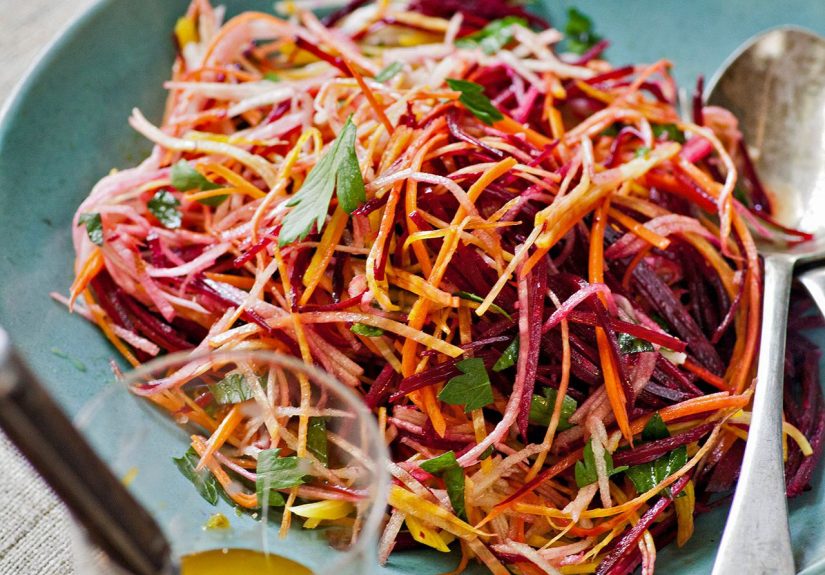
| Beets | Box grater / food processor | Peel first; wear gloves unless you want “mystery hands” | Beet salad, slaw, quick pickles |
| Cauliflower | Box grater / food processor | Pulse florets for “rice”; grate stems too (they’re edible!) | Cauli rice, fritters, bowls |
| Broccoli stems | Box grater / julienne peeler | Peel tough outer layer; shred the crisp interior | Slaw, stir-fry, salads |
| Brussels sprouts | Food processor / knife | Trim ends; slice thin to avoid “mini cabbage boulders” | Raw salads, quick sautés |
| Onions | Box grater / knife | Use for sauces when you want onion flavor without chunks | Meatballs, marinades, dressings |
| Cucumbers | Julienne peeler / mandoline | For watery cucumbers, pat dry before dressing | Salads, quick pickles, bowls |
| Kale / greens | Knife (chiffonade) | Remove thick stems; stack leaves; slice into ribbons | Salads, soups, sautés |
Moisture management: the secret to non-soggy shreds
Some vegetables shred like a dream. Others… leak. If your shredded pile looks like it’s sweating through a breakup,
you need moisture control.
Watery vegetables (zucchini, summer squash, cucumbers)
- For fritters, pancakes, and baking: shred, lightly salt, wait 10–15 minutes, then squeeze hard in a towel or cheesecloth until noticeably drier.
- For soups/sauces: you can often skip squeezingextra moisture cooks off.
- For salads: pat dry, then dress right before serving so things stay crisp.
Starchy vegetables (potatoes)
- For crispy hash browns/latkes: rinse shredded potato briefly, then squeeze dry. Less starch on the surface can help with crisping.
- For casseroles: you can keep more starch (it helps bind), but still avoid leaving shreds soaking wet.
Dense vegetables (beets, sweet potatoes)
These don’t shed water so much as they demand respect. Use steady pressure, keep your tool stable,
and don’t rush. Shredding is not a race when the vegetable is basically a root-shaped kettlebell.
Smart food safety and storage for shredded vegetables
Shredded vegetables are convenientand more perishable than whole produce because you’ve increased surface area.
A few rules keep things safe and fresh:
- Refrigerate promptly: Don’t leave cut or shredded vegetables out at room temp for more than 2 hours (1 hour if it’s hot).
- Use clean containers: Covered, food-safe containers reduce drying and cross-contamination.
- Keep your fridge cold: Aim for 40°F (4°C) or below.
- Label and rotate: Most prepped produce is best within a few days; if it smells off, looks slimy, or grows fuzz, it’s done.
Quick meal-prep storage tips that actually work
- Shredded carrots: store with a paper towel to absorb extra moisture.
- Shredded cabbage: keep it dry and covered; dress only what you’ll eat.
- Shredded zucchini: squeeze first if you’re planning fritters/baking; freeze measured portions if you shred a ton.
- Shredded potatoes: refrigerate short-term; for best texture, shred close to cooking time.
Cleanup and maintenance (because future-you deserves nice things)
The best shredding tool is the one you’ll actually clean. A few painless habits help:
- Rinse immediately: dried-on starch is basically edible cement.
- Soak narrow graters: a quick hot-water soak helps loosen stuck bits on microplanes and fine graters.
- Brush, don’t stab: use a dish brush to clean teeth safely.
- Check for dullness: if you’re crushing food instead of shredding it, your tool may be worn out.
Troubleshooting: common shredding problems (and fixes)
“My shreds are mushy.”
Your tool may be dull, your veggie may be overripe, or you may be applying too much force. Try a sharper surface,
a firmer vegetable, and slower, steadier strokes.
“Everything is watery and sad.”
Salt + rest + squeeze is your best friend for zucchini and other watery vegetables. For salads, pat dry and dress later.
“My knuckles are in danger.”
When the piece gets small, stop. Use a guard, a glove, a fork, or switch to a knife. The last inch of vegetable is not
worth an urgent care visit and a dramatic retelling.
“The food processor turns everything into tiny confetti.”
Use the shredding disc (not the chopping blade), keep pieces large enough to feed smoothly, and avoid over-processing.
For long shreds, hand-grating or a mandoline julienne often gives better length.
Bring it all together
If you remember nothing else, remember this: choose the right tool for the job, stabilize your vegetable (and your ego),
and control moisture when needed. Once you can shred vegetables confidently, you’ll cook faster, waste less produce,
and magically have more “throw-together meals” that don’t taste thrown together.
of Real-Life Shredding Experience (A.K.A. How I Learned to Respect the Box Grater)
The first time I tried to “shred vegetables for meal prep,” I had a vision: neat containers, colorful slaws, wholesome bowls,
and the smug satisfaction of someone who definitely owns matching lids. Reality looked more like this: a carrot launched off
the grater like a tiny orange rocket, cabbage confetti in places cabbage should never be (hello, toaster), and a zucchini puddle
that made my cutting board resemble a small, suspicious wetlands preserve.
My biggest early mistake was treating the box grater like a medieval weapon. Upright, awkward angle, too much arm power,
and a slow spiral into “why is my shoulder tired and why is nothing shredded?” Then I tried laying it on its side. Suddenly:
control. The shreds collected neatly. My arms stopped complaining. I felt like I’d unlocked a secret level of adulthoodright up until
I realized I had to clean it, which immediately demoted me back to “kitchen rookie.”
Next came zucchini. I thought, “How wet could it be?” Friends: it is wet. It is mostly water wearing a green jacket. I shredded a couple
for fritters, tossed everything into a bowl, and ended up with pancakes that were somehow both soggy and dryan impressive feat, honestly.
The fix was simple but life-changing: salt the shreds, wait a few minutes, then squeeze them like you’re wringing out a tiny towel that owes you money.
After that, my fritters finally browned instead of steaming sadly in their own moisture.
Potatoes taught me a different lesson: speed is not the goaltexture is. Shredded potatoes for hash browns are amazing when they’re dry enough to crisp.
I learned to rinse them quickly if they were super starchy, then squeeze them dry before they hit the pan. The first time I did it right, I got those
crispy edges that make you irrationally proud. I also immediately ate half the batch straight from the skillet “for quality control,” which is the official
term for “I have no patience.”
And then there was cabbage for slaw. If you slice it too thick, you get crunchy ropes. If you slice it too thin, it wilts the second it sees dressing.
The sweet spot, for me, was thin ribbonseither with a sharp knife or a food processor when I was making a big batch. I also learned not to dress the whole
bowl if I wanted leftovers that didn’t taste like yesterday’s soggy intentions. Dressing goes on the portion you’re eating now. Future-you will thank you.
These days, shredding vegetables feels less like a chore and more like a shortcut. A carrot + cabbage base becomes tacos, stir-fries, salads, and quick soups.
Zucchini disappears into muffins. Broccoli stems (yes, stems!) turn into a crunchy slaw that makes you feel like you’re getting away with something.
The real win isn’t perfectionit’s momentum. Once you’ve got a container of shreds in the fridge, cooking gets easier, faster, and a lot more likely to happen
on a weeknight when motivation is low and hunger is loud.