
Table of Contents >> Show >> Hide
- Step 1: Read the problem like a detective (and mark the “do not enter” zones)
- Step 2: Get your exponent “grammar” straight
- Step 3: Simplify using the laws of exponents (before you start solving)
- Step 4: Turn everything into a friendly form (same bases, fewer fractions)
- Step 5: Isolate the exponential or powered piece
- Step 6: If the bases match, set the exponents equal
- Step 7: If the bases don’t match, bring in logarithms (the “exponent extractor”)
- Step 8: Check, interpret, and polish your answer
- Common exponent problem types (quick mini-playbook)
- Common mistakes (and how to dodge them)
- Practice set (with quick answers)
- Final thoughts
- Experience: what actually makes exponent problems click (500-ish words of real talk)
Exponents are like that one friend who’s always “up for anything” (literally up there, floating above the number). They look intimidating, they refuse to come down, and they make you feel like you need special equipment to talk to them. The good news: you do. The equipment is a handful of rules, a little strategy, and (sometimes) logarithmsthe math equivalent of a polite ladder.
This guide walks you through 8 practical steps to solve algebraic problems with exponentseverything from simplifying expressions to solving equations where the variable is in the exponent. Along the way, you’ll see specific examples, common traps, and quick checks that keep your answers from wandering off a cliff.
Step 1: Read the problem like a detective (and mark the “do not enter” zones)
Before you touch the exponents, figure out what the problem is asking and whether there are any restrictions on the variable. Exponent problems often hide “gotchas” in places like denominators, even roots, and expressions that can’t be zero.
Common restrictions to watch for
- Denominators can’t be zero: If you see
1/(x-4), thenx ≠ 4. - Even roots need nonnegative radicands (in real numbers): If you rewrite
(x-2)^(1/2), you’ll needx-2 ≥ 0. - Negative exponents imply a reciprocal:
(x-3)^(-1)means1/(x-3), sox ≠ 3.
Mini example (restriction first):
Solve (x-3)^(-1) = 2
Restriction: x ≠ 3 (because it’s really 1/(x-3)). Now solve: 1/(x-3) = 2 → 1 = 2(x-3) → 1 = 2x-6 → 2x = 7 → x = 3.5. Check restriction: 3.5 ≠ 3, so we’re good.
Step 2: Get your exponent “grammar” straight
Most exponent chaos comes from translation errors. So let’s keep the language consistent:
- Zero exponent:
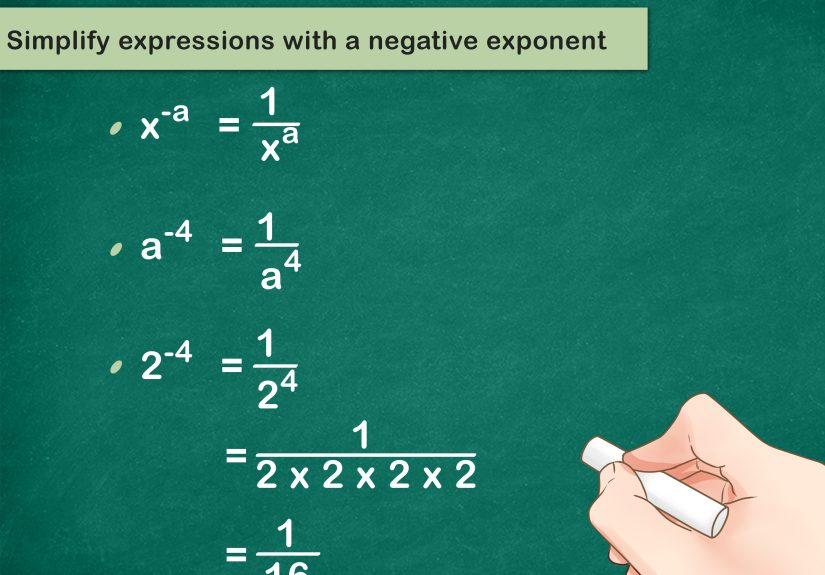
a^0 = 1(fora ≠ 0). - Negative exponent:
a^(-n) = 1/a^n(fora ≠ 0). - Power of 1:
a^1 = a. - Rational (fraction) exponent:
a^(m/n) = (n√a)^m(when working in real numbers, be mindful with even roots).
Mini example (rewrite radicals):
Rewrite ∛(x^2) as an exponent: that’s (x^2)^(1/3) = x^(2/3). This matters because exponent rules are usually easier to apply than radical rules.
Step 3: Simplify using the laws of exponents (before you start solving)
Think of exponent rules as “combining like Lego bricks.” If the base matches, you can usually combine. If the base doesn’t match, don’t force itmath hates being forced.
The exponent rules you’ll use constantly
- Product rule:
a^m · a^n = a^(m+n) - Quotient rule:
a^m / a^n = a^(m-n)(fora ≠ 0) - Power to a power:
(a^m)^n = a^(mn) - Power of a product:
(ab)^n = a^n b^n - Power of a quotient:
(a/b)^n = a^n / b^n(forb ≠ 0)
Example (simplify first, then solve-ready):
Simplify (2x^3y^(-2))^2 / (4x^(-1)y)
Numerator: (2^2)(x^(3·2))(y^(-2·2)) = 4x^6y^(-4)
Whole expression: (4x^6y^(-4)) / (4x^(-1)y)
Cancel the 4’s: x^6y^(-4) / (x^(-1)y)
Combine exponents: x^(6-(-1)) · y^(-4-1) = x^7 · y^(-5) = x^7 / y^5.
Step 4: Turn everything into a friendly form (same bases, fewer fractions)
Many exponent equations become easy if you rewrite numbers using prime bases. Your goal is to make both sides speak the same “base language.” Handy rewrites include:
4 = 2^2,8 = 2^3,16 = 2^4,32 = 2^5,64 = 2^69 = 3^2,27 = 3^3,81 = 3^425 = 5^2,125 = 5^3
Example (rewrite the base):
Solve 4^(x+1) = 64
Rewrite: 4 = 2^2 and 64 = 2^6
So (2^2)^(x+1) = 2^6 → 2^(2(x+1)) = 2^6.
Step 5: Isolate the exponential or powered piece
Exponent problems often look hard because the exponential part is buried under regular algebra. Treat it like any other equation: get the exponential term alone first.
Example (isolate first):
Solve 3·2^(x-1) + 5 = 29
Subtract 5: 3·2^(x-1) = 24
Divide by 3: 2^(x-1) = 8
Now you can rewrite 8 as 2^3 and move to the next step.
Step 6: If the bases match, set the exponents equal
Once you’ve rewritten both sides to the same base (and the base is positive and not 1), you can use the golden rule: If a^u = a^v, then u = v.
Finish the earlier examples:
Example A: 4^(x+1) = 64
From Step 4: 2^(2(x+1)) = 2^6
Set exponents equal: 2(x+1) = 6 → 2x+2 = 6 → 2x = 4 → x = 2.
Example B: 3·2^(x-1) + 5 = 29
From Step 5: 2^(x-1) = 8 = 2^3
Set exponents equal: x - 1 = 3 → x = 4.
Power equations (variable not in the exponent)
Sometimes the exponent is fixed, but the variable is the baselike (x-1)^3 = 8. These are still exponent problems, just with a different vibe.
Solve (x-1)^3 = 8
Take the cube root: x-1 = 2 → x = 3. (Odd roots are friendly: they keep the sign.)
If you have an even power, be extra careful: (x-1)^2 = 9 means x-1 = ±3 → x = 4 or x = -2.
Step 7: If the bases don’t match, bring in logarithms (the “exponent extractor”)
When you can’t rewrite both sides with the same base (like 5^x = 212), you need a tool that pulls the exponent down. That tool is a logarithm.
The key identity is: log(b^x) = x·log(b). You can use ln (natural log) or log (base 10). Most of the time, ln is the go-to because it plays nicely with science and calculus, but either works as long as you’re consistent.
Example A (no matching base):
Solve 5^x = 212
Take logs: ln(5^x) = ln(212)
Bring down exponent: x·ln(5) = ln(212)
Solve: x = ln(212)/ln(5) (decimal approximation comes from a calculator).
Example B (variable in a linear exponent):
Solve 10^(2x) = 52
Take logs: log(10^(2x)) = log(52)
Simplify left: 2x·log(10) = log(52), and log(10)=1
So 2x = log(52) → x = (log(52))/2.
Example C (isolate first, then log):
Solve 3·2^(x+4) = 350
Divide by 3: 2^(x+4) = 350/3
Take logs: ln(2^(x+4)) = ln(350/3)
Bring down exponent: (x+4)ln(2) = ln(350/3)
Solve: x = ln(350/3)/ln(2) - 4.
Step 8: Check, interpret, and polish your answer
“Checking” in exponent problems isn’t just politeness. It’s protection against: extraneous solutions (answers created by operations like squaring both sides), domain violations (like dividing by zero), and rounding weirdness (when logs give approximations).
How to check fast
- Substitute back into the original equation (not the simplified one, if you squared or took roots).
- Re-check restrictions from Step 1.
- Sanity check the size: If
2^x = 1000, thenxshould be around 10 (since2^10 = 1024).
Common exponent problem types (quick mini-playbook)
1) Simplify expressions
Use exponent rules to combine like bases, rewrite negative exponents, and avoid leaving answers with a base “stuck” in the denominator unless that’s allowed. Final answers are usually expected with positive exponents.
2) Solve power equations (variable in the base)
Use roots, but remember even powers produce two possible sign answers: u^2 = 9 → u = ±3. Then substitute back for u.
3) Solve exponential equations (variable in the exponent)
First try: rewrite to like bases. If that fails: isolate the exponential expression and use logs.
4) Convert between radicals and rational exponents
a^(1/2) is a square root, a^(1/3) is a cube root, and a^(m/n) means “take the nth root, then raise to m.” Converting often makes simplification or solving much easier.
Common mistakes (and how to dodge them)
- Mistake:
(x^3)^2 = x^5(Nope.) Fix: Multiply exponents:x^(3·2) = x^6. - Mistake:
(x+y)^2 = x^2 + y^2(Absolutely not.) Fix: It’sx^2 + 2xy + y^2. - Mistake:
a^m + a^n = a^(m+n). Fix: Exponent rules don’t combine terms with additiononly multiplication/division. - Mistake: Forgetting
±when solving even powers. Fix: Always ask: “If I square this, do I lose sign information?” - Mistake: Taking logs before isolating the exponential piece. Fix: Do the regular algebra first.
Practice set (with quick answers)
- Simplify:
x^4 · x^(-9)
Answer:x^(-5) = 1/x^5 - Simplify:
(3a^2b)^3
Answer:27a^6b^3 - Solve:
2^(x-1) = 16
Answer:16 = 2^4sox-1 = 4→x = 5 - Solve:
9^(x+2) = 27
Answer:9 = 3^2,27 = 3^3→3^(2(x+2)) = 3^3→2x+4 = 3→x = -1/2 - Solve:
(x-4)^2 = 25
Answer:x-4 = ±5→x = 9orx = -1 - Solve:
5·3^(2x) = 40
Answer:3^(2x) = 8→ logs:2x ln 3 = ln 8→x = (ln 8)/(2 ln 3) - Rewrite as a radical:
x^(5/2)
Answer:(√x)^5or√(x^5)(context determines best form) - Simplify:
(a^(-1)b^2)/(ab^(-3))
Answer:a^(-2)b^5 = b^5/a^2
Final thoughts
Solving exponent problems isn’t about memorizing a hundred tricks. It’s about running the same small routine: rewrite, simplify, isolate, and choose the right solving tool (equal exponents if you can, logarithms if you must). Once that routine becomes automatic, exponents stop feeling like “advanced math” and start feeling like… algebra wearing a hat. (A very tall hat.)
Experience: what actually makes exponent problems click (500-ish words of real talk)
Here’s what tends to happen when people learn exponents: they start by memorizing rules like flashcards, feel confident for about twelve minutes, and then get ambushed by a problem that looks slightly differentmaybe a negative exponent shows up, or the base is a fraction, or the variable moves into the exponent. Suddenly the rules feel like they evaporated. That’s normal. The fix isn’t “memorize harder.” The fix is to build a repeatable workflow and use it so often you could do it while eating cereal.
The biggest breakthrough for most students is realizing that exponent problems are really two categories wearing the same costume: simplification problems (where your job is to rewrite an expression cleanly) and equation problems (where your job is to find a value of a variable). If you treat every exponent problem like it’s automatically an equation to solve, you’ll do extra work or do the wrong work. So I like to start by asking: “Am I simplifying, solving, or both?”
Another game-changer is treating “make the bases match” as a reflex. At first, rewriting 64 as 2^6 feels like a cute trick. After enough practice, it becomes instinctlike seeing a locked door and immediately checking if you have the key. This is also why practicing with “friendly” numbers (powers of 2, 3, and 5) early on is helpful: it trains your brain to spot structure. Later, when you run into 5^x = 212, you’ll quickly notice the base can’t easily matchand that’s your cue to use logs without panic.
Speaking of logs: people often think logarithms are scary because they arrive late in the math story, like a new character in season five of a show. But the role they play is simple: they pull an exponent down where you can solve for it. If you remember just one movetake ln (or log) of both sides after isolating the exponential expressionyou’ll solve most exponential equations you meet in Algebra 2, precalculus, and beyond. The rest is regular algebra: distribute, combine like terms, divide.
Finally, the skill that quietly separates “I can do these” from “I’m guessing” is checking answers. It doesn’t have to be a full rewrite. Plug your solution back in and see if both sides match (or match closely if you used decimals). This catches classic mistakes: forgetting the ± when solving even powers, violating a restriction like x ≠ 3, or making a tiny slip with a negative exponent. Nothing builds confidence like watching your answer actually work.
If you want a practical practice plan: do 5 problems a day for a week, mixed types (simplify, solve with same base, solve with logs). Keep a “mistake list” of the two or three errors you personally make most often (everyone has a signature movemine used to be dropping parentheses in (x+2)^n). Review that list before you start. It feels silly. It works ridiculously well.






 Close
Close