Table of Contents >> Show >> Hide
- Before You Start: Know What You’re Turning Off
- How to Stop Call Forwarding on Samsung Galaxy: 8 Steps
- Step 1) Confirm which SIM/line is forwarding
- Step 2) Do a quick “real-world” test call
- Step 3) Open Samsung’s call forwarding settings (the usual path)
- Step 4) Turn off “Always forward” first
- Step 5) Disable Busy / Unanswered / Unreachable (the “conditional” trio)
- Step 6) If the toggle won’t “stick,” refresh your network connection
- Step 7) Cancel call forwarding at the carrier level (U.S. codes)
- Step 8) Check for “extra layers” that can mimic call forwarding
- Troubleshooting: Common “Why Is This Still Happening?” Scenarios
- Experiences From the Real World: What Usually Trips People Up (and How to Avoid It)
- Conclusion
Call forwarding is a little like letting your phone “borrow” your calls and drop them off somewhere else.
Useful when you’re traveling, working a shift, or avoiding that one cousin who calls to “quickly ask” a question
that takes 47 minutes. Not so useful when you forget it’s on and wonder why everyone says, “Your phone went straight
to your office line again.”
The good news: stopping call forwarding on a Samsung Galaxy is usually quick. The slightly annoying news:
call forwarding can live in two placesyour phone settings and your carrier’s network.
So if you turn it off on the device but it still forwards, you’ll likely need to cancel it at the carrier level too.
This guide walks you through both, with practical checks and carrier codes for the U.S.
Before You Start: Know What You’re Turning Off
Samsung (and most carriers) break call forwarding into a few common types. Knowing which one you enabled helps you disable it faster:
- Always forward (Unconditional): every call goes to another number.
- Forward when busy: calls forward only when you’re already on a call.
- Forward when unanswered: calls forward when you don’t pick up.
- Forward when unreachable: calls forward when you have no signal / phone is off.
One important heads-up: on many U.S. carriers, your voicemail is basically “conditional forwarding” behind the scenes.
If you fully disable forwarding when unanswered/unreachable, you may also affect voicemail behavior. If your only goal is
to stop calls from going to another number (like a second phone, an assistant, or an old landline),
you’ll typically want to disable anything that forwards to a number you recognize as “not voicemail.”
How to Stop Call Forwarding on Samsung Galaxy: 8 Steps
Step 1) Confirm which SIM/line is forwarding
If your Galaxy has Dual SIM (physical SIM + eSIM, or two SIMs), call forwarding can be enabled on just one line.
Open the Phone app and look for settings that let you choose SIM1/SIM2 (wording varies by model and One UI version).
If you only disable one SIM’s forwarding rules, the other line can keep forwarding and make you feel like your phone is haunted.
Step 2) Do a quick “real-world” test call
Use a different phone (a friend’s phone, a work line, or a VoIP number) and call your Samsung Galaxy number.
Pay attention to what happens:
- If it immediately routes elsewhere: you likely have Always forward enabled.
- If it rings, then routes elsewhere: you likely have No answer forwarding enabled.
- If it routes only when you’re already on a call: it’s Busy forwarding.
This test helps later, because you can repeat it after each change and know exactly what you fixed.
Step 3) Open Samsung’s call forwarding settings (the usual path)
On many Samsung Galaxy phones, the most reliable path is through the Phone app (not the main Settings app):
- Open Phone.
- Tap the three-dot menu (top right).
- Tap Settings.
- Tap Supplementary services (or a similar label like “Calling accounts”).
- Tap Call forwarding.
If your Samsung uses Google’s Phone app or carrier-customized menus, the labels may vary, but you’re looking for a call forwarding screen
that lists the four forwarding types (Always/Busy/Unanswered/Unreachable).
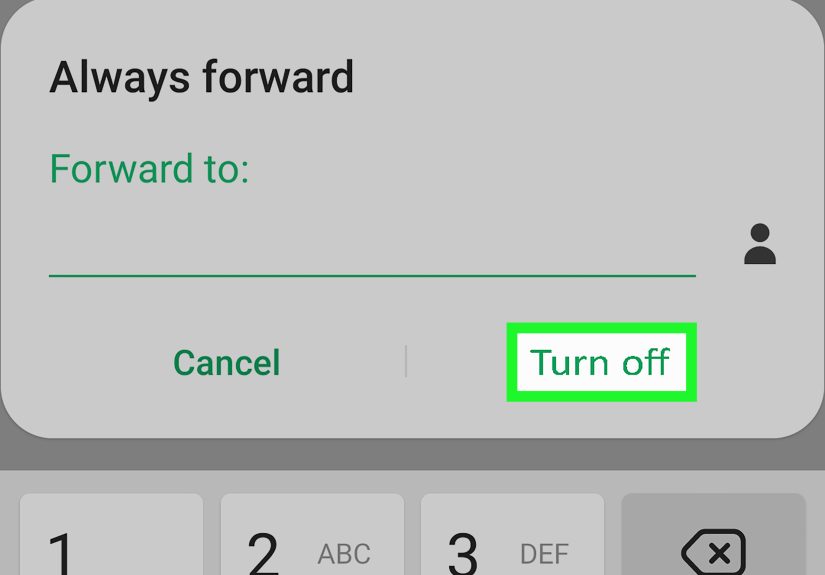
Step 4) Turn off “Always forward” first
If you see Always forward enabled, disable it firstthis is the one that hijacks every call.
In most menus, you’ll tap “Always forward,” then choose Turn off / Disable, or clear the destination number and save.
After you disable it, do another test call. If calls now ring your phone normally, you’re already 80% done.
Step 5) Disable Busy / Unanswered / Unreachable (the “conditional” trio)
Next, open each of these and disable them:
- Forward when busy
- Forward when unanswered
- Forward when unreachable
If you see a forwarding number that’s clearly yours (like an old work line, a spouse’s phone, or a call center),
disable it. If the number looks like a carrier voicemail access number, consider leaving it unless you explicitly want voicemail impacted.
Example: You set “Forward when unanswered” to your Google Voice number during a travel week, so your laptop could ring too.
Now you want calls to stay on your Galaxydisable “Forward when unanswered” or clear the destination number, then save.
Step 6) If the toggle won’t “stick,” refresh your network connection
Sometimes the phone settings update, but the carrier network takes a moment to catch upor it fails quietly.
Try this quick refresh routine:
- Toggle Airplane mode ON for 10 seconds, then OFF.
- Restart the phone.
- Re-check call forwarding settings to confirm they stayed off.
If your phone shows errors like “MMI code” failures or “Supplementary services unavailable,” it’s a strong hint the carrier network is the real source of truth here.
Step 7) Cancel call forwarding at the carrier level (U.S. codes)
If your Samsung settings look correct but forwarding still happens, cancel forwarding directly through your carrier.
These are common U.S. options (your plan/network can affect which codes work):
- Verizon: Dial *73 and call to turn off forwarding (you should hear a confirmation tone/message).
- T-Mobile: Dial ##21# to turn off unconditional forwarding. If you need a broader reset, ##004# can reset call forwarding to default on many T-Mobile setups.
- AT&T: On many AT&T configurations, dialing #21# turns off call forwarding (always). AT&T also publishes feature access codes for call forwarding options.
A practical approach: start with the carrier’s “turn off unconditional forwarding” code, test your calls, then use a broader reset if needed.
If a code doesn’t work, don’t keep speed-running random star codescheck your carrier’s official support page or contact them.
Step 8) Check for “extra layers” that can mimic call forwarding
Even after you disable forwarding on your Galaxy and on the carrier network, calls can still appear to “forward” if another service is routing them.
The usual suspects:
-
Google Voice: If your calls ring other phones, you may have Google Voice forwarding enabled to linked numbers.
Turn off forwarding to the linked device/number in Google Voice settings. - Google Fi: Fi can manage call forwarding features and may have its own settings or carrier-level behavior.
- Carrier app/web portal: Some carriers let you enable forwarding from your account dashboardso it may be “on” even if the phone says “off.”
- Work profile / MDM: Corporate device management can enforce call routing features in rare cases.
After you check these layers, do one more test call. If your phone rings normally again, congratulationsyour calls are officially back from their side quest.
Troubleshooting: Common “Why Is This Still Happening?” Scenarios
Your phone says forwarding is off, but calls still route elsewhere
- Use carrier codes (Step 7). This is often a network-level forwarding rule.
- Toggle Airplane mode or restart (Step 6) to force a network refresh.
- Check your carrier account page for forwarding rules (Step 8).
You see “Conditional call forwarding active” and you didn’t set it
This message can be confusing because many carriers use conditional forwarding for voicemail (busy/unanswered/unreachable).
If the forwarding destination looks like a voicemail number, it may be normal.
If the destination is a random number you don’t recognize, treat it seriously: disable the conditional options,
run the carrier reset code, and contact your carrier to confirm your line’s forwarding rules.
The Call Forwarding menu is missing or “Supplementary services” won’t open
This can happen if the carrier restricts access, the phone is in a bad network state, or the menu is provided by a different dialer app.
Try:
- Switch to mobile data (turn Wi-Fi off) and reopen the Phone app settings.
- Restart the phone and try again.
- Use carrier codes to disable forwarding directly.
- As a last resort, reset network settings (this will remove saved Wi-Fi and Bluetooth pairings).
Experiences From the Real World: What Usually Trips People Up (and How to Avoid It)
If you’ve ever tried to stop call forwarding and thought, “I turned it off… why is it still doing the thing?”
you are very much not alone. In practice, most call-forwarding headaches don’t come from complicated technology
they come from small, human moments. Like enabling forwarding in a rush, or switching carriers, or setting up a second SIM
and forgetting the phone now has “two personalities.”
One common situation: you forward calls to a temporary number during a busy weekmaybe to a work line, an assistant, or a second device
and then you change that second number later. Now your Galaxy keeps trying to forward to a dead end, which feels like calls are “disappearing.”
The fix is usually boring (in a good way): open each forwarding condition and clear the destination, then run the carrier “turn off” code once.
The lesson: call forwarding is not always stored only on your phone. Sometimes it’s stored in the carrier network, meaning your settings
changes need that extra nudge (Airplane mode, restart, or a carrier short code) to fully sync.
Another classic: dual SIM confusion. People disable forwarding on SIM1, test with a call to the number on SIM2, and conclude,
“Nothing changed.” It’s not that the phone hates youit’s that each line can have its own call forwarding rules. If you have a personal
number on eSIM and a business number on a physical SIM, treat them like two separate phones living in one device. When you’re troubleshooting,
always ask: Which number is actually forwarding? Once you focus on the right line, the fix usually takes under two minutes.
Then there’s the “voicemail is forwarding” surprise. Some people open the Call forwarding menu, see numbers filled in under
“when unanswered” and “when unreachable,” and assume they’ve been hacked or their phone was misconfigured. In reality, those entries can be
part of how voicemail works. If you wipe them out, you might stop voicemail from picking up, which can be either a win or a disaster,
depending on your life. (If you run a small business, it’s usually a disaster.) The smarter move is to identify what number the calls are going to.
If it’s clearly a voicemail service number, you may leave it. If it’s a random number you don’t recognize, that’s when you cancel forwarding at the carrier level
and ask support to confirm that no forwarding rules exist on your line.
My favorite “why did this happen?” moment is accidental activation. People sometimes get a call or message that says,
“To fix your account, dial this code,” and the code happens to be a forwarding activation pattern. They dial it, calls start routing elsewhere,
and suddenly it feels like the phone has betrayed them. The better habit is simple: don’t dial unfamiliar star/pound codes unless you initiated the support request
and you trust the source. If call forwarding turns on unexpectedly, disable it through the Phone app, then use your carrier’s official “turn off” code
(like Verizon’s *73 or T-Mobile’s ##21#), and confirm the result with a test call.
Finally, there’s the “everything looks off, but calls still ring somewhere else” caseoften caused by Google Voice or a carrier web portal rule.
People forget they once linked numbers in Google Voice, or enabled forwarding from their carrier account during setup. The phone is innocent;
the routing is happening in a different layer. When you remember to check those extra layers, it’s usually an instant facepalm… followed by instant relief.
And honestly? That’s the best outcome: one toggle, one test call, and your Galaxy goes back to being a phone instead of a call traffic controller.
Conclusion
To stop call forwarding on a Samsung Galaxy, turn it off in the Phone app’s call settings, disable each forwarding condition,
andif forwarding persistscancel it through your carrier using the appropriate U.S. short code. Finish by checking services like Google Voice
or your carrier account portal, and confirm success with a test call. Once you do these steps in order, you’ll get back to the simple joy of calls
ringing exactly where you expect: on your phone.