Table of Contents >> Show >> Hide
- What “Hand Weights” Really Means (and What You Need)
- How to Choose the Right Weight (Without Guessing Forever)
- Warm-Up: 5 Minutes That Make Everything Feel Better
- The Best Easy Hand-Weight Exercises for Home (With Form Cues)
- Easy Dumbbell Workouts You Can Do at Home
- How to Progress (So You Don’t Stall After Week Two)
- Common Home-Workout Mistakes (and Quick Fixes)
- Make It Safer and More Sustainable
- Real-Life Experiences: What Working Out at Home With Hand Weights Actually Feels Like (500+ Words)
- Conclusion
You don’t need a fancy gym membership, a squat rack that looks like it belongs in a superhero movie, or a motivational poster screaming
“NO DAYS OFF” (please, we all need days off). If you’ve got a pair of hand weightsaka dumbbellsand a small patch of floor that isn’t currently
occupied by laundry, you can build strength, improve posture, and feel more capable in daily life.
The goal of this guide is simple: help you work out at home using hand weights with exercises that are straightforward, effective, and beginner-friendly
with options to level up as you get stronger. You’ll learn how to pick the right weight, master the key movements, and follow a few easy routines that
actually fit real schedules.
Quick note: This is general fitness information, not medical advice. If you’re pregnant, recovering from injury, managing a condition, or unsure where to start, check in with a clinician or qualified trainer.
What “Hand Weights” Really Means (and What You Need)
“Hand weights” usually means dumbbells. It can also include small neoprene weights, adjustable dumbbells, or even household stand-ins in a pinch.
But dumbbells are popular for a reason: they’re versatile, scalable, and great for training your whole body at home.
Minimal setup that makes workouts easier
- Two dumbbells (or one dumbbell for certain exercises)
- A sturdy chair (for support, rows, split squats, or step-ups)
- A mat or towel (optional, but your knees may write you a thank-you note)
- A timer (phone timer worksjust don’t get trapped scrolling between sets)
- Clear space (move tripping hazards; your toes deserve peace)
How to Choose the Right Weight (Without Guessing Forever)
The “right” weight depends on the exercise and your current strength. A weight that feels perfect for goblet squats might feel outrageous for lateral raises.
That’s normal. Different muscles, different job descriptions.
A simple rule that works
Aim for a weight that lets you do 8–12 controlled reps with good form, where the last 2–3 reps feel challenging but still clean.
If you can do 12 reps and feel like you could keep going through a whole TV episode, go heavier next time.
If you can’t hit at least 8 reps with solid form, go lighter.
What if you only have one set of dumbbells?
No problem. You can make lighter weights harder by slowing down (3 seconds down, 1 second up), pausing at the hardest point, adding reps, or doing one side at a time.
You can also make heavier weights safer by shortening range of motion temporarily while your technique catches up.
Warm-Up: 5 Minutes That Make Everything Feel Better
Warming up doesn’t have to be complicated. The purpose is to raise your temperature, wake up your joints, and practice the movements you’re about to load.
Think “prep,” not “punishment.”
Do this quick warm-up (no equipment)
- March in place (60 seconds)
- Hip hinges (10 repshands on hips, push hips back, stand tall)
- Bodyweight squats (10 repscomfortable depth)
- Arm circles (20 seconds each direction)
- Shoulder blade squeezes (10 repspinch shoulder blades gently, release)
The Best Easy Hand-Weight Exercises for Home (With Form Cues)
If you only learn a handful of dumbbell exercises, focus on moves that train big muscle groups and everyday patterns:
squat, hinge, push, pull, lunge, carry, and brace your core.
1) Goblet Squat
Targets: quads, glutes, core
Hold one dumbbell vertically at your chest (like you’re protecting a very precious sandwich). Feet about shoulder-width.
Sit back and down, keep your chest tall, and drive through mid-foot to stand.
- Make it easier: squat to a chair and stand back up
- Make it harder: slow the descent or add a pause at the bottom
2) Dumbbell Romanian Deadlift (RDL)
Targets: hamstrings, glutes, back (hinge pattern)
Hold dumbbells at your sides. Soft knees. Push hips back like you’re closing a car door with your butt (classy and effective).
Keep a long spine, lower until you feel hamstrings stretch, then squeeze glutes to stand.
- Form cue: the dumbbells stay close to your legsdon’t let them drift forward
- Common fix: if your back rounds, reduce depth and lighten the weight
3) Reverse Lunge
Targets: glutes, quads, balance
Hold dumbbells at your sides. Step one foot back, lower under control, then push through the front foot to stand.
Reverse lunges are often kinder on knees than forward lunges because you can control the step.
- Make it easier: hold onto a chair with one hand for balance
- Make it harder: add a slight pause at the bottom
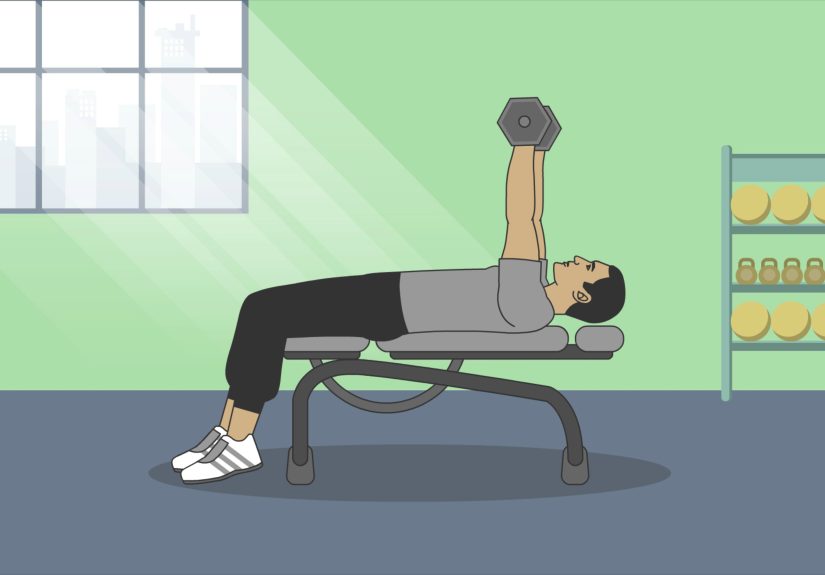
4) Dumbbell Floor Press
Targets: chest, triceps, shoulders
Lie on your back, knees bent. Start with elbows on the floor and dumbbells over your chest.
Press up until arms are straight (not hyperextended), then lower until elbows gently tap the floor again.
- Why it’s great at home: the floor limits range, which can feel safer for shoulders
- Form cue: keep wrists stacked over elbows
5) One-Arm Dumbbell Row (Chair-Supported)
Targets: upper back, lats, biceps
One hand on a sturdy chair, other hand holds the dumbbell. Hinge forward with a flat back.
Pull the dumbbell toward your hip (not your shoulder), then lower with control.
- Feel it more: think “elbow goes back,” not “hand goes up”
- Beginner-friendly: go lighter and slow down
6) Standing Overhead Press
Targets: shoulders, triceps, core stability
Start dumbbells at shoulder height, ribs down, glutes lightly engaged. Press overhead, then lower slowly.
If your low back arches, go lighter and squeeze your glutes like you mean it.
- Make it easier: press one arm at a time
- Make it harder: add a pause overhead
7) Lateral Raise
Targets: side delts (shoulder cap muscles)
Use light weights. Slight bend in elbows. Raise dumbbells out to the sides to about shoulder height, then lower slowly.
This is not the place for ego-lifting. Your shoulders do not care about your ego.
8) Biceps Curl (Standard or Hammer)
Targets: biceps, forearms
Stand tall, elbows close to your sides. Curl up without swinging, lower slowly.
Hammer curls (palms facing each other) can feel friendlier on wrists.
9) Overhead Triceps Extension
Targets: triceps
Hold one dumbbell with both hands overhead. Keep elbows pointing forward.
Lower behind your head under control, then extend back up.
- Make it easier: do triceps kickbacks with lighter weights
10) Farmer Carry (or Suitcase Carry)
Targets: grip, core, posture muscles, overall “real-life strength”
Hold dumbbells at your sides and walk slowly around your space for 30–60 seconds.
For suitcase carry, hold one dumbbell on one side only and resist leaning.
- Form cue: tall posture, shoulders down, slow steps
Easy Dumbbell Workouts You Can Do at Home
You don’t need a complicated split routine to get results. Consistency plus progression beats a “perfect” plan you never do.
Choose a routine that matches your schedule, then repeat it for 4–6 weeks while gradually improving.
Workout A: Beginner Full-Body (2 days/week, 25–35 minutes)
Do 2–3 sets of 8–12 reps each. Rest 60–90 seconds between sets.
- Goblet squat
- Dumbbell RDL
- Floor press
- One-arm row (each side)
- Overhead press
- Farmer carry (30–60 seconds)
Tip: If 2–3 sets feels like a lot at first, start with 1–2 sets and add more over time.
Showing up matters more than doing “max volume” on day one.
Workout B: Time-Saver Circuit (20 minutes, 2–3 days/week)
Set a timer: 40 seconds work, 20 seconds rest. Complete 3 rounds.
- Goblet squat
- One-arm row (switch sides each round)
- Floor press
- Reverse lunge (alternate legs)
- Overhead press
This style keeps your heart rate up and your brain engaged (because you’re busy counting seconds and trying not to negotiate with the timer).
Workout C: 3-Day Weekly Plan (Intermediate-Friendly)
Day 1 (Full Body Strength): Squat, Row, Press, Carry
Day 2 (Lower + Core): RDL, Lunge, Glute bridge (optional), Carry
Day 3 (Upper + Arms): Floor press, Row, Overhead press, Lateral raise, Curls, Triceps
Keep most moves at 2–4 sets of 6–12 reps depending on the exercise and your weight selection. The big lifts (squat/RDL/press/row) usually respond well
to moderate reps and good rest. Smaller moves (lateral raises, curls) often feel best with lighter weights and slightly higher reps.
How to Progress (So You Don’t Stall After Week Two)
Progress isn’t magicit’s small, boring upgrades that add up. Here are simple ways to improve without reinventing your routine every Monday:
- Add reps: If you did 8 reps last week, try 9–10 this week (same weight, same form).
- Add weight gradually: When you can do your top reps comfortably, bump the weight slightly.
- Add a set: Move from 2 sets to 3 sets on your main exercises.
- Slow the tempo: 3 seconds down, 1 second up is a “light weight” multiplier.
- Improve range of motion: Squat a bit deeper or hinge a bit more (without losing posture).
Track one thing
Write down your weights and reps for the big moves. That’s it. You don’t need a fancy app unless you like fancy apps.
A notes app or sticky note works fineas long as you can read your own handwriting later.
Common Home-Workout Mistakes (and Quick Fixes)
Mistake: Going too heavy too soon
If your form turns into a full-body dance routine, the weight is too heavy for today.
Fix: reduce weight and slow down. Controlled reps beat chaotic reps.
Mistake: Holding your breath
Breath-holding can spike pressure and makes sets feel harder than they need to.
Fix: exhale on the effort (standing up, pressing up, pulling up), inhale on the easier phase.
Mistake: Skipping pulling movements
Many people do presses and squats but forget rows. Your posture will notice.
Fix: include at least one row variation in every full-body workout.
Mistake: No rest days
Muscles grow and recover between sessions.
Fix: strength train 2–3 days per week and avoid hammering the exact same muscles hard on back-to-back days.
Make It Safer and More Sustainable
- Start lighter than you think you need. Your tendons and joints appreciate a ramp-up period.
- Use pain as a stop sign. Muscle effort is okay; sharp pain is not.
- Prioritize clean reps. Good form now helps you lift more later.
- Keep your space clear. Tripping over a dumbbell mid-carry is a very dramatic way to end a workout.
- When in doubt, shorten range and slow down. You can always expand range later.
Real-Life Experiences: What Working Out at Home With Hand Weights Actually Feels Like (500+ Words)
Let’s talk about the part most workout plans leave out: the very human experience of lifting dumbbells in your home, where the lighting is weird,
the floor may or may not be level, and your “gym soundtrack” is the dishwasher finishing its cycle.
Many people start out thinking strength training should feel like an action montage. Then reality shows up: the first few sessions often feel
surprisingly technical. You’re trying to remember how to hinge (hips back), how to squat (knees track, chest up), and how to keep your ribs down
on overhead presses so your lower back doesn’t do all the work. In the beginning, you might feel like you’re “bad at it.” What’s usually happening
is simpler: you’re learning a skill. Strength training is part fitness, part coordination.
Another common experience is discovering that grip strength is the sneaky limiter. Your legs may be ready for more on Romanian deadlifts, but your
hands tap out first. This is not a failure; it’s a bonus training effect. Farmer carries and consistent rows tend to improve grip over time, and
many at-home lifters notice that everyday taskscarrying groceries, moving boxes, opening stubborn jarsstart feeling easier.
There’s also the “DOMS surprise” (delayed onset muscle soreness). People who feel fine immediately after a workout sometimes wake up the next day and
walk downstairs like a polite robot. The good news: soreness usually reduces as your body adapts. A gentle walk, hydration, and a reasonable next workout
(not a revenge workout) helps. Most folks find that starting with fewer sets, leaving a rep or two in the tank, and building slowly makes training
more enjoyable and far more consistent.
Home workouts come with a psychological advantage too: fewer barriers. You don’t need to drive anywhere or “look like you know what you’re doing.”
You can do a 20-minute dumbbell circuit, toss the weights back in a corner, and return to your day. That convenience is powerful. Many people find
they train more often simply because starting is easier. And once you’re consistent, results followbetter posture, stronger legs, more stable shoulders,
and that nice feeling of being able to do things without negotiating with your body first.
The most useful “experience-based” tip is this: expect some days to feel weird. Some days you’ll feel strong, coordinated, and unstoppable.
Other days your balance disappears, your dumbbells feel heavier, and your brain forgets what a lunge is. This is normal. Progress isn’t a straight line;
it’s more like a hiking trail with occasional squirrels.
If you stick with it, you’ll likely develop small rituals that make workouts smoother: laying out your dumbbells before you start, picking a short playlist,
keeping a towel nearby, and writing down your reps so you don’t spend five minutes wondering, “Did I do two sets or three? Was that Tuesday?”
Over time, those tiny habits become the reason home training worksand why it keeps working.
Conclusion
Working out at home using hand weights can be simple and surprisingly effective. Focus on the big patterns (squat, hinge, push, pull, lunge, carry),
choose weights that challenge you while keeping form clean, and follow a routine you can repeat consistently. Start small, progress gradually, and let
“easy to start” be your superpower. You don’t need perfectionyou need momentum.