Table of Contents >> Show >> Hide
- Meet TRAPPIST-1: Seven Rocky Worlds in a Tiny, Busy Neighborhood
- What Hubble Actually Measured: UV Light, Not Ocean Waves
- Is That a Water Detection? Not Yet. It’s a Plausibility Argument (a Good One, But Still)
- Atmospheres: The Make-or-Break Ingredient for Liquid Water
- JWST Enters the Chat: From Hints to Harder Constraints
- How Scientists Translate UV Light into “Earth Oceans” (Without Losing Their Minds)
- What Would “Water Evidence” Look Like in Future Observations?
- Big Picture: What TRAPPIST-1 Teaches Us About Habitability Around Red Dwarfs
- Conclusion: A Sensible Amount of Hope, With a Side of Patience
- Experiences: What It’s Like to Follow the TRAPPIST-1 Water Hunt (Without Owning a Space Telescope)
If you’ve ever stared at a glass of water and thought, “Wow, you’re basically the entire plot of every sci-fi movie,”
you’re not wrong. Water is the celebrity ingredient of habitability: it’s common enough to exist in the universe, rare enough
to be precious, and dramatic enough to leave clues when it’s missing.
That’s why astronomers got excited when the Hubble Space Telescope delivered the first “hints” that some of the
Earth-sized TRAPPIST-1 planets could still have waterdespite living around a star that (like many red dwarfs) can be moody,
flare-y, and very much not into gentle skincare routines for planetary atmospheres.
Important disclaimer up front: this is not Hubble snapping a selfie of oceans sparkling on alien beaches.
It’s more like reading the system’s “hydration history” through ultraviolet (UV) light, atmospheric escape physics, and
a detective story starring the lightest element in the universe: hydrogen.
Meet TRAPPIST-1: Seven Rocky Worlds in a Tiny, Busy Neighborhood
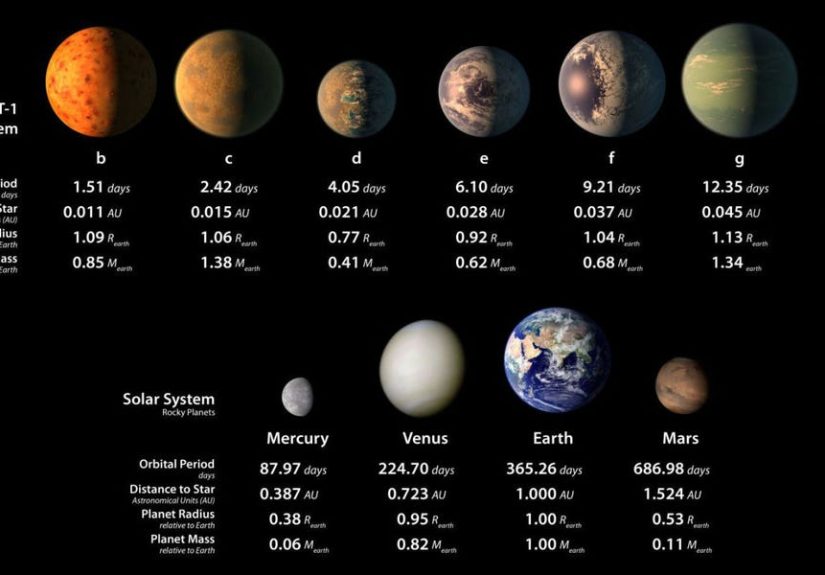
TRAPPIST-1 is a small, cool, ultra-cool dwarf star about 40 light-years away. It hosts
seven roughly Earth-sized planets packed so tightly that all their orbits would fit inside Mercury’s orbit
around our Sun. That’s not a “spacious suburb.” That’s a cosmic apartment complex where you can probably borrow sugar by
throwing it out the window.
Three of these planets orbit in the system’s habitable zonethe region where temperatures could allow
liquid water on a surface if the planet has the right atmospheric conditions. And that “if” is doing a lot of work.
Why this system became a superstar
- Small star, big advantage: When a planet transits (passes in front of) a small star, the signal is easier to detect.
- Multiple Earth-size targets: Seven rocky planets give scientists a whole lab of comparisonssame star, different distances.
- Short orbits: Faster orbits mean more transits and more chances to measure atmospheric clues.
But there’s a catch. Many red dwarfs are active, especially when young, blasting planets with X-rays and extreme UV.
That high-energy radiation can erode atmospheres and strip waterturning potential “blue marbles” into very expensive rocks.
What Hubble Actually Measured: UV Light, Not Ocean Waves
The “possible evidence of water” headline comes from Hubble’s ability to observe a star’s ultraviolet output and what that
implies for water loss and atmospheric escape on nearby planets.
The UV “sunburn test” for planetary atmospheres
Here’s the basic chain reaction:
- UV light breaks water apart (photodissociation): water molecules can split into hydrogen and oxygen.
- Higher-energy radiation heats the upper atmosphere: the lighter piecesespecially hydrogencan escape into space.
- Escaping hydrogen becomes a clue: if hydrogen is leaving, it may point to past or present water being broken up.
Hydrogen is the ultimate escape artist. It’s light, fast, and doesn’t respect property lines. In principle, Hubble can detect
hydrogen around a planet using UV signatures (often discussed around the Lyman-alpha line), which can act as an indirect indicator
that water molecules were broken apart at some point.
What the 2017 “water hints” result actually said
Using TRAPPIST-1’s observed UV radiation, scientists modeled how much water the planets could lose over time.
The takeaway was dramatic:
-
The two innermost planets (TRAPPIST-1b and TRAPPIST-1c) likely took the hardest hit and could have lost
more than ~20 Earth-oceans worth of water over billions of years. -
The outer planetsincluding some in the habitable zoneshould have lost much less, meaning
they could plausibly have retained water.
That’s the “possible evidence” in plain English: the physics of UV-driven escape suggests not every planet in the system had to
end up bone-dry. Some could still be holding onto wateror at least the raw ingredients for it.
Is That a Water Detection? Not Yet. It’s a Plausibility Argument (a Good One, But Still)
Think of this result like finding a wet footprint in a hallway. It’s evidence that water might be nearby, but it’s
not the same as walking into the kitchen and seeing a faucet running.
Why the inner planets probably got “cosmically dehydrated”
The closer a planet orbits, the more high-energy radiation it receives. If TRAPPIST-1 was especially active when young (as many
small stars are), the inner planets could have spent a long time in a high-radiation environmentexactly the conditions that
maximize atmospheric escape.
Water loss doesn’t necessarily mean “no water ever.” It means that, over time, the planet needs a way to replenish volatiles
(via internal outgassing, impacts, or an initially huge inventory) faster than space can steal them. That’s a tough treadmill.
Why the outer planets still have a shot
Farther out, planets receive less UV energy, so escape rates drop. Also, larger planets can hold onto gases more strongly.
If the outer TRAPPIST-1 planets formed with lots of ice and volatiles (a reasonable formation pathway scientists consider),
they may have started with a “water budget” big enough to survive early losses.
In other words: if TRAPPIST-1b is the over-toasted bagel of the system, TRAPPIST-1e/f/g might still be warm and edible.
(Astronomy is delicious. Please don’t eat planets.)
Atmospheres: The Make-or-Break Ingredient for Liquid Water
Water is shy. It doesn’t like being on a surface without an atmosphere to regulate temperature and pressure. So, beyond the
“can water survive?” question is the “can an atmosphere survive?” question.
Hubble’s follow-up: “No puffy hydrogen blankets”
In later Hubble work using transit spectroscopy, scientists looked for signs of extended, hydrogen-dominated atmospheres on
several TRAPPIST-1 planets. A big, hydrogen-rich envelope would make the planets more Neptune-likelarger atmospheres, lower
density vibe, not the rocky worlds many hoped for.
The results ruled out cloud-free, hydrogen-rich atmospheres for multiple planets, supporting the idea that at
least some TRAPPIST-1 worlds are more likely terrestrial rather than mini-Neptunes.
Why “no hydrogen-rich atmosphere” can be good news
- It favors rocky compositions: less likely these are gas-dominated worlds.
- It narrows the search: scientists can focus on thinner, more Earth-like atmospheres (or Mars/Venus-like analogs).
- It raises the stakes for water: if a planet has any water, it’s more likely to be a surface/interior story than a huge hydrogen envelope story.
Of course, “not puffy” doesn’t mean “definitely Earth-like.” A planet can be rocky and still be airless, or have a thin atmosphere,
or have thick clouds that hide spectral features like a smug magician.
JWST Enters the Chat: From Hints to Harder Constraints
If Hubble is the investigator asking clever questions, the James Webb Space Telescope (JWST) is the lab that can run better tests.
JWST works primarily in infrared, which is excellent for detecting molecules like carbon dioxide and probing thermal emission.
What JWST has taught us so far (and why it matters for water)
-
TRAPPIST-1b: observations are consistent with a bare-rock scenario (or at least no thick heat-redistributing atmosphere).
That’s a reminder that being “Earth-sized” does not guarantee being “Earth-like.” - TRAPPIST-1c: thermal measurements disfavor a thick CO2-rich atmosphere and suggest a volatile-poor pathway is plausible.
-
TRAPPIST-1e (a key habitable-zone target): JWST observations are complicated by stellar contamination; current data may not decisively
confirm or rule out an atmosphere.
These results don’t “cancel” the Hubble water hints. They refine the story. If inner planets are airless or volatile-poor, that’s
consistent with the idea that intense early radiation can be brutal. Meanwhile, the most promising water candidates remain the
habitable-zone and outer planetsexactly where the 2017 Hubble UV analysis pointed.
How Scientists Translate UV Light into “Earth Oceans” (Without Losing Their Minds)
You’ll often see water-loss estimates written as “Earth oceans.” That’s not because anyone expects a planet to literally pour
20 oceans into space like a cosmic bathtub. It’s a convenient unit that helps communicate scale.
Ocean-equivalents: a practical, slightly wild unit
An “Earth-ocean equivalent” is basically a way to say: “If you took Earth’s ocean water and turned it into hydrogen and oxygen,
this is how many oceans’ worth of hydrogen could be lost.”
The estimate depends on:
- Stellar history: how active the star was, especially early on.
- Planet distance: closer planets get more high-energy radiation.
- Planet gravity and composition: heavier and larger planets retain gases better.
- Atmospheric chemistry: how water vapor, oxygen, and hydrogen behave under radiation.
- Replenishment: volcanic outgassing or interior reservoirs can restore some volatiles.
So when you hear “more than 20 Earth oceans could be lost,” treat it as a scale indicator, not a literal measurement with a
measuring cup. The key message is relative: inner planets lose a lot more; outer planets lose a lot less.
What Would “Water Evidence” Look Like in Future Observations?
To move from “possible evidence” to “strong evidence,” astronomers want direct atmospheric signatures or indirect consistency
across multiple lines of data.
Some of the best signals scientists look for
- Water vapor absorption features in transmission spectra (hard for small planets, but not impossible with enough data).
- CO2 and other greenhouse gases that help interpret temperature and pressure conditions.
- Thermal phase curves indicating whether an atmosphere transports heat from day to night.
- Stellar activity corrections that separate planet signals from star spots and flares.
TRAPPIST-1 is both a dream and a headache: a dream because the planets are so observable by transits, and a headache because
small stars can have spots and microflares that mimic or distort atmospheric signals. It’s like trying to hear a whisper while
someone keeps tapping the microphone.
Big Picture: What TRAPPIST-1 Teaches Us About Habitability Around Red Dwarfs
Red dwarfs (M dwarfs) are the most common type of star in our galaxy. If life is common, odds are it’s hanging out near a red dwarf.
But red dwarfs have a reputation: they can be highly active when young, and that radiation can strip atmospheres and water.
TRAPPIST-1 gives us a rare, controlled experiment: seven similar planets, one star, different orbital distances. If we can learn
which planets keep atmospheres and waterand whywe learn something huge about where to look for life in the Milky Way.
The current “reasonable hypothesis”
A balanced interpretation today looks something like this:
- Inner planets: more likely to be airless or volatile-poor due to strong irradiation and escape.
- Habitable-zone planets: still plausible candidates for atmospheres and retained water, but require careful confirmation.
- Outer planets: may have retained more water, depending on formation history and atmospheric evolution.
That’s not a guarantee of oceans, clouds, and alien dolphins. But it is a scientifically grounded reason to keep watching.
Conclusion: A Sensible Amount of Hope, With a Side of Patience
“Hubble spots possible evidence of water” is one of those headlines that can sound like a slam-dunk discoveryuntil you read
the fine print and realize the universe is, as usual, subtle.
What Hubble really delivered was a physics-based plausibility result: TRAPPIST-1’s UV radiation and the rules of
atmospheric escape suggest the inner planets likely lost a lot of water, while the outer planetsespecially those in the habitable
zonecould have retained some. That is meaningful, because it tells astronomers where to focus the next generation of observations.
Then JWST arrived and started tightening the screws: some inner worlds look increasingly airless or volatile-poor, while the best
candidates for atmospheres (and therefore surface water potential) remain the temperate planets that are harderbut not impossible
to characterize.
So the story isn’t “We found oceans.” It’s: We found a reason to keep searchingand a shortlist of planets worth
the telescope time, the modeling sweat, and the inevitable debates on whether that wiggle in the data is water… or just the star
being dramatic again.
Experiences: What It’s Like to Follow the TRAPPIST-1 Water Hunt (Without Owning a Space Telescope)
You don’t need a PhD or a billion-dollar observatory to feel the thrill of this search. The TRAPPIST-1 water story has a way of
pulling people in because it mixes big cosmic questions with tiny, almost comically fragile signals. You’re not watching a planet
directlyyou’re watching a star dim by a fraction of a percent and trying to infer whether a distant world has air, clouds, and maybe
water. It’s like guessing what’s in a sealed lunchbox by listening to it rattle on a bus.
For space fans, one of the most common “experience moments” is the press-release roller coaster. You read a headline that sounds
like a blockbusterpossible evidence of water!and your brain immediately paints an alien coastline. Then you dig in and realize
the evidence is UV radiation, photodissociation, and hydrogen escape models. It’s less “ocean documentary” and more “forensic accounting.”
And yet… it’s still wildly exciting, because you’re watching the scientific method work in real time.
Another shared experience is learning to love the word “constraint”. In everyday life, a constraint is annoying. In exoplanet
science, it’s a victory. When Hubble says “the inner planets could have lost more than 20 Earth oceans,” that’s a constraint. When later
observations say “no puffy hydrogen blanket,” that’s a constraint. When JWST suggests “probably no thick CO2 atmosphere here,”
that’s a constraint. Each one chops away at the impossible options, narrowing the menu of realities the universe is willing to serve.
If you’ve ever tried stargazing on a humid nightsquinting through haze, waiting for a gap in the cloudsyou already understand a big part
of the emotional texture of exoplanet work. You’re dealing with interference. For backyard astronomers it’s weather and light pollution.
For professionals studying TRAPPIST-1, it’s stellar spots, microflares, instrument systematics, and the fact that the most important molecules
don’t announce themselves with a neon sign. They show up as gentle dips and subtle slopes that demand patience.
There’s also a very human “aha” moment when you realize water doesn’t have to mean Earth 2.0. Some people imagine oceans and immediately
imagine life. But in the TRAPPIST-1 context, “water” can mean many things: ice locked in rock, water vapor that gets split apart by UV, or a deep
interior reservoir that never sees daylight. Following this topic often changes how people talk about habitability. You start thinking in systems:
star activity, atmosphere chemistry, geology, magnetic fields, and time. Lots and lots of time.
And then there’s the fun part: turning cosmic scales into relatable mental pictures. “Earth-oceans of water loss” is both awe-inspiring and weirdly
practical. You can almost imagine a cosmic accountant stamping paperwork: “Planet b: overdraft. Planet e: maybe still solvent.” It’s the kind of
phrase you repeat to friends at dinner like you’re delivering trivia from the future: “Did you know a planet might lose twenty Earth oceans of water?”
Watch their face. Enjoy the silence. You’ve earned it.
Finally, the TRAPPIST-1 water hunt is an experience in scientific humility. Every new dataset can sharpen the story or complicate it. A result can be
both exciting and cautious at the same timeand that’s not a bug, it’s the feature. If you stick with the story, you start to recognize the difference
between a headline and a conclusion. You learn why “possible evidence” is still valuable: it guides the next observation, the next model, the next clever
way to separate a planet’s whisper from a star’s noise.
In other words: following TRAPPIST-1 is like watching a mystery novel where the detective is a space telescope, the clues are photons, and the plot twist
is always the samethe universe is complicated, but we’re getting better at reading it.