Table of Contents >> Show >> Hide
- What does “I know you are, but what am I?” mean?
- Why this comeback works (even when it shouldn’t)
- Where did the phrase come from?
- How to use it (without sounding like you’re 7)
- What it communicates underneath the joke
- Better alternatives (that don’t sound like a playground)
- Related phrases and modern cousins
- FAQ
- Everyday experiences with “I know you are, but what am I?” (and what they teach you)
- Conclusion
There are comebacks that sparkle with wit, comebacks that land like a perfectly tossed paper airplane,
and then there’s the comeback that simply refuses to participate in the conversationwhile still
somehow “winning” the argument in the most chaotic way possible.
“I know you are, but what am I?” is that comeback. It’s a classic schoolyard boomerang:
whatever you just threw at me? Congrats, it’s now yours againno receipt required.
In this guide, we’ll break down what the phrase means, why it works (and why it’s so annoying),
how Americans actually use it, and what to say instead when you’re trying to sound like a functioning adult.
What does “I know you are, but what am I?” mean?
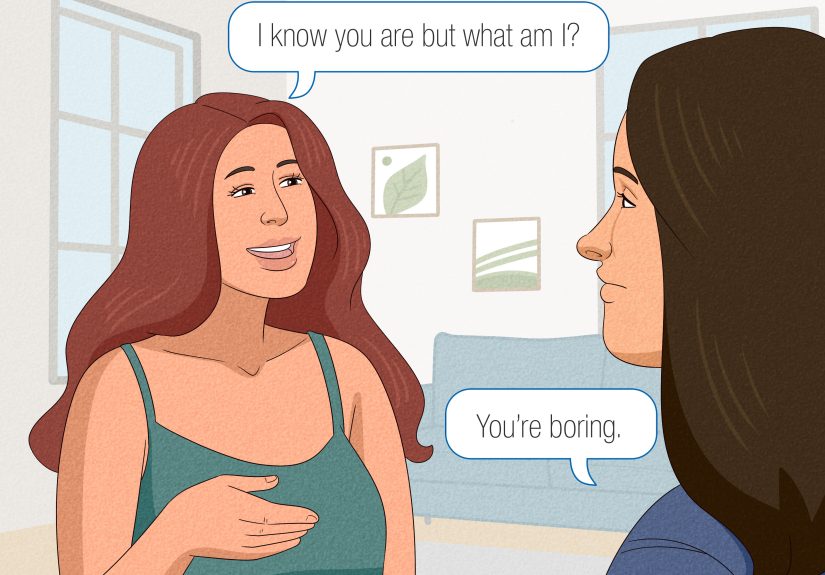
“I know you are, but what am I?” is a childish retort used after someone insults you. The speaker is basically saying:
“That insult applies to you, not me.” It flips the accusation back onto the person who said itwithout
giving any real explanation.
The “question” part (“but what am I?”) isn’t a sincere request for information. It’s rhetorical and snarky, like a verbal shrug
with a smirk. The goal isn’t to debate; it’s to deflect.
Quick translation into plain American English
- They say: “You’re weird.”
- You say: “I know you are, but what am I?”
- Meaning: “Nope. That’s you. Not me.”
How it sounds in real conversations
Here are a few mini-dialogues that show the vibe:
-
Person A: “You’re a baby.”
Person B: “I know you are, but what am I?”
(Translation: “Nice try. You’re the baby.”) -
Person A: “You’re so annoying.”
Person B: “I know you are, but what am I?”
(Translation: “You’re annoying. Also, I’m not discussing this with you.”)
Why this comeback works (even when it shouldn’t)
The phrase has the staying power of glitter on a carpet: it refuses to leave. Here’s why.
1) It hijacks the conversation
Instead of responding to the insult, the speaker changes the “rules” mid-game. Now it’s not about whether the insult is fair;
it’s about who can keep the back-and-forth going the longest. This is why it often turns into a loop:
“You’re dumb.”
“I know you are, but what am I?”
“You’re dumb!”
“I know you are, but what am I?”
(At this point, the argument has become a karaoke machine with one song.)
2) It uses “mirroring” as a shield
The comeback acts like a verbal mirror: whatever you say reflects back to you. That’s also why it’s closely related to other
classic kid defenses like “No, you!” and “I’m rubber, you’re glue.” These responses don’t prove anythingthey just reject the insult
and toss it back.
3) It’s the low-effort cousin of a real argument
In grown-up terms, this is in the same neighborhood as the “you too” moveanswering criticism by accusing the other person of the same thing.
In debate and logic, that move is often discussed as a tu quoque (or “appeal to hypocrisy”) style deflection.
But on the playground, nobody is submitting footnotes. It’s just a quick dodge.
4) It can feel powerful when you feel cornered
If someone is teasing you and you don’t know what to say, a repeatable script can feel like armor. It lets you respond instantly, without
having to improvise a clever line. Is it elegant? No. Is it effective at ending the conversation? Weirdly, yes.
Where did the phrase come from?
In the United States, “I know you are, but what am I?” is widely recognized as a long-running playground comebacksomething kids repeat because
it’s simple, rhythmic, and endlessly reusable. It’s been floating around for decades in kid culture, passed along the way jump-rope rhymes and
cafeteria rumors travel: mysteriously and at high speed.
The pop-culture boost: Pee-wee Herman
While the phrase existed as a childish retort before it became a pop reference, it hit a major popularity wave in the 1980s thanks to Pee-wee Herman.
In Pee-wee’s Big Adventure (1985), Pee-wee uses it repeatedly during an argument, cementing it as a quotable catchphrase for a generation.
Later, Pee-wee’s TV era helped keep the vibe aliveespecially for people who grew up repeating the line with a deliberately goofy tone. Today, many adults
recognize the phrase as both a kid comeback and a nostalgic pop-culture reference (even if they’d rather die than admit they still quote it).
Is it “old” or just “eternal”?
It’s hard to pin down an exact “birthday” for playground language, because kids don’t publish peer-reviewed journals titled
Quarterly Proceedings of the Third-Grade Insult Economy. But the phrase shows up in American print sources by the early 1980s,
and it’s often described as a standard kid retort that predates its famous movie moment.
How to use it (without sounding like you’re 7)
The phrase can be used in a few different ways, and context is everything. In many settings, it reads as intentionally juvenileeither as a joke or as a
sign that the conversation has officially left the adult chat.
Use it when…
- You’re joking with friends and everyone understands it’s playful, not mean.
- You’re quoting pop culture (especially 80s/90s nostalgia) for comedic effect.
- You want to defuse a mild insult by making it silly rather than escalating.
Skip it when…
- It’s a serious conversation (feedback at work, relationship conflict, real hurt feelings).
- Someone is genuinely bullying you and you need support, not a verbal ping-pong match.
- You’re trying to persuade anyonebecause this line isn’t persuasive; it’s evasive.
Punctuation, delivery, and variations
You’ll see the phrase written a few ways:
“I know you are, but what am I?” (most common),
“I know you are but what am I?” (less punctuated),
and sometimes shortened into the even more minimal “No, you are.”
In speech, tone does most of the work. People often say it with a sing-song rhythm or exaggerated innocencebecause the humor comes from how
unserious it is. If you deliver it deadpan in a tense meeting, expect the emotional temperature to drop to “awkward refrigerator.”
What it communicates underneath the joke
Even though the phrase is childish, it can still carry messagessome harmless, some not-so-great.
It can signal: “I’m not engaging with this.”
Sometimes it’s a quick exit ramp. The speaker refuses to accept the insult as valid and won’t debate it.
It can signal: “I’m embarrassed and covering it.”
When people feel attacked, they may protect themselves with deflection. In psychology, a related concept is projectionattributing uncomfortable
feelings or traits to someone else (“They’re the problem!”) instead of facing your own feelings. Not everyone who says this phrase is “projecting,”
but the emotional impulseget it away from mecan be similar.
It can also signal: “I don’t have a better comeback.”
And honestly? That’s fine. Not every moment requires verbal gymnastics. But if you find yourself relying on this line often, it may be worth upgrading your
toolboxespecially if you want to shut down insults without sounding like you’re still waiting for recess.
Better alternatives (that don’t sound like a playground)
If your goal is to stand up for yourself, set a boundary, or de-escalate conflict, here are options that work in real life.
If you want to shut it down calmly
- “Not cool.”
- “Don’t talk to me like that.”
- “We can talk when you’re ready to be respectful.”
- “Okay.” (said neutrally, then move on)
If you want to redirect to something useful
- “What do you mean by that?” (forces clarity)
- “If you have feedback, be specific.”
- “Are you trying to hurt my feelings, or are you actually upset about something?”
If this is bullying, not banter
If someone is repeatedly targeting you, the best “comeback” is often support and safetynot a duel of insults. Many bullying-prevention resources emphasize
strategies like staying with friends, walking away when possible, and talking to a trusted adult or authority figure who can help.
Related phrases and modern cousins
“I know you are, but what am I?” is part of a whole family of deflections and comebacks in American English.
Classic cousins
- “No, you!” (the ultra-short version)
- “Takes one to know one.” (a slightly more “grown” version)
- “I’m rubber, you’re glue…” (the poetic extended cut)
Modern cousins
- “Clapback” (internet culture’s word for a sharp, strong comebacktypically much more specific than a mirror retort)
- “Whataboutism” (a debate tactic that deflects criticism by pointing to someone else’s wrongdoing; it’s the “adult suit” version of a childish deflection)
FAQ
Is “I know you are, but what am I?” an insult?
Not exactly. It’s more of a reversal. It tries to turn the insult back onto the person who said it, without adding new information.
It can still feel insulting because it implies, “That’s youperiod.”
Is it ever “clever”?
It can be funny when used ironically or as a pop-culture wink. But as a serious rebuttal, it’s not considered clever; it’s considered childish.
That’s part of its identitylike a whoopee cushion for language.
Does it end arguments?
Sometimes. Not because it resolves anything, but because it can make the conversation feel pointless. It often leads to repetition, and repetition is the natural enemy
of emotional energy.
Everyday experiences with “I know you are, but what am I?” (and what they teach you)
Most Americans don’t learn this phrase from a dictionarythey learn it the way you learn that touching wet paint is a bad idea: through experience, curiosity,
and one regrettable moment where you realize you are now part of the problem.
Experience #1: The playground loop. You’re in elementary school. Someone says, “You’re weird,” and your brain does that emergency shutdown thing where
your vocabulary temporarily disappears. Then you remember the magic spell: “I know you are, but what am I?” Suddenly, you’re not frozen anymoreyou’re armed.
The other kid repeats the insult louder, and you repeat your line louder, and now the argument is basically two human echo chambers competing for airtime.
The lesson: this phrase doesn’t solve conflict; it replaces conflict with repetition until everyone gets bored or a teacher notices.
Experience #2: The sibling rematch. At home, siblings are often the most relentless critics because they’ve studied your weaknesses like it’s a major.
You try the line once. It “works” in the sense that it irritates them. So they come back with, “I know you are, but what am I?” and now you’re trapped in a hall of mirrors
where nobody remembers what the original insult was. The lesson: when both people use mirror comebacks, the conversation becomes pure frictionheat with no light.
Experience #3: The group chat misfire. As you get older, the phrase shifts from a real comeback to an ironic reference. Someone posts a petty insult,
and you reply with “I know you are, but what am I?” because you think it will read as a joke. Sometimes it does. Sometimes it lands like you just showed up to a costume party
dressed as “middle school.” The lesson: online, tone is fragile. If people don’t know you’re joking, the phrase can look defensive instead of funny.
Experience #4: The “adult version” in disguise. In workplaces, schools, or public conversations, you may hear a more polished version of the same move:
someone is criticized, and instead of addressing it, they fire back, “Well, you did it too,” or “What about when you messed up?” It’s basically “I know you are…”
with a blazer on. The lesson: deflection is common at every age; adults just use more syllables.
Experience #5: The moment you outgrow it. The phrase tends to fade when you discover stronger tools: setting boundaries, asking for clarity, using humor that
doesn’t punch back blindly, or walking away. Most people don’t stop because the phrase becomes “wrong”; they stop because it becomes less useful. The lesson: the best response
isn’t always a comeback. Sometimes it’s a calm “Not cool,” a change of subject, or getting support when someone’s being cruel.
In the end, “I know you are, but what am I?” is a cultural fossil of kid logic: simple, repeatable, and occasionally hilariousespecially when used as a wink, not a weapon.
If you treat it like a joke or a nostalgia quote, it can be charming. If you treat it like a serious strategy, it usually turns your argument into a rerun nobody asked for.