
Table of Contents >> Show >> Hide
- What Is the New LEGO Death Star Set?
- Why the Price Tag Is Such a Big Deal
- A New Design Direction: Not a Sphere, but a “Slice” of the Death Star
- What’s Inside the Set: Scenes, Minifigures, and Fan-Service Moments
- Release Timing, Availability, and Early Purchase Perks
- Is the $1,000 Price Actually “Worth It”?
- How This Set Fits Into LEGO’s Bigger Strategy
- Collector Experience and Final Take: What Living With a $1,000 LEGO Death Star Is Really Like
If your wallet just whispered, “I’ve got a bad feeling about this,” you’re not alone.
LEGO’s new Star Wars Death Star (set 75419) didn’t just arrive with a dramatic reveal it arrived with a $999.99 price tag that instantly turned heads, triggered debates, and made even seasoned collectors pause mid-scroll. Yes, this is the set that pushed LEGO into four-digit territory in the U.S., and yes, it’s being discussed with the same intensity usually reserved for movie trailers and housing markets.
But here’s the twist: this isn’t just “big LEGO is expensive now” news. The new Ultimate Collector Series (UCS) Death Star is a serious design statement, a nostalgia machine, and a collector-focused display build packed with scenes from A New Hope and Return of the Jedi. It’s part model, part diorama, part fan service, and part conversation starter for anyone who walks into your living room and asks, “Wait… is that the Death Star?”
So, what exactly are you getting for a thousand bucks? And is the record-breaking LEGO Death Star price pure sticker shock, or does the build actually make a case for itself? Let’s break it down calmly, rationally, and with only a mild amount of dramatic breathing through a Darth Vader helmet.
What Is the New LEGO Death Star Set?
The new set is LEGO Star Wars Death Star 75419, part of the Ultimate Collector Series line and clearly aimed at adult fans (AFOLs), collectors, and Star Wars enthusiasts who enjoy display-worthy builds as much as (or more than) play features.
Key specs at a glance
- Set number: 75419
- Theme: LEGO Star Wars UCS
- Age rating: 18+
- Piece count: 9,023 pieces
- Minifigures: 38
- Price (U.S. MSRP): $999.99
- Official dimensions: 20.6 in (H) x 18.9 in (W) x 15.1 in (D)
Right away, two things jump out: the 9,023-piece count and the 38 minifigures. That combination makes this set feel less like a single display object and more like a curated museum of Death Star moments. LEGO leans hard into that idea by including iconic scenes, characters, and Easter eggs across the structure.
Why the Price Tag Is Such a Big Deal
Let’s address the superlaser in the room: $999.99.
This isn’t just expensive for a LEGO Star Wars set. It’s expensive for a LEGO set, period and that’s why headlines focused so heavily on the price. The new UCS Death Star is widely described as LEGO’s most expensive set ever at launch in U.S. MSRP terms, and it became the brand’s first major set to hit the $1,000 price point.
That milestone matters because LEGO pricing has been climbing steadily for years, especially in collector lines. Big licensed sets are no longer niche oddities they’re a major business category. We’ve seen premium builds before, but this Death Star pushes the ceiling higher and forces a new question: How much is too much, even for die-hard fans?
Some fans immediately celebrated the ambition. Others saw the number first and the design second. And honestly, both reactions make sense.
Record-breaking doesn’t always mean “largest in every way”
Here’s an important nuance: the new Death Star is the largest LEGO Star Wars set to date by piece count at launch, but it is not the largest LEGO set ever by piece count. LEGO has released other giant non-Star-Wars sets with more pieces.
That distinction matters because the record-breaking part of this story is mostly the price (and for Star Wars fans, the franchise-specific scale and minifigure count), not necessarily “most bricks in LEGO history.” In other words: you’re paying for size, licensing, design complexity, and brand value not just a mountain of bricks.
A New Design Direction: Not a Sphere, but a “Slice” of the Death Star
If you were expecting a giant, fully spherical Death Star, you may have done a double take when the images dropped.
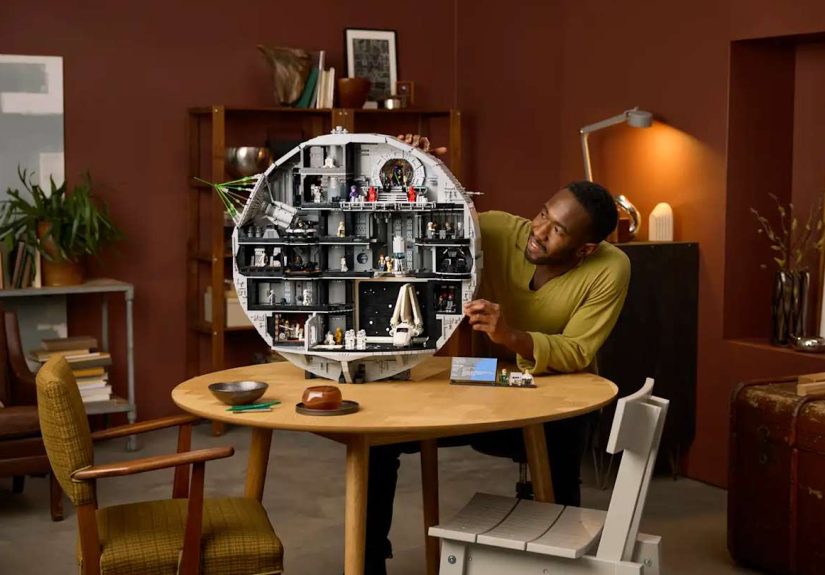
Instead of a complete globe, LEGO built this version as a vertical cross-section / slice-style diorama. Think of it as a dramatic cutaway view that displays multiple rooms and scenes at once. It’s a very different philosophy from older Death Star playsets, and it’s one of the reasons the set is generating so much discussion.
Why LEGO likely chose the cross-section format
- Display visibility: You can see the rooms and scenes without opening anything up.
- Narrative density: More iconic moments fit into one “greatest hits” structure.
- Space efficiency: A slice can be easier to display than a giant sphere.
- Build variety: Multiple scene-based sub-builds help reduce repetition.
For many collectors, that’s a smart move. A full sphere would be impressive, sure but also huge, harder to store, and less visually informative unless LEGO made it open up in a complex way. The cross-section format puts the action front and center.
That said, critics aren’t wrong either: some fans feel that paying a premium for the Death Star and not getting the classic spherical silhouette is a tough sell. That tension design innovation vs. iconic shape expectations is a big reason this set sparked so much online debate.
What’s Inside the Set: Scenes, Minifigures, and Fan-Service Moments
The strongest argument in favor of the set is simple: there is a lot going on here.
LEGO packed the model with recognizable locations and moments from the original trilogy-era Death Star storylines, especially A New Hope and Return of the Jedi. Depending on how you display it, it can feel like a stacked highlight reel of your favorite scenes.
Notable scenes and areas featured
- Trash compactor sequence
- Princess Leia’s holding cell
- Tractor beam control area
- Conference/chamber spaces
- Emperor Palpatine’s throne room
- Hangar bay with Imperial Shuttle
- Superlaser section
- Luke and Leia bridge swing moment
- Darth Vader vs. Obi-Wan Kenobi duel references
That lineup is why many reviewers and fans describe the build as a display-first diorama rather than a traditional “playset.” It’s less about rolling it across the floor making pew-pew noises (though no judgment) and more about staging scenes, admiring details, and appreciating how much Star Wars history is packed into one object.
The 38-minifigure headline is doing a lot of work
LEGO also made the minifigure count a centerpiece of the marketing and for good reason. Thirty-eight minifigures is a massive inclusion for a single set, and it helps justify the “premium collector event” framing.
You get core characters like Luke, Leia, Han, Vader, Obi-Wan, and Palpatine, plus multiple variants and Imperial personnel. Coverage also highlighted figures tied to Rogue One, including Galen Erso and Director Krennic, which is a nice lore-forward touch for fans who appreciate the Death Star’s origin-story connections.
And yes, there’s also the now-famous hot tub Stormtrooper Easter egg because LEGO knows that if you’re spending four figures on a set, you deserve at least one “Wait, what am I looking at?” moment.
Release Timing, Availability, and Early Purchase Perks
At launch, LEGO positioned the Death Star as a premium release with the usual collector-friendly rollout:
- LEGO Insiders early access: October 1, 2025
- General availability: October 4, 2025
- Launch promo gift: TIE Fighter with Imperial Hangar Rack (set 40771), while supplies last, during the early launch window
That release strategy matters more than it might seem. At this price point, LEGO isn’t just selling a product it’s selling a launch moment. Early access, limited rewards, and gift-with-purchase extras all reinforce the idea that this is a collector event, not a casual toy aisle pickup.
Is the $1,000 Price Actually “Worth It”?
This is the question everybody asks, and the honest answer is: it depends on what you value.
It may feel worth it if you are…
- A dedicated LEGO Star Wars collector
- A display-focused builder with space for a centerpiece set
- A fan of the original trilogy and Death Star scenes specifically
- Someone who values minifig variety and diorama storytelling
- A collector who buys flagship LEGO releases at launch
It may feel overpriced if you are…
- Expecting a fully spherical Death Star build
- Comparing it only on price-per-piece
- More interested in play value than display value
- A fan who likes UCS sets but has a strict budget ceiling
- Someone who feels $1,000 crosses a psychological line (totally fair)
The reality is that the LEGO Death Star 75419 price tag is as much about market positioning as it is about the bricks. LEGO knows the adult collector segment is willing to pay for premium licensed experiences up to a point. This set tests where that point is.
And if online reactions are any indication, the answer is not a simple yes/no. It’s more like: “I hate the price… but I also can’t stop zooming into the photos.”
How This Set Fits Into LEGO’s Bigger Strategy
The new UCS Death Star didn’t appear in a vacuum. It fits a larger LEGO trend: bigger sets, older audiences, higher prices, and stronger display appeal. Over the past several years, LEGO has increasingly treated adults as a core audience, not a side audience.
This set reflects that shift in a very obvious way. It’s labeled 18+, built around cinematic nostalgia, loaded with detail, and priced like a luxury collectible. In other words, LEGO isn’t merely selling construction toys here it’s selling a premium fan experience.
That strategy has worked well for LEGO overall, but it also creates tension. Every new flagship release raises expectations around value, innovation, and what collectors think a “must-have” should look like. The Death Star set is exciting, ambitious, and impressive but it also proves that premium fandom products now live in a price range where people expect near-perfection.
Collector Experience and Final Take: What Living With a $1,000 LEGO Death Star Is Really Like
Let’s talk about the part that doesn’t always show up in product listings: the actual experience around a set like this.
For many fans, the journey starts long before the box arrives. It starts with rumors, blurry leaked photos, Reddit arguments, and a lot of “No way LEGO actually charges $1,000 for this.” Then the official reveal hits, and suddenly the joke becomes a budgeting conversation. People start doing the same ritual math: “If I skip a few impulse buys… if I sell a couple old sets… if I call this my birthday/holiday/everything gift…” The Death Star becomes less of a toy purchase and more of a mini financial strategy game.
Then there’s the emotional side. A set like this hits a sweet spot for Star Wars fans who grew up with the original trilogy. The Death Star isn’t just a spaceship (okay, moon-shaped battle station). It’s a bundle of iconic movie moments: the trench-run tension, the trash compactor panic, the throne room showdown, the “we’re in too deep” energy of the whole saga. That nostalgia adds real value for collectors, and LEGO clearly knows it.
Once the build begins, the experience changes again. Instead of one repetitive shell build, the cross-section format gives builders a series of smaller payoffs. You finish a room, place it into the larger structure, and instantly feel progress. That matters on a mega-build. It keeps momentum up. It also turns the project into something you can enjoy over multiple sessions, which is exactly how many adults build: a few steps after work, a weekend deep dive, maybe a long session with a podcast on in the background.
Display is another big part of the ownership experience. Most people buying a UCS Death Star aren’t putting it away in a closet. This is a centerpiece set the kind of thing that changes a room. The cross-section design actually helps here because guests can see the scenes without you having to open panels or give a guided tour. It invites conversation. Even non-LEGO people tend to react the same way: first at the size, then at the details, then at the price. (“Wait… how much?”)
Of course, the price never fully disappears from the experience. Even fans who love the set often describe a weird combination of awe and guilt. It’s the collector version of ordering dessert and then staring at the receipt. But that tension is part of why this release became such a headline story: it sits right at the border between passion purchase and luxury splurge.
My practical takeaway? This set makes the most sense for builders who want a statement piece and genuinely enjoy the process of building detailed display models. If you’re hoping for broad play value or a “reasonable” Star Wars set, there are far better options. If you want the most talked-about LEGO Star Wars release in years and you’re comfortable with the cost the new Death Star absolutely delivers a memorable collector experience.
In short: the record-breaking price tag is real, the debate is justified, and the set itself is undeniably impressive. LEGO aimed for a fully operational flagship release and whether you see it as genius, excess, or both, it has already done what great collector products do: it made people care.






 Close
Close