Table of Contents >> Show >> Hide
- Why Brooklyn Brownstones Go Dark So Fast
- Start with the Daylight You Already Have
- Let Light Travel: Interior Openings That Change Everything
- Skylights and Light Shafts: The Brooklyn Cheat Code (Done Right)
- The Big Move: “Blow Out the Back” (and When It’s Worth It)
- Landmarks_toggle: Brightening Without Fighting the Front Facade
- Artificial Light That Feels Like Daylight’s Best Friend (Not a Replacement)
- Brownstone-Specific Lighting Moves Room by Room
- A Practical “Brightening Plan” You Can Actually Execute
- Conclusion: Bright Doesn’t Have to Mean Bland
- Experience Notes: What “Light to a Brooklyn Brownstone” Feels Like in Real Life (Extra )
Brooklyn brownstones are famously charmingcarved stone stoops, tall parlor windows, ornate moldings, and that “I can’t believe I live here” feeling
you get every time you fumble with the front door keys. They’re also famously… dim. Not “romantic candlelit dinner” dim. More like “where did I leave
my coffee and why is it cold already?” dim.
The good news: you don’t need to turn your 19th-century townhouse into a glass spaceship to brighten it up. With a smart mix of architecture,
finishes, and layered lighting, you can pull daylight deeper into the house, make hallways feel less like tunnels, and keep the historic soul intact.
This guide breaks down practical ways to bring natural light and better artificial lighting into a Brooklyn brownstone
from quick wins to full “blow out the back” transformations.
Why Brooklyn Brownstones Go Dark So Fast
A classic brownstone layout often has lots that are narrow and deep, which means daylight enters mainly from the front and the rearthen runs out of
steam somewhere around the middle like it’s climbing the subway stairs at Atlantic Avenue. Many Brooklyn rowhouses sit on lots that are commonly
around 18 to 20 feet wide (and sometimes even narrower), which intensifies the “bright ends, dark center” effect.
The usual culprits
- Deep floor plates: Long rooms, central stairs, and stacked partitions block light’s path.
- Historic window proportions: Beautiful? Yes. Huge? Not always (especially on side wallsbecause there usually aren’t side walls).
- Layers of renovations: Older extensions, dropped ceilings, heavy drapery, and dark finishes can quietly steal your daylight.
- Landmark rules: In many neighborhoods, you can’t just enlarge the front windows because you woke up feeling inspired.
The real strategy is not “more windows everywhere,” but better light movement: help daylight enter, bounce, and travel; then support it with a
lighting plan that makes evenings feel intentional rather than accidental.
Start with the Daylight You Already Have
Before you cut holes in your roof (tempting, I know), squeeze everything you can out of existing windows. These moves are low drama, high reward.
1) Clean glass and clear the “window clutter”
This sounds too basic to matteruntil you do it. Dusty panes, bulky shades, and furniture parked in front of windows reduce light more than you think.
Consider lighter window treatments (sheers or top-down/bottom-up shades) so you keep privacy without blocking the sun.
2) Make surfaces work for you
Brightening isn’t only about light sources; it’s also about what your light hits. Light-colored walls and ceilings reflect more daylight, mirrors bounce
it into darker zones, and shiny or light-toned finishes help rooms feel bigger and airier. If your brownstone currently features “Moody Cave Chic,” you
can still keep contrastjust pick where the darkness lives (hint: not on every wall).
3) Use paint sheen strategically
In low-light rooms, a slightly higher sheen (like eggshell or satin) can reflect more light than flat paint. You don’t need to gloss your entire living
room like a grand piano, but you can quietly give light a better trampoline.
Let Light Travel: Interior Openings That Change Everything
In a narrow townhouse, the magic is rarely at the perimeterit’s in the connections between rooms. If daylight can travel through the
interior, your brownstone stops feeling like a series of separate caves and starts feeling like one bright home.
Transom windows: old-school brightening with historic credibility
Transom windows sit above doors (or other windows). Historically, they provided daylight and ventilation before homes had electricity and modern HVAC.
In brownstones, restoring existing transomsor adding compatible interior transomscan pull light from brighter rooms into hallways and stair landings
while keeping privacy at eye level.
- Where they shine: Between a bright rear kitchen and a dark center hallway; above bedroom doors; over a parlor pocket door opening.
- Privacy options: Frosted, reeded, or textured glass gives glow without a full view of your laundry chair.
- Design tip: Match muntin patterns and trim profiles to your home’s era so it looks like it was always there.
Glass partitions and interior doors that borrow daylight
If you want a bigger daylight upgrade without completely open-plan living (because noise is real and so are teenagers), consider glass interior doors or
partial glass partitions. One standout approach: translucent or fluted glass around stairs or between zones, which lets light pass while softening views.
A well-documented example comes from a very narrow Fort Greene row house (about 12.5 feet wide and roughly 45 feet long) where the owners struggled
with darkness because each floor had only windows at the ends. The renovation used translucent steel-and-glass elements and a central light path so
daylight could move through the house instead of stopping at the first wall.
Stairwells: turn the middle of the house into a light engine
The stair is often the brownstone’s central spineso treat it like a daylight opportunity. If you can create a “light void” that drops through the stair
run (sometimes paired with skylights above), the center of the house can become a glow zone instead of a shadow zone.
Skylights and Light Shafts: The Brooklyn Cheat Code (Done Right)
Skylights can be transformative, especially when paired with a shaft that aims light into the center of the home. But skylights also have a reputation:
“I wanted more sun, and now I have an indoor waterfall.” That reputation is usually a flashing and detailing problemnot a skylight problem.
Skylight best practices that protect your ceiling (and your sanity)
- Prioritize proper waterproofing: Ice-and-water membrane and correct flashing sequencing are non-negotiable.
- Choose the right unit: Fixed vs. venting, curb-mounted vs. deck-mountedyour roof type and use case matter.
- Plan for heat gain and glare: Consider shades, glazing options, and where the sun will hit during summer afternoons.
- Maintenance: Inspect periodically, keep debris off, and address sealant issues earlybefore your drywall becomes modern art.
If you’re already replacing an old skylight, reputable step-by-step guidance emphasizes careful removal, membrane continuity, and layered flashing so
water is directed away from the opening rather than invited inside.
The Big Move: “Blow Out the Back” (and When It’s Worth It)
One of the most dramatic ways to brighten a brownstone is to replace the rear wall of the garden and/or parlor level with a large glass systemFrench
doors, sliders, or a steel-and-glass grid wall. It can connect interior spaces to the yard, add views, and flood the deepest parts of the floor with
daylight.
What to consider before you fall in love with a wall of glass
- Zoning and rear yard rules: Rear yard depth and “bulk” limits can determine whether an extension is possible and how far you can build.
- Structure and permitting: Rear walls are typically load-bearing; this is engineering territory, not “my cousin is handy” territory.
- Energy performance: Big glazing can mean more heat gain in summer and heat loss in winterplan HVAC and shading accordingly.
-
Fire and property-line constraints: If you’re close to an adjacent building, specialty requirements (including fire-rated assemblies)
may come into play.
Sometimes, expanding openings without extending the footprint can be the sweet spot: more light, fewer downstream consequences, and less risk of the
middle of the floor becoming darker because an addition blocks light from reaching inward.
Landmarks_toggle: Brightening Without Fighting the Front Facade
Many Brooklyn brownstones sit in historic districts, which means exterior changesespecially on primary facadesmay require approvals. The practical
takeaway: you often have more freedom at the rear than the front, but “more freedom” does not mean “do whatever.”
Smart, approval-friendly approaches
- Rear yard interventions: Rear additions and enlargements are often reviewed with visibility and contextual criteria in mind.
- Keep significant features: Protect historic lintels, sills, bays, and details where they existespecially if you’re altering openings.
- Design for minimal visibility: If an addition can’t be seen from a public thoroughfare, approvals are often more straightforward.
Translation: your best “big daylight” moves are frequently at the back of the house, designed to be discreet from the street, and handled with a team
that knows the approval process.
Artificial Light That Feels Like Daylight’s Best Friend (Not a Replacement)
Once you’ve improved daylight flow, your artificial lighting should do two things:
(1) support tasks and safety, and (2) keep the house feeling warm and architectural at night.
The secret isn’t one giant ceiling fixture; it’s layers.
Layered lighting: the brownstone formula
- Ambient: Overall lightsoft, even, and glare-controlled.
- Task: Focused light for cooking, reading, grooming, and working.
- Accent: Light that adds depthart lights, wall washers, shelf lighting, or uplights on molding.
Pick the right LED “personality” (color temperature + CRI)
Two numbers matter when you’re choosing LED lighting: CCT (how warm or cool the light looks) and CRI (how accurately
it reveals colors). In a brownstone with warm woodwork and historic plaster, high-CRI light is the difference between “glowing” and “why does my wall
color look vaguely ill?”
- Living rooms + bedrooms: often feel best around the warm end of the spectrum (think cozy, not yellow).
- Kitchens + baths: can handle a slightly cooler neutral for clarityespecially over counters and mirrors.
- Target CRI: choose higher-CRI lamps where color matters (kitchens, baths, artwork, wardrobes).
Dimmers: the simplest luxury upgrade
Dimmers let one room do multiple jobs: bright for cleaning, medium for dinner, low for movie night. They also help a brownstone feel intentional in the
evening instead of “we turned on every light because the hallway is scary.”
Brownstone-Specific Lighting Moves Room by Room
Entry + hall
- Brighten vertically: Use sconces or wall washers to lift light up walls (it makes narrow spaces feel wider).
- Mirror placement: Place a mirror where it captures real daylight (not where it only reflects your stress).
- Warm ambient base: Keep it welcoming; harsh entry lighting makes the whole home feel colder.
Parlor floor
- Separate zones with light: Use layered lighting to define seating vs. dining without adding walls.
- Highlight details: Accent lighting on moldings or a mantle adds “brownstone drama” in the best way.
- Control glare: If you have tall front windows, avoid placing TV/screens directly opposite them.
Kitchen (where “bright” is basically a love language)
- Under-cabinet task lights: Make counters usable without casting shadows from your own head (rude!).
- Pale uppers + reflective surfaces: A modern, minimal palette can visibly increase the sense of light and air.
- Rear glazing: If possible, maximize daylight at the backthis is often where it has the biggest whole-floor impact.
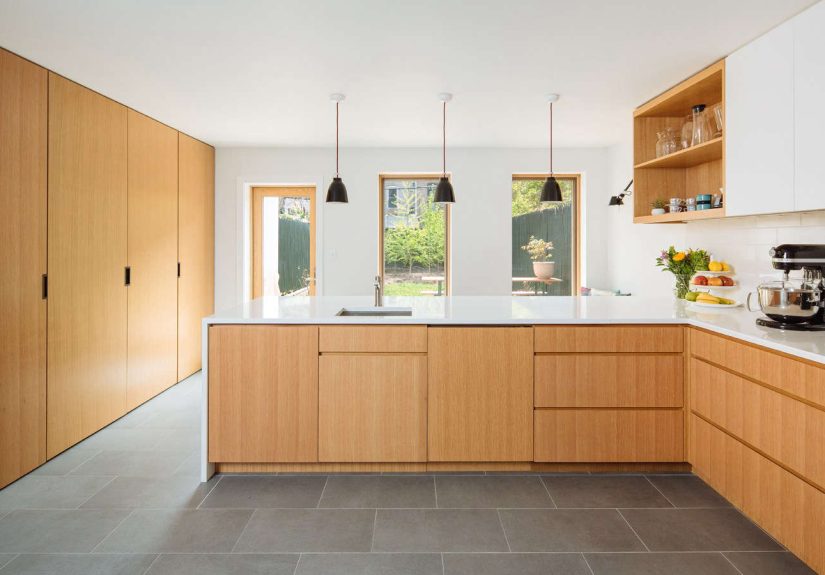
A design case in point: a late-1890s Brooklyn brownstone kitchen renovation used a clean palettewhite oak base cabinetry paired with white uppersto
create a brighter, lighter-feeling space while keeping the architecture calm and minimal.
Stairs (don’t let them be the “dark middle”)
- Continuous glow: Step lights, low-level sconces, or concealed LED can create safe, beautiful wayfinding.
- If you have a skylight above: Help that light drop by keeping stairwell finishes lighter and avoiding heavy visual blockage.
- Glass + fluted partitions: Great for borrowing light while keeping acoustic/visual separation.
Garden level
- Borrow light from the rear: If the back is brighter, use interior glass to share it inward.
- Consider moisture + durability: Garden levels can be more humid; choose fixtures rated appropriately.
- Warm it up: A garden level can feel “basement-y” fastwarm layered lighting helps it feel like real living space.
A Practical “Brightening Plan” You Can Actually Execute
Weekend wins (low cost, high impact)
- Clean windows; remove heavy treatments; add sheers where needed.
- Paint the darkest ceiling you own (it’s probably in the hallway) a lighter tone.
- Add mirrors where they reflect daylightnot just lamps.
- Replace the worst bulbs with higher-quality LEDs and put key areas on dimmers.
Mid-range upgrades (requires some pros)
- Add interior transoms or restore existing ones.
- Swap solid interior doors for glass or partial glass where privacy allows.
- Introduce layered lighting: ambient + task + accent in main rooms.
- Improve stair lighting for safety and “center-of-house glow.”
Major renovations (big payoff, bigger planning)
- Add skylights/light shafts to brighten the center.
- Rework the rear glazing (doors/windows or a more dramatic opening).
- Consider a rear addition only if it won’t make the interior darker and it fits zoning/approvals.
Conclusion: Bright Doesn’t Have to Mean Bland
The best-lit brownstones don’t feel like a showroom; they feel like a home that knows how to use light. Daylight enters, travels, and lands where people
actually live. At night, layered lighting keeps the architecture warm and the mood flexiblebecause you deserve a house that can do “Sunday morning
coffee” and “Friday night dinner party” without switching personalities.
Start small: reflect more, block less, and upgrade your lighting quality. Then, if you’re ready, tackle the architectural moves that let light flow
through the heart of the home. Your brownstone can keep its historic character and still feel bright enough to find your coffee. Revolutionary.
Experience Notes: What “Light to a Brooklyn Brownstone” Feels Like in Real Life (Extra )
The first time you walk into a well-lit Brooklyn brownstone, you notice something before you can name it: the house feels calm. Not “museum quiet,” but
visually calmthe way a good winter coat feels warm without being heavy. The glow starts at the front windows, but it doesn’t stop there. It slips down
the hall, catches on pale walls, and somehow reaches the middle of the home where you’d expect darkness to live rent-free.
Morning light is the biggest tell. In many brownstones, the front parlor gets the spotlight while the center hallway gets… thoughts and prayers. But when
transoms, glass doors, and reflective finishes are doing their jobs, the whole first impression changes. You don’t feel like you’re leaving daylight
behind as you walk inwardyou feel like you’re moving through it. Even the stair can become a gentle lantern if it has borrowed light from above or from
a brighter rear room.
Kitchens are where the “light experience” becomes emotional. In a dim kitchen, cooking feels like a chore you’re doing in a cave, even if the cabinets
are gorgeous and the appliances cost as much as a semester at NYU. But in a bright kitchenespecially one with a pale palette and good task lightingyour
brain relaxes. You can see what you’re chopping, the counters look cleaner, and the room feels inviting instead of purely functional. That’s why modern
brownstone kitchen updates often lean into lighter materials and cleaner lines: they’re not trying to erase history; they’re trying to give the room
oxygen.
Evenings are where a lot of brownstone lighting plans either shine or fall apart. If your only strategy is “turn on overhead fixtures,” the house can
feel flat and a little harshlike a stage lit from the ceiling. But when you have layers, the experience changes. A pair of sconces in the hall makes
the space feel wider. A lamp by the sofa creates a cozy pocket without darkening the rest of the room. A soft accent light on built-ins or art adds depth
and makes the architecture feel intentional. Dimmers are the unsung heroes here: they let you adjust the house to the moment instead of forcing your life
to match a single brightness level.
The most surprising “experience upgrade” is how light affects movement. In a bright home, you naturally use more of it. You’ll read in the back room.
You’ll work at the kitchen table longer. You’ll actually enjoy going down to the garden level because it feels like part of the housenot the place you
go only to do laundry and question your life choices. Better light changes behavior. It makes the brownstone feel less segmented and more like one home
with different moods throughout the day.
And here’s the most Brooklyn part: you don’t have to pick between “historic” and “bright.” The best projects respect the bonesmoldings, stair details,
proportionswhile using modern tools (glass, LEDs, controls) to make daily life better. Light becomes the bridge between the brownstone you fell in love
with and the brownstone you can actually live in.