
Table of Contents >> Show >> Hide
- Why Build a Double Desk With Secondhand Cabinets?
- Planning the Desk Before You Buy Anything
- Choosing the Right Secondhand Cabinets
- Designing a Functional Double Desk Layout
- Selecting the Desktop Surface
- Tools and Materials You May Need
- Step-by-Step: How to Make a Big Double Desk With Secondhand Cabinets
- Step 1: Measure the Space
- Step 2: Clean and Repair the Cabinets
- Step 3: Adjust the Height
- Step 4: Position and Level the Cabinets
- Step 5: Add Supports for the Desktop
- Step 6: Cut and Fit the Desktop
- Step 7: Attach the Desktop
- Step 8: Paint or Finish Everything
- Step 9: Add Trim, Hardware, and Cable Management
- Ergonomics: Making the Desk Comfortable for Real Work
- Storage Ideas for a Cabinet-Based Double Desk
- Budget Breakdown: What This Project Might Cost
- Design Styles That Work Beautifully
- Common Mistakes to Avoid
- When to Hire Help
- Extra Experience: What I Learned From Making A Big Double Desk With Secondhand Cabinets
- Conclusion
Some home office projects begin with a Pinterest board. Others begin with a suspiciously sturdy cabinet sitting in a thrift store, whispering, “I still have one more career left in me.” Making a big double desk with secondhand cabinets is one of those DIY projects that feels practical, creative, budget-friendly, and just a little bit heroic. You are not merely building a desk. You are rescuing cabinets from retirement, giving your workspace serious storage, and creating a command center large enough for two laptops, two coffee mugs, and at least one emotionally important stack of papers.
A double desk is especially useful for couples, roommates, siblings, kids doing homework, remote workers, small-business owners, crafters, and anyone whose “temporary work corner” has slowly taken over the dining table like a polite invasion. By using secondhand cabinets as the base, you can save money, reduce waste, and build something far more customized than a flat-pack desk that starts wobbling the first time someone types aggressively.
The best part? This project does not require a luxury workshop or a contractor-level tool collection. With careful measuring, smart cabinet selection, a solid desktop surface, and a little patience, you can create a large two-person desk that looks built-in, feels sturdy, and stores everything from office supplies to printer paper to the random charging cables no one can identify but everyone is afraid to throw away.
Why Build a Double Desk With Secondhand Cabinets?
A big double desk made from used cabinets solves several home office problems at once. First, it gives two people a defined workspace without needing two separate desks. Second, cabinets provide hidden storage, which is the secret ingredient in making a home office look calm instead of chaotic. Third, secondhand cabinets are often made from durable materials and can be found at architectural salvage stores, Habitat-style resale shops, Facebook Marketplace, garage sales, remodeling leftovers, and local classified listings.
Compared with buying a new built-in office system, a secondhand cabinet desk can be dramatically more affordable. You might spend more time hunting for matching pieces, but the savings can be worth it. Even mismatched cabinets can work beautifully if they are the same height or can be adjusted with legs, shims, or a platform base. Once painted the same color and topped with one continuous desktop, they often look intentionallike a custom office installation rather than a “look what I found in someone’s garage” situation.
Planning the Desk Before You Buy Anything
Before you fall in love with a row of cabinets, measure your room. Then measure it again, because walls enjoy being less straight than they appear. A double desk usually works best along a long wall, inside a wide alcove, or across one side of a multipurpose room. The key is to provide enough width for two people to sit comfortably without elbow fencing.
Recommended Size for a Two-Person Desk
For a comfortable big double desk, aim for at least 96 inches wide. A 10-foot to 12-foot desktop feels even better if your room allows it. Each person should ideally have 42 to 60 inches of personal work surface. Depth matters too. A desktop depth of 24 inches can work for laptops and writing, while 28 to 30 inches is better for monitors, keyboards, lamps, and desk accessories.
Standard desk height is usually around 29 to 30 inches. Many kitchen base cabinets are about 34.5 inches tall before a countertop, which may be too high for seated typing unless you use an adjustable chair and footrest. That does not mean kitchen cabinets are off-limits. It simply means you need to plan carefully. Some DIYers shorten cabinet bases, remove toe kicks, use lower storage cabinets, or choose a counter-height setup for stool seating. Comfort should win over looks every time. A gorgeous desk that makes your shoulders climb toward your ears is not a desk; it is a slow-motion neck cramp.
Choosing the Right Secondhand Cabinets
The cabinets are the foundation of the project, so do not judge them by paint color alone. Ugly cabinets can be painted. Bad structure is harder to forgive. Look for boxes that feel solid, sit level, and do not smell like damp basements, mystery spices, or a decade of mouse drama.
What to Look For
Good secondhand cabinets should have sturdy frames, functional drawers, intact doors, and minimal water damage. Open and close everything. Check whether drawers slide smoothly. Look inside for mold, swelling, cracks, or peeling veneer. A few scratches are harmless. A cabinet floor that feels soft or crumbly is a red flag.
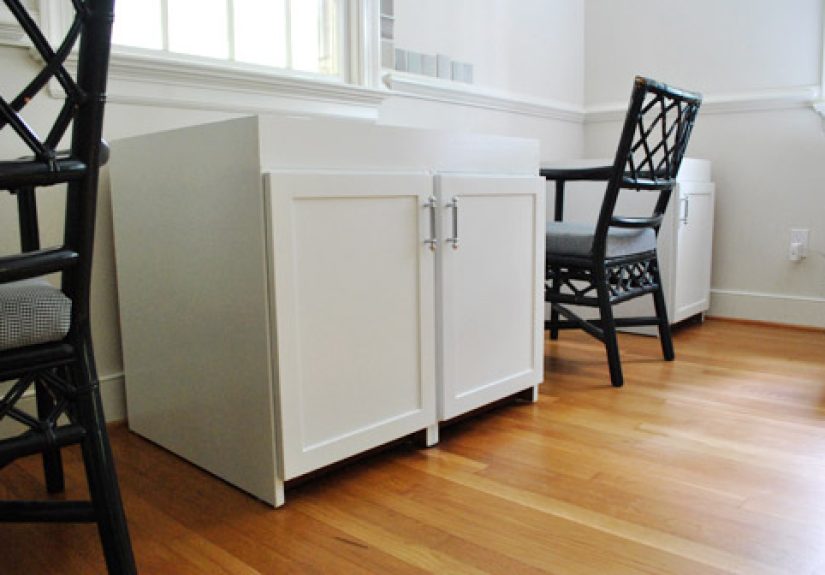
Matching cabinets are convenient, but not required. For a double desk, a common layout uses one cabinet at each end and one cabinet in the middle, creating two knee spaces. Another option uses two file cabinets on the outside edges with a long desktop spanning across them and wall cleats or support legs in the center. If you need storage for office equipment, consider a wider center cabinet with drawers or shelves. If both users need legroom, keep the middle area open and add support brackets underneath.
Best Cabinet Types for a Desk
Base cabinets, drawer cabinets, file cabinets, and shallow storage cabinets can all work. Drawer bases are excellent for office supplies because they keep small items from becoming a drawer-shaped archaeological dig. Door cabinets are useful for bulky items like printers, binders, camera gear, craft bins, or backup paper. If you find upper wall cabinets, they may be shallower and shorter, which can be useful if you build a platform under them to reach the correct height.
Designing a Functional Double Desk Layout
A successful DIY cabinet desk is not just about placing a board across some boxes. The layout should match the way you actually work. Think about computers, monitors, printers, task lighting, outlets, cords, chairs, and storage habits. Be honest. If you are the type of person who owns seven notebooks and uses all of them “for different things,” your desk needs drawers.
Popular Layout Options
The classic three-cabinet layout places one cabinet on the left, one in the center, and one on the right. This creates two separate seating zones. It is strong, symmetrical, and easy to build. The downside is that the center cabinet may reduce legroom if not planned correctly.
A two-cabinet layout uses cabinets at each end with a long desktop spanning across. This creates generous legroom but requires extra support in the middle, especially for a very wide desktop. You can add wall cleats, metal brackets, furniture legs, or a hidden support rail.
A built-in wall-to-wall layout uses cabinets, cleats, filler strips, trim, and a long top to create a permanent custom look. This is ideal for a dedicated office, craft room, or homework station. It takes more finishing work, but the result can look polished and expensive.
Selecting the Desktop Surface
The desktop is where your project goes from “storage with ambition” to “actual desk.” Popular materials include butcher block, plywood, solid-core doors, laminate countertops, reclaimed wood, melamine panels, and repurposed flooring installed over a plywood base. Each has advantages.
Butcher block is attractive, strong, and relatively easy to finish. Plywood is affordable and can look modern with edge banding or a hardwood front strip. A solid-core door can make a surprisingly sturdy desktop if the size works. Laminate countertop is durable and easy to clean. Reclaimed boards can look beautiful, but they need to be flat, smooth, and properly joined so your mouse does not go off-roading during spreadsheet season.
How Thick Should the Desktop Be?
For a large double desk, thickness matters. A desktop that is too thin may sag over time, especially across a long span. A surface around 1 to 1.5 inches thick is usually a good target for strength and appearance. If you use thinner plywood, reinforce it underneath with support rails or a frame. Always consider the span between cabinets. The farther the desktop stretches without support, the more important reinforcement becomes.
Tools and Materials You May Need
Your exact shopping list will depend on your layout, but most secondhand cabinet desk projects use a similar set of supplies. You may need a measuring tape, level, drill, screws, clamps, stud finder, circular saw or table saw, sander, wood filler, primer, paint, caulk, brackets, shims, trim, drawer pulls, and a desktop material. Safety gear matters too: eye protection, hearing protection, gloves, and a dust mask are not decorative accessories. They are the tiny adults in the room telling you to keep your eyeballs.
If you are cutting old painted materials, be cautious. Older cabinets may have finishes that require special handling. When in doubt, test first and avoid sanding unknown old paint without proper precautions.
Step-by-Step: How to Make a Big Double Desk With Secondhand Cabinets
Step 1: Measure the Space
Measure the wall width, baseboard depth, outlet locations, window placement, and chair clearance. Mark where each cabinet will go using painter’s tape on the floor. Sit in a chair and test the layout before building. This low-tech step can prevent high-drama regrets later.
Step 2: Clean and Repair the Cabinets
Secondhand cabinets usually need a spa day. Remove hardware, vacuum the inside, clean grease or grime with a degreasing cleaner, and repair dents with wood filler. Tighten loose screws, reattach drawer slides, and replace broken hinges. If the cabinet backs are flimsy, reinforce them with plywood or attach the units securely to wall studs.
Step 3: Adjust the Height
Check whether the cabinets create a comfortable desk height. If they are too tall, you may need to remove toe kicks, trim down the base, or choose a taller chair with a footrest. If they are too short, build a platform base or add furniture legs. The goal is a work surface that allows relaxed shoulders, bent elbows, and neutral wrists while typing.
Step 4: Position and Level the Cabinets
Place the cabinets in position and use a level from side to side and front to back. Floors are rarely perfect, especially in older homes, so use shims where needed. Secure cabinets to studs when possible, especially if the desk will be built in. Attach neighboring cabinets to one another for stability.
Step 5: Add Supports for the Desktop
Install wall cleats along the back if the desk runs against a wall. Cleats help carry the weight of the desktop and reduce sagging. For long spans, add center supports, metal brackets, or hidden rails. Do not rely on hope as a structural system. Hope is lovely, but screws are better.
Step 6: Cut and Fit the Desktop
Cut your desktop to size, test-fit it, and make adjustments for walls that are not square. If the desk fits between two walls, leave a small gap for expansion and easier installation. You can cover small gaps with trim or caulk. Sand sharp edges and round the front edge slightly for comfort.
Step 7: Attach the Desktop
Secure the top from underneath using screws through cabinet rails or brackets. Choose screws that are long enough to hold but not so long that they pop through the top like tiny metal periscopes. If using solid wood, allow for seasonal movement with figure-eight fasteners or slotted holes where appropriate.
Step 8: Paint or Finish Everything
Paint can make mismatched secondhand cabinets look like one custom unit. Sand glossy surfaces, use a bonding primer, and apply durable cabinet paint. For the desktop, choose a finish that can handle daily use. Polyurethane, hard wax oil, laminate, or a durable enamel may be suitable depending on your material. Let finishes cure properly before dragging monitors and coffee mugs across them.
Step 9: Add Trim, Hardware, and Cable Management
Filler strips, base trim, and side panels can make the desk look built-in. New drawer pulls or knobs instantly upgrade old cabinets. For cable management, drill grommet holes, mount power strips underneath, and use cable trays or clips. A big double desk can become a jungle of cords if you do not tame it early.
Ergonomics: Making the Desk Comfortable for Real Work
A double desk should look good, but it also needs to feel good after several hours of use. Keep monitors about an arm’s length away, with the top of the screen near eye level. Your keyboard and mouse should allow your elbows to stay close to your body and your wrists to remain straight. Use chairs that adjust to each person, especially if two users are different heights.
If the cabinet bases make the desktop slightly higher than a standard desk, a footrest can help. If you use stools, choose ones with back support if you plan to work for long periods. Good lighting is also part of comfort. Place task lights where they do not create screen glare. Your future self, the one not squinting at 4 p.m., will be grateful.
Storage Ideas for a Cabinet-Based Double Desk
Secondhand cabinets shine because they turn wasted wall space into organized storage. Use shallow drawers for pens, sticky notes, chargers, batteries, and small tools. Use deep drawers for files, printer paper, notebooks, and craft supplies. Add pull-out trays for printers or scanners if the cabinet is deep enough.
Inside door cabinets, use baskets, labeled bins, and shelf risers. Mount hooks inside cabinet doors for headphones or cords. If two people share the desk, divide storage zones clearly. One side can be for work supplies and the other for school, hobbies, or household paperwork. Without zones, every drawer eventually becomes “the drawer of things we were too tired to categorize.”
Budget Breakdown: What This Project Might Cost
The cost of making a big double desk with secondhand cabinets varies widely. Cabinets may cost anywhere from very cheap to several hundred dollars depending on quality, location, and whether you buy a full set. A desktop surface may be the largest expense. Butcher block and quality plywood cost more than reclaimed material, while a repurposed countertop may save money if it fits your space.
Do not forget finishing costs. Primer, paint, sandpaper, screws, brackets, trim, caulk, and hardware can add up. Still, even with these extras, a DIY secondhand cabinet desk can cost far less than a custom built-in office. It also gives you control over size, storage, style, and finish.
Design Styles That Work Beautifully
This project can fit many home styles. For a modern farmhouse look, paint cabinets warm white or soft gray and use a butcher block top. For a moody office, choose deep green, navy, charcoal, or black cabinets with brass hardware. For a clean modern look, use flat-front cabinets, simple pulls, and a pale wood or white desktop. For a playful family homework station, paint the base a cheerful color and add cork boards or wall organizers above each seat.
The secret is consistency. Secondhand pieces look intentional when they share a finish, hardware style, and countertop. Add matching lamps or chairs to visually connect both sides of the double desk.
Common Mistakes to Avoid
The biggest mistake is choosing cabinets before measuring the space and deciding on desk height. The second biggest mistake is ignoring support. A long desktop needs proper structure, or it may sag. Another common problem is forgetting chair clearance. Cabinets are useful, but humans still need knees.
Also avoid painting without prep. Cabinet paint needs clean, sanded, primed surfaces to last. Skipping prep may feel efficient until the paint scratches off the first time you slide a stapler across it. Finally, plan cable access before attaching the top. Drilling cord holes after everything is installed can be done, but it is less fun than doing it at the right time.
When to Hire Help
This project is DIY-friendly, but some situations deserve professional help. Hire an electrician if you need new outlets, wall-mounted power, or lighting changes. Ask a carpenter for help if your walls are very uneven, your desktop is unusually heavy, or you want a fully built-in look with custom trim. There is no shame in calling a professional. The goal is a safe, durable desknot a dramatic story involving a countertop, a wall, and gravity.
Extra Experience: What I Learned From Making A Big Double Desk With Secondhand Cabinets
The first lesson is simple: bring a tape measure everywhere. When shopping secondhand, the perfect cabinet appears when you least expect it, usually when you are wearing the wrong shoes and driving the smaller car. Measurements save you from buying something that almost works. “Almost” is the most expensive word in DIY.
The second lesson is that matching height matters more than matching style. I have seen ugly cabinets become gorgeous with primer and paint, but I have never seen uneven cabinets magically become level without extra work. When choosing secondhand cabinets, I now check height, depth, drawer function, and box condition before I care about color. A scratched oak cabinet with strong drawers is a better candidate than a pretty cabinet with a warped frame.
Another useful experience: always test the seating position before securing anything. Place the cabinets, lay a temporary board across them, pull up the chairs, and pretend to work. Type on a laptop. Reach for a notebook. Move your elbows. Check whether two people can sit without bumping each other. It may feel silly, but it reveals layout problems immediately. A desk that looks spacious on paper can feel cramped when real chairs and real humans enter the scene.
Cable management is also easier before the top is attached. On one project, I waited until the desk was finished to think about cords. That was a mistake. Suddenly I had monitor cables, laptop chargers, lamp cords, and a printer cable all trying to escape in different directions. Now I plan grommet holes, under-desk power strips, and cable trays before final installation. Future sanity is worth one extra hour of planning.
Painting secondhand cabinets taught me patience. The cleaning and sanding stage is not glamorous, but it determines whether the finish lasts. Old cabinets may have furniture polish, kitchen grease, dust, or mystery residue on them. A bonding primer helps, but it is not a wizard. Clean first, scuff-sand, prime, then paint with thin coats. Rushing this process usually leads to chips, streaks, and muttering.
I also learned to budget for small things. The cabinets may be cheap, but screws, brackets, trim, caulk, primer, paint, drawer pulls, sandpaper, and wood filler quietly join the party. These items are not expensive individually, but together they can surprise you. A simple spreadsheet or written budget helps keep the project from becoming “affordable” in quotation marks.
One of the best decisions is adding more support than you think you need. A big double desk carries monitors, books, arms, coffee cups, printers, and occasionally a cat who believes every horizontal surface is a throne. Wall cleats, center legs, brackets, or support rails make the desk feel solid. Nobody wants a bouncy desktop during a video call.
Finally, the most satisfying part of making a big double desk with secondhand cabinets is the transformation. You start with cabinets that someone else removed, overlooked, or no longer needed. After measuring, cleaning, painting, fitting, and finishing, those pieces become a useful workspace with personality. It feels custom because it is custom. It fits your room, your storage needs, your budget, and your daily habits. And yes, it gives you a very reasonable excuse to say, “I built that,” whenever someone compliments your office.
Conclusion
Making a big double desk with secondhand cabinets is one of the smartest DIY home office projects because it combines storage, sustainability, customization, and serious value. With the right planning, old cabinets can become the foundation for a spacious two-person workstation that looks polished and works hard every day. Focus on strong cabinet boxes, comfortable desk height, proper support, durable finishes, and thoughtful cable management. The result is not just a deskit is a practical, personality-filled workspace built from materials with a past and a very useful future.






 Close
Close