Table of Contents >> Show >> Hide
- How We Picked (and Why These Games Keep Getting Played)
- The Shortlist: Our Favorite Lawn Games This Year
- 1) Cornhole (a.k.a. Bag Toss)
- 2) Bocce Ball
- 3) Spikeball (Roundnet)
- 4) KanJam (Flying-Disc + Deflections)
- 5) Kubb (a.k.a. Viking Chess)
- 6) Mölkky
- 7) Ladder Toss (Ladder Golf)
- 8) Washer Toss
- 9) Horseshoes
- 10) Croquet (Six-Wicket, American Rules)
- 11) Giant Tumbling Tower (a.k.a. Giant Jenga)
- 12) Badminton (Backyard-Savvy)
- 13) Pickleball (Driveway or Mini-Court Edition)
- 14) Bottle Bash / Polish Horseshoes
- Quick Compare: Space, Pace, and Party Fit
- Buying & Setup Tips That Actually Matter
- Safety First (Please Retire the Vintage Lawn Darts)
- Formats We Used to Keep Things Moving
- What’s Trending This Year
- The Takeaway
- of Real-World Backyard Wisdom
- Conclusion
From ultra-chill bocce to sweatier Spikeball rallies, these are the backyard games that kept our cookouts lively, our step counts suspiciously high, and our guests hanging around for “just one more round.” We vetted rules, recommended spaces, and durability tipsthen battle-tested everything at barbecues, block parties, and one very competitive cul-de-sac.
To keep things real, we cross-checked rules and recommendations from leading U.S. sources (official associations, pro rulebooks, and top-tier guides) and condensed what matters most: setup, space, learning curve, and who will actually love it. (Think: kids, grandparents, hyper-competitive cousins.) Recent roundups from Good Housekeeping and The Spruce also helped us sanity-check what’s hot for casual players this year.
How We Picked (and Why These Games Keep Getting Played)
- Fast, fair fun: Easy to learn in five minutes or less, with enough depth to keep rematches spicy.
- Flexible spaces: Most games here fit on an average lawn; we note official and “backyard” distances so you can scale up or down.
- Multi-age friendly: Great for a mix of adults, teens, and kidsno elite athleticism required (well, except when Uncle Dan goes full tournament mode).
- Weather & wear: Durable components or clever “soft” alternatives when you’re playing on delicate turf (or indoors on a rainy day).
The Shortlist: Our Favorite Lawn Games This Year
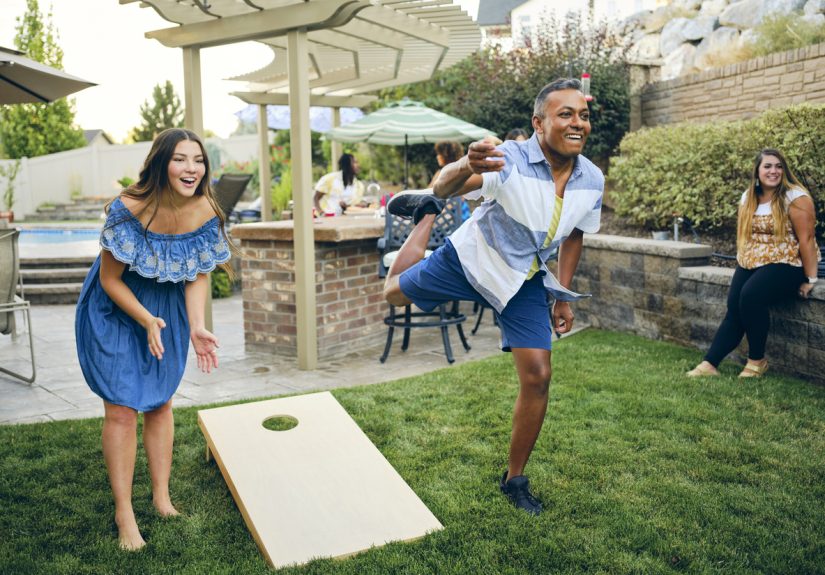
1) Cornhole (a.k.a. Bag Toss)
Why we love it: Universal crowd-pleaser; scales from casual tossing to bracket-style showdowns. Official board size is 2×4 ft with a 6-inch hole; standard board-to-board distance is 27 ft (move closer for kids).
Space check: Two boards 27 ft apart; keep a safe buffer behind the toss line.
Pro tip: If you’re playing at night, add LED hole lights so dramatic last-bag drop-ins get the ovation they deserve.
Nerd note: Regulation court footprints and lane notes exist for tournaments, but for a backyard, 27 ft is the gold standard.
2) Bocce Ball
Why we love it: Strategic without being sweaty; perfect for mixed ages. Official courts are ~87×13 ft, but backyard courts commonly shrink to ~60×12 ft and still feel great.
Space check: Flat grass or packed gravel. If space is tight, play “free-form” across yard markers.
Pro tip: For decks or delicate turf, use soft/beanbag bocce setslightweight, stackable, and they float for poolside shenanigans.
3) Spikeball (Roundnet)
Why we love it: High-energy 2-on-2 with 360° movement and volleyball-style touches (up to three per team). Expect quick rallies and glorious dives.
Space check: About a 20–25 ft radius of clear space around the net is comfy for most groups.
Pro tip: Defenders: square up early and communicate the second touchclean sets make put-aways automatic.
4) KanJam (Flying-Disc + Deflections)
Why we love it: Frisbee meets teamwork. Set the two cans 50 ft apart; throwers aim while partners deflect. Exact score to 21or nail an “instant win” through the slot.
Space check: Best on open lawns or parks; wind adds delightful chaos.
Pro tip: Train that gentle “redirect” angletoo much heat and you’ll air-mail your partner’s fingertips.
5) Kubb (a.k.a. Viking Chess)
Why we love it: Tactics + throwing accuracy. Official pitch is 5m × 8m; underhand batons only. Clear the opposing “kubbs,” then topple the king to win.
Space check: Works on grass or dirt; use corner stakes to lay out the rectangle.
Pro tip: Group field-kubbs tightly on your opponent’s sideone baton can knock down multiples if you stack them smartly.
6) Mölkky
Why we love it: The scoring puzzle is addicting. Knock down one pin? Score its face value. Knock down several? Score the count of pins. First to exactly 50 wins; overshoot and you drop to 25 (oof). Three whiffs in a row and you’re out.
Space check: Short throwing distance; plays nicely in small yards.
Pro tip: Late game, aim to finish exactly at 50don’t get greedy and reset your score.
7) Ladder Toss (Ladder Golf)
Why we love it: Quick to learn, oddly satisfying when bolas wrap just right. Most sets score 3-2-1 from top to bottom rungs; many house rules play to exactly 21.
Space check: Comfortable at backyard distances; give 10–15 ft per side and adjust for players.
Pro tip: Add a “must win by 2” rule for instant drama in close matches.
8) Washer Toss
Why we love it: Compact, portable, terrific for patios. Common backyard distance is ~20 ft between boxes; “official” washers.org lists 25 ft (cup-to-cup). Scoring is typically 3 for the cup, 1 for the box/board; many play to 21.
Space check: Works where cornhole won’t fit; keeps the competition tight.
Pro tip: Use contrasting washers so scoring and “cancel-outs” are painless.
9) Horseshoes
Why we love it: Americana classic. Two stakes are set 40 ft apart, angled slightly toward each other; cancellation or count-all scoring depending on your group.
Space check: Needs more room than washers; sand or clay pits are kind on misses.
Pro tip: Paint stakes in bright colors for visibility at dusk.
10) Croquet (Six-Wicket, American Rules)
Why we love it: Low-impact with layers of strategy: roquets, croquets, and wicked wicket routes. The U.S. Croquet Association maintains the American Rules; full tournament courts are carefully laid out, but backyard setups play great with a simplified wicket pattern.
Space check: Smooth, short grass is your friend; trim a quick “fairway” if the lawn is shaggy.
Pro tip: Color-code mallets to ballsfewer arguments, more tea-time banter.
11) Giant Tumbling Tower (a.k.a. Giant Jenga)
Why we love it: Zero setup and maximum suspense. Official rules keep it simple (one hand at a time; replace blocks on top). Use wider blocks or a ground mat for stability on grass.
Pro tip: Start from the middle blocks to keep weight balanced longer. (Yes, there’s strategy.)
12) Badminton (Backyard-Savvy)
Why we love it: Light cardio with satisfying smashes. Net height is 5’1″ (1.55 m) at the posts and 5′ (1.524 m) at center per badminton lawshandy if you’re stringing a temporary setup.
Space check: Regulation doubles courts are 44×20 ft; in a yard, shrink the footprint and keep the fun. (LED birdies at night = instant crowd.)
13) Pickleball (Driveway or Mini-Court Edition)
Why we love it: The social sport of the moment. A regulation court is 20×44 ft with a net that’s 36″ at the posts and 34″ in the middlegreat to know when taping a mini-court on the driveway or setting a portable net on flat lawn.
Pro tip: Start with skinny-kitchen games (shorter NVZ) for newcomers, then graduate to full rules.
14) Bottle Bash / Polish Horseshoes
Why we love it: A disc game with built-in highlight reels: knock the bottle, catch the disc, rack up points. Typical backyard setup spaces stakes ~25 ft apart (many sets vary); defenders try to snag both bottle and disc.
Quick Compare: Space, Pace, and Party Fit
| Game | Best For | Setup/Space | Intensity | Learning Curve |
|---|---|---|---|---|
| Cornhole | All ages, brackets | 27 ft between boards | Low–Medium | 2 minutes |
| Bocce | Multi-gen groups | Scale from patio to 60×12 ft | Low | 2 minutes |
| Spikeball | Active teens/adults | Open circle around net | High | 5 minutes |
| KanJam | Disc fans | 50 ft between cans | Medium | 2 minutes |
| Kubb | Tactical players | 5×8 m pitch | Medium | 10 minutes |
| Mölkky | Family game night | Small footprint | Low | 3 minutes |
| Ladder Toss | Patios/porches | Short distance lanes | Low | 2 minutes |
| Washer Toss | Small yards | 20–25 ft between boxes | Low | 2 minutes |
| Horseshoes | Classic crowd | 40 ft stake-to-stake | Low–Medium | 5 minutes |
| Croquet | Strategists | Flexible wicket course | Low | 10 minutes |
| Giant Tower | All ages, indoors/out | Table or firm lawn | Low | 1 minute |
| Badminton | Families, doubles | Net + ~yard-sized court | Medium | 5 minutes |
| Pickleball | Social sport lovers | 20×44 ft (scale down) | Medium | 10 minutes |
| Bottle Bash | Disc + reflexes | ~25 ft between poles | Medium | 2 minutes |
Buying & Setup Tips That Actually Matter
- Weatherproofing: Cornhole bags with all-weather fill, sealed seams, and board surfaces that resist warping will last seasonsnot weekends. (Plenty of sets from mainstream retailers hit these marks.)
- Scale for your crowd: For bocce, heavier 110–114 mm balls feel “right” for adults and longer courts; go smaller/lighter for kids and casual play.
- Soft options save lawns: Try soft bocce or foam bolas when you’re on a pristine lawn or deck.
- Outfitting with “editor picks”: Recent lists from People, Good Housekeeping, and The Spruce spotlight crowd-tested sets (and frequent sales). Use these as shortlists, then filter by materials and warranty.
Safety First (Please Retire the Vintage Lawn Darts)
Worth stating clearly: sharp-tipped lawn darts are banned in the United States (since 1988). If you find an old set, dispose of itdon’t bring it to the party. Safer, blunt-tip “arc toss” darts do exist and scratch the same itch without the ER visit.
Formats We Used to Keep Things Moving
- Backyard Triathlon: Cornhole → Spikeball → Bocce. Points 3-2-1 per event add up to a podium finish.
- Station Rotation: Set 4–5 games around the yard. Teams collect stamps or QR codes after each win and trade them for dessert supremacy.
- “One-Bag Handicap” for Kids: In cornhole, shorten the distance and give kids one “redo” per frame so they stay engaged.
What’s Trending This Year
Lists from major outlets agree: quick-setup games that play well in smaller spaces (Spikeball, Ladder Toss, Washer Toss) and strategy-forward classics (Bocce, Croquet) keep topping “best of” roundups. Expect KanJam and Bottle Bash to anchor the “party game” end of the spectrum, while pickleball and badminton pull in the racquet-sport crowdeven if you’re chalking mini courts instead of going full regulation.
The Takeaway
If you’re starting from scratch, pick one classic (Cornhole or Bocce), add one action game (Spikeball or KanJam), and keep one compact set (Washers or Ladder Toss) ready for small spaces. That trio covers every moodfrom lazy sunset tosses to competitive sprintsand guarantees your lawn becomes the unofficial neighborhood rec center.
of Real-World Backyard Wisdom
This summer, we turned the lawn into a test labsome scientific rigor, plenty of lemonade, and exactly one neighbor who brought a whistle. What we learned starts with setup friction. If a game takes more than five minutes to assemble (looking at you, tangled badminton nets), it gets played less. We pre-packed each kit in a labeled totestakes, spare parts, a Sharpie for impromptu bracketsand the participation rate jumped overnight.
Space hacking was next. Our yard isn’t a football field, so we adjusted distances: cornhole stayed regulation for adults but moved closer for kids; bocce lines were garden hose segments; Kubb boundaries were bright tent stakes. These visual cues cut arguments and sped up play. For mixed-ability groups, we leaned on house handicapsone re-throw per frame in cornhole for beginners, or a “one-touch” allowance in early Spikeball ralliesthen phased them out as folks warmed up.
We also discovered the magic of micro-tournaments. Big brackets are fun for a reunion, but on random Saturdays a best-of-three mini-series was perfect. Winner keeps the court; challenger picks the next game. Rotations kept energy high and, importantly, gave everyone a reason to cheer for someone else’s match (the snack table has surprisingly good sightlines).
Lighting turned out to be a cheat code. A $20 string-light zigzag and a couple of solar path markers transformed dusk into prime time. LED birdies and bag lights extended sessions by an hour without feeling like we were playing in a cave. We also learned to stash rain-plan alternatessoft bocce and giant tumbling towerso the party didn’t die when clouds rolled in. (Soft sets saved our hardwood floors and everyone’s nerves.)
Scorekeeping got smarter: clothespin clips on a flip-score board for cornhole, whiteboard markers on laminated cards for Kubb and Mölkky, and a QR code to a Google Sheet when my cousin felt… very spreadsheety. Kids loved being “official scorers,” which is also how we taught them basic arithmetic without them noticing.
Finally, a word on vibes. The best nights weren’t the ones with perfect bracketsthey were the ones with goofy house rules, creative team names, and a “win by 2” chant that may haunt our neighbors. We kept a trophy shelf (okay, it’s a windowsill) with rotating prizes: a golden washer, a crown for the Kubb king-slayer, and a foam “MVP” belt that’s mostly an excuse for photos. If you want your lawn to be the place people remember, make the games easy to start, the rules clear enough to be fair, and the atmosphere silly enough that no one’s afraid to lose. That’s how you build traditions that last longer than the grass stains.
Conclusion
Pick a classic, add an action game, keep a compact set on standby. Mark lines clearly, scale distances to your space, and consider soft equipment when lawns (or living rooms) need gentleness. And pleaseno vintage lawn darts. Your guests (and insurance) thank you.