Table of Contents >> Show >> Hide
- What Exactly Is The Sentinel?
- Why Marfa Makes This Story Bigger Than One Town
- The Reinvention of a Legacy Paper
- From Newsroom to “Third Space”
- The Building Tells the Story, Too
- Why This Model Works When So Many Papers Are Struggling
- More Than a Pretty Case Study
- The Experience of The Sentinel: Why the Place Changes the Story
- Conclusion
Marfa, Texas, is the kind of place that makes big cities feel a little overdressed. It is small, remote, dusty in the most cinematic way, and somehow still internationally famous. People come for the art, the sky, the desert quiet, the Chinati Foundation, the odd magic of a town that feels both deeply local and lightly surreal. But among Marfa’s galleries, patios, and postcard-worthy storefronts, one of the most important attractions is not a sculpture or a roadside photo stop. It is a newspaper with a coffee habit.
The Sentinel in Marfa is not just a café. It is not just a bar. It is not just a newspaper office, either. It is a hybrid space built around a simple but radical idea: local journalism does not have to survive on noble speeches and shrinking ad budgets alone. Sometimes it can survive on breakfast tacos, retail shelves, community events, and the stubborn belief that a town still deserves someone to cover the school board, the county, the culture, the weather, the art openings, and the stories people tell when nobody is pretending they are too busy to listen.
That is what makes The Sentinel so fascinating. In Marfa, saving the presses did not mean treating the newspaper like a museum piece under glass. It meant turning it into a living part of daily life. The result is one of the most interesting local media stories in America: a West Texas experiment that feels stylish on the surface, practical underneath, and genuinely hopeful at a time when hope is not exactly overflowing in the local news business.
What Exactly Is The Sentinel?
The short answer is this: The Sentinel is home to The Big Bend Sentinel, the historic weekly paper that has covered Far West Texas since 1926. The longer answer is a lot more fun. Today, The Sentinel is a coffee shop, restaurant, bar, retail space, and event venue in Marfa that supports local independent journalism. That setup sounds unusual because it is unusual. It also sounds a little crazy, which is often how good ideas introduce themselves.
The Big Bend Sentinel is not some trendy startup pretending to be old because it likes vintage fonts. It is the real thing. The publication traces its roots through nearly a century of regional reporting, and its archive connects the current paper to older Marfa newspaper history, including the town’s earlier paper culture dating back to the nineteenth century. Its modern newsroom covers Presidio, Brewster, and Jeff Davis counties, a vast stretch of Far West Texas that the paper itself describes as roughly the size of Switzerland. In other words, this is rural reporting on a grand geographic scale, even if the staff stays intentionally lean.
That scale matters. This is not a city magazine filling pages with brunch rankings and suspiciously enthusiastic real estate copy. The paper’s coverage lives where national themes become local realities: border issues, immigration, education, land use, healthcare, culture, public meetings, weather, and the everyday mechanics of life in a rural region. The Sentinel’s model works because it never forgets what the journalism is actually for.
Why Marfa Makes This Story Bigger Than One Town
Marfa has roughly 2,500 residents, depending on which recent dataset you use, yet its cultural footprint is hilariously oversized. The town has become famous for its art scene, desert landscape, dark skies, and slow-burn mystique. Official tourism materials describe it as an oasis of culture in the Chihuahuan Desert, and that description is not mere brochure poetry. Marfa’s identity really does sit at the intersection of ranching history, Mexican and immigrant settlement, contemporary art, tourism, and a kind of deliberate slowness that feels almost rebellious in the algorithm age.
Donald Judd and the Chinati Foundation helped turn Marfa into an international art destination, but the town’s appeal goes beyond minimalism and museum tours. Marfa attracts travelers who want atmosphere, people who like destinations with strong identities, and regular visitors who do not mind driving a long way for a place that feels unlike anywhere else. That steady stream of visitors becomes part of The Sentinel story. In many towns, a newspaper is expected to survive on subscriptions and advertising while everyone politely ignores the math. In Marfa, tourism creates another possibility: visitors can help fund the civic information locals need.
That does not mean The Sentinel is built only for tourists. Quite the opposite. Its success comes from being visibly embedded in the town. But Marfa’s unusual mix of locals, artists, ranch families, newcomers, and curious travelers gives the business model extra fuel. The same visitor economy that fills hotel rooms and gallery tours can also buy lunch, coffee, cocktails, gifts, and newspapers. In Marfa, the town’s character is not background decoration. It is part of the revenue strategy.
The Reinvention of a Legacy Paper
Maisie Crow and Max Kabat moved to Marfa from New York City in 2016, not because they were on a mission to become small-town newspaper owners, but because they were looking for a different kind of life and community. Then the newspaper found them. In 2019, the longtime owners approached them about buying the paper. Crow, a documentary filmmaker and journalist, and Kabat, a marketing and business strategist, were hardly the standard-issue heirs to a rural weekly. That may be exactly why they were able to see a different future for it.
Instead of treating the paper like a fading institution that needed one more round of heroic belt-tightening, they treated it like a brand, a civic asset, and a physical gathering point. They leaned into print instead of abandoning it. They invested in place instead of pretending the internet would solve everything. And they developed a diversified business around the publication rather than asking the publication to stand alone in a business environment that has been merciless to local newspapers for years.
The approach was refreshingly unsentimental. Yes, the paper is historic. Yes, local journalism matters. But nobody pays the electric bill with abstract love for democracy. The Sentinel’s strategy recognized that a newspaper can be mission-driven and still need a workable business model. That practical streak may be the smartest thing about the whole enterprise.
From Newsroom to “Third Space”
One of the clearest ideas behind The Sentinel is that local news should not live only on a doorstep, a website, or a social media feed. It should have a place people can actually enter. Kabat has described the venture as a kind of “third space,” meaning a public place that is neither home nor work, where community life can happen more naturally. That is more than branding talk. It is a structural choice.
The Sentinel gives journalism a physical presence in the middle of town. You can show up for coffee and leave with a newspaper. You can come for lunch and end up talking about a school issue, an art opening, a county decision, or a person everyone in town knows. You can buy something from the retail side, attend an event, sit on the patio, and absorb the fact that the local paper is not a ghost haunting the internet. It is right there, in public, being useful and visible.
This matters because one of local journalism’s biggest modern problems is invisibility. Plenty of people say they care about local news in theory, but theory does not always inspire habit. The Sentinel turns support into a routine. It invites people to participate in the ecosystem even when they did not walk in planning to make a grand civic gesture. Sometimes preserving a newspaper looks less like waving a flag and more like ordering another coffee.
The Building Tells the Story, Too
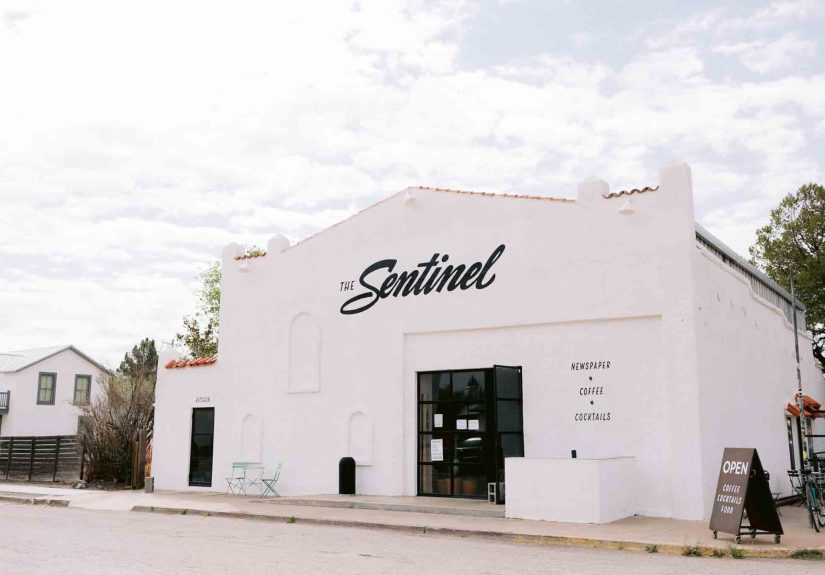
The space itself adds another layer to the appeal. The Sentinel occupies a historic adobe building in Marfa with a past life that included a local dive bar and, before that, a funeral home. That biography alone deserves its own screenplay. Inside, the design mixes desert restraint with warmth: adobe texture, bright light, local objects, and enough visual intelligence to make the place feel intentional without becoming precious.
That design does real work for the business. It helps the venue function as a destination, but it also reinforces the broader point that local journalism can be woven into culture instead of hiding in a back office. The paper does not sit apart from the café identity. It is the reason the place exists. This is not a coffee shop that slapped a newspaper name on the wall for atmosphere. The journalism gives the space its meaning. The space, in turn, helps fund the journalism.
It is a neat loop, but not a shallow one. The aesthetics may get people through the door, yet the deeper achievement is operational. The Sentinel transformed a legacy paper’s real estate from overhead into an asset. That sounds like a business-school sentence, but in Marfa it translates into something wonderfully concrete: a building that earns its keep while keeping local reporting alive.
Why This Model Works When So Many Papers Are Struggling
The broader local news picture in the United States is rough. Northwestern’s 2025 State of Local News report found that nearly 40 percent of all local U.S. newspapers have vanished and that 50 million Americans now live with limited or no access to reliable local news. More than 130 papers shut down in the previous year alone. Those are not abstract numbers. They describe a country where communities steadily lose watchdogs, memory-keepers, event calendars, obituaries, context, and accountability.
Against that backdrop, The Sentinel stands out because it does not rely on one fragile revenue stream. Subscriptions still matter. Advertising still matters. But so do coffee sales, food and beverage sales, events, retail goods, and the broader energy of being a real place in a real town. That diversified model does not make journalism easy, yet it does make the business less dependent on digital ad roulette and less vulnerable to the idea that every local paper should become a thinner website with a stronger sense of doom.
Another reason the model works is that Marfa visitors do not necessarily want everything to be frictionless and digital. Part of Marfa’s appeal is its slower tempo. Print fits that mood beautifully. A physical weekly newspaper in a place like this is not a relic. It is almost a luxury good, in the best sense: tactile, finite, local, and worth taking home.
That said, not every town can copy Marfa. Most places do not have Marfa’s tourism economy, design cachet, or international art halo. But the principle behind The Sentinel travels well: build around what makes your community distinct, create more than one way for people to support local news, and make journalism visible in everyday life. The lesson is not “open a chic desert café.” The lesson is “stop pretending the old revenue model is coming back unchanged.”
More Than a Pretty Case Study
There is always a risk that stories like this get flattened into lifestyle content. Cute town. Cool space. Great coffee. Local paper survives. Roll credits. But The Sentinel deserves a more serious reading. Its significance is not that it looks nice in photographs, though it certainly does. Its significance is that it offers a working answer to a hard question: how do you preserve local reporting in a place where the audience is small, the geography is huge, and the industry trend line is ugly?
The answer in Marfa has been to connect journalism to culture, commerce, routine, and physical space without reducing it to any one of those things. The paper is still the point. The café does not replace reporting; it supports it. The style does not replace substance; it helps attract attention to it. The venue does not dilute the mission; it expands the number of ways people can participate in that mission.
There is also something quietly democratic about the setup. A newspaper office can feel intimidating or invisible. A café feels open. A bar feels social. An event space feels communal. The Sentinel lowers the barrier between the newsroom and the public, not by cheapening journalism, but by making it part of normal life. That may be one of the most useful ideas local media has produced in years.
The Experience of The Sentinel: Why the Place Changes the Story
To understand The Sentinel, it helps to imagine not just the business model, but the experience. Walk into the space in the morning and the whole idea starts making emotional sense before it makes financial sense. There is coffee in the air, desert light on the walls, the low hum of conversation, and a feeling that this place wants you to stay a while instead of rushing you back to your car or your screen. That is important, because good local journalism has always depended on time: time to observe, time to ask follow-up questions, time to notice what changed on a street corner and who has not been seen around town lately.
The experience of The Sentinel turns that value into atmosphere. You are not just consuming a product. You are entering a civic habitat. One table might hold travelers mapping out a Chinati visit. Another might have locals discussing a county issue, a school event, or a person they all know. Someone buys breakfast. Someone grabs a paper. Someone lingers over lunch. Someone comes back later for a drink. Piece by piece, the place does what so many news organizations say they want to do but rarely manage in practice: it becomes part of community life instead of hovering outside it.
That feeling is especially powerful in a town like Marfa, where the landscape itself encourages you to slow down and pay attention. The open sky, the distance, the stark beauty, the weirdness, the art, the heat, the long conversations after dark, the sense that the town rewards looking twice instead of once, all of that matches what local reporting is supposed to do. A newspaper in Marfa should not feel generic. It should feel rooted. The Sentinel does.
Even the building’s layered past adds to the experience. A space that has already lived several lives feels like the right home for a paper devoted to continuity. The town changes. Ownership changes. Business models change. But the need for a shared place to gather stories, debate decisions, mark losses, and celebrate local wins does not really go away. The Sentinel makes that continuity visible. It says, in effect, that journalism is not only something published. It is something hosted.
And then there is the simplest experience of all: the pleasure of seeing a local paper treated like it matters. Not hidden in a corner. Not apologizing for existing. Not acting like print is embarrassing. At The Sentinel, the newspaper is part of the room’s identity. That has psychological power. It reminds people that local reporting is not a leftover from another century. It is an active ingredient in public life. In an era when so much news feels placeless and disposable, The Sentinel feels specific, tangible, and stubbornly alive. That may be why the idea resonates so widely. It is not just a business story. It is a mood correction.
If the future of local journalism is going to survive anywhere, it will probably survive in places that create this kind of bond between reporting and daily life. The Sentinel in Marfa does not offer a magic formula, but it does offer something more believable: a model people can feel. You can taste it in the coffee, hear it in the room, see it in the paper, and recognize it in the fact that one small Texas town decided local news was worth building a place around.
Conclusion
The Sentinel in Marfa, Texas, is one of those ideas that seems obvious only after someone else has been brave enough to do it first. Take a historic weekly newspaper. Keep print alive. Build a beautiful, useful, public-facing space around it. Let food, drink, events, retail, and culture help pay for reporting. Root the whole thing in the identity of the town. Then make it clear that saving local journalism is not only a matter of nostalgia. It is a matter of design, business, habit, and community will.
In Marfa, saving the presses did not require pretending the old world still works. It required building a new one around the same civic purpose. That is why The Sentinel matters. It proves a local newspaper can still be essential, still be loved, and still be economically inventive without losing its soul. In a country where too many local papers disappear quietly, that is not just good branding. That is good news.
Note: This article is intentionally provided as body-only HTML for web publishing and omits external source links by request.