
Table of Contents >> Show >> Hide
- What Is a 3D Printed Water Droplet Automaton?
- Why This Automaton Is So Mesmerizing
- The Role of Cams: Tiny Plastic Choreographers
- How 3D Printing Changes the Automaton Game
- Why Tolerances Make or Break the Build
- The Physics Behind the Water Droplet Effect
- From Dean O’Callaghan to Desktop Fabrication
- Why Makers and Teachers Love Projects Like This
- Design Lessons From the 3D Printed Water Droplet Automaton
- Why This Little Machine Still Matters
- Experience Section: What It Feels Like to Watch and Build a Water Droplet Automaton
- Conclusion
Some machines are loud, oily, dramatic things that look as if they are seconds away from demanding a union break. Then there are machines like the 3D printed water droplet automaton: quiet, hypnotic, and oddly emotional for something made from plastic, cams, rods, rings, and human patience. Turn the crank and a tiny mechanical universe wakes up. A sphere rises and falls in the center. Concentric rings ripple outward like a drop landing on a still pond. Your brain knows it is a clever mechanism. Your eyes insist it is water.
This is the magic of a good automaton. It does not need an app, a touchscreen, or a software update that arrives precisely when you are trying to show it to friends. It uses old mechanical ideascams, followers, shafts, timing, friction, and rhythmto create a living illusion. The 3D printed water droplet automaton is especially fascinating because it takes a traditional wooden kinetic sculpture concept and translates it into the language of desktop fabrication. In other words, it is part sculpture, part engineering lesson, part fidget toy for people who secretly read CAD tutorials for fun.
Inspired by Dean O’Callaghan’s wooden Water Experiment No. 33, the 3D printed version became a favorite in maker circles because it shows exactly what 3D printing does best: it turns a beautiful but complex mechanical idea into something that can be studied, remixed, printed, adjusted, and appreciated by anyone willing to wrestle with tolerances and the occasional stubborn support scar.
What Is a 3D Printed Water Droplet Automaton?
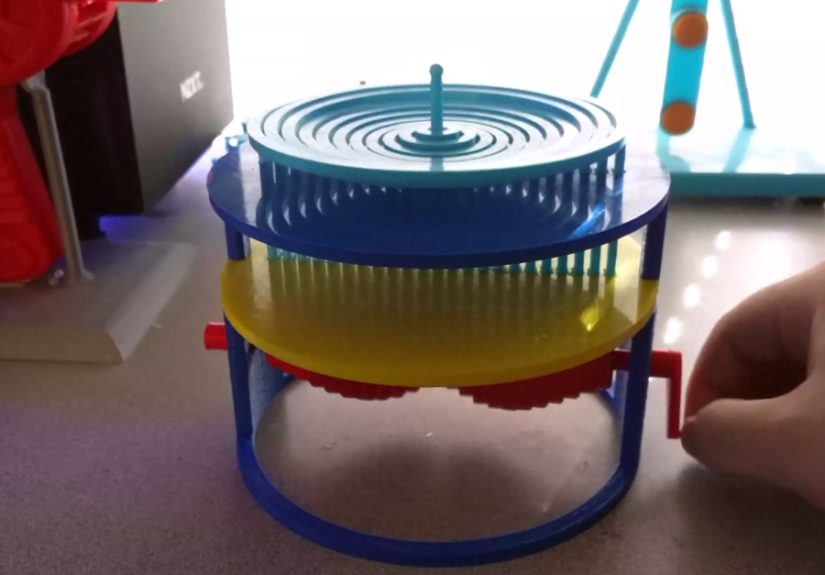
A 3D printed water droplet automaton is a hand-cranked kinetic sculpture designed to imitate the ripples created when a droplet strikes a water surface. The key word is imitate. There is no actual water involved, which is excellent news for your desk, your electronics, and your printer filament stash. Instead, the illusion comes from precisely timed vertical motion.
At the center of the piece, a ball moves up and down like the falling droplet. Around it, a series of circular rings rise and fall in a sequence. When the crank turns smoothly, the rings create a wave pattern that appears to spread across the surface. It is the mechanical equivalent of dropping a pebble into a pond, except the pond is plastic and the pebble is politely attached to a shaft.
The Basic Parts Behind the Illusion
The automaton usually relies on a few essential mechanical elements:
- Hand crank: The human-powered input that drives the system.
- Axle or shaft: The rotating spine that transfers motion through the sculpture.
- Cams: Shaped rotating pieces that convert circular motion into rising and falling motion.
- Followers: Parts that ride along the cams and respond to their shape.
- Rings: The visible ripple surface that creates the water-droplet effect.
- Central sphere: The “drop” that helps sell the illusion.
That sounds simple enough until you try to make all of those parts move together without wobbling, binding, squeaking, or developing the personality of a shopping cart wheel. The beauty of the design is that the complexity stays mostly hidden under the surface, while the top view remains clean and poetic.
Why This Automaton Is So Mesmerizing
The hypnotic quality comes from timing. Each ring reaches its high and low point at a slightly different moment. This delay creates the impression of a traveling wave. Your eye reads the sequence as fluid motion even though every piece is moving mechanically in place.
That is why the automaton can feel strangely calming. It has repetition without boredom, motion without chaos, and engineering without the smell of burnt electronics. It sits in the same mental category as marble machines, pendulum waves, kinetic wall sculptures, and those desk toys people claim are “for focus” but mostly use while avoiding email.
The Brain Loves Pattern
Humans are pattern-hunting creatures. We see faces in clouds, animals in constellations, and occasionally meaning in printer error messages. A ripple pattern is especially satisfying because it is familiar. We have all seen raindrops hit puddles, coffee drips land in a mug, or pebbles disturb a lake. The automaton borrows that natural memory and recreates it with hard parts.
The result feels organic even though the movement is completely designed. That contrast is the hook. A viewer can enjoy the piece as art, then lean closer and enjoy it again as a mechanism. It is not hiding the fact that it is a machine. It is proudly saying, “Yes, I am made of cams. And yes, I can still look like a tiny pond having a dramatic moment.”
The Role of Cams: Tiny Plastic Choreographers
The cam is the secret sauce. In mechanical terms, a cam is a shaped rotating part that changes one type of motion into another. In this case, it converts the rotary motion of the crank into the vertical motion of the rings. Different cam shapes create different movement profiles. A round cam mounted off-center creates a smooth rise and fall. A more dramatic profile can create a sharper lift, a pause, or a quick drop.
In a water droplet automaton, the cams must be arranged so the rings move in a carefully staggered sequence. This is less like building a random stack of parts and more like composing music. If one cam is out of phase, the ripple may look odd. If several cams are off, the wave can become less “tranquil pond” and more “plastic dinner plate trying to escape.”
Mechanical Timing Matters
Timing is what separates a mesmerizing automaton from a crank-powered confusion machine. The rings need to move with enough difference between them to suggest travel, but not so much that the pattern breaks apart. This is where mechanical design becomes visual design. The maker is not only asking, “Does it work?” but also, “Does the motion feel right?”
That question matters because the sculpture is not reproducing water physics perfectly. It is creating a convincing visual metaphor. The goal is not to fool a fluid dynamics professor armed with a clipboard. The goal is to make a viewer pause, smile, and maybe whisper, “Okay, that is cooler than it has any right to be.”
How 3D Printing Changes the Automaton Game
Traditional automata are often made from wood, brass, wire, paper, and found materials. That tradition is rich, charming, and full of personality. 3D printing does not replace it; it adds another doorway into the craft. With a 3D printer, a maker can prototype cams, rings, spacers, gears, and support structures quickly. A design that once required a woodshop can now begin as a model on a laptop and a spool of filament on a desk.
This matters because automata are all about iteration. The first version rarely behaves perfectly. A ring may rub. A cam may be too steep. A shaft may flex. A clearance that looked generous in CAD may become a plastic handshake of doom after printing. With additive manufacturing, the maker can adjust the digital file and try again without starting from zero.
PLA, PETG, Resin, and the Material Question
For a display piece like this, PLA is often a practical choice because it prints easily and holds crisp details. PETG can be tougher but may introduce more stringing or flexibility, depending on the printer and settings. Resin printing can produce smoother surfaces and finer details, but resin parts require washing, curing, and more careful handling. For moving parts, the best material depends on the size of the mechanism, the desired finish, and how much post-processing the maker is willing to do.
Whatever material is used, smooth motion usually requires attention after printing. Light sanding, careful cleanup, lubrication in the right places, and test-fitting can make the difference between a graceful ripple and a crank that feels like it is grinding through a bag of crackers.
Why Tolerances Make or Break the Build
Every 3D printer has limits. A model may be perfect on screen, but the printed part is still shaped by nozzle width, layer height, shrinkage, cooling, resin behavior, bed adhesion, and calibration. This is why tolerances are so important in a 3D printed automaton. A moving assembly needs clearance between parts. Too tight, and the mechanism binds. Too loose, and the rings wobble like a nervous jellyfish.
For FDM printing, moving parts often need more clearance than resin or SLS parts because layer lines and extrusion variation affect fit. That does not mean FDM cannot produce excellent automata. It simply means the design should respect the process. A smart maker prints test pieces, checks movement, adjusts dimensions, and resists the ancient temptation to fix everything with brute force and wishful thinking.
Common Build Challenges
Several issues can appear during a project like this:
- Ring friction: The rings may rub against supports or each other.
- Cam binding: Followers may catch if the cam surface is rough or too steep.
- Shaft wobble: Long printed shafts can flex or rotate unevenly.
- Layer texture: Printed surfaces may need sanding for smooth contact.
- Phase errors: Incorrect cam orientation can disrupt the wave pattern.
- Assembly confusion: Many similar-looking parts can turn a build session into a tiny plastic detective story.
The good news is that these problems are part of the learning process. Automata teach patience because they refuse to be rushed. They reward small adjustments. They also remind makers that “almost smooth” is not the same as smooth, especially when one sticky cam can ruin the whole ballet.
The Physics Behind the Water Droplet Effect
The real-life inspiration is wave motion. When a droplet hits water, energy moves outward from the impact point. The surface rises and falls in circular ripples. If multiple waves meet, they can interfere with one another, creating areas where the movement appears stronger or weaker. This is why water surfaces can look simple at first glance but become beautifully complex when you keep watching.
The automaton does not simulate every detail of fluid behavior. Instead, it abstracts the most recognizable feature: expanding circular motion. It uses rings to represent the water surface and timed vertical movement to suggest the wave. The viewer fills in the rest. That is not a flaw; it is art doing its job.
A Mechanical Simulation, Not a Digital One
Today, water ripples can be simulated with software in seconds. A graphics engine can calculate waves, reflections, damping, and light effects with dazzling realism. Yet the 3D printed water droplet automaton remains compelling because it is physical. You can hear the faint mechanical rhythm. You can feel resistance in the crank. You can see the parts doing the work.
That physical honesty gives the sculpture its charm. It is not pretending to be a perfect virtual pond. It is a mechanical poem about a pond. And like most poems, it works best when you do not demand that it also function as plumbing.
From Dean O’Callaghan to Desktop Fabrication
Dean O’Callaghan’s wooden Water Experiment No. 33 helped popularize the visual idea: a hand-made automaton that recreates the spreading pattern of a water droplet. The 3D printed version shows how maker culture preserves and transforms ideas. Someone sees a beautiful wooden mechanism, studies the motion, imagines a printable version, models the parts, shares the files, and suddenly the concept travels across workshops, classrooms, and hobby rooms.
This is one of the best things about the modern maker ecosystem. Inspiration no longer stays locked in a single studio. A clever mechanism can become a printable project, a classroom demonstration, a design challenge, or a starting point for someone else’s remix. The water droplet automaton is a perfect example because it sits at the intersection of art, physics, mechanical design, and open sharing.
Why Makers and Teachers Love Projects Like This
A 3D printed water droplet automaton is more than a pretty desk object. It is a compact lesson in mechanical engineering. Students can learn about cams, followers, rotary motion, linear motion, timing, friction, tolerances, and wave behavior from one build. Better yet, the lesson is visual. When something is wrong, the motion usually tells you.
That makes automata excellent teaching tools. A worksheet can explain a cam, but a hand-cranked model makes the idea click. The learner turns the crank and sees rotation become lift. They change a part and watch the motion change. This kind of hands-on feedback is powerful because it connects abstract concepts to physical results.
It Also Makes Failure Less Scary
Automata are wonderfully forgiving learning projects because failure is visible and fixable. If a ring sticks, you inspect the contact point. If the motion is uneven, you check alignment. If the cam timing feels wrong, you adjust the sequence. Instead of hiding mistakes, the machine performs them right in front of you, like a tiny mechanical theater critic.
That can be frustrating, of course. But it also builds real skill. The maker learns to diagnose, test, and refine. In a world full of sealed gadgets that punish curiosity, a visible mechanism is refreshing. It says, “Look inside. The trick is right here.”
Design Lessons From the 3D Printed Water Droplet Automaton
The first lesson is that motion needs room. Beautiful CAD models often fail because parts are designed too tightly. The second lesson is that surface finish matters. A cam may have the correct shape, but if the surface is rough, the follower will not glide smoothly. The third lesson is that rhythm is a design material. In kinetic sculpture, time is as important as shape.
The fourth lesson is that simplicity is deceptive. The top of the automaton looks clean and minimal, but underneath is a carefully coordinated system. That hidden complexity is what makes the piece satisfying. It gives viewers two experiences: the instant pleasure of the ripple and the slower pleasure of understanding how it works.
Tips for Building or Remixing One
- Print a small tolerance test before committing to the full mechanism.
- Use consistent print settings for parts that must fit together.
- Clean cam surfaces carefully and remove blobs or seams.
- Test the crank and cam assembly before installing every visible ring.
- Keep similar parts labeled so assembly does not become a puzzle from a mischievous goblin.
- Turn the crank slowly during testing to identify binding points.
- Consider subtle lubrication where plastic rubs against plastic.
Most importantly, do not expect the first assembly to be perfect. Kinetic sculptures are negotiated into smoothness. You make a change, test the motion, make another change, and eventually the machine begins to feel alive.
Why This Little Machine Still Matters
The 3D printed water droplet automaton continues to attract attention because it represents a healthy kind of technology: understandable, repairable, shareable, and beautiful. It does not need to collect data, connect to Wi-Fi, or ask you to create an account before enjoying the ripple. It simply turns a hand movement into a visual pattern.
That simplicity feels almost rebellious. In an age of black-box devices, visible mechanisms remind us that technology can be transparent. You can understand it by watching. You can improve it by tinkering. You can explain it to a child, a friend, or a skeptical relative who still thinks 3D printers only make keychains and tiny dragons.
Experience Section: What It Feels Like to Watch and Build a Water Droplet Automaton
The first experience of watching a 3D printed water droplet automaton is surprisingly quiet. You expect a gimmick, perhaps a neat little motion toy that earns a polite nod. Then the crank turns, the rings begin to rise and fall, and the room seems to slow down. The motion is not flashy. It does not jump out shouting for attention. It pulls attention inward. You follow the central sphere, then the first ring, then the next, and suddenly you are watching waves move through plastic as if the material forgot it was solid.
There is a special pleasure in seeing a natural event translated into a mechanism. A real water droplet is quick and delicate. It happens and disappears. The automaton stretches that moment, slows it down, and lets you inspect it. It is like putting a ripple under a magnifying glass, except the magnifying glass has cams underneath and probably took several hours to print.
Building one creates a different kind of appreciation. On video, the motion looks effortless. On the workbench, effort is everywhere. You notice every tiny imperfection: the elephant’s foot on the bottom of a part, the seam line on a cam, the shaft that is just a little less straight than optimism promised. You learn that kinetic sculpture is not only about designing shapes. It is about managing contact. Where does this part rub? Where does force travel? Is the crank smooth because the mechanism is aligned, or because you are turning it with the cautious fear of someone defusing a snack-sized bomb?
The assembly stage can feel like a conversation with the object. The automaton tells you what it needs by misbehaving. A sticky ring says, “Give me clearance.” A jerky cam says, “Smooth my surface.” A wobbly shaft says, “Support me better, genius.” This feedback is part of the fun. The project trains your eye and your hand. You begin to feel the difference between a part that fits and a part that merely agreed to be forced into position.
Once the mechanism finally runs smoothly, the reward is larger than the object itself. You are not just watching a ripple. You are watching dozens of small decisions cooperate. Print settings, material choice, cam geometry, assembly order, sanding, alignment, and patience all become visible in motion. The sculpture turns into a record of the process that made it.
There is also a strong emotional quality to the piece. Many 3D prints are useful, funny, decorative, or technically impressive. This one is calming. It has the slow satisfaction of a pendulum and the visual softness of water. It is the kind of object people gather around without being told to. Someone turns the crank. Someone else leans in. Another person asks, “How does it do that?” Then the explanation begins, and the automaton becomes what great maker projects often become: a conversation starter.
For makers, the biggest lesson may be that beauty does not require complexity on the surface. The visible motion is simple, but the timing behind it is thoughtful. For teachers, the lesson is that mechanical principles become memorable when they are attached to wonder. For designers, the lesson is that 3D printing is not only a production tool; it is a way to explore movement, rhythm, and emotion. And for everyone else, the lesson is even simpler: sometimes turning a crank and watching plastic pretend to be water is exactly the tiny miracle the day needed.
Conclusion
The 3D printed water droplet automaton is mesmerizing because it turns a familiar natural moment into a visible mechanical performance. It combines the history of hand-cranked automata with the accessibility of modern 3D printing, creating a project that is artistic, educational, and delightfully nerdy in the best possible way. Its cams and rings do not merely move; they perform. They show how rhythm can become sculpture and how plastic parts can suggest something as soft and fleeting as a ripple on water.
For anyone interested in kinetic sculpture, 3D printing, mechanical toys, or hands-on STEM learning, this automaton is worth studying. It proves that a good mechanism does not need to be complicated to the viewer. It needs to be clear, graceful, and timed well enough to make the eye believe. Add a crank, a few cams, and a lot of patient tuning, and suddenly a desktop machine can make a pond appear where there is no water at all.






 Close
Close