
Table of Contents >> Show >> Hide
- Why Prices Still Feel High Even When Inflation “Improves”
- Meet the Underrated Culprit: Demand-Pull Inflation
- Why Demand for “Stuff” Surged
- When Supply Can’t Keep Up, Demand Turns Into Higher Prices Fast
- Category Examples: How Demand Shows Up in Real Price Spikes
- Why Businesses Raise Prices When Demand Is Hot
- So Is It “Demand” or “Supply”? The Answer Is: Yes.
- What Could Bring Price Pressure Down?
- Practical Ways to Cope With High Prices (Without Becoming a Spreadsheet Hermit)
- Bonus: of Real-World Experiences With “Demand for Stuff”
- Conclusion: High Prices Follow Crowds, Not Just Crises
If you’ve felt like price tags have been doing CrossFit lately, you’re not imagining things. Even when
inflation “comes down,” your grocery receipt can still look like it took a spontaneous trip to Vegas.
That’s because inflation is the rate prices risenot a magical rewind button that brings prices back
to where they used to be.
There’s a popular story about high prices that goes like this: supply chains broke, shipping got weird,
and everything got expensive. That story is real… but incomplete. The other big ingredient is much
less cinematic: we wanted to buy a lot of stuff, and we often tried to buy it all at once.
When demand runs hotespecially while supply is limitedprices don’t just climb. They sprint.
Why Prices Still Feel High Even When Inflation “Improves”
Here’s the first mind-bender: a lower inflation rate doesn’t mean prices are falling. It means prices
are rising more slowly. If a $4 item becomes $4.40, and then later becomes $4.49, inflation cooled
but you’re still paying more than you used to.
Add a second mind-bender: some prices are “sticky.” Businesses don’t always cut prices quickly when
costs ease. They may keep prices elevated to rebuild margins, to cover higher wages, or simply because
customers keep buying anyway. (Economists call this pricing power. Regular humans call it “wait, what?”)
And then there’s the third mind-bender: your personal inflation rate may differ from the
headline number. If the things you buy mostrent, insurance, groceries, child carerise faster than
other categories, your household budget feels it.
Meet the Underrated Culprit: Demand-Pull Inflation
Inflation can come from several directions, but two are especially useful for understanding what
happened in recent years:
-
Cost-push inflation: prices rise because producing and delivering goods/services gets more expensive
(think: energy spikes, shipping delays, missing parts). -
Demand-pull inflation: prices rise because buyers want more than businesses can supply at the
current price (think: everyone ordering at once, booking at once, upgrading at once).
In a basic supply-and-demand picture, when demand shifts outward and supply can’t keep up,
prices and quantities tend to rise together. That “together” part matters. It’s the signature
of demand pushing the market, not just supply shrinking it.
Why Demand for “Stuff” Surged
1) A sudden “money meets moment” problem
During and after the pandemic shock, households had unusually strong support relative to normal recessions:
various fiscal measures, temporary income boosts, and then a fast reopening of spending opportunities.
When a lot of consumers have more ability to spend, overall demand increases. If supply responds slowly,
prices do the reacting.
One key insight from policy research is that even well-intentioned demand support can push demand beyond
what the economy can produce in the short runespecially when capacity is constrained and supply is
less flexible than expected. When that happens, the extra demand shows up more in prices than in output.
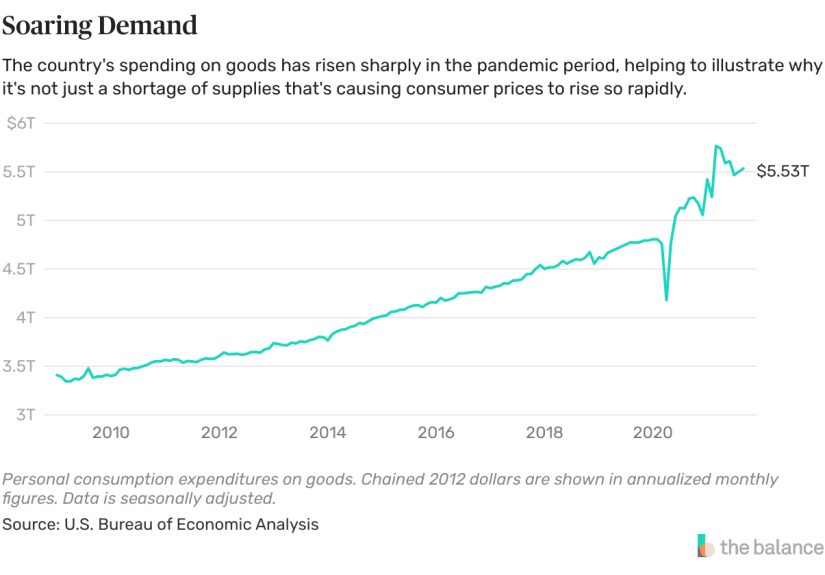
2) The Great Spending Swap: services down, goods up
When services were restrictedtravel, dining out, entertainment, in-person experienceshouseholds
redirected spending toward goods: home offices, furniture, electronics, home improvement supplies, cars,
hobby gear, and “I deserve this” purchases that arrived in very large cardboard boxes.
This wasn’t just a vibe; it was a measurable shift. When more spending piles into goods, the pressure
concentrates in industries that can’t instantly ramp production. Factories, ports, trucking, and
inventory systems don’t scale overnightespecially when the world is stressed at the same time.
3) Cheap-ish financing (and the habits it created)
For a stretch, borrowing costs were low enough to make big purchases feel “manageable” on a monthly payment.
That boosts demand for things typically financedcars, appliances, renovations. Even after rates rose,
the desire to “buy now before it gets worse” can keep demand stronger than expected.
4) Psychology: scarcity, FOMO, and “might as well”
Demand isn’t only about income. It’s also about expectations and behavior. When people see “limited stock,”
“backordered,” or “prices rising,” they rush purchases forward. That can create a feedback loop:
expected inflation increases today’s demand, which then increases today’s pricesconfirming the fear.
When Supply Can’t Keep Up, Demand Turns Into Higher Prices Fast
Demand alone doesn’t automatically create big inflation. The real fireworks happen when demand rises
while supply is constrained. Recent research on the pandemic-era inflation surge finds that supply
constraints and bottlenecks mattered a lotand that demand shocks interacting with those constraints
helped drive the takeoff in inflation.
Think of it like a restaurant with half the staff: even if the menu stays the same, a Friday-night crowd
will cause long waits. The restaurant can raise prices (or add a service fee) because the line itself
proves demand is strong. The economy had versions of that story across goods categories, and later in
services as reopening demand surged.
Category Examples: How Demand Shows Up in Real Price Spikes
Cars and big-ticket durable goods
Durable goods are especially sensitive to demand surges because production is complex and capacity is
capital-intensive. Add shortages of key inputs (like semiconductors) and shipping constraints, and
you get the perfect setup: buyers still want cars and appliances, but supply can’t match the pace.
That’s when demand translates into higher prices, markups, and fewer discounts.
Even after supply improves, demand can keep prices elevated through “new normals” in features, trim levels,
and financing terms. Translation: the cheapest options vanish first, so the average price paid rises.
Housing, rent, and the “shelter” heavyweight
Housing is where inflation gets personal. Shelter is a huge part of the consumer price basket, and it has
quirks. Market rents can move quickly, but measured shelter inflation can lag because many leases reset
annually and because official measures include owners’ equivalent rent, which estimates what homeowners
would pay to rent their own homes.
Demand plays a starring role here: when more households try to rent or buy at the same timebecause of
migration, household formation, work-from-home shifts, or lifestyle changesprices rise. And because housing
supply is slow to expand, demand can outpace supply for long stretches.
Travel, restaurants, and the “services snapback”
When services reopened, many people tried to make up for lost timeliterally. Flights, hotels, concerts,
and dining were suddenly back, and demand surged. Unlike goods, services depend heavily on labor and capacity
constraints (you can’t “manufacture” extra hotel rooms by next Tuesday).
When demand hits a service capacity ceiling, you see surge pricing, fewer deals, and higher baseline prices.
If you’ve ever paid “holiday weekend” rates on a random Thursday, you’ve met the demand curve in person.
Food and energy: where demand mixes with global shocks
Food and energy prices can jump for reasons beyond domestic demandweather, global commodity markets,
geopolitical shocks. But demand still matters at the margin. When consumers keep buying and substitution
options are limited, price increases stick longer.
Restaurants are a clean example: higher demand plus higher wages plus higher input costs can push menu prices
up, and diners may still pay because eating out is partly a “treat” category. When demand remains steady,
prices don’t feel pressure to retreat.
Insurance, repairs, and “the sneaky categories”
Some of the most frustrating price increases come from categories that don’t feel optional: auto insurance,
home insurance, repairs, medical services. Demand matters here tooespecially when more people drive,
travel, buy cars, renovate homes, or file claims. Higher demand for services can collide with limited skilled
labor, making price increases stubborn.
Why Businesses Raise Prices When Demand Is Hot
When demand is strong, businesses learn something valuable: customers will keep buying at a higher price.
That’s not a moral judgement; it’s just market feedback.
In high-demand periods, companies also face practical incentives:
- Inventory management: higher prices slow demand just enough to prevent sellouts.
- Capacity rationing: when supply is limited, price helps allocate scarce goods or time slots.
- Margin rebuilding: after a shock, firms may restore margins to buffer future uncertainty.
- Wage and rent realities: even if shipping costs fall, labor and leases may remain higher.
That’s why demand-led inflation often feels like it spreads. It doesn’t stay confined to one product.
Once demand is broadly strong, pricing power becomes contagious.
So Is It “Demand” or “Supply”? The Answer Is: Yes.
If you’re hoping for a single villain, inflation is going to disappoint you. Supply constraints
absolutely matteredespecially early on. But demand often provided the gasoline, and constrained supply
provided the match.
A useful way to think about it: demand explains why price increases were broad, while
supply explains why some categories spiked violently. In many markets, demand and supply
issues overlapped and amplified each other.
Research that decomposes inflation into demand- and supply-driven components often finds that demand played
a large role in the overall rise, even while acknowledging that some famous categories (like cars) had
meaningful supply-driven dynamics too. The point isn’t to argue over a single causeit’s to recognize that
strong spending can keep prices elevated even after bottlenecks start easing.
What Could Bring Price Pressure Down?
If demand helped push prices up, then cooling demand (or increasing supply) helps bring inflation down.
That’s the basic logic behind higher interest rates: they make borrowing more expensive, reduce some
spending, and give supply time to catch up.
But “cool demand” isn’t a cozy strategyit can mean slower growth and fewer jobs if taken too far.
That’s why central banks aim for a “soft landing”: reducing inflation without breaking the labor market.
It’s a tricky balancing act, not a video game slider.
Over time, several forces can help:
- Supply recovery: production and logistics normalize, inventories rebuild.
- Demand normalization: spending shifts back from goods spikes to steadier patterns.
- Expectations stabilize: fewer “buy now” rushes, more predictable pricing behavior.
- Productivity gains: more output per worker can ease price pressure without a demand slump.
Practical Ways to Cope With High Prices (Without Becoming a Spreadsheet Hermit)
You can’t personally lower aggregate demand (unless you cancel the entire economy, which is frowned upon).
But you can reduce how much high-demand pricing hits your budget.
Use timing as a discount
When demand spikes seasonallyholidays, back-to-school, travel peaksprices often follow. If you can shift
purchases or trips by a few weeks, you sometimes get a meaningful savings without sacrificing quality.
Swap brands, not joy
Store brands and “good enough” alternatives are underrated inflation fighters. If demand has pushed up
premium products, the value tier often stays more stableespecially for groceries and household basics.
Watch the “quiet drains”
Subscription creep is real. When prices rise broadly, small monthly charges add up faster than you expect.
A quick cleanup can offset a chunk of inflation without changing your daily routine.
Negotiate what’s negotiable
Many people don’t realize how many bills are flexible: internet plans, some insurance premiums,
even medical billing arrangements. In a high-price era, asking once is basically a budget strategy.
Bonus: of Real-World Experiences With “Demand for Stuff”
If you want to understand demand-driven price pressure, don’t start with a chartstart with a story
you’ve probably lived (or heard a dozen versions of). It often begins with a simple plan: “We’ll upgrade
the home office,” “We’ll replace the car,” “We’ll finally take that trip,” or “Let’s get a new couch
because the old one squeaks like a haunted ship.” Multiply that plan by millions of households making
similar decisions, and you get the most polite stampede in modern history.
The first experience many people remember is the sold-out phenomenon. You’d browse a website,
see something in stock, go make coffee, come back, and it was gone. That’s not just inconvenienceit’s
demand communicating to sellers that the current price is too low to balance the crowd. The next step is
predictable: fewer promotions, longer delivery times, and price increases that feel suspiciously timed
with the words “Only 2 left.”
Then comes the substitution game. When the exact item you want becomes expensive or unavailable,
you shift to the next best option. But so does everyone else. A midrange product suddenly becomes the
“smart pick,” demand floods it, and the “smart pick” becomes the “still-expensive pick.” That pattern
showed up in everything from laptops to patio furniture to carsespecially when inventories were thin.
In real life, it felt like shopping became competitive, even when nobody said it out loud.
Another common experience: the price of convenience rises first. Delivery fees, quick shipping,
premium seating, last-minute bookingsthese are basically demand meters. When demand is high, convenience
gets priced like a luxury. People notice it most with travel and events: the same flight on a different
day costs wildly more, or a hotel rate changes between lunch and dinner. That’s demand meeting limited
capacity, and pricing reacting in real time.
High demand also shows up in services bottlenecks. Need a contractor? The schedule is booked.
Need a repair? The earliest appointment is “sometime after the heat death of the universe.” Even when
the materials cost cools, the service price can stay elevated because the scarce resource isn’t the
productit’s time and skilled labor. When enough households decide to renovate, repair, or upgrade,
the calendar itself becomes a supply constraint.
And finally, there’s the experience nobody enjoys: the “new normal” receipt. You adapt, then
you forget you adapted. The first time you pay the higher price, it’s shocking. The tenth time, it’s
irritating. The fiftieth time, it’s just the priceand that’s how high prices become sticky. Demand doesn’t
have to stay at emergency levels for prices to remain higher. It only has to stay strong enough that
sellers don’t feel pressure to retreat.
Conclusion: High Prices Follow Crowds, Not Just Crises
Supply problems helped create the original squeeze, but demand helped turn that squeeze into broad,
persistent price pressure. When households and businesses want more goods and services than the economy
can quickly provide, prices risesometimes quickly, sometimes stubbornly, often in ways that feel personal
because they hit everyday categories.
The good news (yes, there’s good news): understanding demand makes inflation less mysterious. High prices
aren’t only about broken supply chains or abstract policy debates. They’re also about a simple reality:
when everyone wants the same stuff at the same time, the price tag notices.





 Close
Close