Table of Contents >> Show >> Hide
Every few weeks, the internet coughs up the same recycled hot take: “Gay people didn’t exist back then.”
Which is a little like saying, “Gravity was invented in 1687, and before Newton, everyone just… floated politely.”
People who loved people of the same sex have existed for as long as people have existed. What has changed is
what societies called it, how openly people could live it, and whether history bothered to keep the receipts.
That’s why this kind of post goes viral: someone gathers a stack of imagesportraits, newspaper clippings, protest photos,
candid snapshots, museum objectsand suddenly the “they’re new” myth starts wheezing like an old laptop trying to run 47 browser tabs.
The point isn’t that every era used the word “gay” (they didn’t). The point is that same-sex love, desire, partnership,
and gender diversity are not modern inventions. They’re human ones.
Why the “They Never Existed” Myth Won’t Die
1) People confuse labels with lives
“Gay,” “lesbian,” “bisexual,” and “transgender” are modern identity terms in the way “smartphone” is a modern term.
That doesn’t mean people didn’t communicate before smartphones. It means the category and the word came later.
Earlier generations may have used different language, lived more quietly, or understood themselves through culture, religion, class,
and family roles instead of identity labels.
2) Records were destroyed, hidden, or never created
When societies punish something, people stop documenting it openly. Love letters get burned. Diaries get edited.
Photographs get tucked into boxes with vague labels like “friends,” because that was safer for everyone involved.
Sometimes the only “official” documentation left is the ugly stuff: police reports, employment investigations, moral panics.
It’s not that LGBTQ people were missingit’s that history often tried to make them disappear.
3) We’ve been trained to read the past through a straight-only filter
If you’ve ever watched two men in an old photo holding hands and heard someone insist, “They were just roommates,”
congratulations: you’ve met the Straight Translator™. In reality, historians use contextnotes on the back of photos,
how people posed, where the image came from, and what else we know about their lives. Sometimes a picture is ambiguous,
and that’s okay. Ambiguity isn’t proof of straightness; it’s proof that real life isn’t a caption contest.
What Counts as “Proof” When History Tried to Hide It
“Proof” doesn’t have to mean a celebrity press release or a rainbow-flag parade (though we love a parade).
It can be a portrait in a national collection. A museum object describing a same-sex relationship. A book of private photos
that survived despite risk. A protest image captured because people finally decided visibility was worth it.
A federal archive documenting both service and discrimination. When you put enough of those together, the picture is loud and clear:
LGBTQ people have always been here.
The 31-Pic Tour: What Those Receipts Tend to Look Like
Below is a “guided tour” of the kinds of images that show up in these viral collections. Some come from museums and archives,
some from family albums, and some from public events once cameras could safely point at the truth. Think of it as 31 snapshots
across time saying, “Hi. We didn’t just arrive. We’ve been waiting for you to notice.”
-
An ancient face with a modern headline:
A museum object identifying Antinous as the beloved of Roman emperor Hadrianevidence that same-sex relationships were known,
discussed, and memorialized in art, not invented by cable TV. -
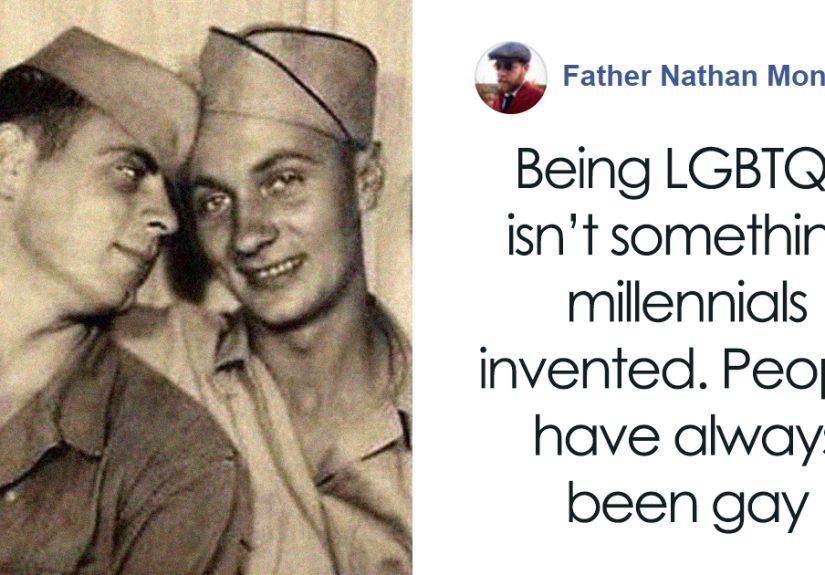
A photobooth strip from the early 1900s:
Two men leaning in, relaxed and affectionatecaptured without a photographer, because privacy was part of the love story. -
A book of “we existed” photos:
A curated collection like Loving, built from images spanning roughly the mid-1800s to the mid-1900shundreds of visual reminders
that romance didn’t start last Tuesday. -
A studio portrait with a handwritten note:
Names, dates, and a location scribbled on the backsmall, ordinary details that turn “maybe friends” into “these were people with a bond.” -
Uniforms and intimacy:
Military snapshots where affection slips past the era’s rulesbecause humans don’t pause love during wartime. -
A protest photo from the 1960s–70s:
Signs, suits, and nerves of steelimages that show LGBTQ people organizing long before it was trendy or safe. -
A Pride march that looks… surprisingly familiar:
Crowds, banners, joy, tensionproof that public LGBTQ community life is decades older than a corporate June logo. -
A portrait of an LGBTQ figure in a national collection:
Writers, artists, activists, and leaderskept in major libraries and archives because their impact is part of American history. -
Walt Whitman and Peter Doyle, documented together:
One of those “history has photos” moments that stops the conversation cold when someone says “there’s no evidence.” -
Bayard Rustin photographed during the civil rights era:
A reminder that LGBTQ history and civil rights history overlap constantlyoften in the same person. -
A newspaper clipping that tries to shameyet preserves the truth:
Sometimes the past documented queer life while wagging a finger. The finger is irrelevant; the documentation matters. -
A federal record that proves both presence and persecution:
Archives showing LGBTQ Americans working in government serviceand also being targeted during moral panics. -
“Lavender Scare” evidence:
Paper trails of people fired or blocked from jobsnot because they didn’t exist, but because they existed loudly enough to be feared. -
A bar interiordim lights, brighter courage:
Photos of social spaces where LGBTQ people could breathe, even when laws and police raids said otherwise. -
Stonewall-era street scenes:
Images and accounts of resistance sparked by police harassmentbecause a community can only be pushed so far. -
A six-day eruption captured in memory and media:
Documentation of the Stonewall uprising as a turning pointproof that modern movements grew from decades of earlier struggle. -
Harlem drag ball glamour:
Pageantry, competition, and communityroots reaching back to the late 1800s and growing into ballroom culture later on. -
Hamilton Lodge ball references:
Records and write-ups showing organized drag balls with diverse crowdsevidence of thriving queer scenes, not isolated “exceptions.” -
Thousands of spectators by the 1930s:
When events draw crowds, that’s not “no one existed”that’s “a lot of people existed, and they showed up dressed to win.” -
Black queer Harlem Renaissance history:
Stories and documentation that highlight LGBTQ life among major cultural figuresbecause creativity and identity have always mingled. -
A museum story explicitly naming queer presence in a movement:
Institutional recognition that queer people shaped American art, music, and literaturenot footnotes, but contributors. -
Two-Spirit education and community history:
Resources explaining Indigenous concepts of gender diversity and the modern “Two-Spirit” termproof that gender variation isn’t new either. -
The origin story of “Two-Spirit” (1990):
Images and documentation showing the term’s community-based creationbecause language evolves to honor lived reality. -
An activist flyer or poster:
Ephemera that survived because people saved itquiet evidence that movements existed between the headlines. -
AIDS memorial imagery:
Quilt panels, vigils, marchesproof of love and loss recorded publicly when silence became unbearable. -
Early LGBTQ organizational photos:
Meetings, newsletters, group portraitsbecause community builds infrastructure, not just vibes. -
Archives of Pride documentation (e.g., 1970s parade photography):
Collections preserved specifically so nobody can pretend it didn’t happen. -
“Friends” who lived together for decades:
Household photos with shared domestic lifesometimes labeled vaguely, sometimes notshowing partnership even when the law refused it. -
Portraits of gender-nonconforming people in period dress:
Not a modern “trend,” but a recurring human realitycaptured whenever cameras and communities allowed it. -
Public recognition by major institutions:
Library and museum curation of LGBTQ subjectsbecause mainstream history is finally making room for what was always true. -
The most powerful “pic” of all:
A family photo where someone is clearly lovedbecause the simplest proof is ordinary life continuing, even under pressure.
So What Should We Do With This Proof?
First, stop arguing about whether LGBTQ people “existed” and start talking about how they were treated, what they created,
and what they had to risk just to live. Second, recognize the difference between “identity language” and “human reality.”
Third, support archivespublic libraries, museums, community historical societiesbecause memory is a muscle, and erasure is a workout plan.
Finally: if you’re the person who shares the 31-photo thread, congratulations. You’re not “rewriting history.”
You’re un-deleting it.
: The Lived Experience of Being Told You “Didn’t Exist”
For many LGBTQ people, the “you didn’t exist back then” claim doesn’t land like a quirky debate prompt. It lands like an eviction notice
from reality. The subtext is rarely neutral: if you’re “new,” then you’re “optional.” If you’re “just a phase,” then your rights can be treated
like a temporary subscription someone forgets to renew.
People describe hearing it at family gatherings, usually right after someone asks why you’re still singlefollowed by a speech about how
“in our day, there wasn’t any of this.” Translation: “In our day, people hid.” The emotional whiplash is real. You’re expected to be invisible
for everyone else’s comfort, then blamed for the absence that invisibility created. It’s like being told, “Nobody in this town ever ate pizza,”
by someone who outlawed cheese.
In classrooms and workplaces, it can show up as a softer, more polished version: “There’s just not enough historical evidence.”
That’s when the archive work becomes personal. Someone goes lookingmaybe out of curiosity, maybe out of survivaland finds a photograph
captioned with two names, a date, and an intimacy that feels unmistakably familiar. The first reaction isn’t always triumph; sometimes it’s grief.
Grief for the years spent believing you were alone in time. Grief for the people in the photo who had to be careful with their affection.
Others talk about the strange tenderness of recognizing themselves in small details: a hand resting on a shoulder in a posed portrait;
a pair of matching rings; a coded phrase in a letter; a community event that looks like a modern gathering, just with different haircuts
and a lot more risk. The past becomes less like a museum and more like a family album you were never shown. You realize that what you’re
experiencing isn’t an exceptionit’s part of a lineage.
And then there’s the anger: not explosive, but clarifying. Because once you see the receipts, you see the patternhow often society tried to erase,
how often communities rebuilt, and how much courage it took to leave even a single photo behind. A photobooth strip might look casual, but in certain
decades it was a quiet act of defiance. A march photo might look celebratory, but it was also a declaration: “We are not going back into the margins.”
That’s why these image collections matter beyond the comment section. They don’t just “win” an argument. They restore continuity.
They give people permission to feel rooted. They turn isolation into inheritance. And for anyone still tempted to say “this is new,”
the most honest response is simple: nowhat’s new is that you’re finally seeing it.
Conclusion
The idea that “gay people never existed until now” collapses the moment you look at actual recordsmuseum descriptions, national archives,
library collections, community photo repositories, and the private snapshots that survived despite real danger. You don’t need mythology.
You need eyes, context, and a willingness to accept what the past has been trying to tell us for a long time:
LGBTQ people have always been herecreating, loving, organizing, and leaving proof behind.