
Table of Contents >> Show >> Hide
- What “AI Aversion” Really Means (And Why Marketers Should Care)
- Why AI-Generated Marketing Assets Can Underperform (Research Patterns)
- The Flip Side: People Also Appreciate Algorithms (Yes, Really)
- A Research-Backed Playbook: How to Use AI Without Tanking Engagement
- Step 1: Assign AI the right job (hint: not “be the brand”)
- Step 2: Build a “human-in-the-loop” pipeline (or enjoy your chaos)
- Step 3: Raise your quality bar (AI makes mediocre easier)
- Step 4: Design for trust signals, not “AI vibes”
- Step 5: Be transparent when it matters (and strategic when it doesn’t)
- Step 6: Governance is not boringit’s what prevents a brand incident
- Practical Examples: AI That Helps Engagement (Instead of Punching It in the Face)
- Quick Decision Table: What to Automate vs. What to Humanize
- The “Don’t Trigger Aversion” Checklist (Print This, Tape It Somewhere)
- Conclusion: Use AI Like a Power Tool, Not a Personality
- Field Notes (): What Actually Happens When You Ship AI Marketing Assets
AI can crank out marketing assets faster than a caffeinated intern with three monitors. Ads. Emails. Social posts. Landing pages. Product images.
If your team is even thinking about generative AI, someone has already asked, “Cool… but will people hate it?”
Here’s the uncomfortable truth: people don’t just judge your creative. They judge your intent. If your audience suspects “this was made by a robot because the brand couldn’t be bothered,” engagement dropssometimes quietly (lower click-through), sometimes loudly (comments that start with “this is giving… AI”).
That reaction has a name in research circles: aversion.
The good news: aversion isn’t a life sentence. It’s a design constraintlike mobile screens, ad fatigue, or the fact that nobody reads your “About Us” page (sorry).
This guide breaks down why AI-made assets can backfire and exactly how to use AI in a way that improves performance without triggering the authenticity alarm.
What “AI Aversion” Really Means (And Why Marketers Should Care)
In decision science, algorithm aversion describes how people lose trust in algorithms after seeing them make mistakeseven when the algorithm is still statistically better than humans.
In marketing, the same psychology shows up as: “If this looks even slightly off, I’m out.”
1) People punish machine mistakes harder than human mistakes
If a human designer crops a logo weirdly, people might shrug. If an AI image has “mystery fingers,” people act like your brand committed a felony.
The emotional penalty is bigger because the audience assumes the mistake is systemic (“the brand is spamming with machines”), not situational (“someone had a rough Monday”).
2) “Authenticity tax” is real
Consumers routinely describe suspected AI marketing as annoying, boring, confusing, or simply “not for me.”
They may not articulate it as a research term, but the vibe is: less human, less trustworthy, less worth my attention.
3) Aversion hits engagement where it hurts: memory + motivation
Marketing isn’t just “was it pretty?” It’s “did it stick?” When content feels generic or uncanny, it can create cognitive frictionpeople spend effort decoding weirdness instead of absorbing your message.
Translation: fewer conversions, weaker brand recall, and a comment section full of comedians who work for free.
Why AI-Generated Marketing Assets Can Underperform (Research Patterns)
The “negative halo” effect: the creative drags the brand down
When audiences sense AI involvement, they can rate the ad as less engaging and the brand as less likableespecially when the creative feels templated or odd.
Even “high-quality” AI assets can struggle if they don’t map to recognizable human storytelling cues (tone, pacing, emotional specificity).
Personalization expectations are higher than ever
AI is often sold as personalization magic. Ironically, the moment people expect personalization (products, recommendations, messages “for me”), they become more sensitive to anything that feels mass-produced.
If your “personalized” email reads like a horoscope written by a spreadsheet, that’s not personalizationthat’s a betrayal.
Trust is already fragile online
Audiences are living in a content ecosystem full of deepfakes, fake reviews, and questionable “testimonials.” That makes them quicker to doubt what they see.
If your AI workflow creates anything that looks misleadingespecially around claims, endorsements, or reviewsyou’re not just risking engagement. You’re risking compliance.
The Flip Side: People Also Appreciate Algorithms (Yes, Really)
Here’s the part marketers miss when they panic: research also shows algorithm appreciation under the right conditions.
People like AI when it’s clearly competent and the task doesn’t feel deeply personal. In other words:
- Useful + accurate + low emotional stakes → AI feels like a superpower.
- High identity stakes + “this should understand me” → AI feels like an impostor.
This is your strategic unlock: choose where AI leads, where humans lead, and where you blend them.
Don’t use AI as a substitute for taste, empathy, or brand spine. Use it as a multiplier for speed, variation, and iteration.
A Research-Backed Playbook: How to Use AI Without Tanking Engagement
Step 1: Assign AI the right job (hint: not “be the brand”)
AI is great at:
- Generating options (headlines, hooks, subject lines, ad variants)
- Summarizing and restructuring (turning a whitepaper into snackable assets)
- Localization and adaptation (tone tweaks, regional phrasing, format changes)
- Helping teams move faster through “blank page” moments
AI is risky at:
- Making factual claims without verification
- Speaking for real people (testimonials, reviews, “customer stories”)
- Anything where the audience expects earned authenticity (community, social causes, sensitive topics)
Step 2: Build a “human-in-the-loop” pipeline (or enjoy your chaos)
High-performing teams treat AI like a production line with checkpoints:
- Strategy (human): audience, offer, angle, proof, constraints
- Drafting + variation (AI): lots of versions, fast
- Craft (human): voice, specificity, emotional truth, brand fit
- Verification (human + tools): facts, claims, compliance, rights
- Testing (data): A/B, holdouts, creative diagnostics
The point isn’t to “hide AI.” The point is to ensure the output still feels like your brandnot “a brand.”
Step 3: Raise your quality bar (AI makes mediocre easier)
AI increases volume. Volume increases the odds you publish something “almost fine.”
And “almost fine” is how engagement diesquietly, week by week, until your team starts blaming the algorithm, the audience, or Mercury retrograde.
Use a quality checklist before anything ships:
- Specificity: Does it include real details, not generic adjectives?
- Voice: Would a loyal customer recognize this as you?
- Visual sanity: Any uncanny artifacts, weird hands, impossible shadows, nonsense text?
- Claim integrity: Can you prove every measurable statement?
- Human warmth: Does it sound like a person trying to help a person?
Step 4: Design for trust signals, not “AI vibes”
Trust signals are the small cues that say “real people care about this”:
- Customer photos and quotes that are verifiably real
- Behind-the-scenes content (process > polish)
- Named authors and accountable voices
- Clear sourcing and non-sleazy claims
- Consistent brand standards (fonts, tone, positioning)
If you’re using AI for visuals, favor brand-safe creativity over “look what the model can do.”
A stable identity beats a novelty jackpot.
Step 5: Be transparent when it matters (and strategic when it doesn’t)
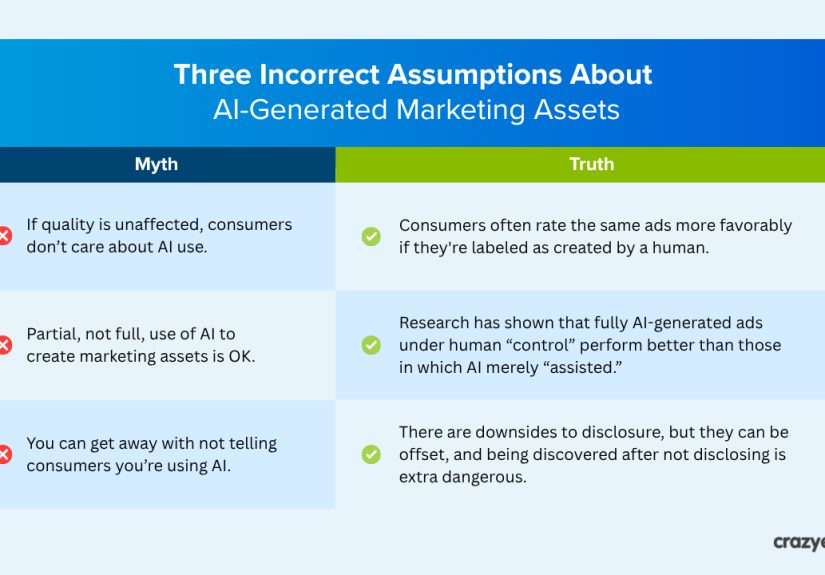
Transparency isn’t one-size-fits-all. You don’t need a flashing banner saying “THIS EMAIL WAS BROUGHT TO YOU BY ROBOTS.”
But you do need transparency where consumers expect it: edited images, synthetic media, political/social claims, and anything that could mislead.
A practical approach:
- Low-risk assets (headline variants, layout drafts): internal AI use, no public disclosure needed.
- Public-facing synthetic media (AI video, AI people, altered photos): use clear labeling and provenance where possible.
- Reviews/testimonials/endosrements: don’t generate them. Ever. Not even “as a starting point.”
Step 6: Governance is not boringit’s what prevents a brand incident
The fastest way to hate AI is to let it run wild until something blows up.
Instead, write down your rules like a grown-up:
- Approved tools list (and where data goes)
- Brand voice guidelines + examples
- Prohibited use cases (testimonials, sensitive targeting, medical/legal claims)
- Review workflow (who approves what)
- Disclosure standards for synthetic or edited media
Governance doesn’t slow you down. It stops you from “moving fast and apologizing on LinkedIn.”
Practical Examples: AI That Helps Engagement (Instead of Punching It in the Face)
Email: Subject-line factories, human-picked winners
Use AI to generate 25 subject lines across different psychological hooks (curiosity, urgency, benefit, social proof).
Then have a human pick 5 that match brand voice and run an A/B test. You’ll get speed and taste.
Paid social: High-velocity creative testing without “slop”
AI is perfect for quickly exploring angles: “save money,” “save time,” “feel confident,” “avoid risk.”
But don’t auto-publish 100 variants. Curate to a tight set, ensure visual quality, and keep message consistency.
The goal is experimentationnot a content flood.
Landing pages: AI drafts, human clarity
Have AI draft multiple layouts and value-prop options. Then humans do what humans do best:
cut fluff, add proof, simplify language, and make it feel like a helpful conversation.
Bonus: AI can also generate “FAQ objections” based on customer support logsthen you answer them with real information.
Short-form video: AI assists, humans star
Use AI for scripts, shot lists, captions, hooks, and cut-down variations.
Keep the on-camera voice human whenever possible. People follow people, not production pipelines.
Quick Decision Table: What to Automate vs. What to Humanize
| Asset | Where AI Helps | Human Must Own | Main Risk |
|---|---|---|---|
| Ad headlines | High-volume variants | Brand voice + truthfulness | Generic claims |
| Product images | Backgrounds, resizing, iterations | Realism, ethics, labeling | Uncanny visuals |
| Testimonials | Almost nothing | Everything | Deception/compliance |
| Landing pages | Draft structure + sections | Clarity + persuasion + proof | Overpromising |
| Social captions | Format + punchy options | Personality + community tone | “Impersonal brand” vibe |
The “Don’t Trigger Aversion” Checklist (Print This, Tape It Somewhere)
- Does it feel specific? Add real details: numbers, scenes, customer language, concrete benefits.
- Is the visual clean? No uncanny artifacts, nonsense typography, or “AI texture.”
- Is it honest? Verify claims, avoid fake endorsements, don’t manufacture social proof.
- Is it on-brand? Voice, positioning, and values are consistent across channels.
- Did you test it? Don’t assumemeasure. Small tests save big budgets.
- Do you have guardrails? Tools list, approvals, and disclosure rules.
Conclusion: Use AI Like a Power Tool, Not a Personality
AI can absolutely help you create marketing assets fasterand sometimes betterif you design around human psychology.
The audience isn’t anti-technology. They’re anti-being-treated-like-a-metric.
When your creative feels lazy, generic, or misleading, aversion kicks in and engagement drops.
When your creative feels useful, accurate, and human-centered, AI becomes invisiblein the best way.
So don’t ask, “Should we use AI?” Ask: Where does AI multiply our best work, and where does it dilute trust?
Answer that well, and you get the upside (speed, scale, iteration) without paying the hidden tax (annoyance, skepticism, weaker recall).
Field Notes (): What Actually Happens When You Ship AI Marketing Assets
Let’s talk about the stuff nobody puts in case studies because it’s slightly embarrassing and also extremely educational.
The first time most teams “go AI,” they do the obvious thing: generate a bunch of assets, admire the speed, and publish.
Then two things happen. First, performance is… fine. Not great. Second, someone in the comments says, “Is this AI?” and suddenly everyone in the building forgets how to breathe.
The panic is usually disproportionate to the actual damage, but it reveals something important: brands want AI to be a secret weapon, while audiences want it to be a responsible tool.
One team I worked with ran AI-generated social captions for a month. Engagement didn’t collapseit just got weirdly flat.
The captions were grammatically perfect and emotionally hollow. The brand voice had always been a little playful, and the AI copy was “playful” the way a tax form is “interactive.”
The fix wasn’t banning AI. We created a short voice guide: three things the brand always says, three things it never says, and a list of customer phrases pulled from reviews and support tickets.
After that, AI drafts got 60% of the way there, and humans took the last 40%which is the expensive, valuable part anyway.
Visuals are where teams learn humility. AI can produce stunning imagesand also a background sign that reads “SPECLAL OFFAR.”
The lesson: AI is not a final designer; it’s a concept generator. We started treating AI images like rough comps.
Human designers either retouched them heavily or used them as inspiration for clean, brand-correct visuals.
The surprising upside? The team explored more concepts than ever, then shipped fewer, better assets.
The biggest “oh no” moment is almost always compliance-adjacent.
Someone asks the model to “make 10 testimonial options,” because they mean “find the right structure.”
But the output reads like real people said real things, and now you’ve created fake social proof. That’s not marketing. That’s a future screenshot in a regulatory presentation.
We banned AI-generated testimonials outright and replaced them with a workflow: pull real quotes, anonymize when needed, verify consent, and let AI help edit for brevity without changing meaning.
The best results came when teams used AI for what it’s best at: iteration and adaptation.
One ecommerce brand used AI to produce 30 ad variants per product launch (different benefits, different objections, different tones).
Humans curated 8, launched tests, and fed results back into the next prompt cycle.
CTR improved, but the bigger win was operational: the team stopped arguing over opinions and started arguing over data.
That’s the healthiest kind of argument. It ends with better creative and fewer meetings that could’ve been an email.
If you take one thing from these field notes, make it this: audiences don’t hate AI.
They hate content that feels careless. When AI helps you be more relevant, more consistent, and more helpful, engagement rises.
When AI helps you be louder, cheaper, and more generic, aversion shows upright on schedule.







 Close
Close