Table of Contents >> Show >> Hide
- The Main Federal Law: The Fair Labor Standards Act
- What Counts as Not Paying Employees?
- Federal Law Is Only the Floor, Not the Ceiling
- Final Paycheck Laws: The State-Law Trap Door
- Illegal Deductions and Tip Games Are Not Clever
- Retaliation Is Also Illegal
- What Penalties Can Employers Face?
- How Employees Usually Enforce Their Rights
- Real-World Examples of Wage Nonpayment
- on Real Experiences With Unpaid Wages
- Conclusion
If payday at your company feels like a suspense thriller, that is not “startup energy.” That is a legal problem. In the United States, employers generally cannot just shrug, delay payroll, ignore overtime, or decide that post-shift cleanup, training, or “just a few quick emails” somehow happened in a magical law-free zone. There are federal laws against not paying employees, and many states pile on even more rules, more penalties, and, in some places, more pain for employers who try to play hide-and-seek with wages.
The short version: not paying employees can violate federal wage-and-hour law, state wage payment laws, final paycheck laws, anti-retaliation rules, and sometimes criminal statutes. The longer version is where things get interesting, because the answer depends on what was not paid, when it was due, how the worker was classified, and which state is involved. So let’s untangle the payroll spaghetti.
The Main Federal Law: The Fair Labor Standards Act
The biggest federal rule in this area is the Fair Labor Standards Act (FLSA). It is the core federal law that sets minimum wage, overtime, and recordkeeping standards for many employees in the private and public sectors. If an employer fails to pay for hours worked, fails to pay at least the required minimum wage, or ducks overtime for covered nonexempt employees, that can trigger an FLSA violation.
Minimum wage violations
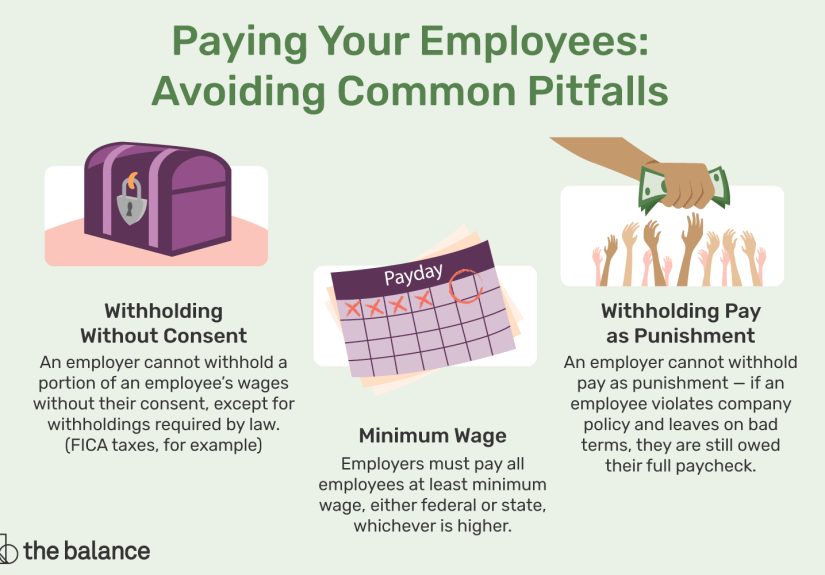
At the federal level, covered nonexempt workers generally must be paid at least the federal minimum wage for all hours worked. That sounds simple until an employer starts making unlawful deductions, forcing off-the-clock work, shaving time, or paying a flat amount that effectively drops the worker below minimum wage. Suddenly, “We paid something” is not much of a defense.
Overtime violations
The FLSA also requires overtime pay for covered nonexempt employees who work more than 40 hours in a workweek. The usual rule is time-and-a-half of the regular rate. That means an employer cannot legally avoid overtime by saying things like:
- “We don’t approve overtime, so we don’t pay it.”
- “You’re salaried, so no overtime for you,” even when the exemption rules are not actually met.
- “Clock out, then finish closing the store.”
- “Just answer a few customer messages after hours. Be a team player.”
If the employer knew or should have known the work was happening, the time may still count. Payroll law is not impressed by motivational speeches.
Hours worked is broader than many employers think
One reason unpaid wage disputes happen so often is that “hours worked” is broader than people expect. In many situations, compensable time can include prep work, required training, certain waiting time, required travel between job sites, post-shift cleanup, and work an employer “suffers or permits” even if it was not formally approved. So when employees are told to be “helpful” before clocking in or after clocking out, that can become a wage theft issue fast.
What Counts as Not Paying Employees?
When people hear “not paying employees,” they often picture a boss who vanishes on payday wearing sunglasses and bad decisions. That happens. But the law covers a wider set of problems, including:
- Not paying regular wages on time
- Failing to pay the minimum wage
- Not paying overtime
- Requiring off-the-clock work
- Making illegal deductions
- Improperly withholding tips or commissions
- Delaying a final paycheck
- Misclassifying employees as independent contractors
- Failing to pay for accrued vacation or final compensation when state law requires it
That last point matters a lot. A company may think, “We didn’t steal wages; we just labeled everyone a contractor.” The law may respond, “Cute. Now pay the back wages.” Misclassification is a major issue because workers wrongly labeled as independent contractors may be denied minimum wage, overtime, and other protections.
Federal Law Is Only the Floor, Not the Ceiling
Here is where many employers get tripped up: the FLSA is often the starting point, not the whole story. States can create stricter wage laws, higher minimum wages, tighter pay-frequency rules, faster final paycheck deadlines, stronger notice requirements, and bigger penalties. When federal and state law both apply, the rule that is more protective of the employee often wins.
That means a business can be technically compliant with one rule and still violate another. A federal lawyer might say, “The FLSA doesn’t require immediate final payment,” while a state labor agency might say, “That is lovely, but our law does.” Welcome to payroll law, where the map is federal and the potholes are local.
Final Paycheck Laws: The State-Law Trap Door
One of the most common unpaid wage fights involves the last paycheck. Federal law generally does not require former employees to receive their final paycheck immediately. But many states do regulate the timing of final wages, and some are much stricter than others.
California: strict and not feeling sentimental
California is famous for tough final paycheck rules. If an employee is discharged, final wages are generally due at the time of termination. If the employee quits without notice, wages are generally due within 72 hours. If the employee gives at least 72 hours’ notice, the wages are generally due at quitting. California can also impose waiting-time penalties when final wages are willfully late, and those penalties can add up quickly.
Washington: next regular payday still means the next regular payday
Washington’s approach is different but still clear: if an employee quits or is fired, the final paycheck generally must be paid on or before the next regularly scheduled payday. Employers also cannot hold that paycheck hostage because the worker did not turn in keys, tools, uniforms, or some other piece of workplace treasure.
Massachusetts: get it right on the way out
Massachusetts is another state employers should not treat casually. In most circumstances, an employee who is fired should be paid in full on the day of discharge. That is not a suggestion. It is more like a legal flashing red light.
New York, Texas, Illinois, New Jersey, and beyond
Other states also regulate wage timing, deductions, final compensation, and complaint procedures. New York enforces claims for unpaid wages, withheld wages, illegal deductions, and tip-related violations. Texas gives workers a wage claim process, but timing matters because a claim generally must be filed within a specific window. Illinois regulates how often wages must be paid and can impose additional damages and penalties when final compensation remains unpaid. New Jersey also provides an official complaint process for underpaid or unpaid wages. In plain English: if a company thinks “We’ll sort it out later” is a payroll policy, the state labor department may have some feedback.
Illegal Deductions and Tip Games Are Not Clever
Some employers do not flat-out refuse to pay. Instead, they get “creative.” They dock pay for register shortages, broken dishes, uniforms, customer walkouts, equipment, or vague “administrative costs.” Whether those deductions are lawful depends heavily on federal and state law, but many deductions are restricted or prohibited, especially if they cut into minimum wage or final compensation.
Tip-related violations are another frequent mess. Taking employee tips improperly, forcing illegal tip practices, or using tip credits incorrectly can turn an ordinary payroll dispute into a full-blown wage-and-hour problem. States like New York explicitly enforce rules against taking illegal kickbacks from wages and appropriating tips. So no, “shared team culture” does not mean management gets the tip jar.
Retaliation Is Also Illegal
Here is an important point employees often miss: the law does not just prohibit unpaid wages. It also prohibits retaliation when workers complain about pay. Under federal law, employees are protected when they file a complaint, cooperate with an investigation, or raise wage concerns, including oral complaints in many circumstances.
That means an employer can create another legal problem by firing, demoting, threatening, cutting hours, or otherwise punishing a worker for asking where their money is. In many wage cases, the original nonpayment is ugly enough. Adding retaliation is like stepping on the gas while driving toward a courtroom.
What Penalties Can Employers Face?
The answer depends on the law, the facts, and the state, but employers who do not pay employees can face a pretty expensive stack of consequences.
1. Back wages
The most obvious remedy is back pay or back wages: the money that should have been paid in the first place. Simple, direct, and often the first item on the bill.
2. Liquidated damages
Under the FLSA, employees may be able to recover an equal amount in liquidated damages on top of the unpaid wages in litigation or private suits. That means the unpaid wage amount can effectively double. There is an important recent procedural nuance, though: as of June 27, 2025, the U.S. Department of Labor’s Wage and Hour Division says it may not supervise liquidated damages in administrative settlements, even though liquidated damages remain available in court actions and private lawsuits.
3. Attorney’s fees and court costs
If a worker sues and wins, the employer may have to pay the worker’s attorney’s fees and court costs. Suddenly that “small payroll misunderstanding” starts buying a whole lot of legal invoices.
4. Civil money penalties
For repeated or willful federal minimum wage or overtime violations, employers may face civil money penalties. States can also add their own layers. Illinois, for example, provides damages and additional penalties for unpaid wages and final compensation under its wage payment law.
5. State-specific premium penalties
Some states get extra spicy. California can impose waiting-time penalties tied to the employee’s daily wage rate for late final pay. Massachusetts law can expose employers to treble damages for certain wage violations. New York’s Wage Theft Prevention Act includes significant damages and penalties in some situations. Minnesota’s wage theft law adds protections and criminal penalties for some employer conduct. In other words, the financial risk is not always limited to “just paying what was owed.”
6. Injunctions and enforcement action
The Department of Labor may supervise back wage payments, bring suit, or seek injunctions to stop violations. State agencies can investigate, issue orders, assess penalties, and push collection efforts too. Employers who thought payroll was a private misunderstanding may discover it has become a government project.
How Employees Usually Enforce Their Rights
Workers who are not paid properly often have several paths, depending on the facts:
- Filing a complaint with the U.S. Department of Labor’s Wage and Hour Division
- Filing a wage claim with a state labor agency
- Bringing a private lawsuit
- Joining a collective or class action where many workers were affected
Sometimes the fastest route is a state administrative claim. Sometimes a lawsuit makes more sense, especially if the case involves large unpaid amounts, retaliation, willful violations, or a whole group of affected workers. Either way, documentation matters: pay stubs, schedules, text messages, time records, commission plans, direct deposit statements, and screenshots of after-hours work requests can all matter more than anyone expects.
Real-World Examples of Wage Nonpayment
To make this less abstract, here are a few everyday scenarios that can violate wage laws:
- A restaurant requires servers to clock out, then roll silverware and clean for 20 minutes every night.
- A warehouse rounds time in a way that always seems to favor the employer and never the workers.
- A home health aide works through meal breaks but is automatically docked 30 minutes daily anyway.
- A sales employee earns commissions, leaves the company, and the employer delays payment because “accounting is still figuring it out.”
- A construction worker is labeled an independent contractor but works a fixed schedule under direct supervision with company tools.
- An employee complains about missing overtime and suddenly gets the worst shifts in the building.
None of those examples require a cartoon villain twirling a mustache. They happen in ordinary workplaces, which is exactly why wage-and-hour law is such a big deal.
on Real Experiences With Unpaid Wages
Talk to people who have been through an unpaid wage dispute, and you hear the same strange mix of emotions: confusion first, then embarrassment, then anger. A lot of workers do not immediately think, “My employer is breaking wage laws.” They think, “Maybe payroll made a mistake,” or “Maybe I filled out the time sheet wrong,” or “Maybe this is just how this industry works.” That uncertainty is part of what lets wage violations drag on.
One common experience is the slow normalization of small unpaid tasks. A worker starts staying 10 minutes late to lock up. Then 15 minutes to finish paperwork. Then 20 minutes because a manager says, “It only takes a second.” After a few months, those “seconds” have quietly become dozens of unpaid hours. People often do not notice how serious it is until they compare notes with a coworker or finally do the math. Suddenly the missing money is not coffee money. It is rent money, grocery money, gas money, or child-care money.
Another common experience is the final paycheck shock. Employees leave a job thinking the worst part is over, only to discover their last wages are delayed, short, or missing commissions, bonuses, or vacation pay that they expected. That moment hits differently because the worker no longer has easy access to the HR office, the work email, or the scheduling system. It can feel like trying to collect money from a party you are no longer invited to attend. Former employees often describe the process as exhausting because they must chase the very people who already failed to pay them correctly.
Then there is the retaliation fear. Even when the law protects complaints, many workers worry that speaking up will label them as “difficult.” In real life, that fear is powerful. People worry about being fired, losing hours, getting bad references, or becoming the person management suddenly “forgets” to schedule. In lower-wage industries, where workers may already be living paycheck to paycheck, even a one-week disruption can be brutal. So some employees stay quiet much longer than they should, hoping the problem will fix itself. Usually, it does not.
There is also a psychological twist that shows up again and again: unpaid wage cases are rarely just about money. Workers often feel disrespected. Being underpaid sends a message that their time is optional, their labor is invisible, or their effort is worth bargaining down after the fact. A line cook who came in early every day, a warehouse worker who skipped breaks to hit quotas, a medical office employee who handled after-hours calls, or a retail closer who stayed late every night may all describe the same feeling in different words: “I did the work. Why am I begging to be paid for it?”
On the employer side, some wage disputes truly start with sloppy systems rather than evil intent: bad timekeeping, weak manager training, automatic deductions, poor classification decisions, or payroll vendors nobody supervises closely enough. But from the worker’s point of view, the reason does not erase the harm. A paycheck that is short by $300 still hurts the same whether the cause was indifference, incompetence, or deliberate corner-cutting.
The most practical lesson from these experiences is simple: wage problems rarely improve by silence. The longer unpaid wages sit, the messier the proof gets, the stronger the resentment grows, and the more expensive the issue can become for everyone involved. Payroll errors may start as paperwork, but they often end as legal evidence.
Conclusion
So, what are the laws against not paying employees? At the federal level, the FLSA is the centerpiece, especially for minimum wage, overtime, and hours worked. But that is only half the story. State wage payment laws, final paycheck rules, anti-wage-theft statutes, deduction rules, tip protections, and retaliation bans often make the legal picture much stricter. In many states, an employer that does not pay on time is not just being sloppy. It is stepping into a minefield filled with back pay, damages, penalties, fees, investigations, and occasionally criminal exposure.
The bottom line is wonderfully unromantic: if people work, they generally must be paid properly, on time, and under the rules that actually apply. Not under vibes. Not under “we’ve always done it this way.” And definitely not under the ancient payroll doctrine of “let’s hope nobody notices.”
Note: This article is for general informational purposes only and is not legal advice.