
Table of Contents >> Show >> Hide
- Has Anyone Actually Died in Space?
- What Happens to Your Body in the Vacuum of Space?
- What Would Happen to a Body Floating in Space?
- Would a Body Stay in Orbit Forever?
- How Space Agencies Prepare for Death in Space
- The Real Causes of Death in Space Are Less Cinematic Than You Think
- What Happens to the Body During Long Spaceflight Before Death?
- Could a Dead Astronaut Be Brought Back to Earth?
- Why the Soyuz 11 Tragedy Still Matters
- Common Myths About Dying in Space
- Experiences and Human Lessons Related to Death in Space
- Conclusion
Space is beautiful, mysterious, and deeply unfair to anything made mostly of water and optimism. It gives us glowing nebulae, sunrise every 90 minutes aboard the International Space Station, and the kind of views that make astronauts sound like poets. It also gives us vacuum, radiation, extreme temperatures, micrometeoroids, and a complete lack of breathable air. So the question sounds grim, but it is also scientifically fascinating: what happens to your body if you die in space?
The short answer is: it depends where “in space” happens. Inside a spacecraft, death would be handled as a medical, operational, and mission-planning emergency. Outside a spacecraft without a working suit, the biggest immediate danger is not freezing, exploding, or turning into a human-shaped comet. The real first villains are pressure loss and oxygen deprivation. Space is not dramatic in the Hollywood way. It is more like a strict physics teacher with no patience for biological excuses.
And has anyone died in space? Yes, but the number is smaller than most people think. The only confirmed humans to die beyond the commonly used boundary of space were the three Soviet cosmonauts of Soyuz 11 in 1971: Georgi Dobrovolsky, Vladislav Volkov, and Viktor Patsayev. Other astronauts have died in spaceflight-related disasters, including Apollo 1, Challenger, and Columbia, but those tragedies happened on the ground, during launch, or during atmospheric reentrynot while drifting in open space.
Has Anyone Actually Died in Space?
Yes. The Soyuz 11 crew remains the only crew known to have died in space itself. Their mission was historically important: they had visited Salyut 1, the world’s first space station, and completed a record-setting stay in orbit. The disaster occurred during their return to Earth, when a ventilation valve opened unexpectedly and the capsule depressurized. Because the crew was not wearing pressure suits, they rapidly lost consciousness and died before the spacecraft landed automatically.
This detail matters because the phrase “died in space” is often used loosely. Spaceflight is dangerous from the launch pad to landing. Apollo 1 killed three astronauts during a ground test in 1967. Challenger was lost shortly after liftoff in 1986. Columbia was lost during reentry in 2003. All were space program disasters. But if we are asking who died above Earth’s atmosphere in a spacecraft, Soyuz 11 is the answer.
What Happens to Your Body in the Vacuum of Space?
Let’s politely escort the movie myths out of the airlock. No, a person would not instantly explode in space. Human skin and tissues are stronger than that. No, the body would not freeze solid in one second. Space is cold in the sense that it has very little heat, but vacuum is a poor conductor. Without air or water surrounding you, heat does not leave the body the way it does in a cold lake or a winter wind.
The true emergency is pressure. On Earth, the atmosphere pushes on us from every direction. We do not notice because our bodies push back. In space, that outside pressure disappears. This can cause gases in the body to expand and water in exposed tissues to begin changing phase at body temperature, a process often discussed under the term ebullism. That sounds like a rejected name for a wizard school, but it is simply what happens when pressure drops too low for liquid water to stay comfortably liquid.
First: Oxygen Runs Out Fast
The brain needs oxygen constantly. Without it, useful consciousness would be very short. A person exposed to vacuum would not have time for a dramatic speech, a final playlist, or a thoughtful review of their life choices. The body would quickly become unable to function. If rescue and repressurization happened almost immediately, survival could be possible in some exposure scenarios. If not, the situation would become fatal.
Second: Holding Your Breath Would Be a Bad Idea
If you ever find yourself accidentally exposed to vacuum, which we sincerely hope remains a problem for professional mission planners rather than your weekend schedule, holding your breath would make things worse. Expanding gas in the lungs could cause serious injury. Astronaut training and pressure-suit design are built around preventing this kind of situation in the first place.
Third: You Would Not Freeze Instantly
Space can be brutally hot in direct sunlight and extremely cold in shadow. But without air, heat transfer is mainly by radiation. That means the cooling process would not look like a cartoon ice cube transformation. Temperature would still become a major problem over time, but oxygen loss and pressure loss are the immediate dangers.
What Would Happen to a Body Floating in Space?
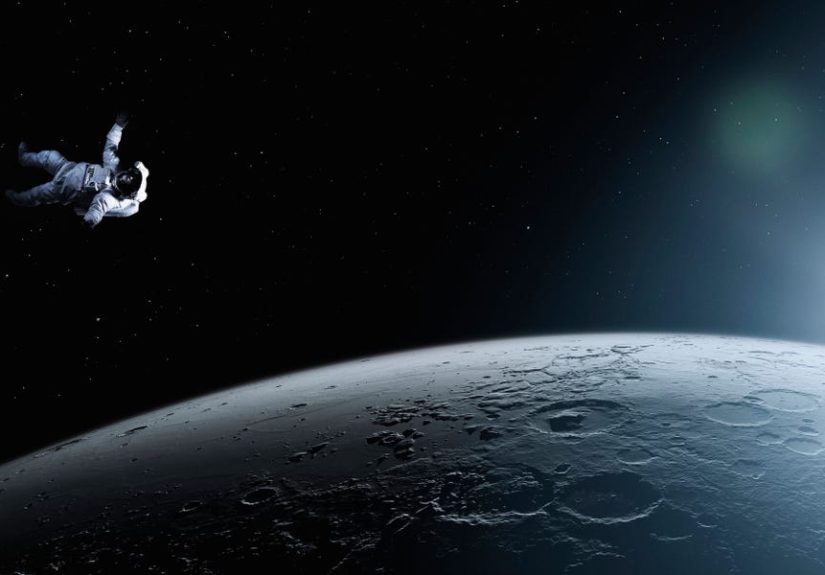
If a body were outside a spacecraft, its condition would depend on sunlight, shadow, location, radiation, and whether it was near Earth, the Moon, Mars, or deep space. In low Earth orbit, the body would keep moving at orbital speed, not “fall straight down” like a dropped phone. Orbit is basically falling around Earth while missing the ground. It is the universe’s strangest form of cardio.
In a spacesuit, the body would remain inside a small artificial environment until the suit failed, leaked, or was recovered. Without a suit, vacuum would remove moisture from exposed areas over time, while radiation and temperature cycling would gradually affect tissues. Traditional decomposition also requires microbes and environmental conditions. Inside a sealed spacecraft, microbes from the body and cabin environment would still matter. Outside in vacuum, decomposition would not proceed the same way it does on Earth.
There is no large real-world dataset on unattended human remains in open space, because thankfully this is not a common research category. Scientists infer likely outcomes from physics, biology, spacecraft accident investigations, and studies of how living bodies respond to pressure, microgravity, and radiation.
Would a Body Stay in Orbit Forever?
Not necessarily. In low Earth orbit, there is still a very thin atmosphere. It creates drag. Over time, objects lose altitude and reenter. A body or object in low Earth orbit would eventually fall into the atmosphere, though the timing would depend on altitude, shape, mass, solar activity, and orbital conditions.
Farther out, the story changes. A body drifting away from a spacecraft in deep space would follow the rules of orbital mechanics. It might orbit the Sun, continue on a long trajectory, or remain associated with a mission path depending on its velocity. Space does not have a “lost and found” desk, which is honestly poor customer service for such a large establishment.
How Space Agencies Prepare for Death in Space
NASA and other space agencies do not talk about death in space for shock value. They plan for it because planning saves lives. Human spaceflight is built on layers of prevention: pressure suits, vehicle pressure monitoring, emergency oxygen, medical protocols, crew training, return plans, and constant communication with mission control.
On the International Space Station, astronauts live in a carefully controlled environment. They monitor air pressure, oxygen levels, carbon dioxide, temperature, fire risks, and equipment health. Exercise systems help reduce bone and muscle loss caused by microgravity. Medical kits and ground-based flight surgeons support crew health. The goal is simple: keep small problems from becoming mission-ending problems.
For future Moon and Mars missions, the challenge becomes harder. Crews will be farther from Earth, communication delays may increase, and a quick return may not be possible. That means mission designers must plan for serious illness, injury, and the possibility of death during long-duration exploration. It is not a cheerful topic, but ignoring it would be like packing sunscreen for Mars and forgetting oxygen.
The Real Causes of Death in Space Are Less Cinematic Than You Think
Science fiction loves instant freezing, explosive decompression, and dramatic asteroid impacts. Real space hazards are usually more technical and less theatrical.
Depressurization
A leak, structural damage, or valve failure can cause a spacecraft or suit to lose pressure. Soyuz 11 showed why pressure suits during risky mission phases can be lifesaving. Modern vehicles are designed with lessons from past accidents in mind.
Carbon Dioxide Buildup
Humans inhale oxygen and exhale carbon dioxide. In a sealed spacecraft, carbon dioxide must be removed. If removal systems fail, the crew can become impaired. Apollo 13 famously turned carbon dioxide removal into an engineering survival story, proving that sometimes the most heroic object in space is a filter adapter.
Fire
Fire inside a spacecraft is terrifying because the crew cannot simply open a window. Apollo 1 changed spacecraft design, materials, testing procedures, and emergency thinking. Fire prevention remains a major part of crew safety.
Radiation
Earth’s magnetic field and atmosphere protect us from much of space radiation. Astronauts outside that protection face higher exposure from cosmic rays and solar particle events. Radiation is more often a long-term health risk than an instant threat, but a severe solar event could become an acute emergency without adequate shielding.
Orbital Debris and Micrometeoroids
Tiny objects in orbit can move at extremely high speeds. Even small debris can damage spacecraft, suits, windows, radiators, and solar arrays. This is why spacecraft shielding, tracking, and avoidance maneuvers matter. A paint fleck moving fast enough is no longer “just a paint fleck.” It is a tiny physics problem with a bad attitude.
What Happens to the Body During Long Spaceflight Before Death?
Even when everything goes right, space changes the body. Microgravity shifts fluids toward the head, which can contribute to facial puffiness and vision issues. Bones and muscles weaken when they no longer work against gravity. The heart, immune system, balance system, and even sleep patterns may change. Astronauts exercise for hours each day not because they are trying to win the galaxy’s fitness challenge, but because their bodies need mechanical resistance to stay strong.
These changes do not mean humans cannot explore space. They mean humans must bring a little Earth with them: pressure, oxygen, water, food, shielding, medicine, exercise, sleep schedules, and a lot of checklists. Space exploration is not humans conquering the cosmos by sheer confidence. It is humans surviving because engineers, doctors, scientists, and astronauts are very good at respecting the rules.
Could a Dead Astronaut Be Brought Back to Earth?
In many mission scenarios, yes, if the spacecraft can return safely. On the International Space Station, a crew member’s remains could theoretically be returned in a crew vehicle, depending on mission circumstances, vehicle capacity, safety considerations, and agency protocols. On a Mars mission, returning a body could be far more difficult because the crew may be months from Earth and working with limited space and resources.
Public details about exact death-management procedures are limited, partly because they involve crew privacy, operational security, and mission-specific planning. However, future long-duration missions will need clear policies. A crew traveling to Mars cannot simply call emergency services and wait near the mailbox. They are the emergency services, the ambulance, the repair crew, the lab team, and occasionally the plumbers.
Why the Soyuz 11 Tragedy Still Matters
Soyuz 11 changed spacecraft safety thinking. After the accident, the Soviet space program redesigned procedures and spacecraft arrangements so crews would wear pressure suits during launch and reentry. That lesson echoes through human spaceflight today: during the most dangerous phases, protect the crew from sudden cabin pressure loss.
The tragedy also reminds us that space disasters do not always look dramatic from the outside. The Soyuz 11 capsule landed successfully. The parachutes worked. The recovery crews reached it. The spacecraft had completed its automatic return. Yet the crew had already died because one invisible requirementbreathable pressurehad disappeared. Spaceflight safety is often about preventing quiet failures, not just surviving obvious explosions.
Common Myths About Dying in Space
Myth 1: You Explode Instantly
No. The body is not a balloon. Vacuum exposure is extremely dangerous, but instant explosion is Hollywood seasoning, not biology.
Myth 2: Your Blood Boils Like Soup
Not exactly. Body temperature and pressure changes can cause fluids in exposed tissues to behave dangerously, but blood inside the circulatory system is under internal pressure. The phrase “blood boiling” is usually oversimplified.
Myth 3: You Freeze Immediately
No. Heat does not leave the body instantly in vacuum. You would face urgent pressure and oxygen problems first.
Myth 4: Space Is Empty, So Nothing Happens
Space is not “nothing.” It is an environment with radiation, vacuum, micrometeoroids, temperature extremes, and orbital mechanics. It may look peaceful, but so does a sleeping cat right before it knocks a glass off the table.
Experiences and Human Lessons Related to Death in Space
One of the most powerful experiences connected to this topic is not death itself, but the emotional discipline astronauts bring to danger. Astronauts know the risks. They train for fire, pressure loss, toxic leaks, medical emergencies, failed docking, emergency return, and communication loss. They rehearse situations no one wants to experience so that panic has less room to enter the cockpit. In space, courage is not loud. It is procedural.
Many astronauts describe seeing Earth from orbit as life-changing. This view, often called the overview effect, can make national borders seem less important and the planet feel fragile. That emotional contrast is striking: the same environment that reveals Earth’s beauty can kill an unprotected human in moments. Space gives astronauts the best view in human history, then immediately reminds them to check their oxygen system.
For the public, stories like Soyuz 11, Apollo 1, Challenger, and Columbia can feel distant, like chapters in a textbook. But each crew was made of real people with families, ambitions, jokes, routines, and favorite foods. Remembering them only as “fatalities” misses the point. They were explorers. Their losses pushed agencies to redesign spacecraft, improve training, question assumptions, and build safer systems. Modern crews benefit from lessons written at great cost.
There is also a strange comfort in how seriously space agencies treat risk. Every mission is surrounded by people whose job is to imagine what could go wrong before it does. Engineers test seals, valves, software, suits, escape systems, parachutes, heat shields, batteries, and life-support systems. Flight surgeons study how the body behaves in microgravity. Mission controllers practice failure scenarios until “unexpected” becomes something they have at least partially expected. Space exploration looks glamorous from the outside, but behind the scenes it is a marathon of preparation.
The topic also changes how we think about everyday life on Earth. We spend our days surrounded by invisible protection: air pressure, oxygen, gravity, a magnetic field, and an atmosphere that burns up many incoming objects before they reach us. We complain about weather, but weather is part of the blanket keeping us alive. Earth is not just home; it is life support on a planetary scale.
So, what happens to your body if you die in space? Scientifically, the answer involves pressure, oxygen, temperature, radiation, microbes, and motion. Historically, the answer leads to Soyuz 11 and the hard lessons of human spaceflight. Emotionally, the answer is a reminder that exploration has always carried risk. Humans go to space not because it is safe, but because we are curious enough to build safety around danger.
That may be the most human part of the whole story. We are delicate creatures from a warm, wet planet, yet we keep designing machines that let us cross impossible distances. We wrap ourselves in pressure suits, climb onto rockets, and carry our tiny bubble of Earth into the dark. Space does not forgive mistakes, but it rewards preparation. And every mission, every checklist, every redesigned valve, and every remembered crew member becomes part of the long effort to make the next journey safer.
Conclusion
Death in space is not the explosive spectacle movies often imagine. The real science is quieter and more serious: oxygen loss, pressure failure, radiation, debris, and the limits of the human body beyond Earth’s protection. The only confirmed people to die in space were the Soyuz 11 cosmonauts in 1971, whose tragedy reshaped safety practices. Other disasters, including Apollo 1, Challenger, and Columbia, remain central to spaceflight history and continue to influence spacecraft design and crew protection.
Space is breathtaking, but it is not built for us. Every astronaut survives there because technology creates a temporary Earth around them. That is the real wonder: not that space is dangerous, but that humans have learned how to visit it at all.





 Close
Close