
Table of Contents >> Show >> Hide
- Radon 101: What It Is (and How It Sneaks In)
- Why Radon Matters: The Health Risk You Don’t Want to Gamble On
- Test During the Buying Process: When, Where, and How
- How to Understand Radon Results Without Spiraling
- Radon Mitigation: The Fix Is Usually Practical (and Effective)
- Real Estate Strategy: Use Radon Testing to Protect Your Health and Your Budget
- Special Situations Buyers Forget (Until It’s Awkward)
- Quick Buyer Checklist: Radon Testing Without the Stress
- of Real-World “Radon Moments” (What Buyers Commonly Run Into)
- Conclusion: The Smartest “Small Step” You Can Take as a Buyer
Buying a house comes with a long checklist: roof, foundation, plumbing, electrical, “is that stain a décor choice or a cry for help?”
But there’s one thing you can’t eyeball, sniff out, or politely ignore during a showingradon.
It’s the ultimate stealthy houseguest: no smell, no color, no taste… and absolutely no interest in paying rent.
The good news? Radon is easy to test for, and usually straightforward to fix. The bad news? If you skip the test,
you might move into a home with elevated radon levels and never know itsometimes for years.
When you’re making one of the biggest purchases of your life, “hope for the best” is not a radon strategy.
Radon 101: What It Is (and How It Sneaks In)
So what exactly is radon?
Radon is a naturally occurring radioactive gas that forms as uranium breaks down in soil and rock.
Outdoors, radon gets diluted fast. Indoors, it can build upespecially in lower levels like basements and ground floors.
And because it’s invisible, your home can have elevated radon levels while looking perfectly Instagram-ready.
How radon gets inside your future home
Radon typically enters through the path of least resistance (which, in many houses, is basically “everywhere”):
small cracks in concrete slabs, gaps around service pipes, sump pits, crawl spaces, floor drains, and tiny openings in foundations.
Even well water from private wells can carry radon and release it into indoor air during showering and dishwashing.
Why “new, renovated, or fancy” doesn’t mean “radon-free”
A common myth is that only old houses have radon problems. Not true.
Radon is about geology and airflow dynamics, not the home’s age or the seller’s excellent taste in backsplash tile.
In fact, tight, energy-efficient homes can sometimes trap radon more effectively because less fresh air naturally leaks in.
Why Radon Matters: The Health Risk You Don’t Want to Gamble On
Radon and lung cancer: the short version
Radon is widely recognized as the second leading cause of lung cancer in the United States after smoking,
and it’s the leading cause of lung cancer among people who don’t smoke.
The risk increases with higher radon levels and longer exposuremeaning it’s not a “one weird weekend in the basement” issue,
but a “living there for years” issue.
The smoking “multiplier effect”
Here’s the part that hits extra hard: radon and smoking together are a brutal combo.
If someone in the household smokes (or used to), reducing radon becomes even more urgent.
Public health agencies warn that smokers exposed to radon have far greater lung cancer risk than non-smokers exposed to the same levels.
How common is radon in U.S. homes?
Radon problems have been found in every state. Nationally, the estimate you’ll see repeated is that
nearly 1 in 15 homes has elevated radon at or above the EPA action level.
Translation: on a typical suburban street, it’s entirely possible that one home has elevated radon while the one next door does not.
That’s why radon isn’t something you can reliably “predict” from a neighborhood vibe or a seller’s confident shrug.
Test During the Buying Process: When, Where, and How
When should you test?
The smartest time to test is during the inspection period, when you can still negotiate repairs, credits, or conditions.
If you wait until after closing, radon becomes a “congratulations, it’s yours” surpriselike inheriting a vintage chandelier,
except the chandelier doesn’t increase your long-term health risk.
Where should the test be placed?
Guidance commonly recommends testing the lowest level that could be used regularly.
Even if the current owner “never goes in the basement,” you might plan a home gym, an office, or a cozy movie room down there.
Test where you’ll actually live, not where the seller stores holiday decorations and regret.
Short-term vs. long-term radon tests (and why real estate usually uses short-term)
Radon levels change with weather, seasons, ventilation, and how the house “breathes.”
That’s why there are two main testing approaches:
- Short-term tests (often at least 48 hours, up to about a week) are popular in real estate because they’re fast.
- Long-term tests (about 90 days or longer) give a better picture of the home’s average exposure over time.
In a home purchase, you usually don’t have 90+ days to spare, so short-term tests are common.
If a short-term result is borderline or you want more confidence, you can follow up later with a long-term test after moving in.
Closed-house conditions: the detail that makes tests meaningful
Here’s where a lot of radon tests go sideways: closed-house conditions.
For many short-term tests, the typical guidance is to keep windows and exterior doors closed
for a period (often around 12 hours) before the test starts and throughout the test,
except for normal entry/exit. Heating and cooling systems can run normally.
Why does this matter? Because if the house is aired out like a breezy beach cottage right before testing,
the radon level you measure may not reflect normal living conditions.
In other words, you could get a result that’s artificially lowlike weighing yourself after you’ve removed your shoes, coat,
backpack, and emotional baggage. Accurate? Technically. Helpful? Not always.
How to Understand Radon Results Without Spiraling
Know the unit: pCi/L
In the U.S., radon is usually measured in picocuries per liter (pCi/L).
You don’t need to memorize the physicsjust recognize that higher numbers mean more radon in the air you breathe.
The EPA action level (and the “consider fixing” zone)
The EPA recommends taking action to reduce radon if the level is 4.0 pCi/L or higher.
Because there’s no known completely safe level, the EPA also suggests considering mitigation
even when levels are between 2.0 and 4.0 pCi/L.
What to do with common scenarios
- Below 2.0 pCi/L: Great. Still, keep the result on file and consider retesting down the roadespecially after renovations.
-
Between 2.0 and 4.0 pCi/L: Not an emergency, but worth thinking about.
Some buyers choose to mitigate now for extra peace of mind (and better resale appeal later). -
4.0 pCi/L and above: This is where you should treat mitigation as a normal part of the transactionlike fixing a bad GFCI outlet,
except the outlet won’t follow you into every breath you take.
Radon Mitigation: The Fix Is Usually Practical (and Effective)
What mitigation typically looks like
The most common mitigation approach for many homes is often some form of soil depressurization:
a vent pipe system and fan that pulls radon from beneath the foundation and releases it safely above the roofline.
It’s not glamorous, but neither is lung cancer.
Does mitigation actually work?
Yesradon reduction systems are widely described as effective, with some systems capable of reducing radon levels dramatically
(often cited up to very high reductions in the right setup). The key is hiring a qualified professional and then
retesting after installation to confirm the levels dropped.
How much does it cost?
Costs vary by region and home design, but radon mitigation is generally priced like a common home repairnot like rebuilding a foundation.
Depending on the house, you might see costs in the ballpark of “a few hundred to a couple thousand dollars,”
and radon test kits can be relatively inexpensive compared with other inspection items.
The point isn’t the exact numberit’s that mitigation is usually doable,
which makes skipping the test even harder to justify.
After mitigation: don’t skip the “proof” step
After a mitigation system is installed, you should test again to verify performance.
Also keep an eye on any system components (like the fan) over time.
A mitigation system isn’t a “set it and forget it forever” gadgetthink of it more like a sump pump:
it works great, but you still want to know it’s running.
Real Estate Strategy: Use Radon Testing to Protect Your Health and Your Budget
How radon results can change the deal (in a good way)
Radon testing isn’t about “killing the dream home.” It’s about making the dream home safer and more predictable.
If the radon level is elevated, you typically have options:
- Request mitigation (installed by a qualified contractor) before closing.
- Negotiate a credit so you can choose the contractor and oversee the work after closing.
- Request a price adjustment that reflects the mitigation cost.
Documentation matters
If mitigation is done as part of the transaction, ask for documentation:
what system was installed, who installed it, and what the post-mitigation test showed.
This isn’t being pickyit’s being the kind of homeowner who keeps receipts and avoids future headaches.
Special Situations Buyers Forget (Until It’s Awkward)
Finished basements and “bonus rooms”
If the home has a finished basement, a downstairs bedroom, or a home office on the lowest level,
radon testing should feel non-negotiable. People spend real hours down theresleeping, working, exercising
which is exactly the kind of long-term exposure scenario radon risk is built on.
Renovations can change radon levels
Big changesnew HVAC, sealing cracks, adding insulation, finishing a basementcan alter how air moves through the home.
Even if a past radon test looked fine, retesting after major renovations is a smart move.
Private wells and radon in water
If the home uses well water, it may be worth asking about water testing.
Some guidance suggests that high radon in air can be a reason to consider checking water too,
because radon can be released into indoor air through everyday water use.
“We’re in a low-risk zone, so we’re fine”… right?
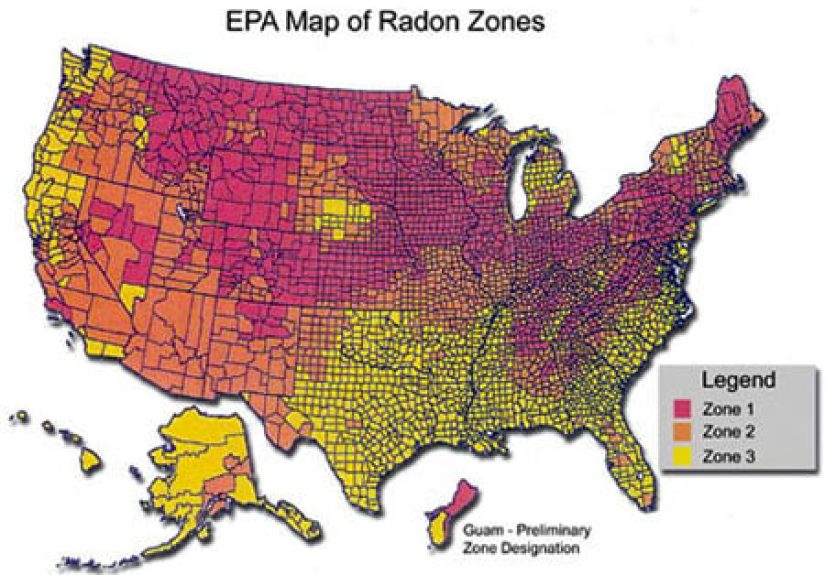
Not necessarily. The EPA has a Map of Radon Zones that describes areas with higher, moderate, or lower potential.
But that map is meant for planning and awarenessnot for deciding whether your specific house is safe.
Local geology matters, but so does the home’s construction and airflow.
Bottom line: even in lower-potential areas, some homes still test high.
Quick Buyer Checklist: Radon Testing Without the Stress
- Add radon testing to your inspection plan (especially if the home has a basement or lower level you’ll use).
- Choose the right method: short-term for the transaction timeline; long-term later for extra confidence if needed.
- Follow closed-house conditions so the result reflects real living conditions.
- Test the lowest livable level, not just the level the seller uses.
- Use the result to negotiate mitigation, a credit, or price adjustments if needed.
- If you mitigate, retest after installation to confirm it worked.
- Retest over time, especially after major renovations or changes in how you use the home.
of Real-World “Radon Moments” (What Buyers Commonly Run Into)
Imagine a couple buying their first home. They’re laser-focused on school districts, commute times, and whether the kitchen has a pantry.
During the inspection, the inspector casually suggests a radon test. The buyers shrug“Sure, why not?”the same way you might add guacamole
because you’re already emotionally invested in the burrito.
Two days later, the radon result comes back above the EPA action level. The buyers panic for roughly seven minutes and then do the most helpful thing:
they ask, “Okay… what’s the fix?” That question changes everything. Instead of imagining the house as a radioactive doom bunker, they learn that many homes
can be mitigated with a proven system, often without tearing up floors or launching a full-blown construction saga.
In another scenario, a buyer is obsessed with the finished basementnew carpet, recessed lighting, a built-in bar. It’s basically a cozy second living room.
The seller says, “We never worried about radon.” The buyer says, “Cool, let’s test anyway.” The results are elevated.
Suddenly, that “bonus space” isn’t just a bonusit’s where the buyer plans to spend weekends, work-from-home days, and maybe even set up a guest bedroom.
The buyer negotiates a mitigation system to be installed before closing, and includes a post-mitigation test requirement.
The deal still happens, but now the basement is both cozy and responsibly managed.
Some of the most frustrating stories happen when testing is skipped. A family moves in, then finishes the basement a year later.
They start using the lower level every dayplayroom, treadmill, movie nights. A neighbor mentions radon during small talk
(because neighbors love two things: weather updates and unsolicited home advice). The family tests and finds elevated levels.
The fix still isn’t impossible, but now it’s happening during normal lifework deadlines, school schedules, and “why did we not do this earlier?”
The lesson: it’s easier to deal with radon when you’re still negotiating, not when you’ve already memorized every creaky stair in the house.
Then there are the “borderline” results: between 2.0 and 4.0 pCi/L. Some buyers choose to mitigate anyway because the cost is manageable and the peace of mind
is priceless. Others decide to do a long-term test after moving in, especially if they’ll use the basement frequently.
Either approach can be reasonablethe important part is making a deliberate choice based on your household, your plans, and your risk tolerance.
The most common thread in all these stories is simple: buyers who test feel informed and in control. Buyers who don’t test are left guessing.
When you’re purchasing a home, guessing is expensivefinancially, emotionally, and potentially physically.
A radon test is one small line item that can prevent a long list of regrets.
Conclusion: The Smartest “Small Step” You Can Take as a Buyer
Radon testing isn’t about being paranoidit’s about being prepared.
Radon is common enough to matter, serious enough to respect, and easy enough to manage that skipping the test makes little sense.
During a home purchase, a radon test helps you avoid hidden risk, negotiate fairly, and move in with confidence.
If the results are elevated, mitigation is usually effective and practical. If the results are low, you gain peace of mind and a solid paper trail.
In short: test for radon the same way you check for a leaky roofbecause “I didn’t know” is not the kind of surprise you want in your forever home.





 Close
Close