Table of Contents >> Show >> Hide
Saturday Night Live has spent decades making America laugh, cringe, and occasionally spit coffee across the room. But behind the sketches, catchphrases, and celebrity cameos, the show has also produced something almost as legendary as its comedy: conflict. Some SNL feuds exploded backstage between cast members with oversized egos and too little sleep. Others played out between musicians and producers, hosts and writers, or public figures and the show’s very opinionated audience. That is what makes these stories so irresistible. SNL is live television, which means tension is never far away, and when the pressure cooker whistles, everyone hears it.
The most famous Saturday Night Live feuds are not just juicy gossip. They reveal how high the stakes can be inside Studio 8H, where a week’s worth of writing, rehearsing, rewriting, and panic-sweating has to land in front of millions of viewers on Saturday night. Some of these clashes ended in grudging respect. Some ended in exile, or at least the entertainment-industry version of exile, which is “we’ll call you” followed by years of profound silence. And a few became part of SNL mythology, passed around like campfire stories for comedy nerds.
Here are 10 of the most famous feuds in SNL history, ranked not by who threw the hardest punch or delivered the pettiest insult, but by how deeply the conflict entered the show’s legend.
Backstage Wars That Became Comedy Lore
1. Chevy Chase vs. Bill Murray
If you know only one SNL backstage fight, it is probably this one. In 1978, Chevy Chase returned to host after leaving the show early for movie stardom, and the cast was not exactly waiting with a fruit basket. Bill Murray, who had stepped into the post-Chevy era, reportedly clashed with Chase backstage in a fight that became instant legend. The feud was fueled by resentment, ego, and the awkward energy that appears when one guy leaves the garage band, becomes a star, and then wanders back in acting like he still gets first pick of the microphone.
The fight mattered because it symbolized a changing of the guard. Chase was the breakout name from the earliest days of the show, but Murray represented the next chapter. Their conflict felt less like a simple argument and more like a royal succession with swear words. Over time, they made peace, but the image of those two comedy giants nearly coming to blows remains one of the defining pieces of SNL cast drama.
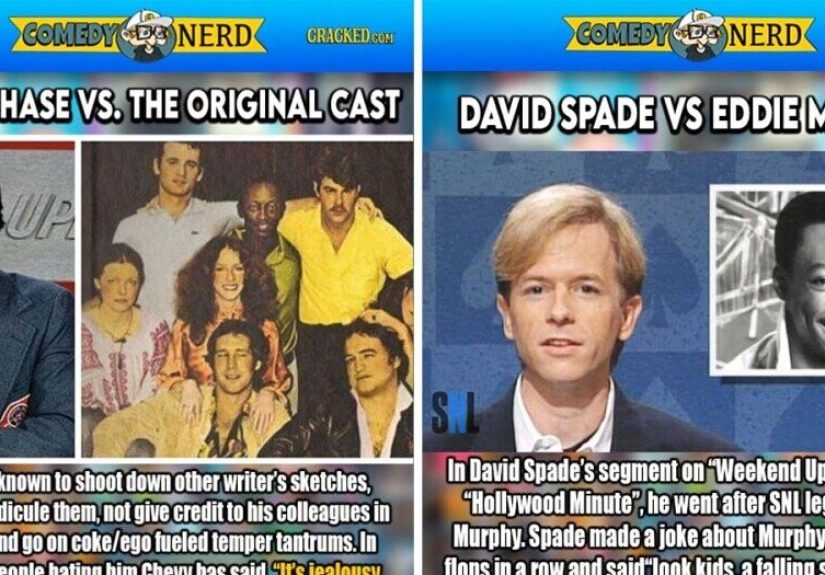
2. Chevy Chase vs. The Original Cast
Chase did not just feud with Murray. His early departure from SNL left bruised feelings across the original ensemble. Oral histories and later interviews have painted a picture of a cast that felt abandoned, irritated, and more than a little suspicious of Chevy’s rapidly inflating ego. On a show built around ensemble chemistry, leaving early for Hollywood was not viewed as a charming act of ambition. It was viewed more like grabbing the lifeboat first and waving at everyone else from a safe distance.
That broader resentment is part of why the Chase-Murray blowup hit so hard. The cast’s frustration had already been simmering. When Chase came back, he was walking into unresolved feelings, not a reunion special. His complicated relationship with the show would linger for decades, making him one of the clearest examples of how fame and SNL controversy often travel together.
3. Norm Macdonald vs. Don Ohlmeyer
Few Saturday Night Live feuds say more about comedy and power than Norm Macdonald’s battle with NBC executive Don Ohlmeyer. Macdonald’s run on “Weekend Update” was fearless, dry, and gloriously unconcerned with making executives comfortable. His relentless O.J. Simpson jokes became central to the conflict, especially because Ohlmeyer was widely reported to be a friend of Simpson. Macdonald was eventually removed from “Weekend Update,” and the explanation never fully convinced anyone who had been paying attention.
What made this feud so memorable was that it felt bigger than one comedian losing a desk job. It looked like a collision between institutional pressure and a comic who refused to sand down his edge. Norm turned the whole situation into part of his legend: the comedian who got in trouble for telling the joke too directly, too often, and too well. In the universe of SNL controversies, that is practically a medal of honor.
Hosts Who Walked Into Studio 8H and Started a Fire
4. Steven Seagal vs. The Cast and Writers
Steven Seagal’s 1991 hosting stint has become shorthand for “how not to do SNL.” Cast members and writers have described him as stiff, humorless, and difficult to work with, which is not exactly ideal on a sketch comedy show. His week at the show has been remembered less as collaboration and more as a hostage situation with cue cards. In later interviews and retrospectives, he was repeatedly labeled one of the worst hosts the show ever had.
The Seagal feud stands out because it was not a clash over politics or a rebellious live-TV stunt. It was a pure chemistry failure. SNL can accommodate oddballs, divas, and even occasional train wrecks, but it depends on a host who understands the basic assignment: be game. Seagal apparently treated that assignment like an insult. The result was one of the most infamous host-versus-show meltdowns in SNL history.
5. Adrien Brody vs. Lorne Michaels
Adrien Brody’s 2003 appearance lives on because of one moment: his improvised introduction for musical guest Sean Paul, delivered in a fake Jamaican accent while wearing dreadlocks. It was the kind of unscripted choice that made viewers blink, producers tense up, and the phrase “never invited back” start stretching its legs. For years, Brody was widely rumored to have been banned from the show.
Brody has since denied knowing of any formal ban, which makes this feud a great example of how SNL rumors become entertainment folklore. Still, formal ban or not, his relationship with the show clearly cooled. That is part of the larger lesson of Studio 8H: SNL loves spontaneity right up until spontaneity threatens to hijack the brand. Then the vibe changes very quickly.
6. Andrew Dice Clay vs. Nora Dunn
In 1990, Andrew Dice Clay hosted SNL, and the booking immediately sparked backlash. Cast member Nora Dunn objected to Clay’s act and refused to appear, publicly distancing herself from the episode. Musical guest Sinéad O’Connor also boycotted that night. Suddenly the episode was no longer just a comedy broadcast. It had become a cultural argument about misogyny, platforming, and whether appearing alongside a controversial comic made someone complicit or merely employed.
What makes this feud so historically important is that it went beyond backstage friction. It split opinions inside and outside the show. Dunn paid a price for her stand, and the episode remains one of the clearest examples of how SNL booking decisions can trigger conflict that is moral as much as professional. Sometimes the feud is not about who insulted whom. Sometimes it is about who decided the room itself was the problem.
7. Donald Trump vs. The Cast, Critics, and Protesters
Donald Trump’s 2015 hosting gig was controversial before he even stepped onstage. Latino advocacy groups protested the booking, public petitions demanded NBC reverse course, and critics argued the show was chasing ratings at the expense of judgment. Afterward, former cast member Taran Killam described the experience in deeply unflattering terms, saying most of the cast and writers were not excited to have Trump there.
This feud mattered because it was not just a performer-versus-producers story. It was SNL versus its own public image. The show has always flirted with cultural chaos, but Trump’s episode forced a different question: when does provocation stop being daring and start looking opportunistic? That tension made the episode one of the most debated examples of SNL backlash in the modern era.
Musical Guests Who Turned Performance Into Protest
8. Sinéad O’Connor vs. SNL, NBC, and America’s Comfort Zone
Sinéad O’Connor’s 1992 performance is one of the most famous moments in live television history. After singing an a cappella version of Bob Marley’s “War,” she tore up a photo of Pope John Paul II and told viewers to “fight the real enemy.” The stunt shocked the audience and producers, and for years it was treated as one of the ultimate examples of someone torching their relationship with SNL on live TV.
But with time, the incident has changed meaning. What once looked like career sabotage now reads as an act of protest that was years ahead of mainstream conversation. Later retrospectives have added nuance, including Lorne Michaels saying the show did not formally ban musical guests and speaking more sympathetically about her courage. That evolution is exactly why this remains one of the most significant SNL feuds: it was not just a fight with a show. It was a fight with the culture’s willingness to hear what she was saying.
9. Elvis Costello vs. Lorne Michaels
In 1977, Elvis Costello began performing “Less Than Zero” on SNL, stopped mid-song, and switched to “Radio Radio,” a sharper and more openly defiant track criticizing broadcast culture. It was a rebellious move, an electric live-TV stunt, and exactly the sort of thing producers do not enjoy when they have carefully planned the running order. For years, the story was that Lorne Michaels was furious and Costello was effectively banished from the show.
The beauty of this feud is its irony. Costello’s protest against media conformity became one of the most celebrated anti-establishment moments in the show’s history. Later returns and retrospectives softened the idea of a permanent ban, but the clash still matters because it captures the contradiction at the heart of SNL: the show wants unpredictability, but preferably the kind that can still hit its marks. Costello heard that and, apparently, replied with a guitar.
10. Rage Against the Machine vs. SNL and NBC
If there were ever a band genetically incapable of “keeping things low-key,” it was Rage Against the Machine. During their 1996 appearance on the Steve Forbes episode, the band attempted to display upside-down American flags onstage. The flags were removed, tensions escalated, and after the performance the group was effectively kicked out of the building. According to later accounts, Secret Service got involved after bassist Tim Commerford hurled a flag into Forbes’s dressing room area. Casual stuff. Very normal Saturday.
This conflict became one of the most famous SNL musical guest controversies because everyone involved seemed perfectly built for collision. Rage was never going to behave like polite background wallpaper, and network television was never going to treat open political provocation as charming set decoration. The result was a feud that still gets referenced whenever people talk about rebellious performances that pushed SNL right up against the limits of what live TV would tolerate.
Why These Feuds Still Matter
The reason these famous Saturday Night Live feuds keep resurfacing is simple: they tell the truth about the show. SNL is often remembered as an institution, but institutions can sound neat and polished, like a museum with better lighting. In reality, the show has always been closer to a pressure chamber with wigs. It runs on speed, nerves, ego, and creative ambition. That combination produces brilliance, but it also produces conflict, because talented people under impossible deadlines are not famous for whispering, “No, after you.”
These feuds also reveal how much the show depends on chemistry. When a host, cast member, musician, or executive breaks that chemistry, the audience can feel it even if they do not know the backstory yet. Sometimes the discomfort makes for incredible television. Sometimes it just makes everyone look like they need a nap and a mediator. Either way, the friction becomes part of the legend.
The Experience of Watching SNL Feuds Unfold in Real Time
What makes these conflicts especially fascinating is the experience of watching them unfold while they are still messy, unresolved, and very much alive. A great SNL feud does not usually announce itself with a helpful title card saying, “Attention, history is happening now.” It sneaks up on you. A sketch feels stiff. A musical performance suddenly goes off-script. A host looks like they wandered into the wrong building and are trying to solve the problem entirely through confidence. Then the next morning, the recaps, interviews, and whispered backstage stories begin, and everyone realizes they did not just watch a weak episode or a weird segment. They watched television mythology being born.
For viewers, that experience can be strangely electric. Live television always carries the promise that something could go wrong, but SNL adds another layer: something could go wrong in a way that says something meaningful about fame, power, politics, or comedy itself. That is why these moments linger. They are not just mistakes. They are stress fractures that expose the machinery. You suddenly see how much work it takes to make spontaneity look polished, and how quickly that polish can crack.
For performers, the experience must be even more intense. Every appearance on SNL is already a test of stamina and flexibility. The week moves fast, the expectations are absurdly high, and the reward for surviving is often hearing that one sketch you loved got cut at dress rehearsal. Now add tension with producers, conflict with cast members, or the urge to make a personal statement in front of a national audience. That is not just performance pressure. That is emotional roulette in professional makeup.
There is also something very American about the way SNL feuds get processed. First comes outrage. Then comes media overanalysis. Then, years later, everyone turns the mess into nostalgia. A backstage fight becomes a charming bit of legend. A controversial performance becomes a brave act of artistic rebellion. A disastrous host becomes a beloved cautionary tale, like a campfire story told by writers who survived on coffee and panic. Time does not erase these moments. It edits them into something more usable, often more flattering, and occasionally funnier than they felt at the time.
That is why the show’s most famous feuds remain such durable cultural material. They are stories about live performance, yes, but also about ego, collaboration, rebellion, and consequence. They remind fans that comedy is not made in a vacuum. It is made in rooms full of opinionated people, under bright lights, with too little sleep and far too much at stake. And when those conditions produce friction, the sparks can be as memorable as any punchline. Sometimes more memorable, honestly. Plenty of sketches vanish into history. A truly great SNL feud never does.
Final Thoughts
The funniest thing about Saturday Night Live feuds may be that they fit the show perfectly. SNL has always thrived on instability, personality, and risk. That is why it can produce a perfect sketch one week and a five-alarm backstage disaster the next. The same live-wire energy that makes the show exciting also makes it combustible. And that is probably why viewers keep coming back. Comedy is the headline, but chaos has always been part of the brand.
From Chevy Chase and Bill Murray trading insults to musicians turning performances into acts of rebellion, these feuds have become essential parts of the show’s identity. They are reminders that the history of SNL is not just built on catchphrases and celebrity impressions. It is also built on arguments, grudges, protests, hurt feelings, and the occasional career-limiting decision made in front of millions. In other words, live from New York, it is conflict.