Table of Contents >> Show >> Hide
If regular tic tac toe feels a little too quiet, too still, and too likely to end with someone dramatically announcing, “It’s a cat’s game,” human tic tac toe is the upgrade you didn’t know you needed. It takes the familiar 3-by-3 grid, the race to get three in a row, and the easy-to-learn rules of the classic game, then adds actual people, movement, strategy, noise, and the occasional heroic dive into a square that probably looked more graceful in someone’s imagination.
That is exactly why human tic tac toe keeps showing up in physical education classes, youth groups, recess programs, field days, and family parties. It is simple enough for kids to understand in minutes, but active enough to keep a group engaged. Better yet, it blends movement with decision-making. Players are not just running around for the sake of running around; they are reading the board, blocking an opponent, choosing a lane, and working with teammates.
Below are three fun ways to play human tic tac toe, along with setup tips, rule tweaks, and smart ideas for making each version smoother, safer, and much more entertaining. Whether you are planning an indoor group game, a PE warm-up, a youth ministry icebreaker, or a field day game that does not require a truckload of equipment, one of these versions will fit the job nicely.
Why Human Tic Tac Toe Works So Well
At its core, tic tac toe is beautifully simple: two sides, a 3-by-3 grid, and one goalget three in a row across, down, or diagonally. That built-in structure makes it incredibly easy to scale into a group activity. Once the grid gets bigger and the “pieces” become people, the game still feels familiar, but now it also builds speed, communication, spatial awareness, and tactical thinking.
That mix is a big reason active versions of tic tac toe are popular in school and youth settings. The game gets players moving, but it also rewards teamwork and strategy. In other words, the fastest team does not always win. Sometimes the team that pauses for half a second and says, “Block the diagonal!” ends up looking like tactical geniuses.
Another bonus is flexibility. You can run human tic tac toe in a gym, classroom, church hall, blacktop, lawn, or playground. You can make it high-energy or low-pressure. You can play with chairs, tape, hoops, beanbags, scarves, cones, or players standing directly in the spaces. Translation: this is one of those rare group games that works whether your supply closet is fully stocked or basically contains one cone and pure optimism.
1. Relay Human Tic Tac Toe
If you want the version most commonly used in PE and field day settings, start here. Relay human tic tac toe turns the classic game into a race. Teams run to a giant board, place markers, sprint back, and tag the next player. It is fast, strategic, and surprisingly competitive for a game that once lived peacefully on notebook paper.
Best for
Elementary PE, recess, after-school programs, camps, and field day events.
What You Need
- 9 hula hoops, taped squares, or chalked spaces for the board
- 6 markers total, such as beanbags, cones, scarves, or discs
- A start line for each team
- Two teams, ideally with at least 3 players each
How to Set It Up
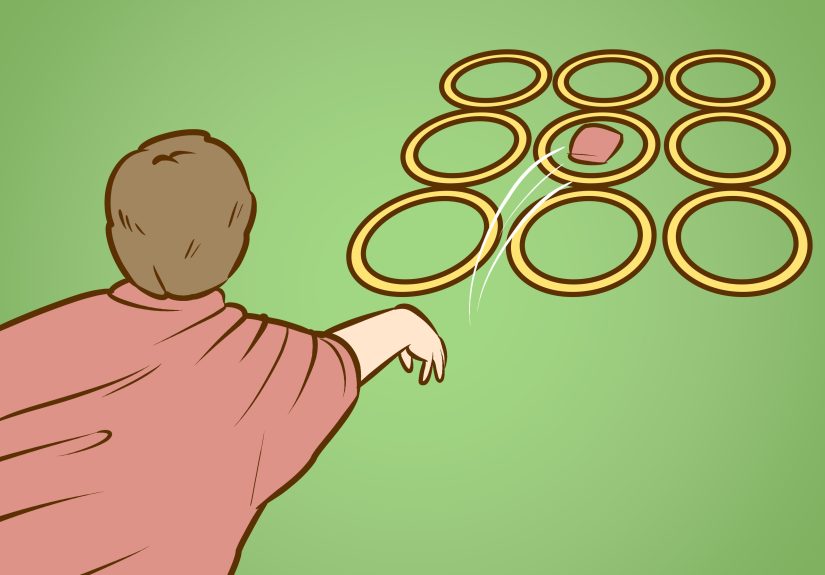
Create a large 3-by-3 grid several feet away from the starting lines. Each team gets three matching markers in one color or type. The first three players in each line are the opening movers. If you have a bigger group, everyone else queues behind them and rotates in once the game begins.
How to Play
On “Go,” the first player from each team runs to the board and places one marker in any open square. They race back and high-five the next teammate, who runs to place the second marker. Then the third player does the same.
If a team gets three in a row after those opening placements, the round ends. If not, the next runners must move one of their team’s existing markers to an empty square instead of adding a fourth marker. That rule is what makes the game more than just a sprint. Suddenly, players need to think ahead, protect lanes, and block obvious threats.
The smartest teams quickly figure out two things. First, diagonals are sneaky. Second, panic-running without looking at the board is a great way to lose to a slower team that actually used its brain.
Why This Version Is So Popular
Relay human tic tac toe works because it combines short bursts of vigorous movement with decision-making. Players run, stop, assess the board, choose a square, and transition back to the line. It is active, but not chaotic when supervised well. It also allows for creative movement variations. Instead of running, players can skip, hop, tiptoe, shuffle sideways, or balance a beanbag on their heads if you are feeling brave and strangely optimistic.
Easy Variations
- Fitness relay: Add five jumping jacks before a player can place a marker.
- Skill relay: Dribble a ball, crab-walk, or hop to the board.
- Small-group station: Run multiple boards at once to reduce waiting time.
- Outdoor giant board: Use cones or chalk for a bigger field-day setup.
2. Chair-Grid Human Tic Tac Toe
If the relay version is the sporty cousin, the chair-grid version is the clever indoor sibling that shows up ready to play with minimal setup. In this format, players literally become the Xs and Os by sitting in chairs or standing in marked squares. It is simple, visual, and works especially well for mixed-age groups because the rules are easy to understand at a glance.
Best for
Youth groups, classrooms, rainy-day indoor play, church events, family gatherings, and team-building sessions.
What You Need
- 9 chairs arranged in a 3-by-3 grid, or 9 taped floor squares
- Two teams
- Enough space around the board for safe movement
How to Set It Up
Place the chairs in three rows of three, leaving enough room for players to move between them safely. Divide the group into two teams. One team is X, the other is O. Teams line up on opposite sides of the board.
How to Play
Teams alternate turns sending one player at a time to sit in an empty chair. Once seated, that player is locked in place for the round. The goal is to get three teammates in a rowhorizontal, vertical, or diagonalbefore the other side does.
That sounds easy, and it is. But it is also wildly entertaining, because every turn turns into a group strategy session. One team whispers, “Take the center.” The other team also takes the center because, yes, everybody watched the same board-game movie in their head. Then suddenly one empty corner becomes the most important real estate in the building.
Why This Version Works
Chair-grid human tic tac toe is great when you want the “human” part to be literal. It invites participation without requiring all-out speed, which makes it accessible for groups with different ages or ability levels. It also encourages communication and shared decision-making. The board is visible, the objective is clear, and every move feels important.
This format also shines as an icebreaker. There is just enough friendly competition to wake people up, but not so much complexity that half the room needs a coaching seminar before the first round starts.
Ways to Make It Better
- Rotate players each round so nobody is stuck being a spectator.
- Use colored bandanas or pinnies if you want teams to be more visually distinct.
- Swap chairs for taped boxes if you want a standing-only version.
- Run a best-of-five match to turn a quick activity into a mini tournament.
3. Called-Number Human Tic Tac Toe
This is the most dynamic version for larger groups because it adds a referee and a surprise element. Instead of every player choosing when to move, each team member gets a number. The leader calls a number, and the matching player from each team races to claim a square on the board. It feels part strategy game, part reaction challenge, and part “Why did I suddenly forget where the diagonal was?”
Best for
Large youth groups, middle school events, leadership camps, indoor game nights, and competitive team-building.
What You Need
- A large taped or chalked 3-by-3 grid
- Two even teams
- A referee or facilitator
- Optional bandanas, vests, or floor markers to identify teams
How to Set It Up
Create a giant board on the floor or ground. Each square should be big enough for one person to stand comfortably inside. Number players on both teams so each person has a matching counterpart on the other side: two number ones, two number twos, and so on.
How to Play
The referee calls a number. The matching player from each team races toward the grid and chooses a square to claim. Then both players return to their teams. The referee calls another number, and the game continues until one team forms three in a row.
You can make the squares “claimed” by having players stand in them, place a bandana, or drop a marker. Some groups keep the players in the squares. Others treat each turn like a quick placement round and reset bodies to the sidelines after the move. Both work. The best choice depends on your space and how fast you want the rounds to move.
Why This Version Feels Fresh
The called-number format gives every player a specific role and keeps attention high because nobody knows whose number is coming next. It also prevents a few dominant players from hijacking every turn. Everyone has to stay alert, and every called move can change the board in a hurry.
This version also adds an extra layer of fairness. Since players are paired by number, participation tends to spread out more evenly. That matters in bigger groups where the loudest kid usually believes he or she has been elected captain, strategist, announcer, and part-time referee.
Fun Twists
- Double call: Call two numbers at once for a faster, messier, more hilarious round.
- Movement challenge: Players must hop, shuffle, or spin before entering a square.
- Defense mode: Allow only one second to choose a square once the player reaches the board.
- Outdoor summer version: Use chalk or lawn spots on grass, blacktop, or pavement.
Tips for Running Any Human Tic Tac Toe Game
1. Protect the playing space
Give players enough room to move safely around the board. Tight spacing is fine for strategy, not for collisions. Chairs should be stable, taped lines should be visible, and running lanes should be clear.
2. Keep rules short
The beauty of human tic tac toe is that people can learn it fast. Explain the win condition, show where players start, and clarify whether they are placing, sitting, standing, or moving markers. Done. No one came for a 14-minute lecture on grid theory.
3. Rotate often
The game is best in short rounds. Reset quickly and swap players, leaders, or movement styles. Fast resets keep the energy high and prevent the activity from turning into a waiting contest.
4. Use strategy language
Encourage teams to think aloud: center, corner, block, diagonal, open space. That keeps the activity from being just a footrace and helps younger players learn how game strategy works.
5. Adapt for your group
If you have younger kids, slow it down. If you have older students, add movement challenges or best-of series play. If you have a mixed group, use the chair-grid or standing version first, then graduate to the relay format once everyone is comfortable.
Common Mistakes to Avoid
The biggest mistake is making the board too small. Human tic tac toe should feel active, not like everyone is trying to park in the same tiny driveway. Another common issue is forgetting to explain what happens after all three markers are placed in relay play. If that step is unclear, players will invent rules on the spot, and those rules will somehow always benefit the team currently losing.
Also, do not underestimate the power of visible team colors. When teams are easy to distinguish, the board becomes easier to read, the strategy improves, and fewer people shout, “Wait, was that ours?” while staring directly at their own beanbag.
What the Experience Is Really Like: on the Fun, Chaos, and Surprising Strategy
The best way to understand human tic tac toe is to watch a group play it for the first time. At the start, there is always a tiny moment of skepticism. The kids who expected dodgeball look mildly unconvinced. The adults running the event are hopeful but pretending to be casual about it. Then the first round begins, and within about fifteen seconds, the whole thing clicks.
In a gym, the relay version has a very specific rhythm. Sneakers squeak. Teammates start yelling advice they absolutely did not have one second earlier. Someone races to the center square like they just discovered buried treasure. Another player, moving at top speed and fueled entirely by competitive spirit, realizes too late that they should have blocked the diagonal instead. Suddenly the quiet little pencil game from childhood feels like a playoff sport.
The chair-grid version creates a different kind of energy. It is less about speed and more about visible tension. You can actually watch strategy happen on people’s faces. One player sits down in the top corner looking very pleased. Another team huddles for two seconds and sends a player to the center with the seriousness of a chess master making a tournament move. The funniest part is that spectators become invested immediately. Even people who are not playing start whispering suggestions like assistant coaches who have seen this formation on film all week.
The called-number version might be the most memorable because it blends anticipation with surprise. Players stand ready, waiting for their number, mentally rehearsing the route to the board. When the referee finally calls it, the reaction is instant. There is a burst of movement, a split-second decision, and then a scramble to see whether the player made the brilliant choice or the “why-did-I-not-see-that-corner” choice. It feels fair because everyone has a turn, and it feels exciting because every call matters.
What stands out most in real-life play is how often strategy beats raw speed. A team can be fast and still lose because they ignore the center, forget to block, or keep chasing one row while the other team quietly builds a diagonal. On the flip side, a team that talks well, watches the board, and stays calm can win even without the fastest runners. That is part of the charm. Human tic tac toe rewards movement, but it also rewards thinking.
There is also something wonderfully low-stakes about the experience. Nobody needs advanced athletic skills. Nobody needs expensive equipment. The laughter tends to come naturally because the game creates tiny dramatic moments over and over again: the near win, the last-second block, the unexpected comeback, the player who accidentally becomes the hero of the round after being convinced they would “just go stand somewhere.”
By the end of a session, most groups want “just one more round,” which is usually the best review any game can get. That is the magic of human tic tac toe. It is familiar enough to feel comfortable, active enough to burn some energy, and strategic enough to keep people coming back. Not bad for a game that started with nine little squares and a couple of pencil marks.
Final Thoughts
Human tic tac toe proves that a simple classic can still be a crowd-pleaser when you scale it up and get people moving. The relay version is perfect for PE and field day. The chair-grid version is ideal for indoor groups and quick team-building. The called-number version adds surprise and structure for bigger groups that need everyone involved.
If you are choosing just one, match the format to your space and your group’s energy level. Want speed? Pick the relay. Want simple setup? Use the chair grid. Want a more organized large-group challenge? Go with the called-number version. Either way, you will end up with a game that gets people laughing, thinking, moving, and plotting that next diagonal like it is a matter of national importance.