Table of Contents >> Show >> Hide
- What Is Astrophotography?
- Main Types of Astrophotography
- Essential Astrophotography Gear
- Best Beginner Camera Settings for Astrophotography
- How to Focus on Stars
- Planning the Perfect Astrophotography Shoot
- Editing and Stacking Astrophotography Images
- Common Astrophotography Mistakes
- Astrophotography With a Smartphone
- Why Dark Skies Matter
- Beginner Astrophotography Workflow
- of Real-World Astrophotography Experience
- Conclusion
Astrophotography sounds like the kind of hobby that requires a mountaintop observatory, a lab coat, and possibly a dramatic soundtrack. Good news: it does not. At its simplest, astrophotography is the art and science of photographing the night skystars, the Moon, planets, meteor showers, the Milky Way, nebulae, galaxies, and sometimes that one airplane you swear was a UFO until you zoomed in.
Today, you can begin with a smartphone, a tripod, and a little patience. As your curiosity grows, you can move into DSLR or mirrorless cameras, star trackers, telescopes, dedicated astronomy cameras, and image-stacking software. The hobby can be wonderfully simple or delightfully nerdy, depending on how far down the cosmic rabbit hole you want to tumble.
This guide explains what astrophotography is, how it works, what gear you need, how to choose camera settings, and how to improve your images without making the stars look like someone spilled glitter on a black tablecloth.
What Is Astrophotography?
Astrophotography is photography focused on celestial objects and night-sky scenes. It can include wide-angle photos of the Milky Way over a desert, close-up images of lunar craters, planetary videos of Jupiter, long-exposure star trails, or deep-sky images of nebulae and galaxies that are far too faint for the human eye to see clearly.
The magic comes from long exposure and light gathering. A camera sensor can collect light for seconds, minutes, or even hours. That allows it to reveal faint details hidden in the dark, such as dust lanes in the Milky Way, the soft glow of the Orion Nebula, or the delicate color in a star cluster.
Astrophotography sits at the crossroads of art, astronomy, weather watching, and technical problem-solving. You are not just pressing a shutter button. You are planning around moon phases, avoiding clouds, fighting light pollution, focusing in near darkness, and politely asking your tripod not to betray you.
Main Types of Astrophotography
Nightscape and Milky Way Photography
Nightscape photography combines the sky with a landscape foreground. Think of the Milky Way rising over mountains, a barn under a star-filled sky, or a lone tree framed by constellations. This is one of the best starting points because you only need a camera, a wide-angle lens, and a sturdy tripod.
Lunar Photography
The Moon is bright, beautiful, and very beginner-friendly. Unlike faint deep-sky objects, it does not require extremely long exposures. A telephoto lens or telescope helps capture craters, ridges, and shadows. The best lunar photos often happen around the quarter phases, when side lighting creates strong texture across the Moon’s surface.
Planetary Photography
Planetary imaging usually involves a telescope, a tracking mount, and video capture. Instead of taking one photo, astrophotographers record thousands of frames and stack the sharpest ones. This technique helps reveal details like Jupiter’s cloud bands, Saturn’s rings, and Mars during favorable oppositions.
Deep-Sky Astrophotography
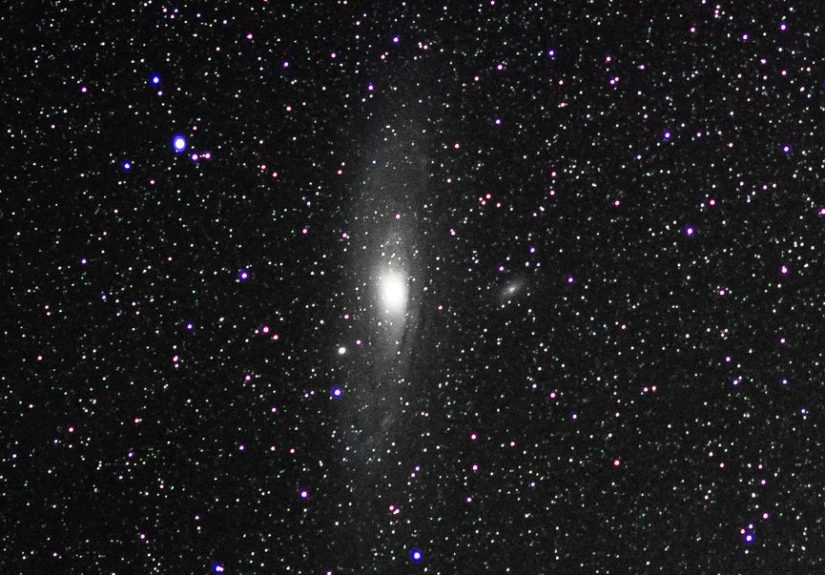
Deep-sky astrophotography targets faint objects beyond the solar system, including nebulae, galaxies, and star clusters. This is where the hobby becomes more technical. A stable tracking mount, accurate polar alignment, long exposures, calibration frames, and image-processing software all become important. It is also where “just one more upgrade” becomes a phrase your wallet learns to fear.
Star Trails
Star trail photography captures the apparent motion of stars across the sky as Earth rotates. Instead of freezing the stars as sharp points, you intentionally let them form arcs or circles. This can be done with one very long exposure or by stacking many shorter exposures. A north-facing composition in the Northern Hemisphere can create circular trails around Polaris.
Essential Astrophotography Gear
You do not need to buy everything at once. In fact, starting simple is better. Astrophotography rewards learning more than shopping, although shopping does show up wearing a convincing disguise called “research.”
Camera
A DSLR or mirrorless camera with manual controls is ideal for beginners because it lets you adjust shutter speed, aperture, ISO, focus, and file format. Many modern smartphones can also shoot night-sky images using night mode or manual camera apps. The most important feature is control over exposure.
Lens
For Milky Way and nightscape photography, a wide-angle lens with a large aperture is useful. Lenses such as 14mm, 20mm, or 24mm on a full-frame camera are popular choices. A low f-number, such as f/1.8, f/2.0, or f/2.8, allows more light to reach the sensor. For the Moon, planets, or distant objects, longer focal lengths are better.
Tripod
A sturdy tripod is non-negotiable. Long exposures exaggerate even tiny movements, so a wobbly tripod can turn stars into sad little noodles. Choose one that can hold your camera securely and remain steady in light wind.
Remote Shutter or Timer
Pressing the shutter by hand can shake the camera. A remote shutter release or the camera’s built-in timer helps reduce vibration. For repeated exposures, an intervalometer is useful, especially for star trails and stacking sequences.
Star Tracker
A star tracker rotates with Earth’s motion, allowing longer exposures without star trailing. It is not required for beginner nightscape photos, but it becomes very useful for deep-sky imaging and cleaner Milky Way shots.
Telescope and Mount
A telescope is not the first thing every beginner needs, but it opens the door to lunar, planetary, and deep-sky photography. The mount is often more important than the telescope itself. A stable equatorial tracking mount helps keep celestial objects centered during long exposures.
Best Beginner Camera Settings for Astrophotography
There is no single perfect setting for every night sky photo, but there are excellent starting points. For Milky Way photography with a DSLR or mirrorless camera, try manual mode, a wide-open aperture, ISO 1600 to 6400, and a shutter speed between 10 and 25 seconds. The exact shutter speed depends on your lens focal length and whether you are using a full-frame or crop-sensor camera.
A common beginner setup might be: 20 seconds, f/2.8, ISO 3200, manual focus, and RAW file format. RAW files preserve more image data than JPEGs and give you much more flexibility when editing exposure, color, contrast, and noise.
For the Moon, use much shorter exposures because the Moon is bright. You may start around ISO 100 to 400 and adjust shutter speed until the lunar surface is detailed rather than overexposed. For planets, video capture with high frame rates often produces better results than a single still photo.
How to Focus on Stars
Autofocus usually struggles in the dark, so manual focus is the way to go. Switch your lens to manual focus, use live view, zoom in digitally on a bright star or planet, and slowly adjust the focus ring until the star becomes the smallest, sharpest point possible.
Do not simply twist the lens to the infinity symbol and assume victory. Many lenses focus slightly past infinity, which is a very rude design choice for anyone standing in the cold at midnight. Take a test shot, zoom in, and check the stars. If they look like tiny donuts, refocus.
Planning the Perfect Astrophotography Shoot
Great astrophotography begins before sunset. Planning helps you avoid common disasters, such as arriving at a location only to discover a full Moon blasting the sky like a cosmic flashlight.
Check the Moon Phase
For Milky Way and faint stars, aim for nights near the new Moon. A bright Moon washes out dim sky details. For lunar photography, of course, the Moon is the guest of honor, so plan around the phase that gives you the shadows and features you want.
Find Dark Skies
Light pollution is one of the biggest challenges in astrophotography. City lights brighten the sky and hide faint stars. Dark-sky parks, rural areas, deserts, mountains, and coastal locations often provide better conditions. Even driving one or two hours away from a major city can make a dramatic difference.
Watch the Weather
Clear skies matter, but so do humidity, haze, smoke, wind, and atmospheric turbulence. A “clear” night can still produce soft images if the air is unstable. For deep-sky and planetary work, calm air and good transparency can be just as important as cloud cover.
Know Your Subject
The Milky Way core is seasonal and position-dependent. Planets move. Meteor showers peak on specific dates. The Orion Nebula is a winter favorite in much of the Northern Hemisphere, while the galactic core is best seen during warmer months. Astronomy apps and sky maps can help you plan where and when your subject will appear.
Editing and Stacking Astrophotography Images
Editing is not cheating. In astrophotography, editing is part of the process. Cameras collect faint signals, and post-processing helps reveal them. The goal is to enhance real detail, not turn the Milky Way into a neon smoothie.
Basic edits often include white balance adjustment, exposure correction, contrast, noise reduction, sharpening, and selective color refinement. For Milky Way images, you may gently increase clarity and contrast to bring out dust lanes. For lunar images, careful sharpening can reveal craters and surface texture.
Stacking is especially important. By combining multiple images of the same subject, software can increase signal and reduce random noise. Deep-sky photographers also use calibration frames: dark frames help correct thermal noise, flat frames help correct dust spots and vignetting, and bias frames help address sensor readout patterns.
Common Astrophotography Mistakes
Using Too Long of a Shutter Speed
If your exposure is too long and you are not using a tracker, stars will streak. That may be great for star trails, but not for sharp Milky Way photos. Use shorter shutter speeds with longer focal lengths.
Forgetting to Shoot RAW
JPEG files throw away useful image data. RAW files give you more room to recover shadows, adjust color, and reduce noise. If your camera supports RAW, use it.
Ignoring Foreground Composition
A sky full of stars is beautiful, but a strong foreground makes the image memorable. Trees, rock formations, lakes, cabins, and silhouettes can give the viewer a sense of place.
Overediting the Sky
It is tempting to slide every editing control to “maximum drama.” Resist. Oversaturated stars, crunchy noise reduction, and glowing halos can make the image look artificial. The universe already has style. It does not need a glitter filter.
Astrophotography With a Smartphone
Smartphone astrophotography has improved enormously. Many phones now offer night modes that automatically combine multiple exposures. For better results, use a tripod or phone clamp, avoid touching the screen during exposure, and shoot from the darkest location available.
Manual camera apps can allow control over ISO, shutter speed, focus, and RAW capture. A phone will not match a dedicated camera for deep-sky imaging, but it can capture star fields, the Moon, bright planets, constellations, and even the Milky Way under dark skies. The best camera is not always the most expensive one. Sometimes it is the one already in your pocket, quietly judging your 2% battery level.
Why Dark Skies Matter
Astrophotography depends on darkness, and darkness is becoming harder to find. Light pollution reduces the number of visible stars, affects wildlife, wastes energy, and interferes with astronomical observation. Responsible outdoor lighting, shielded fixtures, warmer color temperatures, and turning off unnecessary lights can help protect the night sky.
Satellite trails are another growing issue. Large satellite constellations can leave streaks in long exposures, especially near twilight. Image stacking and rejection tools can remove some trails, but prevention is not always possible. For photographers, astronomers, and anyone who simply likes looking up, preserving the night sky is more than a hobby concern. It is cultural, scientific, and deeply human.
Beginner Astrophotography Workflow
Start with a simple target: the Moon, star trails, or a wide-angle Milky Way scene. Scout a dark location during daylight so you are not stumbling around at night like a raccoon with a camera bag. Check the Moon phase and weather. Charge your batteries. Bring a headlamp with a red-light mode, warm clothing, snacks, and more patience than you think you need.
At the location, set up your tripod, compose your shot, focus manually on a bright star, and take test exposures. Adjust ISO and shutter speed until the stars are visible but not blown out. Review the image on the camera screen, zoom in to check focus, and keep shooting. Take multiple frames if you plan to stack them later.
Back home, import your RAW files, select the sharpest shots, and edit carefully. Compare versions. Walk away for ten minutes and come back with fresh eyes. Your first edit may look like the galaxy was dipped in grape soda. That is normal. Taste improves with practice.
of Real-World Astrophotography Experience
The first real lesson in astrophotography is that the sky has a personality, and it is not always cooperative. You can plan perfectly, pack carefully, drive to a dark location, set up your tripod like a proud professional, and then watch clouds roll in with the timing of a villain entering a movie. This is part of the experience. Astrophotography teaches patience because the universe does not care about your schedule, your memory card, or the fact that you brought the good lens.
One of the best beginner experiences is photographing the Milky Way for the first time. Standing under a genuinely dark sky can feel almost unreal if you live near city lights. The Milky Way may appear as a soft, pale band overhead. On the camera screen, after a 15- or 20-second exposure, it becomes brighter and more detailed than your eyes could see. That moment is addictive. It is usually followed by checking focus, realizing the stars are blurry, and muttering something educational under your breath.
Another memorable experience is learning how much foreground matters. A photo of the stars is nice. A photo of the stars above a winding road, a quiet lake, or a mountain ridge tells a story. The best nightscape images feel like invitations. They make viewers imagine themselves standing there, hearing the wind, feeling the cold, and wondering why they did not bring a better jacket.
Cold weather is a surprisingly serious part of astrophotography. Batteries drain faster. Fingers get clumsy. Metal tripod legs become tiny frozen enemies. A practical tip from experience: dress warmer than the temperature suggests, bring spare batteries close to your body, and organize your bag before it gets dark. Searching for a lens cap in a black backpack under a black sky is not a hobby. It is a punishment.
Focusing is another classic challenge. During the day, focus feels easy. At night, it becomes a tiny technical ceremony. The best approach is to use live view, magnify a bright star, and adjust manually until the star is as small as possible. Take test shots often. A whole night of slightly soft images is heartbreaking, especially when the composition is perfect.
Editing brings its own learning curve. Early astrophotography edits often go too far: too much saturation, too much contrast, too much sharpening, too much everything. A better approach is to make small adjustments and preserve a natural feel. Let the stars stay elegant. Let the sky breathe. The goal is not to create a fantasy poster; it is to reveal what the camera captured with care.
The most rewarding part of astrophotography is that progress is easy to see. Your tenth attempt will be better than your first. Your fiftieth will be better than your tenth. You learn the sky, your gear, your local weather, and your own creative preferences. More importantly, you spend time looking up. In a world full of glowing screens, that alone is worth the trip.
Conclusion
Astrophotography is one of the most rewarding ways to connect creativity with science. It can begin with a simple photo of the Moon and grow into detailed images of galaxies, nebulae, and star-filled landscapes. The essential ingredients are not expensive gear or perfect conditions. They are curiosity, planning, patience, and practice.
Start small. Learn manual settings. Find darker skies. Shoot RAW. Focus carefully. Edit gently. Over time, you will stop guessing and start understanding what the night sky, your camera, and your location are trying to tell you. And when you finally capture an image that makes you whisper “wow” at the back of your camera, congratulations: the universe has officially recruited you.